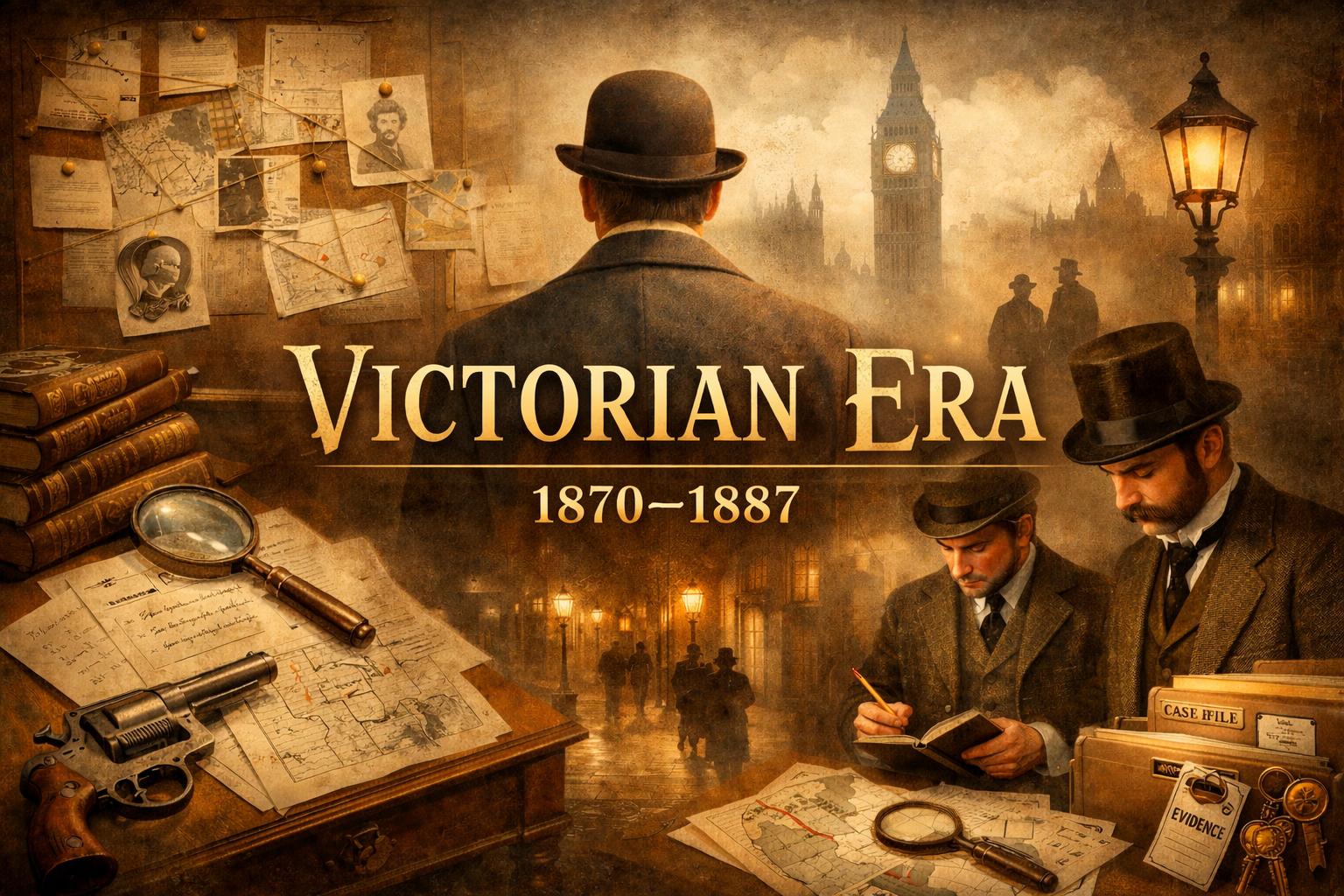
Order, Anxiety, and the Birth of Modern Systems
The Victorian era was an age of confidence and unease in equal measure. The period spanned much of the nineteenth century. It was marked by rapid industrial growth, expanding cities, and scientific optimism. There was a widespread belief in progress. This era also experienced deep social anxiety about crime, class, morality, and disorder.
It was a period obsessed with systems: systems of law, systems of labor, systems of knowledge, and systems of control. Bureaucracies expanded. Institutions became more professional. Society increasingly relied on documentation, evidence, and classification. These measures helped make sense of a rapidly changing world.
These conditions did not merely shape literature — they demanded new kinds of stories.
A World Becoming Legible
Victorian society was increasingly readable on paper:
- Census records
- Police reports
- Court transcripts
- Letters, wills, contracts, and files
Life left a trail of documents, and truth was often buried somewhere within them.
This growing reliance on written evidence changed how stories were told. Narratives began to unfold through testimonies, records, conflicting accounts, and reconstructed timelines. Suspicion replaced coincidence; proof replaced intuition.
Victorian literature became fascinated with hidden truths. These were secrets locked inside homes, families, institutions, and respectable façades.
Crime, Respectability, and Fear
The Victorian era was haunted by contradiction. Respectability mattered intensely, yet scandals flourished. Cities grew wealthier and more anonymous, while crime became both a real concern and a public spectacle.
Murder, fraud, bigamy, and theft were not distant horrors — they were domestic threats. The question was no longer whether crime existed, but how it could be uncovered without tearing society apart.
This tension shaped Victorian storytelling across genres:
- Sensation novels
- Social problem novels
- Legal dramas
- Early crime narratives
All grappled with the same underlying fear: that truth was present, but obscured.
From Experiment to Infrastructure
The literary experiments that define the Beginnings era consisted of early investigations and amateur truth-seekers. They also included proto-detective figures and documentary storytelling. These did not disappear in the Victorian period. Instead, they were absorbed, refined, and normalized.
What had been tentative became repeatable.
What had been experimental became expected.
By the Victorian era, readers no longer encountered investigation as a novelty. They recognized its patterns. They understood its logic. They trusted that secrets could, eventually, be exposed through method rather than chance.
This shift marks a crucial transition: from the invention of detection to the organization of detection.
Professionalization and Authority
One of the defining features of the Victorian era was the rise of professional authority.
Detection increasingly belonged to:
- Police officers
- Inspectors
- Consulting professionals
- Paid investigators
Investigation became work, not merely brilliance. It required patience, observation, record-keeping, and procedure. This change reflected broader Victorian faith in institutions — even as that faith was often questioned or strained.
The detective, whether official or independent, became a figure who navigated between order and chaos, truth and social stability.
Women, Domestic Space, and Hidden Knowledge
Victorian culture drew sharp lines between public and private life — but those boundaries were porous.
Women writers, in particular, explored crime and investigation within domestic spaces: homes, families, inheritances, marriages, and social reputation. The domestic sphere became a site of concealment, surveillance, and quiet detection.
Rather than standing outside the framework, these narratives revealed how deeply crime was embedded within everyday life.
This emphasis would profoundly shape later detective fiction, even when women’s contributions were later minimized or forgotten.
Why the Victorian Era Matters
The Victorian era did not invent crime, nor did it invent investigation. What it did was stabilize them.
It created the conditions in which:
- Detection could recur
- Methods could be trusted
- Readers could expect logic, not miracle
- Crime fiction could become a genre rather than an anomaly
In short, the Victorian period turned curiosity into structure.
All future developments depend on the systems established during this era. These include Sherlock Holmes, the Golden Age, and the professional detective. Even modern crime fiction is based on these foundations.
If the Beginnings era asked whether truth could be uncovered, the Victorian era insisted that it must be.
Conclusion
The Victorian era is where detective fiction learned how to work.
It moved away from Gothic uncertainty and moral allegory and toward structure, method, and procedure. Crimes were no longer solved by coincidence or revelation alone, but through observation, patience, and persistence. Detectives became professionals. Cases became systems.
This was not yet the age of the brilliant, eccentric genius.
It was the age of notebooks, interviews, false leads, and quiet reasoning.
Everything that follows in detective fiction — including its most famous figure — rests on the groundwork laid here.
If you’re curious to see how this era took shape, the archive continues below.
- Usual Suspects explores the authors who defined Victorian detective fiction and helped establish its rules.
- Forgotten Footprints revisits real-name writers whose contributions have faded from view.
- Fading Ink looks at pseudonyms, anonymity, and the voices history partially erased.
Each section opens a different case file — and each leads deeper into the evolution of the genre.
Take your time.
Follow the trail that interests you.
The investigation continues.








Hello Gumshoe! On the track or authors? leave us reply!