Detective Authors Archive

From famous authors to the forgotten- the search continues

Eras:

Other eras and subjects to come

The Usual Suspects

The Forgotten Footprints

The Fading Ink

Homepage

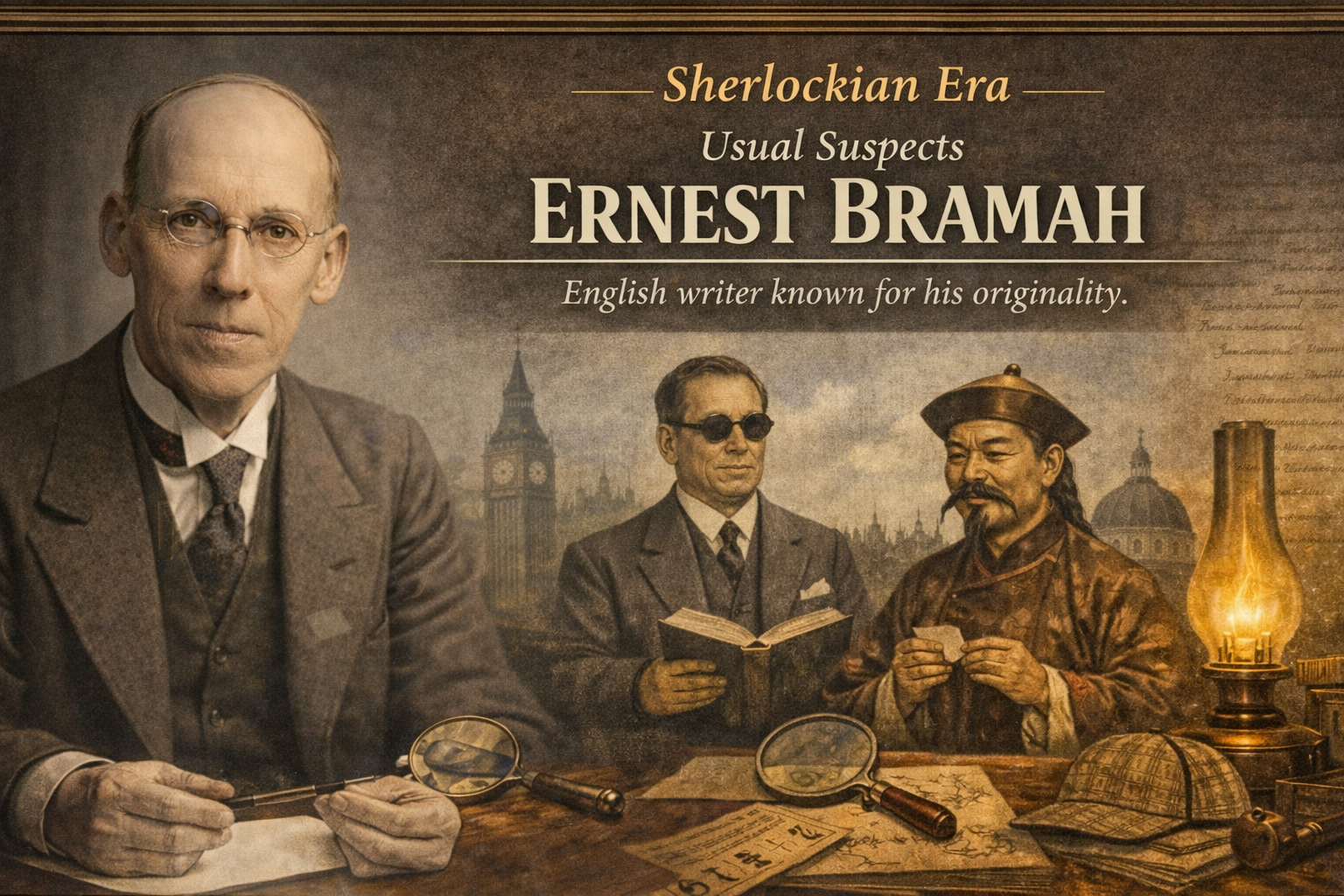
  • The Usual Suspects: The Sherlockian Era: Case # 013: Ernest Bramah

    “English writer known for his originality.”


    Hook

    The popularity of detective fiction soared at the beginning of the twentieth century. This popularity created a crowded field of sleuths. These sleuths were inspired by Sherlock Holmes. Some writers followed the formula closely. Others tried something entirely different. Ernest Bramah belonged firmly to the second group.

    Bramah did not simply imitate Holmes. Instead, he introduced readers to a sleuth who immediately stood apart from the crowd. This investigator’s unusual abilities challenged the very idea of what observation meant in crime fiction. Many of these stories unfolded in and around London, one of the great literary settings of detective fiction.

    But before this unusual detective appeared, Bramah himself had already begun building a career as a versatile and imaginative writer.


    Biography – Ernest Bramah

    Ernest Bramah Smith: National Portrait Gallery: by Elliott & Fry: https://www.npg.org.uk/collections/search/portrait/mw99999/Ernest-Bramah-Smith?utm_source=chatgpt.com


    Ernest Bramah was born Ernest Bramah Smith in 1868 in Manchester, England. His path to a literary career was not entirely straightforward. He left school at sixteen because of health problems. Afterward, he worked in several occupations. Eventually, he turned toward journalism and writing.

    By the late nineteenth century, Bramah had started contributing stories and articles to magazines. He also submitted to newspapers. He gradually developed his voice as a storyteller. His early work revealed a writer with a sharp wit and a talent for constructing clever plots.

    Bramah did not follow the path of many authors who became closely associated with a single genre. He showed an early interest in exploring different kinds of storytelling. Over time, he would move comfortably between humor, satire, fantasy, and mystery. He developed a reputation as a versatile and imaginative writer.

    Bramah remained active for several decades. He gradually established himself as one of the more distinctive voices in early twentieth-century popular fiction.


    Other Works

    Before becoming widely associated with detective fiction, Bramah had already gained recognition through other literary creations.

    His most popular works included the stories of Kai Lung. Kai Lung was a wandering storyteller. His adventures take place in a fictionalized version of ancient China. These tales blended humor, irony, and adventure while using a deliberately ornate and playful storytelling style.

    Major collections in the series include:

    • The Wallet of Kai Lung
    • Kai Lung’s Golden Hours
    • Kai Lung Unrolls His Mat
    • Kai Lung Beneath the Mulberry Tree

    Bramah also experimented with satire and speculative ideas. In What Might Have Been, he explored an imagined political future for Britain.

    Although these works demonstrated the range of his imagination, Bramah remained fascinated by puzzles and logical problems. Detective fiction flourished during this time. The success of Sherlock Holmes largely contributed to this surge. Many writers attempted to imitate Doyle’s famous detective.

    Bramah answered a debate according to literary tradition. Someone claimed that a blind man could never function convincingly as a detective. Confident that reasoning and perception mattered more than sight alone, he set out to prove the point in fiction.


    Meet the Detective

    The result of this challenge was Max Carrados, one of the most unusual investigators of the Sherlockian era.

    First appearing in 1914, Carrados was a wealthy and highly intelligent amateur detective who happened to be completely blind. Ernest Bramah did not treat blindness as a limitation. Instead, he built the character’s investigative methods around heightened awareness. Bramah carefully interpreted the world around him.

    Carrados is typically portrayed as calm, cultured, and quietly confident. He is a collector of rare coins and a man of considerable intellect. He approaches mysteries with patience and curiosity rather than dramatic flair. His blindness has sharpened his other senses, allowing him to notice details that others often overlook.

    Criminals often assume that a blind man cannot observe them. They tend to underestimate him. This is a mistake that Carrados uses to his advantage.

    Carrados is sometimes assisted by his friend Louis Carlyle. He is a professional investigator who occasionally brings cases to him. Carlyle also narrates some of their adventures.


    The Carrados Stories

    The adventures of Max Carrados first appeared in popular magazines of the early twentieth century. Later, they were gathered into book collections. Many detective stories of that period were first serialized. These mysteries engaged magazine readers who followed new cases as they appeared.

    The principal collections include:

    • The Eyes of Max Carrados
    • Max Carrados
    • The Bravo of London

    Across these stories, Carrados investigates a wide range of mysteries, including thefts, frauds, and complex criminal schemes. The puzzles are often carefully constructed. They allow readers to follow the detective’s reasoning. Each clue gradually reveals the truth behind the case.

    Through these magazine stories and later collections, Ernest Bramah created a detective series. This series remained part of his work for many years.


    What Carrados Brought to Detective Fiction

    n a literary landscape filled with detectives modeled after Sherlock Holmes, Max Carrados offered something genuinely different.

    Many early twentieth-century investigators relied heavily on visual observation—studying footprints, examining physical clues, and interpreting subtle gestures. Ernest Bramah designed a detective who could not see these details. This forced both the character and the reader to think about detection in a new way.

    Carrados solved problems through careful listening, memory, touch, and logical reasoning. The stories often invite readers to reconsider the nature of observation itself. It is important not just to see clues, but to understand their meaning.

    This approach allowed Bramah to explore a different dimension of detective reasoning. It demonstrated that the genre still had room for originality. Many writers were producing variations of the Holmes formula at that time. Carrados showed that a detective’s greatest tool was not sight. Instead, it was perception.


    Did Bramah Ever Walk Away From Carrados?

    Some detective writers eventually abandoned their most famous characters in order to pursue other projects. In the case of Ernest Bramah, however, Max Carrados remained an important part of his work.

    Bramah wrote widely in other genres. These included additional stories featuring Kai Lung. However, he returned to Carrados repeatedly over the course of his career. New adventures continued to appear in magazines and later collections across several decades.

    Rather than abandoning the character, Bramah seemed content to revisit his blind detective whenever inspiration struck. As a result, Carrados remained one of the most recognizable figures in his body of work. He also emerged as one of the more distinctive detectives from the Sherlockian era.


    Media Adaptations

    Max Carrados never achieved the level of screen fame enjoyed by some literary detectives. However, the character did find his way beyond the printed page.

    Several Carrados stories were adapted for radio by the BBC during the twentieth century. The format proved particularly well suited to these mysteries. Carrados often solves cases through voices, footsteps, and subtle auditory clues. Radio allowed listeners to experience the investigations similarly to the detective himself—through sound rather than sight.

    These productions helped introduce the character to new audiences. They showed how well Bramah’s unusual detective translated into an audio format.


    Legacy

    Through the originality of his ideas, Ernest Bramah secured a distinctive place in the development of early twentieth-century detective fiction.

    His blind detective Max Carrados remains one of the most inventive investigators to emerge from the Sherlockian era. Many writers were producing detectives modeled closely on Sherlock Holmes at the time. Bramah showed that the genre could still evolve through fresh ideas. He used unusual perspectives.

    Carrados’s stories continue to appear in classic detective fiction anthologies. These include The Rivals of Sherlock Holmes. This anthology helped reintroduce many early twentieth-century detectives to modern readers.

    Together with his other works—particularly the adventures of Kai Lung—Bramah’s writing reveals a creative imagination. His creativity extended well beyond a single genre.


    Later Years and Death

    In the later decades of his life, Bramah continued writing across several genres. Alongside occasional returns to detective fiction, he also revisited other literary creations, including the adventures of Kai Lung.

    Bramah remained active as a writer into the 1930s. During this period, detective fiction itself was evolving with the rise of the Golden Age mystery.

    He died in 1942. He left behind a body of work that ranged from satire and fantasy. His work included one of the most unusual detective series of the early twentieth century.


    Conclusion

    Through the creation of Max Carrados, Ernest Bramah demonstrated that detective fiction could still surprise readers with bold ideas. By building mysteries around perception rather than sight, he expanded the possibilities of what a fictional detective could be.

    Though he wrote across many genres, Carrados remains one of the most imaginative detectives to emerge from the Sherlockian era.


    Question for the Reader

    Max Carrados solved crimes without ever seeing the clues that surrounded him.

    Do you think this makes him one of the most original detectives of the Sherlockian era? Or do you prefer the traditional style of investigators like Sherlock Holmes?


    ← Previous Case: Case 012 — Melville Davisson Post  
    Next Case → Case 014 — Baroness Orczy
    Hello Gumshoe! On the track or authors? leave us reply!

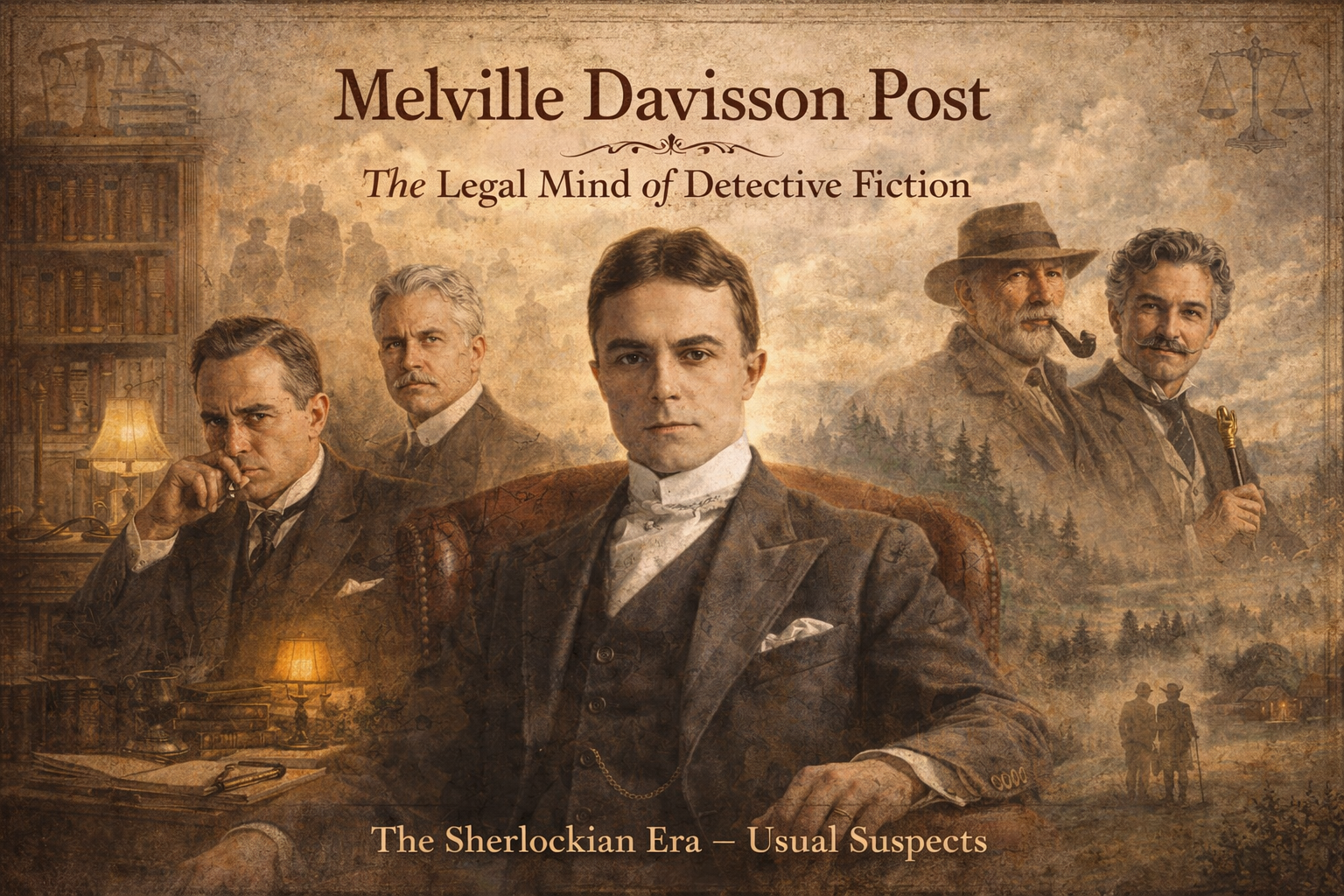
  • The Usual Suspects: The Sherlockian Era: Case #012: Melville Davisson Post

    he Legal Mind Behind Early Detective Fiction


    Hook

    Courtroom dramas were not always television staples. Forensic science did not always dominate crime fiction. There was once a quiet, sharp-eyed lawyer who solved mysteries with logic alone.

    Meet Melville Davisson Post. He was a writer who turned the law itself into a tool of mystery. Post gave detective fiction one of its most unusual perspectives.


    Biography

    https://upload.wikimedia.org/wikipedia/commons/c/c3/Melville_Post.JPG

    Melville Davisson Post (1869–1930) was an American author and lawyer. He was born in West Virginia. This detail would later shape the rural, grounded atmosphere of many of his stories.

    Unlike many of his contemporaries, Post didn’t come from journalism or medicine (like Arthur Conan Doyle). Instead, he trained and worked as a lawyer, gaining firsthand experience with the complexities—and limitations—of the legal system.

    👉 It was this experience that pushed him toward writing.

    Disillusioned with how justice could be manipulated through technicalities and loopholes, Post began crafting stories that explored:

    • the gap between law and justice
    • the power of legal reasoning
    • and the moral questions behind every crime

    After leaving active legal practice, he turned to writing full time, publishing short stories in major magazines of the era. Though he never reached Doyle’s global fame, he earned a reputation for crafting intelligent, tightly constructed mysteries.

    Outside of his writing career, Post was married. He devoted time to raising horses. This reflects a lifestyle rooted in the same rural sensibilities found in many of his stories.


    ️Post’s Investigators & Legal Minds

    👉 This is where Melville Davisson Post truly stands apart.

    Rather than relying on a single iconic sleuth, Post explores crime through two distinct lenses:

    • the lawyer, who manipulates or navigates the legal system
    • the detective, who seeks truth through observation and reasoning

    Together, they create a fascinating tension:

    👉 Justice can be pursued… or avoided—depending on who is in control.


    The Lawyers – Masters of the Legal Maze

    If Post’s detectives seek truth beyond the law…

    👉 his lawyers reveal what the law can truly do—for better or worse.

    Through them, Post explores a more unsettling idea:

    • justice is not always guaranteed
    • the law can be interpreted, stretched… even weaponized
    • and intelligence can serve either side of the moral divide

    ️ Randolph Mason – The Anti-Detective

    • A brilliant American lawyer
    • Master of legal loopholes
    • Uses the law to protect the guilty

    👉 A rare kind of investigator—one who doesn’t solve crimes, but ensures they go unpunished.


    ️ Sir Henry Braxton – The Law in Balance

    • A British barrister
    • Works within the legal system
    • Solves cases through logic and legal reasoning

    Where Mason exposes the weaknesses of the law, Braxton represents its potential:

    • careful
    • methodical
    • grounded in procedure

    👉 If Mason bends the law, Braxton restores its balance.


    If the lawyers manipulate justice, the detectives seek something deeper: truth itself.


    ‍Beyond the Law: The Detectives

    https://pdr-assets.b-cdn.net/essays/eugene-francois-vidocq-and-the-birth-of-the-detective/08-mysteriesofpolic01grifiala_0379-edit.jpeg?height=850&width=1200

    If the lawyers test the limits of justice…

    👉 Post’s detectives look beyond it—toward truth, motive, and human nature.

    They do not rely solely on systems or procedures, but on:

    • observation
    • reasoning
    • and an understanding of what drives people to commit crimes

    Uncle Abner – The Moral Detective

    • A rural West Virginian
    • Deeply religious
    • Guided by moral and philosophical reasoning

    Abner observes, reflects, and ultimately reveals truth through:

    • human nature
    • moral consequence
    • and a near-biblical sense of justice

    👉 Less a detective… more a judge of the human soul.


    Monsieur Jonquelle – The Observational Sleuth

    • A refined, analytical investigator
    • Relies on observation and deduction

    Jonquelle represents a more classical approach:

    • logical
    • precise
    • quietly methodical

    👉 A restrained but effective presence in Post’s work.


    The Marquis – The Aristocratic Investigator

    • A gentleman of status and intellect
    • Moves within elite circles
    • Solves mysteries through social insight and reasoning

    The Marquis offers a different lens:

    • less moral than Abner
    • less procedural than Braxton
    • more attuned to society and behavior

    👉 Where Abner looks inward, the Marquis reads the world around him.


    What He Brought to Detective Fiction

    Melville Davisson Post didn’t redefine detective fiction outright…

    👉 but he quietly expanded its possibilities.


    Law as a Tool of Mystery

    Rather than focusing solely on clues or physical evidence, Post shifted attention toward:

    • legal reasoning
    • technicalities
    • and the structure of the law itself

    The mystery could unfold not just in the investigation…

    👉 but in how the law is applied.


    The “Inverted” Crime Story

    Post was among the early writers to explore a different kind of mystery:

    👉 not who committed the crime… but whether they can escape punishment

    This added a new kind of tension:

    • intellectual
    • procedural
    • and often unsettling

    Moral vs Legal Truth

    At the heart of Post’s work lies a recurring question:

    👉 What is right… and what is lawful?

    His stories explore the gap between the two, giving his work a philosophical depth that goes beyond simple puzzle-solving.


    A Different Atmosphere

    Especially in the Uncle Abner stories, Post moves away from urban, fast-paced mystery.

    Instead, he favors:

    • rural settings
    • slower pacing
    • reflection over action

    👉 Less spectacle… more thought.


    Other Works

    Melville Davisson Post made significant contributions to detective fiction. He was a highly prolific writer. He produced more than 230 works over the course of his career.

    His output extended well beyond mystery stories and included:

    • essays
    • short fiction in various genres
    • and non-fiction writings

    Among these is The Hidden Thing, a work dealing with German codes and secret communications during the First World War. He also wrote Dwellers in the Hills, reflecting his interest in rural life and character-driven storytelling.

    Much of his writing appeared in popular magazines of the time. This demonstrates his versatility. It also shows his ability to engage a wide readership.

    👉 This broader body of work reveals an author not confined to a single genre. The author is deeply engaged with ideas, place, and the structure of storytelling.


    Did He Walk Away from Detective Fiction?

    👉 Did Melville Davisson Post eventually turn away from detective fiction… or simply move beyond it?

    Not entirely—but detective fiction did not define his entire career.

    Melville Davisson Post continued writing throughout his life, producing:

    • detective stories
    • essays
    • and other literary works

    However, unlike some of his contemporaries, he did not build a long-running series centered on a single, evolving detective figure.

    👉 His contributions to detective fiction remain concentrated within a distinct period of his writing life.


    Legacy & Media Adaptations

    Melville Davisson Post’s legacy is not defined by widespread fame…

    👉 but by quiet influence and lasting curiosity.


    A Presence in Detective Fiction History

    His work continues to appear in:

    • classic mystery anthologies
    • historical studies of detective fiction

    Stories featuring Uncle Abner and Randolph Mason are often included in collections such as The Rivals of Sherlock Holmes. This inclusion ensures their continued circulation.


    Adaptations & Media

    Post’s work has seen limited direct adaptation:

    • no major film or television franchise
    • no widely recognized screen portrayal

    However, his influence can be felt in:

    • legal dramas centered on courtroom reasoning
    • stories built around loopholes and technicalities
    • narratives focused on escaping justice

    A Writer Ahead of His Time

    Elements of his work anticipate:

    • the legal thriller
    • morally complex crime fiction
    • inverted mystery structures

    👉 Ideas that would only become widespread decades later.


    Later Years & Death

    In his personal life, Melville Davisson Post was married, though his wife died relatively young. The couple had one child, who died in infancy.

    He continued to live in West Virginia. He maintained a strong connection to rural life. He devoted time to raising horses. This pursuit reflects the environment so often present in his stories.

    Post died in 1930, at the age of 61, after a riding accident.


    Conclusion

    Melville Davisson Post may not be the most famous name of the Sherlockian era…

    👉 but he is one of its most intriguing.

    Where others focused on deduction or action, Post turned inward:

    • toward the law
    • toward morality
    • and toward the uneasy space between the two

    👉 His stories remind us that solving a mystery is not always about finding the truth. It is about understanding what that truth means.


    A Question for the Reader

    So where do you stand?

    👉 Do you prefer a detective who seeks truth and justice, like Uncle Abner…

    or one who exposes the system’s flaws—like Randolph Mason?


    ➡️ Next Case

    If Post explored the limits of law and logic…

    👉 the next case will challenge something far more fundamental.

    A detective unlike any we’ve seen so far—one who proves that perception itself can be… deceptive.

    ➡️ Next: Ernest Bramah


    📚 References

    Primary Works

    • Uncle Abner: Master of Mysteries
    • The Strange Schemes of Randolph Mason

    Secondary Sources & Context

    • The Rivals of Sherlock Holmes
    • The Cambridge Companion to Crime Fiction

    ️ Additional Reference

    • The Penguin Book of Murder Mysteries

    Hello Gumshoe! On the track or authors? leave us reply!

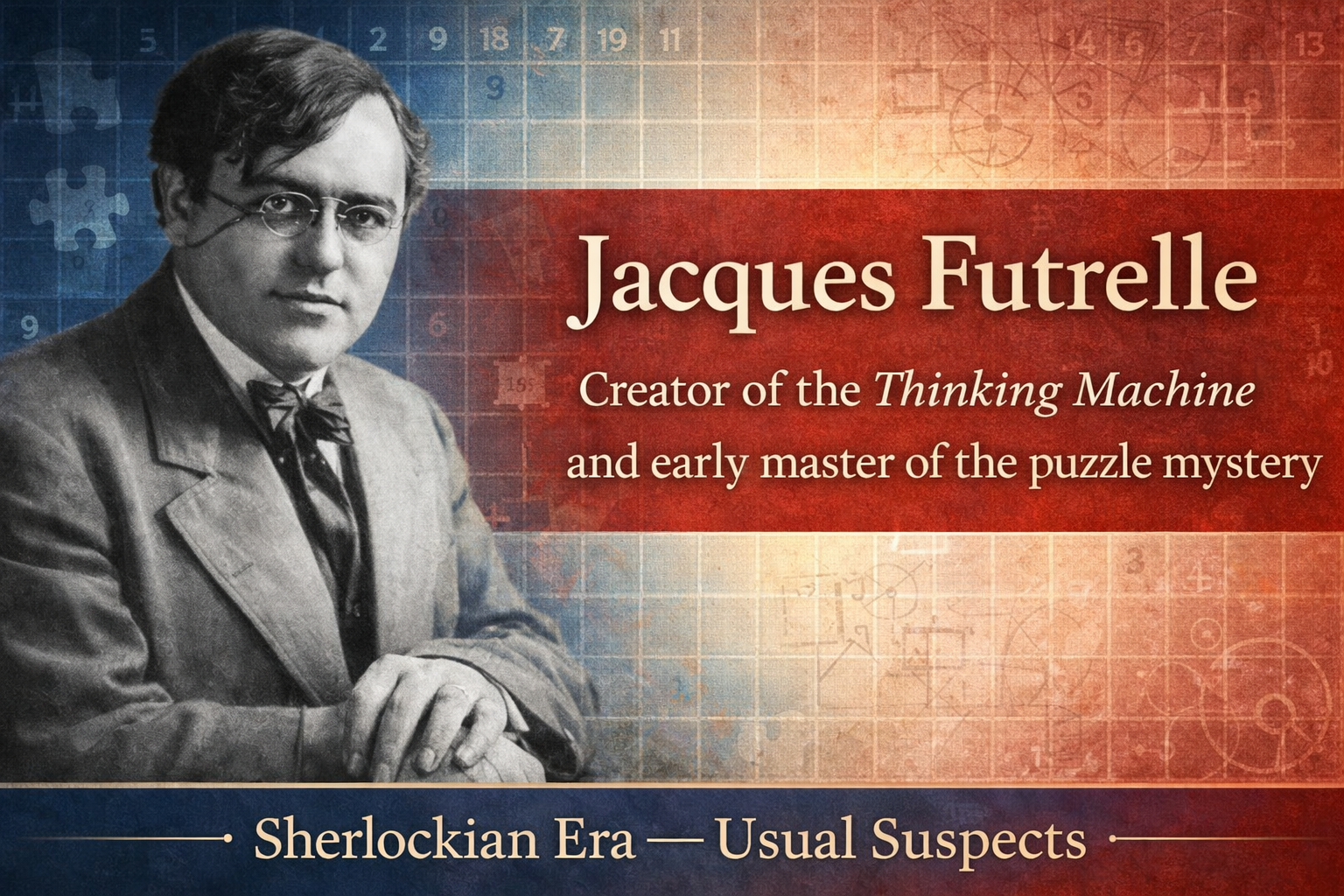
  • The Usual Suspects: The Sherlockian Era: Case #011: Jacques Futrelle

    Creator of the Thinking Machine and early master of the puzzle mystery

    Introduction

    Some detectives rely on observation. Others rely on instinct.

    But in the stories of Jacques Futrelle, crime could be solved through something even colder and more precise: pure logic.

    What if a mystery could be unraveled the way a mathematician solves an equation?

    Futrelle wrote at the height of the magazine era in the early twentieth century. He built stories around ingenious intellectual puzzles. These were crimes that seemed impossible. Careful reasoning revealed the solution. His mysteries challenged readers to follow every clue and test their own powers of deduction.

    Long before the Golden Age’s puzzle-heavy mysteries became famous, Futrelle was showing something remarkable. Detective fiction could involve a battle of intellects. It was not just a hunt for clues. It was not just a hunt for clues.


    https://www.encyclopedia-titanica.org/titanic-victim/jacques-futrelle.html?utm_source=chatgpt.com


    Biography

    Jacques Futrelle was born on April 9, 1875, in Pike County, Georgia, United States.

    Before becoming a writer of mystery fiction, Futrelle built his career in journalism. He worked for newspapers in Atlanta, where he began as a reporter before moving into editorial work. Journalism gave him valuable experience in writing quickly, clearly, and engagingly—skills that would later shape his fiction.

    By the late 1890s, Futrelle had moved north. He continued working in the newspaper world. He eventually became associated with Boston journalism. During this period, he developed a reputation as a capable writer and editor while also beginning to experiment with fiction.

    Futrelle married Lily May Futrelle, who shared his literary interests and also worked as a writer and journalist. The couple would remain closely connected to the world of publishing and magazines.

    At the beginning of the twentieth century, Futrelle started publishing short stories in popular American magazines. Publications such as The Boston American, The Saturday Evening Post, and The American Magazine offered significant exposure. They supplied a large audience for writers of popular fiction. Futrelle’s clever mystery stories quickly attracted attention.

    His tales stood out for their ingenious logical problems. These tales also featured carefully constructed plots. Readers were challenged to follow the clues. They could solve the mystery alongside the characters.

    By the early 1900s, Futrelle had established himself as one of the promising writers. He contributed to the rapidly growing field of detective and puzzle fiction.


    Meet the Detective: The Thinking Machine

    Among the many detectives appearing in early twentieth-century mystery fiction, one stood out. This detective had extraordinary confidence in the power of logic.

    In the stories of Jacques Futrelle, the mysteries are solved by Professor Augustus S. F. X. Van Dusen, a brilliant scientist known simply as “The Thinking Machine.”

    Van Dusen approaches crime very differently from many fictional detectives of the time. He doesn’t chase suspects or search dark alleys for clues. Instead, he treats each case as an intellectual challenge. It’s a problem that can be solved through careful reasoning and scientific thinking.

    Physically, the professor is often described as small and somewhat fragile in appearance. He has a large, prominent head that seems almost too big for his body. This is a fitting symbol of his enormous intellect. His sharp eyes and intense expression suggest a mind constantly at work, examining every detail.

    Van Dusen’s confidence in his own reasoning is legendary. He firmly believes that no problem exists that cannot be solved through logic. In some stories, he demonstrates this belief by unraveling mysteries without even leaving his chair. He relies entirely on deduction and careful analysis.

    The stories are usually narrated by Hutchinson Hatch, a newspaper reporter who accompanies the professor during many of his investigations. Much like Dr. Watson in the Sherlock Holmes stories, Hatch serves as both observer and storyteller.

    The choice of a reporter as narrator is particularly fitting, as Futrelle himself began his career in journalism. Through Hatch’s eyes, readers witness the professor’s extraordinary reasoning. They share in the surprise when seemingly impossible crimes are solved through nothing more than the power of intellect.

    Together, the pair investigate a wide variety of puzzling cases. They handle everything from strange disappearances to crimes that appear logically impossible. The Thinking Machine demonstrates that even the most baffling mystery can yield to reason.


    What He Brought to Detective Fiction

    At the beginning of the twentieth century, detective fiction was evolving rapidly. Writers inspired by Arthur Conan Doyle were experimenting with new types of detectives and new ways of presenting mysteries.

    Jacques Futrelle contributed to this evolution by emphasizing logic and intellectual puzzles as the central engine of his stories.

    While many detectives of the era relied on observation, disguise, or physical investigation, Futrelle’s mysteries often revolved around pure reasoning. Crimes in his stories often seemed impossible at first. They appeared baffling. However, they were unraveled through careful analysis and logical deduction.

    This approach helped popularize what would later become known as the puzzle mystery. These are stories in which readers are invited to follow the clues. They can attempt to solve the mystery themselves.

    Futrelle was also particularly skilled at crafting ingenious problem-based plots, where the mystery itself becomes a kind of intellectual challenge. Some of his stories revolve around seemingly unsolvable situations, locked-room problems, or elaborate schemes that require precise reasoning to untangle.

    These elements would later become defining features of the Golden Age of detective fiction. They influenced writers who placed a strong emphasis on fair-play puzzles and logical solutions.

    Futrelle’s career was relatively brief. However, he demonstrated that detective fiction could be more than a tale of crime and investigation. It could also be a game of intellect between author and reader.


    Legacy & Media

    The career of Jacques Futrelle was remarkably short. However, his impact on detective fiction proved far greater than its length might suggest.

    Through the adventures of Professor Augustus S. F. X. Van Dusen, Futrelle helped push the genre toward a new kind of mystery. This mystery was driven not by action or suspense alone. It was driven by pure intellectual challenge. His stories invited readers to participate in the puzzle. Readers followed each clue. They tested their own reasoning against the brilliant logic. This logic ultimately revealed the solution.

    One story in particular, The Problem of Cell 13, became legendary among mystery enthusiasts. It is built around an apparently impossible situation. The mystery is solved entirely through reasoning. It remains one of the most admired puzzle mysteries ever written. Even today, the story frequently appears in anthologies of classic detective fiction.

    Futrelle’s influence can also be seen in the later tradition of impossible crime stories. This branch of the genre flourished during the Golden Age. It inspired masters of intricate mystery plotting.

    Yet the Thinking Machine did not remain confined to the printed page. In the early twentieth century, several of the stories were adapted during the silent film era. These adaptations brought Futrelle’s brilliant logician to cinema audiences. Later, the character appeared in radio programs. In more recent decades, the stories found new life in elaborate European audio dramas. This was particularly true in Germany. Modern radio adaptations introduced the Thinking Machine to an entirely new generation of listeners.

    Even after Futrelle himself was gone, the stories continued to circulate. Additional collections of the Thinking Machine adventures appeared after his lifetime. This ensured that readers could continue to encounter one of detective fiction’s most purely logical sleuths.

    His early death has also left readers and historians with one of the enduring “what ifs” of detective fiction. Many have wondered how Futrelle might have further developed the Thinking Machine had he lived longer. Would Professor Van Dusen have become one of the leading sleuths of the genre? Could he have stood alongside the great detectives who defined the decades that followed?

    Futrelle has also appeared as a character in modern historical mystery fiction. In The Titanic Murders, author Max Allan Collins imagines Jacques Futrelle himself as a protagonist. He is at the center of a murder investigation aboard the RMS Titanic. The novel blends real historical figures with fictional intrigue. It turns the creator of the Thinking Machine into a detective. He solves a mystery during the ship’s fateful voyage.

    In more recent years, Futrelle’s stories have also found new life through digital media. Several creators have produced narrated readings and adaptations of the Thinking Machine stories online. These adaptations introduce them to modern audiences through audio storytelling. Channels such as Neural Surfer have brought some of these classic puzzle mysteries to platforms like YouTube. This demonstrates that Futrelle’s ingenious plots can still capture the imagination of listeners. This happens more than a century after they were first published.

    For a writer whose career ended so suddenly—and far too early—the legacy he left behind is a remarkable one.


    Death

    In April 1912, Jacques Futrelle and his wife Lily May Futrelle were on a trip to Europe. They were returning aboard the RMS Titanic.

    Many people today know the tragedy through the film Titanic. It dramatizes the sinking of the great ocean liner during its maiden voyage.

    On the night of April 14–15, 1912, the ship struck an iceberg in the North Atlantic. As the situation grew desperate, passengers struggled to reach the lifeboats. Futrelle helped his wife into one of the boats. He insisted that she leave the ship without him.

    Lily Futrelle survived the disaster.

    Jacques Futrelle did not.

    He stayed behind, like many men aboard the ship. The liner slowly sank beneath the icy waters of the Atlantic. His body was never recovered.

    He was 37 years old.

    With his death, detective fiction lost a writer. His career had only just begun to unfold. Readers are left to wonder what new mysteries the Thinking Machine might have solved had its creator lived longer.


    Conclusion

    Though his career was brief, Jacques Futrelle left a distinctive mark on the evolution of detective fiction. The genre was still defining itself after Arthur Conan Doyle. During this period, Futrelle demonstrated that mysteries could be crafted as intricate intellectual puzzles.

    Through the adventures of Professor Augustus S. F. X. Van Dusen, he introduced readers to a detective whose greatest weapon was not strength or courage. It was not even observation but the relentless power of logic. Stories like The Problem of Cell 13 played a crucial role in shaping the tradition of puzzle-driven mysteries. This tradition would later flourish during the Golden Age of detective fiction.

    More than a century later, the Thinking Machine still fascinates readers. It appeals to those who enjoy mysteries built around clever reasoning. It also intrigues readers with seemingly impossible problems.

    Yet Futrelle himself is not always as widely remembered as some of his contemporaries. His work raises an interesting question for modern readers:

    Have you ever encountered the stories of the Thinking Machine, or is Jacques Futrelle a new discovery for you?

    Sometimes the most intriguing figures in detective fiction history are the ones who nearly slipped through the cracks.


    References

    Primary Works

    • Futrelle, Jacques. The Thinking Machine. New York: Dodd, Mead & Company, 1907.
    • Futrelle, Jacques. The Thinking Machine on the Case. New York: Dodd, Mead & Company, 1908.
    • Futrelle, Jacques. The Thinking Machine: Further Problems. New York: Dodd, Mead & Company, 1912.

    Secondary Sources

    • The Cambridge Companion to Crime Fiction, edited by Martin Priestman. Cambridge University Press.
    • The Penguin Book of Murder Mysteries.

    ← Previous Author
    R. Austin Freeman — Creator of Dr. Thorndyke

    Next Author →
    Ernest Bramah — Creator of Max Carrados


    Hello Gumshoe! On the track or authors? leave us reply!

  • The Usual Suspects: The Sherlockian Era: Case #010: R. Austin Freeman

    Where science meets detection in Edwardian London

    Introduction

    At the turn of the twentieth century, London was the city of Sherlock Holmes. It was also becoming the birthplace of scientific detective fiction.

    Fog, footprints, and clever deductions filled the streets of Victorian mysteries. However, one writer searched elsewhere for answers: the laboratory.

    That writer was R. Austin Freeman, the creator of one of the most methodical investigators in the genre: Dr. John Thorndyke.


    https://cdn.britannica.com/13/11713-004-34DFD562/Richard-Austin-Freeman-1935.jpg

    R. Austin Freeman (1862–1943). Author portrait. Public domain, via Wikimedia Commons.


    Biography

    Richard Austin Freeman (1862–1943) was a British physician who brought an unusual level of scientific realism to early detective fiction.

    Freeman was born in London. He studied medicine at Middlesex Hospital. He began his career as a colonial medical officer in West Africa. His time abroad was cut short when he contracted a serious illness that forced him to return to England.

    Back in London, Freeman gradually shifted from medicine to writing. His medical training, however, never left him. Instead, it became the foundation of his fiction.

    Many detective stories relied on clever intuition or dramatic revelations. Freeman, however, approached crime differently. He emphasized evidence, observation, and scientific reasoning.

    He had a background in medicine and natural science. Using this knowledge, he developed mysteries that emphasized forensic detail. He focused on methodical investigation and the careful interpretation of physical clues. He focused on methodical investigation and the careful interpretation of physical clues.

    This scientific approach would become one of Freeman’s defining contributions to detective fiction during the early twentieth century.


    London: The City as a Laboratory

    https://images.openai.com/static-rsc-3/uB_zUTwTD46OszWyOeXusLsyLtxfJf_klCaMMqdRl2kro_68W0bp82zbsxc41eJ9F1xElWeuBWw78oqmLmKhWSqaSTtVrZ6c5icHcQORE5g?purpose=fullsize&v=1

    At the beginning of the twentieth century, London was the capital of the British Empire. It was also becoming a center of science, medicine, and legal scholarship.

    For R. Austin Freeman, the city offered the perfect setting for a new kind of detective story.

    Freeman’s mysteries often move between crime scenes, laboratories, and courtrooms. He does not focus on foggy alleys or dramatic chases through the streets. London’s scientific institutions, medical knowledge, and legal system provided the tools for solving crimes through careful investigation.

    In this world, the city itself becomes part of the investigative process. A scrap of dust from a London street can become crucial evidence. A fragment of bone examined under a microscope can also be vital. Additionally, a fingerprint left behind on a document can be a key piece of evidence.

    Freeman’s London is therefore less about atmosphere. It is more about analysis. It is a place where science and law work together to uncover the truth.

    And in this scientific London, Freeman introduced the detective who would embody this new approach to crime solving.


    Meet the Detective: Dr. John Thorndyke

    In the scientific London imagined by R. Austin Freeman, crime is not solved through brilliant guesswork alone. It requires patience, precision, and above all evidence.

    To embody this approach, Freeman created one of the most distinctive investigators of the early twentieth century: Dr. John Thorndyke.

    Dr. John Thorndyke in his laboratory. Illustration created for Detective Authors Archive.

    Thorndyke is both a physician and a barrister, an unusual combination that allows him to examine crimes from two perspectives. As a scientist, he analyzes physical evidence with careful attention to detail. As a lawyer, he understands how that evidence must stand up in court.

    Rather than dramatic confrontations or daring chases, Thorndyke’s investigations often unfold in laboratories, studies, and courtrooms. Using microscopes, fingerprints, trace materials, and medical knowledge, he patiently reconstructs events that criminals believed impossible to prove.

    Sherlock Holmes dazzles readers with brilliant deductions. Thorndyke, on the other hand, proceeds with quiet certainty. He allows science itself to reveal the truth.

    This careful, methodical approach contributed to Thorndyke’s status as one of the earliest forensic detectives. He is also recognized as one of the most convincing forensic detectives in the history of crime fiction.


    Major Works Featuring Dr. Thorndyke

    Dr. John Thorndyke first appeared in 1907. He would go on to star in a long series of novels and short stories written by R. Austin Freeman.

    Freeman developed a body of work over several decades. This body of work consistently emphasized scientific reasoning. It also highlighted forensic detail and careful reconstruction of crime.

    Some of the most notable Thorndyke stories include:

    • The Red Thumb Mark : the first novel featuring Thorndyke. It is one of the earliest detective stories to focus heavily on fingerprint evidence.
    • The Eye of Osiris – a complex mystery involving identity, disappearance, and careful forensic examination.
    • The Mystery of 31 New Inn – a case that combines legal intrigue with Thorndyke’s meticulous scientific methods.
    • The Singing Bone – a famous collection that includes several of Freeman’s innovative detective stories.
    • Dr Thorndyke’s Casebook – a later collection that showcases the full range of Thorndyke’s investigative techniques.

    Across these stories, Freeman demonstrated that solving a crime could depend on the smallest physical trace. It could be a fingerprint, a fragment of bone, or a microscopic clue. These are often overlooked by everyone else.


    What Freeman Brought to Detective Fiction

    Through the stories of Dr. John Thorndyke, R. Austin Freeman helped introduce a new figure to crime fiction: the scientific detective.

    Drawing on his medical background, Freeman built mysteries around physical evidence and forensic reasoning. Fingerprints, trace materials, and careful laboratory analysis are crucial in solving his cases. These techniques were used long before they became common in real investigations.

    Freeman also experimented with storytelling. In several of his stories, the reader sees how the crime was committed right from the start. Meanwhile, the detective gradually uncovers the truth. This format later became known as the inverted detective story.

    Together, these innovations helped move detective fiction toward a more methodical and scientific approach to crime solving.


    Did Freeman Ever Walk Away from His Detective?

    Unlike some writers who eventually grew tired of their famous sleuths, R. Austin Freeman never truly abandoned Dr. John Thorndyke. Freeman occasionally explored other genres. However, he returned to Thorndyke throughout most of his writing career. The scientific detective became the central figure of his work. Freeman also allowed his detective to age naturally over time. This approach is rarely seen in detective fiction of the period. In most stories from that time, characters often remain unchanged from one story to the next. As the series progresses, Thorndyke gradually becomes a more established expert. He mentors younger colleagues. This reinforces Freeman’s vision of detection as a careful, scientific profession.


    Other Works Beyond Thorndyke

    Although best known for creating Dr. John Thorndyke, Freeman also explored other genres throughout his career.

    Early in his writing life he collaborated with the physician and writer John James Pitcairn on several works of fiction. One of their most notable books is The Travels of Dr Gordon. The novel is inspired in part by Freeman’s experiences working as a doctor in West Africa.

    Freeman also wrote historical and speculative fiction. Among these works is The Shadow of the Wolf. It is an unusual story set in prehistoric times. This story reflects his interest in anthropology and natural science.

    In addition to fiction, Freeman produced several non-fiction works on scientific subjects. He drew on his medical training. His fascination with the natural world also influenced these works.

    These writings reveal a writer with interests that extended beyond the detective story. Crime fiction ultimately secured his place in literary history.


    Legacy and Media Adaptations

    R. Austin Freeman never achieved the worldwide fame of Arthur Conan Doyle. However, his influence on detective fiction has been significant and long-lasting.

    Through the character of Dr. John Thorndyke, Freeman helped establish the idea that crime could be solved through scientific analysis. Careful examination of evidence played a crucial role. This approach would later become central to modern crime fiction.

    Thorndyke himself appeared in several adaptations during the twentieth century. In 1964 the BBC produced a television series titled Dr. Thorndyke, starring Peter Copley as Freeman’s scientific detective. Many episodes are now lost. The production still demonstrates the continued interest in the character decades after his literary debut.

    Freeman’s stories also proved well suited to radio. A number of Thorndyke cases were adapted for BBC Radio. The careful explanation of clues and reasoning translated effectively into dramatic storytelling.

    Beyond direct adaptations, Freeman’s narrative experiments left a lasting mark on the genre. He used the inverted detective story. In this format, the audience sees the crime before the detective solves it. This approach helped shape what later became known as the “howcatchem” format. This structure would eventually become famous in television crime series such as Columbo.

    Freeman is often recognized as one of the key writers of the Sherlockian era. He helped move detective fiction toward more scientific investigations. His work promoted methodical inquiries that would define the twentieth century.


    Later Years and Death

    During the later decades of his life, R. Austin Freeman continued to write steadily, producing additional mysteries and short stories well into the 1930s.

    By this time, the detective story had entered what would later be called the Golden Age of detective fiction. Writers such as Agatha Christie and Dorothy L Sayers gained international popularity. Freeman’s more scientific and methodical style represented an earlier stage in the development of the genre. However, his work continued to attract devoted readers.

    Freeman died in 1943 at the age of 81. He left behind a body of work. is His work influenced the move from the detective fiction of the Sherlock Holmes era. It helped establish the more structured mysteries of the twentieth century.


    Conclusion

    In the crowded streets of early twentieth-century London, many fictional detectives used their intuition. They often engaged in dramatic confrontations or had brilliant flashes of deduction. But in the stories of R. Austin Freeman, the city becomes something different: a laboratory of evidence.

    Through the careful investigations of Dr. John Thorndyke, Freeman showed that the smallest detail could reveal the truth. Each detail, whether it’s a fingerprint, a fragment of bone, or a trace of dust from a London street, can reveal the truth. They can uncover even the most carefully planned crime.

    In doing so, he helped move detective fiction toward a more scientific and methodical form of investigation. This change shaped the evolution of the genre for the twentieth century.


    References

    Primary Works

    • The Red Thumb Mark; The Eye of Osiris; The Mystery of 31 New Inn. E-artnow, 2022. (3 British Mystery Classics in One Volume).

    Secondary Sources

    • The Cambridge Companion to Crime Fiction. Cambridge University Press.
    • The Penguin Book of Murder Mysteries. Penguin Books.
    • The Rivals of Sherlock Holmes.

    Image Credits

    • Portrait of R. Austin Freeman (1862–1943). Public domain.
    • London street scene, early twentieth century. Public domain photograph.

    Continue Exploring the Sherlockian Era

    Sherlock Holmes may dominate the Sherlockian era. However, he was not the only detective walking the streets of literary London.

    Discover the other authors who played a role in shaping this intriguing period of detective fiction. They range from brilliant rivals to forgotten innovators. These individuals expanded the boundaries of the genre.


    A Question for the Readers

    Many detectives rely on brilliant deduction or dramatic confrontations to solve their cases.

    What makes a detective more compelling in your opinion? Is it the flash of genius, like Sherlock Holmes? Or is it the careful scientific method used by Dr. Thorndyke?

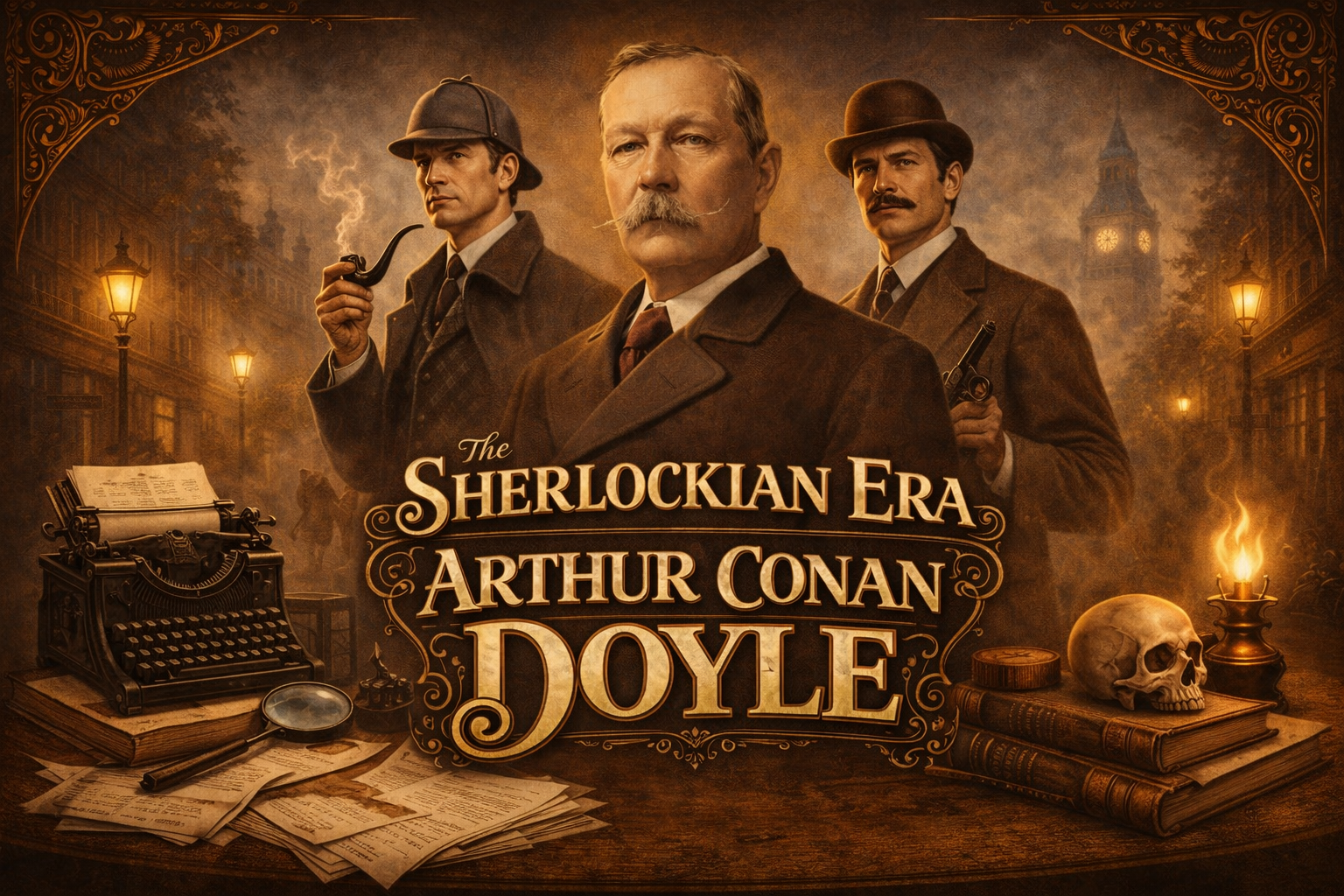
  • The Usual Suspects: The Sherlockian Era: Case #009: Arthur Conan Doyle

    The city is alive with fog and footsteps.

    Gaslight flickers against damp stone. Carriages pass in the distance. Somewhere in London, a door opens onto a narrow staircase leading to a modest flat at 221B Baker Street.

    Inside, a consulting detective waits — observant, precise, impatient with error. Beside him stands a loyal companion, ready to record what the world is about to witness.

    This is where modern detection took shape.

    And behind that famous address stood a writer named Arthur Conan Doyle.


    Arthur Conan Doyle

    by Walter Stoneman, for James Russell & Sons
    bromide print, circa 1916
    NPG Ax39223

    National Portrait Gallery


    Biography

    Arthur Conan Doyle was born in 1859 in Edinburgh, Scotland, into an Irish Catholic family. His mother, Mary Doyle, encouraged his love of storytelling. She also nurtured his interest in history from an early age. These influences would later shape both his detective fiction and his historical novels.

    He studied medicine at the University of Edinburgh, where he developed a disciplined approach to observation and reasoning. One of his professors, Dr. Joseph Bell, was known for making precise deductions. He based his deductions on small physical details. This method would later inspire Sherlock Holmes.

    After qualifying as a physician, Doyle opened a medical practice. Patients were few, and during long quiet hours he began writing fiction. In 1887, he introduced Sherlock Holmes in A Study in Scarlet. The character would soon transform his career.

    Doyle married Louisa Hawkins in 1885, and they had two children. After her death, he later married Jean Leckie, with whom he had three more children. During the Boer War, he served as a physician in South Africa. In 1902, he was knighted for his public service.

    Although Holmes brought him international fame, Doyle continued to write across genres — including historical fiction, adventure, and speculative tales.


    Meet His Detective: Sherlock Holmes

    In 1887, Arthur Conan Doyle introduced a consulting detective unlike any readers had seen before.

    His name was Sherlock Holmes.

    From the moment he appeared in A Study in Scarlet, Holmes stood apart. He noticed what others ignored. He drew conclusions from the smallest details — a stain, a footprint, the wear on a sleeve. His mind worked quickly, sometimes impatiently, always precisely.

    Holmes was not a member of the police. He operated independently, offering his services to those who sought his expertise. He approached crime as a problem to be solved through careful observation, logical reasoning, and scientific knowledge.

    But Holmes did not stand alone.

    At his side was Dr. John Watson — physician, army veteran, and narrator of the stories. Watson served as more than a companion. Through his eyes, readers entered the world of Baker Street. His presence made Holmes’ brilliance understandable, grounded, and human.

    Together, they established what would become known as the Baker Street model:

    • A brilliant but unconventional detective
    • A loyal companion who narrates the case
    • A domestic base of operations (221B Baker Street)
    • Clients who arrive with seemingly unsolvable problems
    • A final explanation that reveals how every clue fits together

    This structure proved remarkably durable. It would influence countless detective stories that followed — sometimes directly imitated, sometimes subtly reworked — but rarely ignored.


    Expanding the World of Holmes

    While Sherlock Holmes and Dr. Watson form the core of the series, Doyle gradually expanded the world around them.

    One of the most intriguing additions was Mycroft Holmes, Sherlock’s older brother. Introduced in The Adventure of the Greek Interpreter, Mycroft possesses equal powers of deduction. If not greater, yet he lacks his brother’s energy. Mycroft also lacks the inclination to pursue cases. Through him, Doyle deepened the mythology of the Holmes family. He hinted at a wider network of intellect operating behind the scenes of government and empire.

    In later reinterpretations, new members of the Holmes family have appeared. Enola Holmes is a younger sister imagined in modern adaptations. Though not created by Doyle, Enola reflects the enduring flexibility of the Holmes universe. It shows the universe’s ability to grow beyond its original boundaries.


    What He Brought to Detective Fiction

    When Sherlock Holmes appeared, he did more than solve fictional crimes.

    He set the standard.

    Arthur Conan Doyle gave detective fiction a clear structure through Holmes. It includes the brilliant consulting detective and the loyal narrator. It also features the carefully placed clues and the final explanation that ties every detail together.

    Holmes treated crime as an intellectual challenge. He relied on observation, logic, chemistry, disguise, and an understanding of human behavior. Readers were invited to follow the clues alongside him. They sometimes tried to solve the mystery first. They often fell just short.

    That structure became a blueprint.

    Writers who followed would refine it, challenge it, or modernize it — but they could not ignore it. The detective story, as it evolved into the twentieth century, carried Holmes’ influence in its bones.

    Even today, new adaptations, reinterpretations, and reimaginings return to the same core idea Doyle established. This core idea is that reason, carefully applied, can bring order to chaos.

    Holmes became more than a character.

    He became the reference point.


    Some Essential Holmes Stories

    Over the course of four novels and dozens of short stories, Sherlock Holmes became a fixture of popular culture. While every reader has personal favorites, several cases stand out as especially influential or enduring.

    • A Study in Scarlet: marks the first appearance of Holmes and Watson. It introduces the method of deduction that would define the series.
    • The Sign of the Four — expanding the partnership and deepening the detective’s world.
    • The Hound of the Baskervilles — blending rational explanation with Gothic atmosphere.
    • The Final Problem — where Holmes confronts Professor Moriarty in one of the most famous scenes in detective fiction.
    • The Adventure of the Speckled Band — often remembered for its tension and clever resolution.

    Together, these stories show the range of Doyle’s imagination. They span from urban crime to rural mystery. They include quiet deduction and dramatic confrontation.


    Stepping Away from Sherlock Holmes

    Success can be complicated.

    By the early 1890s, Sherlock Holmes had become a sensation. Readers eagerly awaited each new story in The Strand Magazine, and the detective’s popularity continued to grow.

    But for Arthur Conan Doyle, that success brought frustration.

    He did not want to be known for only one character. He had ambitions beyond detective fiction. He aimed to write historical novels, adventure stories, and other literary pursuits. He felt these deserved equal recognition.

    In 1893, Doyle made a bold decision. In The Final Problem, he sent Sherlock Holmes over the Reichenbach Falls in a confrontation with Professor Moriarty.

    Readers were outraged.

    The reaction was immediate and intense. Subscriptions were reportedly canceled. Letters poured in. Holmes’ death felt personal to many.

    Eventually, Doyle relented. Years later, Holmes returned.

    The episode reveals something simple and very human. Even the creator of the most famous detective in literature struggled. He found it difficult to step out of his shadow.


    Beyond Sherlock Holmes

    Although Sherlock Holmes dominates his legacy, Arthur Conan Doyle wrote widely across genres.

    He produced historical novels such as The White Company and its companion work Sir Nigel. These works reflect his long-standing fascination with medieval history.

    He also ventured into early science fiction with The Lost World. He introduced Professor Challenger, a bold and argumentative scientist. The adventures blended exploration with speculative science.

    In addition, Doyle wrote adventure fiction, plays, essays, and works defending his views on spiritualism. His literary interests were broad, even if Holmes ultimately eclipsed them in public memory.


    Legacy & Influence

    Sherlock Holmes did not simply become popular.

    He became foundational.

    Through Holmes, Arthur Conan Doyle established a model of detective fiction that shaped the genre for decades. The consulting detective became a staple of crime fiction. So did the companion narrator and the carefully structured case. The climactic explanation was also crucial. These elements became part of the architecture of crime fiction.

    Writers who came after Doyle contributed various elements. Some refined forensic detail. Others emphasized pure logic or shifted the setting. They all worked in conversation with Doyle’s creation.

    His influence reached beyond imitation.

    His brother-in-law, E. W. Hornung, created A. J. Raffles, a gentleman thief often seen as a deliberate inversion of Holmes. Where Holmes solved crimes, Raffles committed them — yet the structural similarities were unmistakable. The brilliant central figure. The loyal narrator. The intimate storytelling voice. This author will be explored in a later section of the archives.

    Holmes had become a reference point — one that could be mirrored, challenged, or transformed.

    By the early twentieth century, the detective story had matured into a recognizable form. And at its center stood Baker Street.


    Media & Adaptations

    Sherlock Holmes did not remain confined to the printed page for long. Doyle’s detective has been reinterpreted in early silent films, modern television, and international cinema. Each era reshapes him while preserving his essential qualities.

    Silent-era adaptations in the early twentieth century proved that Holmes translated easily to visual storytelling. By the 1940s, Basil Rathbone had created the classic cinematic image of Holmes. He appeared complete with deerstalker and pipe in a series of widely popular films.

    Later interpretations offered new tonal variations. Peter Cushing portrayed a sharper, more intense detective in The Hound of the Baskervilles. On television, Jeremy Brett delivered a performance widely praised for its faithfulness to Doyle’s original stories. His portrayal reinforced Holmes’ Victorian character and temperament.

    The twenty-first century brought further reinvention.
    In Sherlock Holmes and its sequel, Robert Downey Jr. presented a more physically dynamic and action-oriented Holmes, introducing the character to a new global audience.

    The BBC series Sherlock stars Benedict Cumberbatch as Holmes. It also features Martin Freeman as Watson. The series transported the detective into contemporary London. It preserved his deductive brilliance.

    Other adaptations explored alternative perspectives. The CBS series Elementary reimagined Watson as a woman. She was portrayed by Lucy Liu. This shifted the partnership while retaining the core investigative dynamic.

    Holmes has appeared in animated and speculative settings. This includes Sherlock Holmes in the 22nd Century. The character demonstrates flexibility across genres.

    A more reflective interpretation came with Mr. Holmes. Ian McKellen portrayed an aging detective confronting memory and legacy. This serves as a reminder that Holmes can evolve not only in setting, but in tone.

    New series such as Watson and Young Sherlock continue to reinterpret the Holmes universe for contemporary audiences.

    From Victorian London to modern cities — and even imagined futures — Sherlock Holmes remains adaptable.

    Few fictional characters have endured so consistently across time and media. Despite all the reinterpretations, reinventions, and performances that followed, Sherlock Holmes began with one writer. He was sitting at a desk in late nineteenth-century Britain.

    The character grew beyond the page — onto stage, screen, and into global popular culture. Arthur Conan Doyle continued to write and lecture. He pursued interests that stretched far beyond Baker Street.

    Holmes would take on a life of his own.

    Doyle, meanwhile, moved into the final chapters of his own.


    Later Life and Death

    In his later years, Doyle devoted much of his energy to causes outside detective fiction. After the losses of the First World War, he became a committed advocate of spiritualism. He lectured widely and published works in its defense.

    He continued to write across genres, but Sherlock Holmes had already secured a permanent place in literary history. By the time Doyle died in 1930, the detective had outgrown his creator. He had become one of the most recognizable fictional figures in the world.


    Conclusion

    Arthur Conan Doyle created a character who stepped beyond his own lifetime.

    Sherlock Holmes became more than a literary figure. He became a reference point for writers and readers. He also became a reference point for generations of storytellers. These storytellers would build upon the foundation laid at 221B Baker Street.

    Doyle’s ambitions reached beyond detective fiction, and his life was shaped by medicine, war, history, and personal conviction. Yet it is Holmes — observant, precise, enduring — who secured his lasting place in literary history.

    The door to Baker Street opened once.

    It has never fully closed.


    Continue Through the Sherlockian City

    Baker Street was only the beginning.

    Step back into the fog-lit streets and meet the other minds who shaped the Sherlockian Era. These were writers who refined forensic science. They sharpened logic and expanded the detective story in new directions.

    And now a question for you:

    When you think of Sherlock Holmes, what comes first? Is it the stories? the character? Or the many faces he has worn on screen?

    The city still has many doors to open


    References

    Primary Works

    Doyle, Arthur Conan. Sherlock Holmes: The Complete Novels and Stories. 2 vols.
    New York: Bantam Classics, 2003.

    Doyle, Arthur Conan. The White Company. London: Smith, Elder & Co., 1891.

    Doyle, Arthur Conan. The Lost World. London: Hodder & Stoughton, 1912.


    Biographical Sources

    Doyle, Arthur Conan. Arthur Conan Doyle: A Life in Letters.
    Edited by Jon Lellenberg, Daniel Stashower, and Charles Foley.
    New York: HarperPress, 2007.

    Miller, Russell. The Adventurous Life of Sir Arthur Conan Doyle.
    New York: St. Martin’s Press, 2008.


    Critical Studies

    The Cambridge Companion to Crime Fiction.
    Cambridge: Cambridge University Press, 2003.

    The Penguin Book of Murder Mysteries.
    London: Penguin Classics.


    One response to “The Usual Suspects: The Sherlockian Era: Case #009: Arthur Conan Doyle”

    1. […] Arthur Conan DoyleCreator of Sherlock Holmes. As the central architect of the consulting detective model, Doyle defined the expectations of logic, observation, and fair-play reasoning. […]

    Hello Gumshoe! On the track or authors? leave us reply!

  • The Usual Suspects: The Sherlockian Era

    The Minds Who Ruled the Gaslight

    The fog has lifted just enough.

    Streetlamps glow against wet pavement. Carriages pass in shadow. A newspaper folds under one arm. Somewhere above a narrow staircase, a mind is at work.

    The Sherlockian Era did not merely produce detectives.

    It produced reputations.

    These were the figures who transformed deduction into spectacle. They made reasoning dramatic. They turned observation into performance. They convinced readers that crime could be untangled by intellect alone.

    Some refined forensic science.
    Some sharpened pure logic to a razor’s edge.
    Some brought moral reflection or institutional authority into the investigation.
    All of them helped shape what the modern detective would become.

    Over time, scholars and critics have studied their methods and traced their influence across generations of crime fiction.

    Here, we keep it simple.

    We step into the city as readers. We are curious, observant, and ready to follow the clues. We meet the writers who defined the era. They built the foundations of modern detection.

    These are the names that ruled the gaslight.

    The usual suspects of the Sherlockian world.


    The Usual Suspects

    The Sherlockian Era was shaped by writers who did more than create memorable detectives. Each writer refined a different aspect of the emerging genre. They ranged from forensic precision to pure logic and from moral reasoning to institutional authority. Together, they strengthened the foundations of modern detective fiction. They ensured that deduction would remain at the heart of the mystery story.

    Here are the principal figures of the era:


    Arthur Conan Doyle
    Creator of Sherlock Holmes. As the central architect of the consulting detective model, Doyle defined the expectations of logic, observation, and fair-play reasoning.

    R. Austin Freeman
    A pioneer of forensic detail, Freeman introduced scientific method and medical precision into detective fiction through Dr. Thorndyke.

    Jacques Futrelle
    Through Professor Van Dusen, “The Thinking Machine,” Futrelle emphasized pure intellectual deduction and tightly structured logical puzzles.

    Melville Davisson Post
    With his Uncle Abner stories, Post blended moral reasoning. He used careful logic to offer a quieter but deeply analytical form of detection.

    Ernest Bramah
    Creator of the blind detective Max Carrados, Bramah challenged conventional assumptions and expanded the boundaries of deductive storytelling.

    Baroness Orczy
    Through Lady Molly of Scotland Yard, Orczy introduced institutional authority to the Sherlockian detective tradition. She added a strong female perspective.


    The Sherlockian city does not sleep.

    Gaslight flickers in narrow streets. Footsteps echo against stone. Somewhere, a clue waits to be noticed — a detail overlooked, a pattern waiting to be understood.

    These writers gave readers more than mysteries. They offered a way of thinking. They believed that even in the thickest fog, reason could cut a clear path forward.

    Now it is time to step into their world. Follow their methods. See how each mind shaped the art of detection.

    The game is afoot.


    Hello Gumshoe! On the track or authors? leave us reply!

  • The Sherlockian Era (1880-1910)

    The Age When Deduction Became a Discipline

    The Sherlockian Era is not just about a detective.

    It is about a world that suddenly felt modern.

    Between the late 1880s and the early 1910s, cities expanded at dizzying speed. Streets filled with gaslight and shadow. Railways connected towns. Telegraph wires carried news faster than ever before. Newspapers multiplied. Crime stories spread.

    Urban life became complicated.

    And complication breeds mystery.


    🌆 A City Growing Too Fast

    Industrial progress reshaped daily life:

    • Crowded streets
    • Anonymous neighbors
    • Expanding police forces
    • Scientific advances
    • Rising literacy

    For the first time, ordinary readers were surrounded by stories of crime reported in detail.

    The modern metropolis created a new anxiety:

    If anything can happen in the crowd…
    Who can make sense of it?

    Detective fiction stepped forward with an answer.


    📰 The Age of Serialization

    The era was powered by magazines.

    Stories arrived in installments. Readers waited for the next issue. Cliffhangers became conversation topics. Fiction became part of weekly routine.

    Crime was no longer confined to bookshelves — it lived in parlors and cafés.

    Detective stories became shared cultural experiences.


    🔬 Science Enters the Scene

    This was also a period of rapid scientific curiosity:

    • Early forensic methods
    • Growing fascination with fingerprints
    • Advances in chemistry
    • Interest in psychology

    Society began to believe that crime could be understood — not merely punished.

    The detective figure evolved into something new:

    Not just brave.
    Not just moral.
    But analytical.

    Reason became heroic.


    🌫 Mood of the Era

    This is not the domestic comfort of the Golden Age.

    This is gaslight, fog, newspaper ink, and violin strings in narrow rooms.

    It feels:

    • Urban
    • Intellectual
    • Slightly detached
    • Curious rather than sentimental

    There is confidence in logic…
    but also fascination with danger.


    ⚙️ Why This Era Matters

    The Sherlockian period stands between two worlds:

    Victorian moral drama

    Urban intellectual crime fiction

    Golden Age puzzle precision

    It is the moment detective fiction becomes modern.

    The moment crime becomes a problem to be solved, not merely endured.

    And the moment readers begin to expect fairness, logic, and method.


    🌫 Enter the City

    The Sherlockian Era is more than a chapter in literary history.

    It is a city at dusk.
    Gaslight flickering.
    Footsteps echoing on wet pavement.
    A question waiting to be answered.

    This was the moment detective fiction became modern —
    when reason stepped forward to challenge chaos.

    🕵️ The fog is rising. Step into the Sherlockian streets.

  • The Fading Ink: The Victorian Era: Case #011 : William Russell

    Introduction

    When you look through the early history of detective fiction, you expect to find famous names. But sometimes you come across a name that raises more questions than answers.

    Logo for this section

    William Russell is one of those names.

    His stories appear in Victorian crime writing, often presented as detective or police-style recollections. Yet figuring out exactly who he was is not straightforward. The nineteenth century had more than one William Russell, and over time those identities became tangled. The stories remain part of the early detective tradition — even if the author himself is harder to pin down.


    The Man — or Men — Behind the Name

    The name William Russell presents an immediate problem for literary history.

    In the nineteenth century, more than one public figure bore that name. Journalists, correspondents, and writers all appear in bibliographic records under “William Russell,” making attribution difficult without careful contextual work.

    The William Russell relevant to early detective fiction is associated with the tradition of police recollections. He is also linked with investigative narratives that circulated in Victorian periodicals. His work is part of a broader culture of semi-memoir crime writing. These stories are presented as professional reminiscences. They often blend fiction and a documentary tone.

    Over time, however, the clarity of authorship blurred. Bibliographies occasionally conflated individuals, and the commonness of the name made clean attribution difficult. In some cases, Russell’s work has been discussed alongside other figures in the police narrative tradition. These discussions include writers such as Thomas Waters. This further complicates the historical record.

    It can be stated with confidence that this William Russell contributed to the Victorian fascination with investigative storytelling. These narratives predate or parallel the rise of the fully mythologized consulting detective. Beyond that, biographical detail remains comparatively thin, and the literary footprint of the name has become less distinct over time.

    This instability is significant. It is not anonymity, but the confusion of attribution that places William Russell within the Victorian Fading Ink section.


    The Stories

    The work most closely associated with William Russell is Recollections of a Policeman. This volume is presented in the style of professional reminiscence. Like many nineteenth-century crime narratives, it adopts the voice of a working investigator recounting past cases.

    This form was popular in Victorian periodicals and book publications. Readers were drawn to stories that felt authentic. These stories were detailed. They were procedural. They were grounded in the daily realities of crime and investigation. Whether fully factual, fictionalized, or somewhere in between, such recollections blurred the line between memoir and narrative entertainment.

    In Russell’s case, the emphasis is less on theatrical brilliance and more on experience. The cases unfold through observation, practical reasoning, and familiarity with urban life. The tone is often steady and documentary rather than sensational.

    These recollection-style narratives form an important bridge in detective fiction history. They sit between early crime reportage and the later rise of the fully mythologized consulting detective.


    Russell in the Victorian Detective Landscape

    Recollections of a Policeman belongs to a phase of crime writing that predates the great fictional detectives. It partly prepares the ground for those who would soon dominate the genre.

    In the mid-to-late nineteenth century, readers were fascinated by crime, investigation, and the growing professional police force. Books presented as first-hand accounts from officers or detectives offered something that felt both informative and thrilling. They promised insight into the realities of crime-solving at a time when modern policing was still developing.

    William Russell’s work sits within that tradition.

    Russell’s investigator is different from later figures such as Arthur Conan Doyle’s Sherlock Holmes. The investigator does not rely on eccentric genius or dramatic flair. The focus is on experience. It involves the slow accumulation of knowledge. There is also familiarity with criminal habits. Practical reasoning is shaped by daily work.

    This style represents an important stage in detective fiction’s evolution. Before the consulting detective became a literary icon, there were narratives grounded in professional routine and urban realism. Russell’s recollections help illustrate that transition: from police memoir to fully fictional detective hero.

    He may not have created a legendary sleuth. However, he contributed to the atmosphere in which such figures could later emerge.


    Media & Revival

    Later fictional detectives moved easily into film, radio, or television. However, Recollections of a Policeman did not generate a lasting media legacy. The work has remained primarily within literary and historical study rather than popular adaptation.

    Its survival has depended on reprints and the continued interest of readers exploring the early development of detective fiction. The book is not widely dramatized. It remains valuable as part of the Victorian police recollection tradition. This form helped shape how crime narratives were told before the rise of the iconic consulting detective.

    Today, Russell’s work is most often encountered in historical discussions of early crime literature rather than in mainstream adaptations.


    Why He Belongs in Fading Ink

    William Russell is not an anonymous writer, and his work has not vanished entirely. Recollections of a Policeman survives, and its place in early detective literature is recognized.

    What has faded is clarity.

    The name “William Russell” was common in the nineteenth century, and over time attribution became less precise. Multiple public figures shared the name, and literary history has not always separated them cleanly. As a result, Russell’s authorial identity has softened at the edges. The stories remain accessible, but the man behind them is harder to isolate with certainty.

    This is not total erasure — it is blurring.

    That instability places William Russell within the Victorian Fading Ink section. His contribution to early detective storytelling endures, even if the sharp outline of the author has dimmed over time.


    Later Years and Death

    Precise biographical details about the William Russell associated with Recollections of a Policeman are limited. The name was shared by multiple nineteenth-century figures. Consequently, separating the crime writer from others bearing the same name has not always been straightforward.

    Russell’s work belongs to the Victorian period. It is part of the tradition of police-style narrative that flourished before the dominance of the consulting detective. Beyond his contribution to this genre, surviving documentation of his later life is comparatively sparse.

    As with many writers whose names were common, the historical record is clearer about the stories. Their work circulated primarily in periodical culture. It is less clear about the individual behind them.


    Conclusion

    William Russell may not be a household name, and his identity may not be sharply defined in literary history. Yet his work stands as part of an important stage in the development of detective fiction.

    Before the consulting detective became a cultural icon, readers were already fascinated by investigative narratives presented as professional recollections. Recollections of a Policeman reflects that earlier moment — when crime writing balanced realism, experience, and emerging narrative form.

    Russell’s place in the Victorian detective landscape is therefore not one of fame, but of foundation. His stories remind us that the genre evolved gradually, shaped by many voices — some celebrated, others blurred by time.

    In that blur, William Russell remains.


    Call to Action

    Did Russell’s police-style storytelling surprise you?

    Do you prefer realistic investigative recollections — or dramatic deduction?

    Explore the other authors in Victorian Fading Ink. Compare their approaches. See how detective fiction slowly transformed from case notes into legend.


    Reference Section

    • William Russell. Recollections of a Policeman. [Zinc Read, 2024].

    Closing the Victorian Fading Ink

    The Victorian period did not produce detective fiction in a single voice. Alongside the famous names were writers whose contributions helped shape the genre quietly. Sometimes they used pseudonyms. At times, they shared recollections. Occasionally, their identities later blurred.

    Mary Fortune, Arthur McGovan, and William Russell remind us that detective fiction was built gradually. Before the consulting detective became a cultural icon, working investigators created the foundations of crime storytelling. Memoir-style narratives contributed as well. Regional voices played a crucial role in carving out these foundations.

    But the era was about to change.

    Soon, a detective would emerge who would not fade at all.

    In the next chapter, we enter the Sherlockian Era. Deduction becomes legend in this era. One name reshapes the genre permanently.


    Hello Gumshoe! On the track or authors? leave us reply!

  • The Fading Ink: The Victorian Era: Case #010: Arthur McGovan

    Detective of Victorian Edinburgh

    (Pseudonym of William Crawford Honeyman)


    Introduction

    Before Sherlock Holmes became the defining face of detective fiction, other investigators were already walking the streets of Britain’s cities. They solved crimes not with theatrical brilliance, but with steady professional observation.

    Logo for this section

    One of them worked not in London, but in Edinburgh.

    His name was Arthur McGovan.


    Picture Taken from: The McGovan Casebook: Experiences of a Detective in Victorian Edinburgh. Edinburgh: Mercat Press, 2003.


    The Man Behind the Name

    Arthur McGovan was the detective-fiction pseudonym of
    William Crawford Honeyman (1845–1919).

    William Crawford Honeyman was a Scottish journalist, writer, and musician. While details of his private life are limited in surviving records, there is documentation of his professional activities. His journalism and published works provide this documentation.

    He wrote detective fiction under the pseudonym Arthur McGovan, separating his crime stories from his broader literary and journalistic output. This division was common in the nineteenth century, when authors often maintained different identities for different audiences.

    Beyond these documented facts, biographical details are relatively sparse, and much of Honeyman’s legacy rests on the surviving fiction itself.


    The Pseudonym

    The name “Arthur McGovan” functioned as a distinct authorial identity. It separated Honeyman’s crime fiction from his other writing and allowed him to cultivate a specific detective voice.

    This separation was deliberate. In the nineteenth century, authors often used different names for their work. This helped protect their reputation. It also managed audience expectations or distinguished genres.

    Over time, however, the pseudonym became the lesser-known half of his literary life.


    The Detective: James McGovan

    Within the stories, the detective is often referred to as James McGovan, creating a layered structure:

    • William Crawford Honeyman → the author
    • Arthur McGovan → the pseudonym
    • James McGovan → the fictional detective

    This blending of identities adds a fascinating dimension to the work. The detective persona feels grounded and professional, presented as a working investigator recounting real experiences in Victorian Edinburgh.

    Unlike the eccentric genius model popularized by later figures, McGovan is practical, procedural, and shaped by urban reality.


    The McGovan Casebook

    The principal surviving collection of these stories is:

    The McGovan Casebook: Experiences of a Detective in Victorian Edinburgh
    (Mercat Press, 2003 edition)

    The stories are episodic and rooted in:

    • Observation
    • Methodical investigation
    • Realistic urban settings
    • Social detail

    Edinburgh itself becomes an important backdrop. These are not London fog mysteries; they are grounded in Scottish streets, courts, and neighborhoods.


    McGovan in the Victorian Detective Landscape

    McGovan’s stories appeared during a period when detective fiction was expanding rapidly in magazines and serial publications.

    While Arthur Conan Doyle would soon dominate the genre with Sherlock Holmes, McGovan represents a parallel development. He is the steady professional detective shaped by lived experience rather than mythic genius.

    His work reminds us that Victorian detective fiction was regional and diverse, not solely centered on London.


    Media & Revival

    Arthur McGovan did not transition into film or television, nor did he receive the dramatic afterlife enjoyed by Holmes.

    His survival depends largely on:

    • Reprints
    • Scholarly attention
    • Specialist interest in early detective fiction

    The Mercat Press edition preserves this legacy for modern readers.


    Later Life and Death

    William Crawford Honeyman continued his broader professional and literary career beyond his detective fiction. He died in 1919.

    His life remains traceable. However, the detective identity of Arthur McGovan gradually slipped from mainstream recognition. It survives primarily in bibliographic and archival records.


    Why He Belongs in Fading Ink

    Arhtur McGovan is not an anonymous writer, nor is his real identity lost. However, the pseudonymous detective persona faded from popular memory.

    The man remained documented.
    The detective voice receded.

    This partial fading occurred among literary identities once active in Victorian periodical culture. As a result, it places McGovan within the Victorian Fading Ink section.


    References

    • Honeyman, William Crawford (as James McGovan). The McGovan Casebook: Experiences of a Detective in Victorian Edinburgh. Edinburgh: Mercat Press, 2003.
    • The Cambridge Companion to Crime Fiction. Cambridge: Cambridge University Press, 2003.

    Conclusion

    Arthur McGovan stands as a reminder that detective fiction was built not only by iconic figures. Regional voices and professional storytellers also helped shape the genre’s foundations with their contributions.

    He may not have become a household name. However, in the streets of Victorian Edinburgh, his detective once worked just as steadily as any celebrated sleuth.


    Call to Action

    Have you encountered The McGovan Casebook?
    Do you prefer the grounded realism of a working detective, or the brilliance of a larger-than-life figure?

    Explore the other authors in Victorian Fading Ink to discover the voices that shaped detective fiction beyond the canon.


    Previous: Mary Fortune
    Next: William Russell →


    Hello Gumshoe! On the track or authors? leave us reply!

  • The Fading Ink: The Victorian Era:             Case #009: Mary Fortune (1833–1910)

    Author of The Detective’s Album and The Secrets of Balbrooke

    🕯 A Name That Wasn’t a Name

    For decades, readers of The Australian Journal followed the cases of Detective Mark Sinclair. These stories were signed not by a celebrated author, but by Waif Wander.

    Logo for this section

    Behind that pseudonym stood Mary Fortune. She was a writer whose identity would blur into obscurity. Her stories multiplied across the pages of colonial magazines.

    She was prolific.
    She was professional.
    And for much of literary history, she was nearly invisible.


    Stylized Portrait of Mary Fortune

    Since no official Portrait exists of Mary Fortune, this portrait is a stylized image created by AI.


    Biography

    Mary Fortune was born in 1833 in Ireland and later emigrated to Australia during the mid-nineteenth century. She moved frequently. She faced economic instability and personal hardship. These experiences would later inform the social realism of her fiction.

    By the 1860s, she had begun publishing in The Australian Journal. It was one of the most widely read magazines in colonial Australia. Writing under the pseudonym Waif Wander, Fortune became a regular contributor and eventually one of the publication’s most prolific authors.

    Unlike many writers of the period who produced occasional stories, Fortune sustained a long-running detective series over decades. She published under a pseudonym. Since she wrote within serialized magazine culture, her authorship was not widely preserved beyond its immediate readership.


    🔍 The Detective’s Album

    Beginning in 1868, The Detective’s Album became the central vehicle for Mary Fortune’s detective fiction. Serialized in The Australian Journal, the series followed Detective Mark Sinclair through cases drawn from the realities of colonial life.

    Sinclair is unlike the brilliant eccentric detectives who would later dominate the genre. He is a working professional. Sinclair is a police investigator tasked with maintaining order in a society still defining itself. His cases unfold through interviews, observation, and moral evaluation rather than theatrical deduction.

    The stories often revolve around:

    • Theft and fraud in goldfield communities
    • Domestic conflicts and inheritance disputes
    • Crimes shaped by poverty, displacement, and opportunity
    • Confession-based resolutions grounded in psychological tension

    What distinguishes The Detective’s Album is its tone. Fortune does not glamorize crime. Her narratives are sober, attentive to motive, and frequently sympathetic toward the social conditions that produce wrongdoing.

    The Australian setting is not decorative — it is structural.
    The instability of colonial society shapes the crimes themselves. Justice, in Fortune’s fiction, is procedural but rarely triumphant. It restores order, but not without revealing social fault lines.

    In sustaining this series over decades, Fortune helped normalize the idea of a recurring professional detective. This detective operated within a recognizable social system. This model would later become central to detective fiction worldwide.


    Meet Her Detective

    🕵️‍♂️ Detective Mark Sinclair

    He is the central professional investigator in the long-running series published in The Australian Journal.

    What defines Sinclair?

    • A working police detective (not an amateur sleuth)
    • Procedural and practical rather than eccentric
    • Often dealing with confession-driven cases
    • Grounded in colonial Australian realities
    • Focused on restoring order rather than showcasing brilliance

    He is not a flamboyant character like Holmes.
    He is not a gentleman amateur.
    He is a functioning part of the justice system.

    Fortune’s contribution lies less in creating a “character myth.” Instead, it is more about normalizing the recurring professional investigator. This aspect becomes central to later detective fiction.


    Were there other detectives?

    Fortune did write other crime and investigative tales, but:

    • Mark Sinclair is the primary recurring detective figure.
    • The bulk of her detective identity is tied to The Detective’s Album.

    📚 Her Detective Works (Clarified)

    🔍 The Detective’s Album (1868–1908)

    This is not a single novel.

    It is a long-running serialized collection of detective stories featuring Detective Mark Sinclair, published in The Australian Journal.

    Over decades, Fortune produced hundreds of these pieces. Some were later gathered in partial collections, but during her lifetime they functioned as magazine fiction rather than formal novels.


    📖 Other Detective Narratives

    Beyond The Detective’s Album, Fortune wrote additional crime and mystery stories. However, these were primarily short fiction or serialized narratives. They were not widely circulated standalone novels.

    Her strength was sustained episodic detective storytelling, not the three-volume Victorian novel format.


    🧭 So Did She Write Detective Novels?

    Strictly speaking:

    • No major, widely recognized standalone detective novels define her career.
    • Her reputation rests on serialized detective fiction.
    • Her contribution is procedural continuity, not novel-length plotting.

    And that actually reinforces her Fading Ink identity.

    Fortune’s detective fiction was primarily serialized. It was not published as standalone novels. This factor later contributed to its uneven preservation.


    🎬 Media

    Unlike many later detective writers, Mary Fortune’s work did not transition into film, radio, or television during the twentieth century.

    Her stories were published primarily in serialized magazine form under the pseudonym Waif Wander. They remained largely confined to their original print context. She did not have a stable authorial name attached. There were no major reprint campaigns during the detective fiction boom. As a result, her work did not enter the adaptation cycle that preserved many British and American contemporaries.

    In recent decades, scholars and editors have begun recovering and republishing portions of her writing, but large-scale adaptations remain absent.

    Her disappearance from media history reflects not a lack of output, but the fragility of serialized colonial literature.


    🧭 Legacy

    Today, Mary Fortune is recognized as a foundational figure in Australian crime fiction. She is also one of the earliest women to sustain a long-running detective series.

    Her work expands the map of detective fiction beyond Europe and North America. It demonstrates that the genre developed simultaneously in colonial settings. These settings were shaped by gold rushes, migration, and social instability.

    Fortune’s contribution lies not in spectacle, but in normalization. She established the recurring professional detective within a functioning justice system. She also embedded crime within social realities.

    Her legacy is the quiet proof that detective fiction was never geographically confined — only selectively remembered.


    ⚰ Death

    Mary Fortune died in 1911 in Melbourne, Australia.

    By the time of her death, the pseudonym Waif Wander had long masked the scope of her authorship. She had produced hundreds of detective stories across four decades. However, her name was not firmly attached to her work. This attachment was not in the way later crime writers would be.

    As the twentieth century advanced, detective fiction entered its more commercially branded eras. During this time, Fortune’s serialized colonial stories quietly slipped out of circulation.

    Her passing marked the end of a life shaped by hardship and persistence. It also signaled the beginning of a long period of obscurity. Modern scholarship would eventually begin to reverse this obscurity.


    📚 Selected References

    • The Australian Journal (Melbourne), serialized publication of The Detective’s Album, 1868–1908.
    • Lucy Sussex, Women Writers and Detectives in Nineteenth-Century Crime Fiction.
    • Charles J. Rzepka (ed.), A Companion to Crime Fiction.

    🕯 Conclusion

    Mary Fortune wrote at the edge of empire, in a literary marketplace that preserved stories more reliably than names.

    Through The Detective’s Album, she demonstrated that detective fiction could adapt to new landscapes and new societies. She helped establish the professional investigator as a recurring figure long before the genre solidified its canon.

    Her disappearance was not due to silence — she wrote tirelessly. It was due to authorship hidden behind a pseudonym and publication confined to serialized print.

    In recovering her work, we uncover a broader map of detective fiction’s development. This map stretches beyond London fog into colonial dust.


    🔦 Continue the Investigation

    Mary Fortune is one of several masked voices in the Victorian era whose authorship blurred as their stories endured.

    Return to Victorian — Fading Ink to explore other writers. Their identities faded even as their detective tales shaped the genre’s early evolution.

    Some names vanished.

    The ink did not.

  • The Fading Ink: The Victorian Era

    Introduction

    The Victorian era is often remembered through its most famous names. However, detective fiction of the period was shaped by writers whose identities never fully survived. Fading Ink is devoted to these authors—those whose stories endured while their names gradually slipped from the record.

    Logo for this section

    These writers did not simply fall out of fashion. They published under incomplete names or unstable bylines that were never firmly anchored to a traceable individual. Over time, the stories remained, but the people behind them faded from view. When a writer’s identity can be confidently recovered or a career clearly followed, that author appears elsewhere in the archive.

    This section is intentionally small. Fading Ink is reserved for Victorian detective writers. Their disappearance is inseparable from their work, where the loss of identity is part of the story itself.


    The Authors

    Mary Fortune

    One of the earliest and most prolific writers of detective fiction, Mary Fortune published extensively in the nineteenth century. Despite her output and influence, her personal history remains fragmented. Much of her life must be reconstructed from partial records and periodical traces.

    Arthur McGovan

    Arthur McGovan survives almost entirely as a byline. Beyond the works attributed to him, little is known with certainty, leaving his identity and background largely beyond recovery.

    William Russell

    William Russell helped shape the image of the Victorian police detective. However, his practical, case-by-case realism faded. Larger fictional personalities took center stage.


    Why This List Is Short

    Not every obscure Victorian writer belongs in Fading Ink. A real name can sometimes be traced. A biography can be reconstructed. If a literary career can be followed with confidence, the author appears elsewhere in the archive. Fading Ink is reserved for those whose identities have faded along with their names. Their stories continue to survive.


    Next: Mary Fortune

    Previously: C.L Pirkis


    Hello Gumshoe! On the track or authors? leave us reply!

  • The Forgotten Footprints: The Victorian Era: Case #004: C. L Pirkis

    🕯 Hook

    Before the Golden Age crowned its queens of detection,
    before Miss Marple knitted her way through murder,
    before the word “lady detective” became a marketing hook—

    There was Loveday Brooke.

    Calm. Observant. Professional.

    And behind her stood a writer Victorian readers knew well… but history slowly misplaced.


    Portrait of C.L Pirkis: Catherine Louisa Pirkis – WordFire Press


    📖 Biography

    Catherine Louisa Pirkis was born in 1839 and wrote during the height of the Victorian publishing boom. This was a period when magazines, serialized fiction, and circulating libraries shaped popular reading habits. Pirkis worked confidently within that expanding literary world.

    She initially published in periodicals. This was before her fiction was gathered into book form. She wrote under her own name at a time when many authors — especially women — chose pseudonyms. Her prose is controlled and deliberate, favoring clear structure over sensational excess.

    Unlike some of her contemporaries, Pirkis did not rely heavily on melodrama. Instead, her writing reflects careful plotting and an attention to social detail that would later become central to detective fiction.

    Beyond her literary work, she was involved in animal welfare advocacy. She participated in early efforts toward humane treatment reform. This serves as a reminder that many Victorian writers were active in public causes as well as in print.


    🕵️ Meet the Author’s Detective:

    Loveday Brooke

    Loveday Brooke is one of the earliest recurring professional female detectives in English fiction. She works for a private detective agency. She accepts assignments with the calm assurance of someone who understands both social nuance and investigative method.

    Unlike many fictional women of the period, Loveday is neither romanticized nor exaggerated. She is presented as capable, practical, and observant — often relying on careful social awareness rather than dramatic confrontation.

    Her cases frequently involve:

    • Insurance investigations
    • Domestic deception
    • Social-class tensions
    • Subtle identity puzzles

    Loveday’s strength lies in quiet intelligence. She does not rely on theatrics. She studies people, patterns, and environments — and draws conclusions from what others overlook.

    In tone and structure, her stories anticipate the more disciplined detective fiction that would emerge in the decades to follow.


    📚 Major Work

    The Experiences of Loveday Brooke (1893)

    Originally serialized in Ludgate Magazine, the stories follow Brooke through cases involving:

    • Insurance fraud
    • False identities
    • Domestic deception
    • Social-class tensions

    The structure is tight and episodic.
    The tone is measured.
    The solutions rely on observation rather than coincidence.

    The stories bridge sensation fiction and structured detective procedure — making Pirkis a transitional figure in the genre’s development.


    📚 Other Works — Beyond Loveday Brooke

    Although Catherine Louisa Pirkis is most closely associated with The Experiences of Loveday Brooke, she wrote more than detective fiction.

    Among her other published works is A Datchet Diamonds. This novel is crime-tinged and reflects the Victorian taste for intrigue and moral tension. Like many writers of the period, Pirkis worked within the fluid space between sensation fiction, domestic drama, and mystery.

    She also contributed short fiction to magazines — the lifeblood of Victorian popular literature. These periodicals provided visibility and income, but they did not always guarantee long-term preservation.


    Why Did She Vanish?

    Pirkis did not build an extended franchise like some of her contemporaries. She did not create a character that remained continuously in print through the twentieth century. Much of her work appeared in magazines, and without constant reprinting, authors could quickly fall from public memory.

    The rise of larger-than-life detective figures narrowed the spotlight. This was especially true for those who came to define the genre in the popular imagination. Writers like Pirkis, whose style was restrained and professional rather than dramatic, were easier for literary history to overlook.

    Her disappearance was not due to insignificance. Instead, it resulted from shifting tastes. Limited reprints also contributed. Additionally, the selective nature of canon formation played a part.


    🎬 Media Adaptations

    Unlike many Victorian detective figures, Loveday Brooke has not received major film or television adaptations. No widely recognized screen versions of The Experiences of Loveday Brooke were produced during the twentieth century’s detective boom.

    However, her stories have appeared in:

    • Modern anthologies of early women detectives
    • Scholarly collections of Victorian crime fiction
    • Reprint editions aimed at restoring overlooked authors

    The absence of large-scale adaptation contributed to the fading of Pirkis’s name from mainstream cultural memory. Without film, television, or long-running franchise revival, her work remained largely within literary circles rather than popular entertainment.


    🧭 Legacy

    Today, Catherine Louisa Pirkis is recognized as one of the early architects of the professional female detective in English fiction.

    Loveday Brooke is a transitional figure. She bridges the gap between Victorian sensation narratives and the more structured detective fiction of the twentieth century. Her stories demonstrate that women investigators were present in the genre long before the Golden Age popularized them.

    Modern scholars and editors have restored her work through reprints and anthologies, bringing renewed attention to her contribution. She may not occupy the center of the detective canon. However, her role in expanding the possibilities of the genre remains significant.

    Her legacy is not one of spectacle — but of foundation.


    ⚰ Death

    Catherine Louisa Pirkis died in 1910, at the age of seventy-one. During her lifetime, detective fiction was changing significantly. Structures became more formalized. Larger-than-life investigative figures started to dominate.

    Her passing came just before the genre would move decisively into the twentieth century. It was the era that later critics would call the Golden Age. Her name gradually receded from popular circulation. However, her work remained part of the foundation for the next phase.


    Conclusion

    Catherine Louisa Pirkis may not occupy the brightest spotlight in detective fiction history, but her contribution remains unmistakable. She introduced a capable, professional woman. This character was at the center of the investigation when the genre was still defining itself. She made it feel natural.

    Her work reflects a moment of transition: from sensation to structure, from spectacle to method. Though later figures would dominate public imagination, Pirkis helped widen the field before it narrowed again.

    Forgotten — yes.
    Insignificant — never.


    🗂 Closing the Forgotten Footprints

    The Victorian era did not produce only towering literary monuments. It also produced writers who shaped the genre in quieter ways. These authors made real contributions. Their readership was once substantial. However, their names gradually slipped from common memory.

    Mary Elizabeth Braddon and Catherine Louisa Pirkis represent that delicate middle ground. They were neither anonymous nor insignificant. They published under their own names. They influenced the evolution of crime fiction. Yet they did not carry their reputations intact into the twentieth century.

    Forgotten Footprints is not a category of obscurity — it is a space of recovery.

    These writers remind us that literary history is selective. What survives is not always a measure of merit, but of momentum.


    🔦 Next: Fading Ink

    If Forgotten Footprints gathers those whose names dimmed over time, the next section moves further into shadow.

    In Fading Ink, we meet authors whose identities blurred. These are writers who published under pseudonyms, masks, or anonymity. They left behind works but not always clear names.

    The stories remain.
    The authors do not always.

    Continue to Fading Ink and follow the trail where attribution becomes uncertain and literary history grows quieter still.

  • The Forbidden Footprints: The Victorian Era: Case #003: Mary Elizabeth Braddon

    🔎 Introduction

    Victorian readers devoured her novels for their scandals and secrets. Few noticed she was quietly inventing a new way to investigate crime. Long before famous detectives and forensic rules, Mary Elizabeth Braddon proved that detection could be thrilling without a star sleuth. It could also be deadly without a single gunshot.


    🧬 Biography

    Born in London in 1835, Mary Elizabeth Braddon began her career as an actress before turning to writing. Her breakthrough came in the early 1860s, when a succession of sensation novels brought her extraordinary commercial success. Her books dominated circulating libraries, and her readership spanned Britain and beyond.

    Braddon later became editor of Belgravia. It was a popular literary magazine that published fiction, essays, and poetry. These contributions were from leading writers of the day. Despite her popularity, critics often dismissed her work as sensational. They called it melodramatic. These labels would later contribute to her marginalization in literary history.

    She continued writing well into the late 19th century. She died in 1915. Her reputation narrowed to a single title. Much of her broader influence faded.


    National Portrait Gallery, London: Public-domain portraits of Mary Elizabeth Braddon.


    Why She Matters in Detective Fiction

    Mary Elizabeth Braddon was one of the most widely read novelists of the Victorian era. Her contribution to detective fiction has largely slipped from view. Best remembered today for Lady Audley’s Secret, Braddon helped shape early crime narratives. She demonstrated that investigation could unfold through social observation, moral pressure, and psychological insight. This occurred long before the rise of iconic detectives and forensic logic.

    In Braddon’s fiction, detection does not begin with clues. It begins with watchfulness


    🕵️‍♂️ Meet the Detectives

    Unlike later Victorian crime writers, Braddon did not create a recurring “star detective.” Instead, her investigations are carried out by professionals, observers, and morally alert outsiders—figures who move quietly within respectable society.

    In Henry Dunbar (1864), Miss Monson assumes the investigative role. She is one of the earliest examples of a professional female investigator in Victorian fiction. She works discreetly, relying on patience, observation, and social intelligence rather than authority or force. Her power lies in her ability to read people—and to wait.

    Elsewhere in Braddon’s work, investigation is often distributed among lawyers, doctors, relatives, and confidants. Detection becomes a collective moral process, driven by social pressure and ethical scrutiny rather than a single deductive genius.

    Braddon’s investigators are typically:

    • Quietly professional rather than eccentric
    • Embedded in social networks rather than isolated
    • Focused on motive, behavior, and concealment

    🧭 Did She Remain in Detective Fiction?

    Braddon never confined herself exclusively to detective fiction, nor did she abandon it. Throughout her career, she continued to write sensation novels infused with investigative structures. Her work also expanded into romance, social realism, and family drama.

    Braddon did not move toward the puzzle-driven detective story that would dominate the late 19th century. Instead, she remained committed to psychological suspense and moral inquiry. Her novels ask why crimes occur. They explore how society responds to them. These questions would later be overshadowed by method and mechanics.

    As the genre shifted toward professional male detectives and formalized deduction, Braddon’s approach gradually fell out of fashion.


    🎭 Themes & Style

    • Tone: Domestic realism, moral irony, social critique
    • Settings: Drawing rooms, inheritance offices, English countryside estates
    • Investigative methods: Emotional intelligence, social pressure, guided confession

    Braddon’s fiction blurs the boundary between sensation and detection. It proves that the pursuit of truth can be as thrilling as the crime itself.


    📚 Key Works

    Henry Dunbar (1864)
    A banker’s murder, an impostor’s return, and a sustained investigation conducted through quiet professionalism and moral pressure.

    Lady Audley’s Secret (1862)
    This is not a detective novel in the strict sense. It is a foundational work of psychological crime fiction. The story is centered on secrecy, surveillance, and identity.

    Aurora Floyd (1863)
    A sensational narrative combining romance, scandal, and proto-detective curiosity.


    🎬 Media Adaptations & Cultural Afterlife

    Braddon’s popularity ensured that her work quickly crossed into other media.

    • Lady Audley’s Secret was adapted for the Victorian stage within years of publication. It has since inspired silent films, television adaptations, and radio dramatizations, particularly in Britain.
    • Aurora Floyd and other sensation novels also received 19th-century theatrical adaptations, reflecting Braddon’s close ties to the theatre.

    Henry Dunbar has seen fewer modern adaptations. Its importance lies in its structural role in early detective fiction. This significance outweighs its screen legacy.


    🕰️ Legacy & Place in Forgotten Footprints

    Braddon sold thousands of copies during her lifetime. However, her role in the evolution of detective fiction was later overshadowed. This occurred because of figures such as Poe, Collins, and Conan Doyle. Her work occupies a crucial transitional space. Emotion, intuition, and social observation were central to investigations of guilt and motive.

    She reminds us that before the microscope and magnifying glass came the moral mirror. Few writers held it up to Victorian society with greater sharpness.


    ⚰️ Death

    Mary Elizabeth Braddon died on February 4, 1915, at the age of 79. Like most of her life, the cause of her death is largely unrecorded. Her passing marked the end of a career. It had shaped Victorian popular reading for decades. Later literary memory would narrow her legacy to only a portion of what she actually built.


    📖 References and Further readings

    Primary Works

    • Henry Dunbar (1864)
    • Lady Audley’s Secret (1862)
    • Aurora Floyd (1863)

    Critical & Contextual Sources

    • The Maniac in the Cellar, Winifred Hughes
      This is a foundational study of Mary Elizabeth Braddon. It examines Victorian sensation fiction and is used here for genre and thematic context.
    • The Cambridge Companion to Crime Fiction, Cambridge University Press
      Consulted for historical context on early crime and detective fiction. It examines Braddon’s place within Victorian developments.
    • Women Writers and Detectives in Nineteenth-Century Crime Fiction
      This work explores gender and authorship. It discusses the emergence of female investigators in 19th-century crime narratives.
    • The Penguin Book of Murder Mysteries
      Consulted for genre context and the evolution of crime and detection narratives.

    Archival & Institutional Resources

    • National Portrait Gallery, London
      Public-domain portraits of Mary Elizabeth Braddon.
    • British Library
      Publication history, Victorian reception, and bibliographic records.

    🧾 Conclusion

    Mary Elizabeth Braddon’s detective fiction does not announce itself with famous sleuths or clever puzzles. Instead, it unfolds quietly—through observation, moral pressure, and the slow collapse of respectability. Her investigations remind us that crime does not always leave fingerprints. However, it always leaves traces in behavior, motive, and silence.

    Braddon wrote long before detective fiction became a genre of rules and routines. She showed that the most unsettling mysteries were social ones. In revisiting her work, we recover a forgotten contributor to detective fiction. We also discover an early vision of investigation as an ethical act. This vision looks inward as often as it looks for clues.


    Hello Gumshoe! On the track or authors? leave us reply!

  • The Forgotten Footprints: The Victorian Era

    The Names History Let Slip

    The Victorian era is often described as the moment detective fiction found its footing. What is less often acknowledged is how selective memory became once that footing was secure.

    Not every writer who helped shape crime and investigation carried their reputation forward. Some were absorbed into broader literary movements. Others were overshadowed by louder names that followed. The result is a quieter group of authors whose work mattered — and then slowly slipped from view.

    The Victorian Forgotten Footprints section is deliberately narrow. It is not a catalogue of obscurity, but a focused effort to recover authors who meet three strict conditions:

    • they wrote crime or detective fiction during the Victorian period
    • they published under their real, verifiable names
    • their reputation faded despite genuine contemporary impact

    What remains after applying those rules is not a long list — but a meaningful one.


    The Authors

    Mary Elizabeth Braddon

    Mary Elizabeth Braddon is best known today for her sensation novels. She was one of the most widely read writers of the Victorian era. Her engagement with crime, secrecy, and investigation shaped popular storytelling long before detective fiction settled into fixed forms.

    As the genre professionalized, Braddon’s role was gradually reframed — her influence absorbed, her name sidelined in detective-fiction histories. Yet her work helped establish many of the narrative tensions that later crime writers would refine.

    Her footprint is still there. It simply requires attention to see it.


    Catherine Louisa Pirkis

    Catherine Louisa Pirkis created Loveday Brooke. She is one of the earliest professional female detectives in fiction. This is a milestone that should have guaranteed her lasting recognition.

    Instead, her work became a specialist reference rather than a mainstream name. As detective fiction narrowed its canon, Pirkis’s contribution was acknowledged quietly, then largely left behind.

    Her presence in Forgotten Footprints is not corrective charity; it is historical accuracy.


    Why the List Is Small

    Victorian crime fiction produced many forgotten works — but far fewer forgotten names.

    Publishing culture of the period relied heavily on:

    • initials
    • pseudonyms
    • anonymous or masked identities

    Those authors belong elsewhere in the archive. Forgotten Footprints is reserved for writers whose names were once visible — and then allowed to fade.

    The brevity of this list is not an absence.
    It is evidence.


    What Forgotten Footprints Means

    Forgotten Footprints is not about reclaiming fame.
    It is about restoring continuity.

    These authors were part of the genre’s formation. Their ideas did not disappear — they were carried forward by others, often without attribution. Following their trail reveals detective fiction is not a sequence of great leaps. Instead, it is a layered process of influence, loss, and rediscovery.


    Where to Go Next

    From here, the Victorian era branches in two directions:

    • into Fading Ink, where identities themselves were concealed
    • and into later eras, where detective fiction hardened into recognizable forms

    The footprints remain — if you know where to look.


    Victorian Era Navigation


    Hello Gumshoe! On the track or authors? leave us reply!

  • The Usual Suspects: Victorian Era: Case #008: Grant Allen

    The Thinker Who Let Crime Reason for Itself


    Introduction

    Grant Allen did not write detective fiction to dazzle.
    He wrote it to think.

    The genre was still deciding what it wanted to be at the time. Allen viewed crime as a problem of logic. He also considered it an issue of psychology and systems. His stories ask not only who committed the crime, but how crimes emerge, succeed, and sometimes fail. Detection, in Allen’s hands, is an intellectual exercise — quiet, deliberate, and demanding.


    Official Portrait : https://www.thecanadianencyclopedia.ca/en/article/grant-allen/


    Biography

    A Scientific Mind in a Literary World

    Born in 1848 in Canada and educated in England, Grant Allen occupied an unusual place in Victorian letters. Trained in science and deeply influenced by evolutionary theory, Allen was intellectually restless and broadly curious. He wrote essays on science, psychology, art, and social issues long before fiction became his primary means of income.

    Like many Victorian writers, Allen turned to fiction partly out of necessity. Essays paid poorly; stories sold. But he did not leave his analytical habits behind. Instead, he carried them directly into his storytelling.

    Allen was closely connected to the intellectual debates of his time and counted prominent thinkers among his peers. His fiction reflects this background: ideas matter, reasoning matters, and human behavior is shaped by forces larger than individual will.


    His Detective Fiction

    Grant Allen’s detective fiction resists spectacle. He focuses on process instead of building stories around a single brilliant investigator. He explores how crimes are planned. He examines how evidence accumulates. He shows how understanding unfolds.

    His crime writing emphasizes:

    • cause and effect
    • psychological motivation
    • rational planning
    • reader participation

    Detection is not presented as genius, but as applied reasoning. In many stories, the reader is invited to follow the logic step by step, without theatrical shortcuts.


    Investigators and Narrative Approach

    Unlike many Victorian crime writers, Allen did not create a single iconic detective figure. Investigative authority in his stories often shifts:

    • between narrators
    • through reconstruction of events
    • or via the criminal’s own reasoning

    This approach keeps attention on intellect rather than personality. The crime itself becomes the subject of analysis, rather than the investigator who solves it.


    Colonel Clay and the Gentleman Thief

    A Forward Link

    Allen is best known in crime fiction for creating Colonel Clay, the central figure of The Ancestral Tomb (1897).

    Colonel Clay is not a detective, but a gentleman thief — refined, intelligent, and methodical. His crimes succeed because he understands systems, habits, and human weakness. In many ways, Clay thinks like a detective while acting as a criminal.

    These stories point forward to the gentleman thief tradition, where figures commit larceny while displaying investigative intelligence and strategic reasoning. This strand of crime fiction is morally ambiguous. It is also intellectually playful. We will explore it in a future section of the archive.


    Beyond Detection

    Grant Allen’s literary career extended far beyond crime fiction. He was also:

    • a prolific essayist
    • a scientific and cultural commentator
    • a writer of early speculative and psychological fiction

    This breadth has sometimes obscured his role in detective fiction. His crime stories consistently engage with investigation as an intellectual act. This engagement belongs firmly within the Victorian development of the genre.


    Did He Stay with Detective Fiction?

    Allen did not limit himself exclusively to detective fiction, but he returned to crime and investigation repeatedly throughout his career. Rather than abandoning the genre, he treated it as one avenue among many for exploring ideas.


    Influence and Legacy

    Grant Allen’s influence is subtle but significant. He helped demonstrate that detective fiction could:

    • function without flamboyant detectives
    • reward careful thought
    • explore crime through psychology and structure

    His work contributed to a quieter, more analytical tradition within Victorian crime writing — one that values understanding over display.


    Did Grant Allen Write Beyond Detective Fiction?

    Beyond detective fiction, Grant Allen maintained a wide-ranging literary career. He wrote popular science, social novels, speculative fiction, and essays on art and culture. This intellectual breadth shaped his approach to crime. He treated it not as spectacle, but as a system governed by cause and effect.

    Notable titles include:

    • The Woman Who Did (1895)
      Allen’s most controversial and widely discussed novel. It challenges Victorian ideas of marriage, morality, and female independence. Hugely influential — and fiercely debated.
    • The British Barbarians (1895)
      This satirical and speculative work examines Victorian society through the eyes of an outsider. It blends social critique with evolutionary thinking.
    • This Mortal Coil (1888)
      This is a darker, psychologically driven novel. It explores guilt, responsibility, and moral consequence. These themes also surface in Allen’s crime writing.
    • Physiological Aesthetics (1877)
      This is a work of popular science and criticism. It illustrates Allen’s belief that art, beauty, and behavior could be studied systematically.
    • Evolutionist at Large (1881)
      This is a collection of essays. It makes evolutionary theory accessible to general readers. It reflects the analytical mindset that underpins his fiction.

    Media & Adaptations

    Grant Allen’s fiction was widely read during his lifetime. However, it did not generate the film or television adaptations. These are often linked with later crime writers.

    His influence is felt indirectly, particularly through the gentleman thief tradition that followed in the early twentieth century. Characters skilled in criminal action and intellectual planning would later thrive in popular media. Nonetheless, Allen’s own stories remained primarily literary.

    Many of his works are now available in public-domain editions, ensuring continued access for modern readers.


    Death

    Grant Allen died in 1899 at the age of 51. His life was relatively short, but his ideas continued to circulate well into the twentieth century. They spread particularly through the gentleman thief tradition and intellectually driven crime fiction.


    Conclusion

    Grant Allen reminds us that Victorian detective fiction was not shaped by spectacle alone. Alongside famous detectives and dramatic revelations were writers who believed crime should be understood.

    By letting reason — rather than brilliance — take the lead, Allen expanded what detective fiction could be.


    Navigation

    Previous: George R. Sims
    Next: The Forgotten Footprints: Victorian Era


    References & Further Reading

    Grant Allen is discussed in academic and editorial studies of Victorian crime fiction. The discussions focus on intellectual, psychological, and evolutionary approaches to crime narrative. For further reading here are a few works you can consult:

    • The Cambridge Companion to Crime Fiction
    • The Rivals of Sherlock Holmes (contextual reference)
    • Grant Allen, The Ancestral Tomb (1897)
    • Selected essays and fiction in public-domain editions
    • Image Credit
      Portrait of Grant Allen. Source: The Canadian Encyclopedia.

    Closing the Victorian Usual Suspects

    The Victorian era did not invent detective fiction — but it gave it form.

    Across these authors, investigation became more disciplined, more realistic, and more varied. Logic replaced coincidence. Professional detectives appeared alongside journalists, observers, and analytical narrators. Crime was no longer just a sensation, but a problem to be understood.

    Some writers focused on order and method. Others brought crime into the streets or examined it through intellect rather than personality. Together, they show that Victorian detective fiction was not a single tradition. It was a collection of experiments that shaped what would follow.

    With the Victorian Usual Suspects, detective fiction steps out of its infancy. It moves into structure and is ready for the transformations of the next era.


    Hello Gumshoe! On the track or authors? leave us reply!

  • The Usual Suspects: Victorian Era: Case #007: George R. Sims

    The Man Who Took Detective Fiction to the Streets


    Introduction

    Victorian detective fiction is often linked to drawing rooms, quiet logic, and carefully controlled revelations.
    George R. Sims preferred the street.

    Sims was a journalist first and a storyteller second. He brought crime out of the parlor and into the fog, noise, and urgency of London itself. His work stands at the crossroads. It merges detective fiction and urban reportage. Orderly investigation is filtered through the chaos of real life.


    George R. Sims


    Biography

    A Proper Victorian Career, Lived at Street Level

    George R. Sims was born in London in 1847. It was a rapidly changing city. Industrial progress and extreme poverty existed side by side. Unlike many of his literary contemporaries, Sims did not approach crime as an abstract puzzle. He encountered it firsthand, through the streets, courts, and institutions of Victorian London.

    Sims began his career as a journalist, quickly developing a reputation for vivid, emotionally charged writing. He worked for several newspapers and magazines, gaining particular attention for his investigations into urban poverty, crime, and social injustice. These were not detached reports. Sims placed himself close to his subjects. He described slums, lodging houses, and criminal underworlds using language designed to shock middle-class readers into awareness.

    This journalistic work shaped Sims’s entire literary outlook. He believed writing should engage, disturb, and provoke response. For Sims, crime was not just a mystery to solve. It was a symptom of social failure, economic hardship, and moral neglect.

    Alongside his investigative journalism, Sims became widely known for his satirical persona Dagonet, writing for Punch magazine. Through Dagonet, Sims commented on politics, society, and crime with wit and sharp observation. While not detective fiction, this voice cemented his public identity and broadened his readership far beyond traditional novel audiences.

    Sims was enormously popular during his lifetime. His books sold well, his journalism reached wide audiences, and his name was widely recognized by Victorian readers. Detective fiction evolved toward more formalized structures in the early twentieth century. The emergence of iconic detectives contributed to this trend. As a result, Sims’s work gradually slipped from the center of the canon.

    Today, he occupies a crucial transitional position. He is a writer who helped bridge sensation fiction, crime journalism, and emerging detective narrative. He captured a version of Victorian crime that was immediate, emotional, and inseparable from the city itself.


    His Detective Fiction

    Sims wrote crime and detective stories that balanced investigation with atmosphere. While his plots followed recognizable investigative patterns, they were driven by urgency and realism rather than pure intellectual puzzle.

    His detective fiction emphasizes:

    • observation over abstraction
    • lived urban experience
    • moral complexity
    • social context surrounding crime

    Rather than presenting crime as a neat riddle, Sims framed it as part of a wider social landscape.


    Investigators and Narrative Voices

    Unlike some of his contemporaries, Sims did not rely on a single iconic detective figure. Instead, he often used:

    • journalists
    • observers
    • police figures
    • narrators close to the action

    This approach allowed him to move fluidly between detection, reportage, and moral commentary — a hallmark of his style.


    The Street-Level & Sensational Side

    (Why Sims Feels Different)

    This is where Sims stands apart.

    Sims used his journalistic experience to embrace sensationalism. He did not use it as spectacle for its own sake. Instead, Sims used it as a tool to capture attention and provoke response. His writing is fast, vivid, and sometimes deliberately unsettling.

    He wrote about:

    • slums and lodging houses
    • violence and desperation
    • the human cost of crime

    This street-level focus brought detective fiction closer to the realities of Victorian London. Other writers refined the rules of the genre. Sims tested its limits by showing how crime fiction engages directly with social reality.


    Why This Still Fits Victorian Detective Fiction

    Sims belongs in Victorian Usual Suspects because:

    • he wrote crime-centered narratives
    • he engaged directly with investigation, policing, and criminal psychology
    • he influenced how crime fiction could reflect real urban conditions

    But unlike Green or Morrison, Sims:

    • resisted formal detective mythology
    • favored immediacy over method
    • treated crime as experienced, not solved from a distance

    Did He Stay with Detective Fiction?

    Sims continued to write crime and detective material throughout his career. His work always overlapped with journalism and social commentary. He never confined himself to pure puzzle mysteries, preferring instead to explore crime as part of a broader social fabric.


    Influence and Legacy

    George R. Sims occupies a transitional place in Victorian detective fiction. He helped connect:

    • early crime journalism
    • sensation fiction
    • developing detective narratives

    Sims was later overshadowed by more formalized detective figures. However, he influenced how crime stories could reflect the city itself. This legacy echoes in later noir and hard-boiled traditions.


    Media & Popular Culture

    During his lifetime, George R. Sims was far better known to the general public than many of his fellow crime writers. His work circulated widely through newspapers, magazines, and public readings. This made him a familiar voice rather than a niche literary figure.

    His detective fiction has not generated the type of long-running film or television adaptations seen with later authors. However, Sims’s stories were part of the broader Victorian culture of crime entertainment. This included illustrated magazines, serialized fiction, and stage melodrama. His influence is felt less through direct adaptations. It is more pronounced in the sensational, urban crime storytelling that followed in the late nineteenth and early twentieth centuries.

    Many of his works are now available in public-domain editions. This availability helps preserve his role in the popular, street-level side of Victorian crime writing.


    Other Works

    Although best known today for sensational crime writing and social exposés, George R. Sims maintained a wide-ranging literary career. He worked as a journalist, poet, dramatist, satirist, and crime writer, moving easily between popular entertainment and social commentary. This versatility made him one of the most visible and commercially successful writers of his time.

    Some of his other works include:

    • In the Workhouse: Christmas Day (commonly known as Christmas Day in the Workhouse)
    • Song from Arcadia
    • The Lifeboat
    • ’Ostler Joe

    Death

    George R. Sims died in 1922 at the age of 75.

    By the time of his death, detective fiction had shifted toward more formalized structures and iconic investigators. Writers like Conan Doyle dominated the genre. The sensational, journalistic style Sims championed began to fade from prominence.

    Yet Sims had already left his mark. He captured a version of Victorian crime fiction that was immediate and emotional. It was deeply rooted in the life of the city. This serves as a reminder that detective fiction did not evolve along a single, orderly path.


    Conclusion

    George R. Sims reminds us that Victorian detective fiction was not a single, orderly tradition. Alongside logic and restraint, there was urgency, sensation, and the street.

    Sims brought crime from the drawing room into the city. This shift expanded what detective fiction could be. It also broadened the audience it could speak to.


    Want to know more?

    Explore the Victorian Usual Suspects to discover the many paths detective fiction took before settling into familiar forms.

    Some followed rules.
    Others walked the streets.


    References & Selected Editions

    Primary Works by George R. Sims

    • Rogues and Vagabonds (1880)
      A key example of Sims’s crime-focused writing, blending social observation with accounts of criminal life. Frequently cited for its street-level realism and moral urgency.
    • Horrors of the Poor (1883)
      One of Sims’s most influential works of social investigation. It exposes the realities of urban poverty and crime in Victorian London. Included here for context and influence rather than strict detective fiction.
    • Dagonet columns in Punch (collected editions)
      Sims’s long-running journalistic persona. These writings offer satirical and observational commentary on crime, society, and urban life. While not detective fiction, these writings shaped his public voice and crime-writing approach.

    Secondary Sources & Context:

    George R. Sims does not feature prominently in later detective anthologies. However, he is regularly cited in discussions of Victorian crime journalism and sensation fiction. This reflects his role on the edges of formal detective tradition.

    • The Rivals of Sherlock Holmes (various editions)
      This book provides useful context. It helps in understanding the breadth of Victorian crime writing beyond formal detective figures.
    • The Cambridge Companion to Crime Fiction – edited by Martin Priestman
    • Victorian Crime, Madness and Sensation (selected essays)
      Background reading on the sensational and journalistic strands of nineteenth-century crime literature.
    • Public-domain Victorian magazine archives
      Contemporary illustrations and serialized publications that reflect how Sims’s work originally reached readers.
    • George R. Sims : englishverse.com: an overview of Sims as a poet.

    Notes on Visual Material

    Whenever feasible, original or early book covers are used for Rogues and Vagabonds. They are also used for Horrors of the Poor and collected Dagonet editions. These covers visually represent Sims’s work. These editions reflect his role as a popular, widely read writer rather than a creator of a single iconic detective.


    Previous: Arthur Morrison
    Next: Grant Allen


    2 responses to “The Usual Suspects: Victorian Era: Case #007: George R. Sims”

    1. […] George Robert SimsCrime shaped by the city — journalism, social observation, and popular readership. […]

    Hello Gumshoe! On the track or authors? leave us reply!

  • The Usual Suspects: The Victorian Era:    Case #006: Arthur Morrison

    The Anti-Sherlock of Victorian Crime

    Introduction

    Sherlock Holmes dazzled readers with violin solos and brilliant deductions. Meanwhile, another detective was quietly doing the real work. This work was methodical, practical, and stubbornly ordinary. Arthur Morrison didn’t want a genius detective. He wanted a believable one. And in doing so, he created one of the most important counterweights to Holmes in Victorian crime fiction.


    Biography

    Arthur Morrison was born in 1863 in Poplar, in London’s East End. It was a working-class district far removed from the genteel worlds inhabited by many Victorian literary detectives. His upbringing exposed him early to poverty and overcrowding. He also learned the daily mechanics of urban survival. These experiences would profoundly shape both his fiction and his philosophy of crime writing.

    Morrison was largely self-educated, leaving school at a young age and training himself through voracious reading. He started his professional life as a journalist. He wrote for periodicals such as The National Observer and The Pall Mall Gazette. Journalism taught him discipline, observation, and skepticism—skills that later became central to his approach to detective fiction.


    Why Detective Fiction?

    Morrison came to detective fiction reactively, not romantically. By the early 1890s, Sherlock Holmes dominated popular crime literature. Morrison openly objected to what he saw as an increasingly theatrical and implausible model of detection. He believed that Holmes’s feats, while entertaining, distorted public understanding of how investigations actually worked.

    Martin Hewitt was Morrison’s answer.

    Rather than inventing a brilliant eccentric, Morrison deliberately created a detective who relied on:

    • Careful observation
    • Logical inference
    • Interviews and physical evidence
    • A deep understanding of human behavior

    In short, Morrison wanted detective fiction to “behave”—to operate within the boundaries of realism. His stories were intended not as puzzles powered by genius, but as demonstrations of professional method.


    His Detective: Martin Hewitt:

    The Detective Who Refused to Be Brilliant

    Martin Hewitt was created as a deliberate rejection of the late-Victorian cult of the genius detective. Where other fictional investigators dazzled with intellectual fireworks, Hewitt worked quietly, methodically, and professionally. He was not designed to impress—he was designed to convince.


    Occupation & Role

    Martin Hewitt is a professional consulting detective, operating independently rather than as an amateur or gentleman sleuth. His cases come from clients, not curiosity, and his motivation is practical rather than intellectual. Detection is his trade, not his hobby.

    This professional framing was unusual at the time. It helped form the idea of detection as skilled labor rather than inspired brilliance.


    Methods of Detection

    Hewitt’s approach is grounded in process, not intuition. His investigations typically involve:

    • Careful examination of physical evidence
    • Logical reconstruction of events
    • Interviews and observation of behavior
    • Elimination of improbable explanations

    He is openly skeptical of speculative theorizing and dislikes premature conclusions. Unlike more theatrical detectives, Hewitt often emphasizes what cannot be known as much as what can.

    In many stories, he dismantles seemingly clever explanations by pointing out overlooked practical details—a quiet but devastating technique.


    Personality & Temperament

    Martin Hewitt is calm, composed, and unemotional. He does not seek attention, avoids dramatic confrontation, and shows little interest in impressing others with his intelligence. His confidence comes from experience, not ego.

    He is also notably anti-romantic. Hewitt views crime as a human problem with human causes, not as an abstract puzzle. This gives his stories a grounded, sometimes almost documentary tone.


    Relationship to Sherlock Holmes

    Hewitt is often described as an “anti-Holmes,” and this is entirely intentional. Arthur Morrison designed him as a corrective to what he saw as increasingly implausible feats of deduction.

    Where Holmes leaps, Hewitt verifies.
    Where Holmes astonishes, Hewitt explains.

    This contrast does not make Hewitt inferior—only different. In many ways, he represents what Morrison believed real detectives actually did.


    Narrative Role

    Most Martin Hewitt stories are told through a narrator who observes rather than participates. This reinforces Hewitt’s professionalism and keeps the focus on method over personality. The detective is central, but never dominating.

    The result is a series that feels procedural long before the term existed.


    Importance in Detective Fiction

    Martin Hewitt stands as one of the earliest fully realized realistic detectives in English crime fiction. He bridges the gap between early sensation fiction and the modern procedural, anticipating later police-centered narratives and methodical investigators.

    He never achieved the cultural immortality of Sherlock Holmes. However, Hewitt’s influence can be felt wherever crime fiction values process, plausibility, and professional restraint.


    Key Detective Works

    Morrison introduced Hewitt in short stories rather than novels, reinforcing the case-by-case, professional nature of his work.

    Notable titles include:

    • Martin Hewitt, Investigator (1894)
    • The Adventures of Martin Hewitt (1896)
    • The Red Triangle (1903)

    These stories focus on observation, interviews, physical evidence, and logical reconstruction—elements that would later become staples of modern crime fiction.


    Did Morrison Continue Writing Detective Fiction?

    No—at least not exclusively.

    Although Martin Hewitt brought Morrison fame, he gradually moved away from detective fiction. Morrison increasingly focused on social novels, essays, and historical works, often addressing class inequality and urban hardship. Detective fiction became only one part of his literary output, not his defining identity.

    This move away from genre fiction was partly ideological. Morrison did not view detective stories as inferior. However, he increasingly saw his role as exposing social injustice. He preferred this over entertaining readers with crime narratives.


    Other Works

    Outside crime fiction, Morrison wrote several novels. One notable work is A Child of the Jago (1896). It offers a stark portrayal of slum life that shocked Victorian readers with its realism. These works cemented his reputation as a serious social writer rather than a genre specialist.

    This shift likely contributed to his later marginalization within detective fiction history.


    Media & Adaptations

    Martin Hewitt did make the leap to the screen. The character appeared in several television adaptations. The most notable was in the BBC series The Rivals of Sherlock Holmes. In it, Hewitt was explicitly positioned as Holmes’s contemporary—and competitor.

    Image found on:

    https://cult-tv-lounge.blogspot.com/2017/04/the-rivals-of-sherlock-holmes-martin.html


    Later Life and Death

    In his later years, Morrison withdrew from literary life and focused on art collecting and historical scholarship, particularly Japanese prints. He lived quietly and published little in his final decades.

    Arthur Morrison died in 1945, at the age of 82, from natural causes. By the time of his death, detective fiction had evolved dramatically. His contributions were foundational. Nonetheless, they were largely overshadowed by the enduring cultural dominance of Sherlock Holmes.


    Legacy

    Arthur Morrison’s legacy rests on realism by design. In an era dominated by brilliant, theatrical detectives, Morrison deliberately created a professional investigator. This investigator relied on patience, evidence, and method rather than genius. Through Martin Hewitt, he introduced a new model of detection. This model was grounded in logic and routine. It quietly shaped the future of crime fiction.

    Although overshadowed by Sherlock Holmes and later remembered more for his social novels, Morrison’s influence endured. His work anticipated the modern procedural. It remains a key reference point for understanding how detective fiction evolved beyond eccentric heroes. This evolution moved toward realistic investigation.


    Conclusion

    Arthur Morrison didn’t create the most famous detective of the Victorian era. However, he may have created one of the most important. In a genre increasingly dominated by brilliance and eccentricity, Morrison reminded readers that crime isn’t solved by genius alone. It requires patience, logic, and human understanding.


    Want to know more?

    If you’re curious about the roads not taken in detective fiction, Arthur Morrison is an essential stop. He explored detectives who worked quietly while others took center stage. Dive into Martin Hewitt’s cases and discover Victorian crime without the violin solos.


    References

    • The Rivals of Sherlock Holmes – Dover ed.
    • The Cambridge Companion to Crime Fiction – edited by Martin Priestman
    • Victorian Detective Fiction – various scholarly essays
    • Contemporary periodicals and Morrison’s collected works

    Previous: Anna Katharine Green
    Next →: George R. Sims


    3 responses to “The Usual Suspects: The Victorian Era: Case #006: Arthur Morrison”

    1. […] Arthur MorrisonA quiet counterpoint to brilliance, favoring patience, restraint, and professional routine. […]

      1. Melissa Busque Avatar

        please write comments in the comments section of the Page. Thank you

    Hello Gumshoe! On the track or authors? leave us reply!

  • The Usual Suspects: The Victorian Era:       Case #005: Anna Katharine Green

    The Mother of the American Detective Novel


    The Woman who taught Mysteries how to behave

    Sherlock Holmes had not yet set foot on Baker Street. Detectives did not follow strict rules. Clues did not have to add up. Crime fiction did not pretend to be fair with its readers. An American woman quietly walked in and said, “Let’s do this right.”

    Long before crime novels became a literary staple, Anna Katharine Green was crafting tightly plotted mysteries. She developed professional investigators and used courtroom logic and clue-based detection. Readers couldn’t get enough of it. Today, her name is less familiar to the general public, but her influence is everywhere. While she did not invent Crime Fiction, she DID discipline it. And once you see her fingerprints, you start spotting it everywhere.


    Anna Katherine Green, three-quarter length portrait, seated, facing slightly right. , None. [Between 1870 and 1890] [Photograph] Retrieved from the Library of Congress, https://www.loc.gov/item/94510667/.


    Biography: A Proper Victorian Mind with a Rebellious Pen

    Anna Katherine Green was born in New York, in 1846, into a well-educated family. She grew up in a household where law and logic were part of everyday life. Her father was a well-known lawyer and poet. His work gave her early exposure to legal reasoning, courtroom procedures, and the mechanics of justice. This knowledge would later become central to her fiction.

    Green was educated in the Ripley Female College in Vermont. She showed literary talent early on. However, like many women of her time, she faced limited professional options. Writing fiction became both an outlet and a career. In 1878, she published The Leavenworth Case. This novel would unexpectedly transform her life. It also changed the future of detective fiction in America.

    The book was an immediate success, praised for its intricate plotting and realism. From that moment on, Green became a full-time writer. She produced dozens of novels and short stories. Her career spanned more than forty years. The Leavenworth Case is often credited as one of the first true detective novels in American literature.

    British readers were embracing sensation novels and amateur sleuths. Meanwhile, Green was already treating detective fiction like a serious puzzle. It deserved precision, structure, and respect for the reader.


    Her Detective Fiction: Order, Logic and Fair Play

    The Leavenworth Case is often cited as the first truly successful American detective novel. It introduced readers to a complex murder investigation. Readers encountered multiple suspects and red herrings. The story included a methodical uncovering of truth. These are all elements we now take for granted.

    Green believed mysteries should play fair. No magical revelations. No last-minute villains pulled from thin air. If the solution existed, the readers had already seen the pieces.

    Green went on to write more than 30 detective novels, refining her style with each new case.


    Key Detective novels

    • The Leavenworth Case (1878)
    • A Strange Disappearance (1880)
    • Hand and Ring (1884)
    • The Filigree Ball (1886)
    • The Affair Next Door (1897)
    • The Circular Study (1900)

    Her stories emphasized:

    • logical deduction
    • Legal testimony
    • Witness Statements
    • motive and character psychology
    • careful placement of clues
    • Domestic spaces (Bedrooms, staircases, drawing room)

    Green did not rely on coincidence or melodrama. She treated crime as a puzzle to be solved. She trusted her readers to follow along.


    Meet Her Detectives: Before Holmes, Before Poirot

    Ebenezer Gryce

    Green’s most enduring investigator, Gryce is a professional police detective — observant, methodical, persistent and deeply experienced. Unlike the flamboyant detectives who would follow, Gryce works quietly, piecing together facts through persistence rather than showmanship.

    Ebenezer Gryce is not a flashy detective—and that’s entirely the point.

    He is a professional investigator, older, reserved, and quietly formidable. Gryce works methodically, favoring patience and accumulation of evidence over dramatic insight. He listens more than he speaks. He watches more than he acts. He rarely reveals his conclusions until the case forces his hand.

    Physically, Green describes him as unassuming and somewhat stern, a man who blends easily into the background. He does not command attention through brilliance or eccentricity; instead, he earns authority through experience and persistence. Criminals underestimate him. Witnesses forget him. That is his advantage.

    Gryce’s strength lies in:

    • Careful observation
    • Repetition of inquiry
    • Legal and procedural knowledge
    • Psychological understanding of motive

    He is deeply grounded in real investigative work, often operating alongside lawyers, coroners, and courts. Unlike later fictional detectives, he does not exist outside the system—he is the system.

    Importantly, Gryce is not infallible. He makes mistakes, revises conclusions, and relies on corroboration. This realism was radical for its time and set him apart from sensational or melodramatic sleuths of earlier fiction.


    🧠 Why Gryce Matters

    Ebenezer Gryce represents a turning point:

    • One of the earliest recurring professional detectives in fiction
    • A clear ancestor of procedural detectives
    • A model that predates Sherlock Holmes by nearly a decade
    • Proof that detective fiction could be methodical, serious, and credible

    If Green taught detective fiction how to behave, Gryce showed what that behavior looked like in practice.

    He set an important precedent: the detective as a working professional, not an eccentric outsider.


    👒 Who Is Amelia Butterworth?

    Amelia Butterworth first appears in That Affair Next Door (1897). From the start, she is nothing like the detectives who came before her. She is a respectable, middle-class, unmarried woman of society—precisely the person Victorian culture trained itself to ignore.

    Green turns that invisibility into a weapon.

    Amelia is intelligent, curious, opinionated, and deeply observant. She lives comfortably within the rules of polite society, but she does not accept them as limits on her mind.

    She notices:

    • Who doesn’t behave as expected
    • Which social conventions are being bent—or broken
    • What women say when men are not listening
    • What people assume she cannot possibly understand

    Her investigations rely less on formal authority and more on social access. Drawing rooms, parlors, staircases, servants’ corridors—these are her crime scenes.


    🧠 A Different Kind of Detection

    Amelia does not interrogate suspects.
    She listens.

    She does not demand answers.
    She observes contradictions.

    She is keenly aware of human behavior, especially the small hypocrisies and unspoken rules of Victorian life. Where male detectives often focus on physical evidence, Amelia excels at social evidence—tone, timing, discomfort, and motive hidden behind manners.

    In many ways, she anticipates later Golden Age detectives who solve crimes by understanding people rather than overpowering them.


    ✨ Why Amelia Butterworth Matters

    Amelia Butterworth is one of the earliest fully realized female detectives in fiction. She is not a novelty. She is not a gimmick. She is not a sidekick.

    She is:

    • Competent without apology
    • Curious without being reckless
    • Observant without being theatrical

    Most importantly, she is taken seriously by the narrative itself, even when other characters underestimate her.

    Green does not ask the reader to excuse Amelia’s intelligence. She simply lets it work.


    Selected Quotations

    Green’s writing is precise and deliberate, often reflecting her fascination with logic and justice:

    “Circumstances are like facts; they are stubborn things.”

    Her prose may be restrained, but it is always purposeful — every detail matters.


    Did Anna Katharine Green Stay with Detective Fiction?

    Yes — and decisively so.

    Some Victorian writers experimented briefly with crime before moving on. Unlike them, Anna Katharine Green remained committed to detective fiction throughout her career. She continued writing detective novels well into the 20th century, producing 30 books in her career. While she did write poetry and occasional non-mystery works, her reputation and legacy were built squarely on crime and detection.

    She never abandoned the genre she helped define until readership tastes began shifting towards faster-paced, more sensational mysteries.


    Other Works & Media

    Green’s novels were widely read in her lifetime and continued to circulate well into the early 20th century. Unlike Doyle and later Golden Age writers, her work has not been adapted as extensively as some of her successors. A few early silent-era movies existed, but most of her stories stayed on the page. Nonetheless, her stories influenced generations of crime writers. This influence is particularly strong in the United States.

    While best known for Crime Fiction, Green did write:

    • Poetry
    • Short stories
    • Occasional non-detective tales

    Many of her novels are now available in public-domain editions.


    Death: A quiet exit for a Foundational Mind.

    Anna Katharine Green died in 1935 at the age of 88. By the time of her death, detective fiction had exploded into a global phenomenon. This success was built, in no small part, on foundations she helped lay decades earlier.


    Why She Still Matters

    Green proved that detective fiction could be:

    • intellectually rigorous
    • commercially successful
    • grounded in realism

    She influenced both male and female writers who followed, even if her name slowly faded from popular memory. Without Green, the evolution of American crime fiction would look very different.

    She belongs firmly among the Victorian Usual Suspects.


    References & Further Reading

    • The Cambridge Companion to Crime Fiction
    • Green, Anna Katherine: The Leavenworth Case(1878)
    • The Penguin Book of Murder & Mysteries (Otto Penzler, ed.)
    • Rzepka Charles J.: Detective Fiction
    • The Rivals of Sherlock Holmes
    • Encyclopedia Britannica entry on Anna Katherine Green
    • Public-domain editions of The Leavenworth Case and later Gryce novels

    Conclusion — The Mind Behind the Method

    Anna Katharine Green didn’t just write mysteries—she taught the genre how to behave. Long before detective fiction became a game of logic and fair play, she laid down important standards. Clues must matter. Deductions must be earned. Readers deserve honesty from the author.

    Her influence is everywhere, even when her name is not. Professional detectives, structured investigations, and psychologically grounded motives all trace back to her work. There is also the quiet confidence that a mystery can be solved.

    If Victorian detective fiction is the foundation of the genre, then Anna Katharine Green helped pour the concrete. And it still holds.


    🕵 Follow the Clues Back to the Source

    By the time Anna Katharine Green had established the rules of modern detective fiction, the genre had been developed. It was ready for something else—a face.

    Across the Atlantic, British writers took the logical framework Green helped define. They began shaping detectives who were not just competent, but unforgettable. The Victorian era in Britain would transform method into mythology, turning investigation into character—and detectives into legends.

    📚 Start with The Leavenworth Case and see how modern detective fiction began taking shape.
    🔍 Then explore the Victorian era further. Familiar names shine in this era. Quieter pioneers like Green reveal just how deep the roots really go.

    The investigation continues.


    ← Previous: The Victorian Era – Usual Suspects
    Next →: Arthur Morrison


    One response to “The Usual Suspects: The Victorian Era: Case #005: Anna Katharine Green”

    1. […] Anna Katharine GreenThe detective fiction of this era was the most fully formed. It included legal reasoning. There were recurring investigators and carefully structured cases. […]

    Hello Gumshoe! On the track or authors? leave us reply!

  • The Victorian Era: Usual Suspects        (1870-1887)

    When detective fiction learned how to keep order

    The Victorian era is where detective fiction stopped improvising and started organizing itself.

    By the 1870s, crime stories were no longer driven only by intuition, coincidence, or moral revelation. They became structured investigations. Detectives took notes. They interviewed witnesses. They worked within — and sometimes against — systems of law, class, and bureaucracy.

    The authors gathered here are the ones who made that shift feel natural.

    They are the Victorian Usual Suspects.


    What Makes a “Usual Suspect” in the Victorian Era?

    In this archive, Usual Suspects are not simply famous names.
    They are the authors who:

    • wrote detective fiction under their real names
    • were widely read and influential — both in their time and now
    • helped define how detective stories function
    • shaped reader expectations before Sherlock Holmes changed the genre forever

    These writers did not rely on spectacle or genius alone.
    They trusted method, persistence, and structure.


    The World Around Them

    Victorian society valued order (or at least the appearance of it)

    Cities expanded. Institutions grew. Police forces became more formal. Paperwork, procedures, and rules mattered. Crime was no longer just a personal failing; it was something to be managed, documented, and solved.

    Victorian detectives reflect that world:

    • they move through offices, streets, and courtrooms
    • they work patiently, often quietly
    • they respect routine more than brilliance
    • they solve cases through effort rather than flair

    This is not yet the age of the eccentric genius detective.
    It is the age of professional competence.


    The Victorian Usual Suspects

    The four authors below represent the strongest and most clearly defined voices of Victorian detective fiction before 1887. Each one receives a full case file in this section.

    1. Anna Katharine Green
      The detective fiction of this era was the most fully formed. It included legal reasoning. There were recurring investigators and carefully structured cases.
    2. Arthur Morrison
      A quiet counterpoint to brilliance, favoring patience, restraint, and professional routine.
    3. George Robert Sims
      Crime shaped by the city — journalism, social observation, and popular readership.
    4. Grant Allen: Introduced scientific reasoning and rational inquiry into Victorian crime fiction. He helped shape orderly, method-driven detective stories. These stories paved the way towards Sherlock Holmes.

    What You’ll Find in This Section

    Each Victorian Usual Suspect has their own dedicated page, including:

    • a clear, readable biography
    • their main detective works
    • the investigators they created
    • selected quotations from their fiction
    • notes on whether they stayed with the genre or moved on
    • their lasting influence on detective fiction

    Where possible, you’ll also find period images, public-domain book material, and visual interpretations of detectives based directly on textual descriptions.


    Why They Matter

    Before detective fiction became flashy, it became reliable.

    These authors taught readers to trust process —
    to believe that mysteries could be solved through patience, observation, and work.

    They put order into crime stories.
    And in doing so, they prepared the ground for everything that followed.


    Begin the investigation

    Choose an author and open their case file.
    The Victorian detective story starts here.


    Hello Gumshoe! On the track or authors? leave us reply!

  • The Victorian Era (1870-1887)

    Order, Anxiety, and the Birth of Modern Systems

    The Victorian era was an age of confidence and unease in equal measure. The period spanned much of the nineteenth century. It was marked by rapid industrial growth, expanding cities, and scientific optimism. There was a widespread belief in progress. This era also experienced deep social anxiety about crime, class, morality, and disorder.

    It was a period obsessed with systems: systems of law, systems of labor, systems of knowledge, and systems of control. Bureaucracies expanded. Institutions became more professional. Society increasingly relied on documentation, evidence, and classification. These measures helped make sense of a rapidly changing world.

    These conditions did not merely shape literature — they demanded new kinds of stories.


    A World Becoming Legible

    Victorian society was increasingly readable on paper:

    • Census records
    • Police reports
    • Court transcripts
    • Letters, wills, contracts, and files

    Life left a trail of documents, and truth was often buried somewhere within them.

    This growing reliance on written evidence changed how stories were told. Narratives began to unfold through testimonies, records, conflicting accounts, and reconstructed timelines. Suspicion replaced coincidence; proof replaced intuition.

    Victorian literature became fascinated with hidden truths. These were secrets locked inside homes, families, institutions, and respectable façades.


    Crime, Respectability, and Fear

    The Victorian era was haunted by contradiction. Respectability mattered intensely, yet scandals flourished. Cities grew wealthier and more anonymous, while crime became both a real concern and a public spectacle.

    Murder, fraud, bigamy, and theft were not distant horrors — they were domestic threats. The question was no longer whether crime existed, but how it could be uncovered without tearing society apart.

    This tension shaped Victorian storytelling across genres:

    • Sensation novels
    • Social problem novels
    • Legal dramas
    • Early crime narratives

    All grappled with the same underlying fear: that truth was present, but obscured.


    From Experiment to Infrastructure

    The literary experiments that define the Beginnings era consisted of early investigations and amateur truth-seekers. They also included proto-detective figures and documentary storytelling. These did not disappear in the Victorian period. Instead, they were absorbed, refined, and normalized.

    What had been tentative became repeatable.
    What had been experimental became expected.

    By the Victorian era, readers no longer encountered investigation as a novelty. They recognized its patterns. They understood its logic. They trusted that secrets could, eventually, be exposed through method rather than chance.

    This shift marks a crucial transition: from the invention of detection to the organization of detection.


    Professionalization and Authority

    One of the defining features of the Victorian era was the rise of professional authority.

    Detection increasingly belonged to:

    • Police officers
    • Inspectors
    • Consulting professionals
    • Paid investigators

    Investigation became work, not merely brilliance. It required patience, observation, record-keeping, and procedure. This change reflected broader Victorian faith in institutions — even as that faith was often questioned or strained.

    The detective, whether official or independent, became a figure who navigated between order and chaos, truth and social stability.


    Women, Domestic Space, and Hidden Knowledge

    Victorian culture drew sharp lines between public and private life — but those boundaries were porous.

    Women writers, in particular, explored crime and investigation within domestic spaces: homes, families, inheritances, marriages, and social reputation. The domestic sphere became a site of concealment, surveillance, and quiet detection.

    Rather than standing outside the framework, these narratives revealed how deeply crime was embedded within everyday life.

    This emphasis would profoundly shape later detective fiction, even when women’s contributions were later minimized or forgotten.


    Why the Victorian Era Matters

    The Victorian era did not invent crime, nor did it invent investigation. What it did was stabilize them.

    It created the conditions in which:

    • Detection could recur
    • Methods could be trusted
    • Readers could expect logic, not miracle
    • Crime fiction could become a genre rather than an anomaly

    In short, the Victorian period turned curiosity into structure.

    All future developments depend on the systems established during this era. These include Sherlock Holmes, the Golden Age, and the professional detective. Even modern crime fiction is based on these foundations.


    If the Beginnings era asked whether truth could be uncovered, the Victorian era insisted that it must be.


    Conclusion

    The Victorian era is where detective fiction learned how to work.

    It moved away from Gothic uncertainty and moral allegory and toward structure, method, and procedure. Crimes were no longer solved by coincidence or revelation alone, but through observation, patience, and persistence. Detectives became professionals. Cases became systems.

    This was not yet the age of the brilliant, eccentric genius.
    It was the age of notebooks, interviews, false leads, and quiet reasoning.

    Everything that follows in detective fiction — including its most famous figure — rests on the groundwork laid here.


    If you’re curious to see how this era took shape, the archive continues below.

    • Usual Suspects explores the authors who defined Victorian detective fiction and helped establish its rules.
    • Forgotten Footprints revisits real-name writers whose contributions have faded from view.
    • Fading Ink looks at pseudonyms, anonymity, and the voices history partially erased.

    Each section opens a different case file — and each leads deeper into the evolution of the genre.

    Take your time.
    Follow the trail that interests you.
    The investigation continues.


    Hello Gumshoe! On the track or authors? leave us reply!

  • 🕵️‍♀️ THE AUTHOR BEHIND THE NAME — INTRODUCTION

    Not every detective writer vanished.
    Some did the opposite — they hid on purpose.

    The work Fading Ink is shaped by lost names. It is influenced by scattered pseudonyms and uncertain authorship.
    The Author Behind the Mask is built from writers who were remembered through an alias rather than a birth name.
    Here, identity was not forgotten — it was controlled.

    These are the authors who stepped behind a constructed persona. They signed a fictional identity instead of their own. They let the pseudonym become the legacy.

    Some did it for privacy.
    Some for marketability.
    Some simply because the masked name was stronger than theirs.

    In this section, we follow those aliases. We do not aim to strip them away. Instead, we examine how fiction can become a face.


    🧩 How This Section Works

    A writer belongs to The Author Behind the Mask if:

    • Their pen name is more famous than their real one
    • The pseudonym became the public identity
    • Readers and publishers recognize the alias as the author
    • Their work is still accessible — not fully faded
    • The name on the cover is the name history remembers

    This is the opposite of Fading Ink:
    here, the pseudonym survived while the writer stepped back.


    🗂️ Why There Are No Beginnings Authors Here

    In the earliest era of detective fiction,
    pseudonyms often served as temporary signatures, not full author identities.
    Names like Waters, Russell, or Victor lacked continuity and survived only in fragments.

    They were forgotten names — not lasting masks.

    The true era of recognizable pen-name authors begins later,
    when a pseudonym could carry a whole career.

    So The Author Behind the Mask begins in the next section —
    not here.


    🔎 What Comes Next

    When we reach the Victorian and Sherlockian eras, some names will belong here. Names like “Grant Allen,” “Colonel Weatherhead,” and eventually “Ellery Queen” are included.

    Names that were invented —
    and yet became more real than the authors behind them.


    Section Status: Initialized
    No case files in this era —
    but the rules are set,
    and the masks are waiting.

  • The Fading Ink: The Beginnings: Case #008

    “Martel”

    The detective author who left barely even a name.


    Logo for this section

    If Victor was a whisper, Martel is nearly an echo.

    Martel is one of the most obscure figures in Pre-Golden Age detective writing. His name appears briefly in bibliographies and scattered periodical references. It then disappears without leaving a clear trail of identity, biography, or collected works. He exists as proof. The beginnings of detective fiction were built by voices so faint. We can barely prove those voices were ever here.

    Update: According to Victorian Database, His name was Thomas Delf.
    No known lineage or photo.

    Just Charles Martel, printed in a handful of early publications — and then silence.


    Who Was Charles Martel?

    We don’t know.

    Like Victor, Charles Martel is recorded as a contributor to early detective or investigative stories in 19th-century periodicals. But unlike other fading-ink authors, Martel left even less behind:

    • no verifiable biography
    • no surviving correspondence
    • no publishing contracts
    • no recorded birthplace or death
    • no second signature variation
    • no trace of a real person behind the text

    No initials, no pseudonym variants — nothing to chase.

    Martel is the author historians suspect existed only because his byline appears, once or twice, in a magazine.


    What Did Martel Write?

    Based on surviving references, Martel’s work most closely resembles early crime-case narratives:

    • puzzling domestic crimes
    • modest detective reasoning
    • short conflicts resolved by deduction
    • problems solved through evidence, not spectacle

    These weren’t sensational exposes. They were quiet and rational thought-stories. These stories were stepping stones toward the detective story as we now know it.

    If Victor is the early logician, Martel is the even fainter twin: methodical, understated, disappearing behind the work.


    📜 Attributed Works

    No fully verified “collected works” survive under the single surname Martel. Yet, bibliographic records from Victorian detective-fiction research suggest several titles have been written by the same name (Charles Martel). Alternatively, they have been published under the same name.

    These include:

    All three titles align with the case-memoir format common to early detective storytelling. This format features investigative reasoning, personal recollection, and police-style case narratives. However: Authorship remains uncertain, and no definitive surviving edition confirms Martel as the sole or original writer.

    These titles should be viewed as possible traces of Martel’s work. They are not confirmed output. They serve as examples of how faintly some writers stay in the historical record.


    Why Did He Fade Completely?

    Because historical memory is brutal to writers who:

    • used single surnames
    • published in low-profile serials
    • worked during an era with no proper credit tracking
    • weren’t republished or collected in book form

    Charles Martel exists today only as a bibliographical ghost. This is a reminder that entire detective writers have vanished. This happened simply because nobody recopied their work.

    His stories may still exist, but they are unidentified, untagged, and buried inside unindexed Victorian magazines.

    That is Fade. That is Loss. That is Fading Ink.


    Where to Read Martel Today

    You won’t find a Complete Works copy of Martel — none was ever published.

    Yet, traces of his writing survive in:

    • digitized Victorian newspapers
    • miscellaneous detective-story annuals
    • crime anthology fragments
    • archived literary miscellanies
    • Internet Archive & British Newspaper Archive scans

    Finding Martel is less reading — and more recovery work.


    Why He’s FADING INK

    Charles Martel is a Pseudonym
    🗂 No collected or reprinted works
    📜 Only known through fragmentary publishing traces
    ⏳ Legacy erased by non-preservation

    Martel is the purest loss we’ve documented so far — the author who slipped through history almost entirely.

    Case File: OPEN


    📚 References & Further Reading — Martel

    (Sources and research paths for an author who nearly disappeared)

    Attributed Works

    (Unconfirmed — listed with caution)
    These titles appear in detective-fiction bibliographies and publishing records, but authorship has not been definitively verified:

    • The Detective’s Note-Book (London: Ward & Lock, 1860)
    • Diary of an Ex-Detective (Ward & Lock, c.1860)

    Both are believed to contain case-style detective narratives. They are akin to the proto-fiction standard of the era. However, no confirmed modern edition or public scan has yet been located.


    Primary Research Sources

    Because Martel’s authorship is unconfirmed and his works are uncollected, the most useful sources for investigation are archives and periodical databases, including:

    • British Library Digital Newspapers
      For potential serialized stories, short crime narratives, or unidentified detective cases.
    • Internet Archive (IA)
      Scans of mid-century miscellanies, crime annuals, and unindexed detective fragments.
    • Victorian Periodical Catalogues & Indexes
      Useful for tracking anonymous or singly-signed works across magazine titles.
    • Bassett, Troy J. “Author: Charles Martel.” At the Circulating Library: A Database of Victorian Fiction, 1837—1901, 31 December 2025, http://www.victorianresearch.org/atcl/show_author.php?aid=3276. Accessed 6 January 2026.

    Secondary Reading (Contextual Understanding)

    These works don’t discuss Martel directly, but illuminate the world he was part of — and how easily writers like him disappeared:

    • Studies on anonymous and pseudonymous periodical writing
    • Research on proto-detective fiction before Holmes & Lecoq
    • Scholarship on Victorian police memoir narratives
    • Bibliographies of 19th-century crime & casebook literature

    These help frame Martel as a fragment of detective history rather than a defined author.


    Research Note

    Because Martel exists primarily through bibliographical traces, not preserved texts, any investigation of his writing becomes a form of detective work itself:

    Martel may still be in the archives — unnamed, untagged, and waiting.

    A future discovery could yet bring him back into the light.


    🧩 Conclusion — Martel

    Martel is the faintest fingerprint in this entire investigation.
    No biography, no photograph, no confirmed bibliography — just a last name, drifting through periodical archives like smoke. If the detective genre was built by many hands, Martel’s impression was faint. It was merely the brief pressure of touch before fading.

    He might have written casebooks.
    He might have shaped early fiction.
    He may be a ghost of attribution. This is a name left behind by an editor. It’s a placeholder for someone we can’t recover.

    Whatever the truth, Martel represents the edge of the map.
    Where authorship blurs, where history falters, where ink dissolves.

    Here, the detective disappears entirely.

    Case File: OPEN


    🔍 Transition to What Comes Next

    With Martel, the circle closes.
    Every name in the Beginnings Fading Ink list tells the same story in a different way:

    • authors whose work outlived their identities
    • detectives who eclipsed their creators
    • voices preserved, names erased

    But this archive doesn’t stop here.
    One group remains — those who hid behind pen names on purpose, not by accident.

    👉 Next Era: The Author Behind the Mask
    Where the pseudonym becomes the identity.
    Where fame belongs to the alias.
    Where we finally meet the writers who were seen only through another name.


    🏁 Section Conclusion — Fading Ink: The Beginnings

    We have now closed eight case files. Each one holds a writer whose mark remains in the history of detective fiction. Their names have slipped beyond reach.

    Charles Felix introduced detection before the genre had a label.
    Forrester gave us the first female detective.
    Metta Victor built the earliest American mystery novel.
    Waters and Russell blurred fact and fiction in police memoir form.
    A Police Officer wrote from behind the badge, not the name.
    Victor and Martel nearly vanished into the archive, surviving only as brief signatures in the margins.

    They shaped the form. Later writers refined and perfected it. They did so without the luxury of fame, clarity, or legacy.

    This section exists to give them names again,
    even if history tried to take them away.

    Section: COMPLETE


    When you’re ready, we begin the next stage:

    📂 THE AUTHOR BEHIND THE MASK

    Writers known primarily through pseudonyms — but unlike Fading Ink, they survived.


    🔗 Navigation

    🔼 Previous Case: Victor
    ▶️ Section Complete — Fading Ink: The Beginnings Era

  • Fading Ink: The Beginnings: Case #007

    “Victor”

    One name. No identity. A detective storyteller lost behind a single word.

    Logo for this section

    “Victor” is one of the most mysterious figures in early detective fiction. That’s notable in a section full of missing authors. Unlike Waters or Forrester, Victor didn’t even leave us a convincing persona.
    Just one name, printed sparsely in periodicals, attached to a handful of crime-related tales.

    No initials.
    No biography.
    No consistent publication trail.

    Just Victor — a signature without a person. And because of that, he slipped through history almost instantly.


    Who Was Victor?

    We don’t know.
    There is no confirmed identity behind the name.

    “Victor” appears in early Victorian magazines and serialized crime collections, usually attached to short investigative pieces or detective-style stories.
    But the trail is almost nonexistent:

    • No letters
    • No editorial notes
    • No advertisements
    • No publishing records
    • No one else in the era mentions him

    In the world of early detective writing, that places Victor in a very rare category. He is a storyteller who left fewer clues about himself than the criminals in his stories. He provided less information about himself than they did. a storyteller who left fewer clues about himself than the criminals in his stories.


    🕵️‍♂️ What Did Victor Write?

    Victor wrote a handful of early crime and detection stories that appeared in mid-19th-century periodicals. He published under a single name with no initials or identifying details. This made the surviving titles scattered and difficult to confirm. However, the themes and structure are consistent across the pieces attributed to him.

    His stories typically featured:

    ✔ A puzzle or suspicious incident

    Often involving domestic crime, theft, deception, or unusual behavior.

    ✔ A rational, methodical narrator

    Not a flamboyant detective, but someone who quietly observes and reasons through clues.

    ✔ Short, self-contained investigations

    The tales are brief and to the point. They are proto-detective stories. These stories focus on the logic of the solution. They do not focus on action or melodrama.

    ✔ Early “problem-solving” style

    Rather than chase scenes or Gothic traps, Victor’s stories rely on:

    • observation
    • inference
    • uncovering hidden motives
    • revealing how the protagonist arrived at the truth

    This puts him in the same tradition as the very earliest detective writers before the genre had rules.


    📂 Examples of the types of stories attributed to Victor

    (Because titles vary across periodicals, these are described rather than listed)

    • A case where minor domestic clues reveal a larger deception
    • A theft explained through careful reconstruction of overlooked details
    • A story where unusual behavior reveals guilt more than physical evidence
    • A crime solved through interviews and close watching of suspects
    • A moral tale where crime arises from social pressures rather than villainy

    These stories read like miniature detective reports. They are light on fiction flourishes and heavy on logic. This fits the transitional era between true-crime reportage and structured detective fiction.


    Why Did His Identity Disappear?

    Victor’s anonymity wasn’t an accident — it was the norm for many writers of the time:

    • Magazine contributors weren’t always credited
    • Pseudonyms were used lightly and inconsistently
    • Editors replaced missing names with simple placeholders
    • Authors often wrote for multiple publications without tracking their own prints
    • Payment practices didn’t need proper attribution

    Victor’s biggest problem is that his pseudonym wasn’t distinctive enough to trace.
    “Victor” could have been anyone.
    And in archival research, a common pseudonym might as well be a ghost.


    Where to Read Victor Today

    Victor’s work survives only in:

    • scattered Victorian periodical scans
    • early anthologies of “mystery and crime tales”
    • bibliographies on proto-detective writing

    There is no complete works edition, and his name rarely appears in modern scholarship.
    Finding his stories is an act of historical detective work in itself — fitting for someone in this section.


    References & Suggested Reading — Victor

    Primary Sources (Surviving Material)

    Because Victor wrote under a single-name pseudonym, his stories survive only in scattered periodical publications, such as:

    • Victorian-era magazines and miscellanies
      (available as digitized scans on Internet Archive; search terms like “Victor” detective story or “Victor” mystery tale yield scattered results)
    • Early crime and mystery anthologies
      Some editors in the late 19th and early 20th centuries reprinted a few “Victor” stories. They included these stories within collections of early detective or crime fiction.

    There is no complete or authoritative edition of Victor’s work.


    Secondary Reading (Context & Commentary)

    • Studies on proto-detective fiction
      Works examining the earliest forms of investigative storytelling often mention “anonymous Victorian magazine contributors.” This category firmly includes Victor.
    • Essays on Victorian magazine culture
      These explain how single-name signatures like “Victor” appear in periodicals. They also explain why many authors disappeared behind them.
    • Reference works on early crime fiction
      Bibliographies that attempt to catalogue 19th-century detective tales sometimes list Victor in separate sections. These sections cover “anonymous” or “unattributable” authors.

    Archival Resources

    • Internet Archive
      Best source for scanning through the periodicals where Victor’s stories originally appeared.
    • British Library Newspapers / Periodicals
      Useful for researchers tracing rare detective or mystery stories with minimal author identification.

    Note on Attribution

    “Victor” is one of the most difficult figures in early detective fiction to trace because:

    • the pseudonym is extremely common
    • no initials or descriptive bylines go with it
    • editors rarely preserved author records
    • later reprints often omitted the name entirely

    This complete lack of biographical evidence is precisely what places Victor in The Fading Ink.


    Why He’s FADING INK

    ✒️ Single-name pseudonym
    📂 Zero biographical record
    🕳 Stories scattered and barely preserved
    📉 Legacy lost due to total anonymity

    Victor represents the purest form of Fading Ink:
    the author whose presence is reduced to a single, untraceable word.

    Case File: OPEN


    🧩 Conclusion — Victor

    Victor is one of the faintest voices in early detective fiction. He was a writer who left behind short, methodical crime tales but almost nothing of himself. With only a single-name signature and no surviving records, he slipped through history faster than most. His stories remain; his identity does not. Victor is exactly what Fading Ink stands for: a storyteller reduced to a whisper in the margins of old magazines.

    Case File: OPEN


    🔍 Continue the Investigation

    If Victor felt like a mystery with no trail, the next author goes even further.
    Another name.
    No details.
    Barely any trace at all.

    👉 Continue to the next case: Martel
    The fog thickens — but the search continues.

  • The Fading Ink: The Beginnings: Case #006

    Thomas Waters and William Russell

    One detective, two names… and no certainty who wrote what.

    Logo for this section

    Victorian detective fiction didn’t just rely on mysterious characters — it relied on mysterious authors. The tangled identity behind Thomas Waters and William Russell is particularly confusing. These are two names attached to early police-detective stories.

    Were they the same person?
    Two different writers?
    Publishers mixing things up?
    Another case where a narrator was mistaken for an author?

    Scholars still shrug.

    We know these names appeared on some of the earliest detective stories. But, the truth behind them has slipped away.


    Who Were Thomas Waters and William Russell?

    Short answer: we don’t actually know.

    • Both names appeared on early “casebook” detective tales that looked and sounded like real police memoirs.
    • Both were used inconsistently.
    • Both have been attached to the same style of stories.

    And because Victorian publishers weren’t always careful with bylines, no one is sure whether:

    • Waters was a pseudonym
    • Russell was a pseudonym
    • both were pseudonyms for the same writer
    • or whether multiple hands produced stories in the same formula

    The identity muddle is so bad that modern editors often list them together: Thomas Waters / William Russell (identity disputed).


    What Type of Stories Did They Write?

    Like others of the era, their work follows the “detective recalls past cases” format:

    • suspicious behavior spotted
    • interviews and patient footwork
    • case reconstruction
    • a final explanation of the clues

    It’s a bridge between “true crime” reporting and the fully fictional detective story. We’d eventually get this genre from Dickens, Gaboriau, and Conan Doyle.

    These stories helped Victorian readers imagine how a real officer can think through a case. The author, though, was nowhere near a police station.


    📚 Reading Guide — Thomas Waters / William Russell

    How to read the detective stories whose authors vanished.

    The real identity behind Thomas Waters and William Russell is uncertain. Therefore, their stories appear under several slightly different titles and editions. This guide helps your readers navigate the mess and actually find the stories.


    1️⃣ Start Here — Recollections of a Detective Police-Officer

    This is the best single volume to read first.

    It includes the core detective tales traditionally linked to Waters / Russell:

    • theft and forgery cases
    • missing persons
    • domestic crimes
    • undercover surveillance
    • practical detective reasoning
    • Victorian street-life observations

    These stories feel like early police case files told by a working officer.

    ✔ Availability

    • Project Gutenberg has Recollections of a Policeman (closely related, overlapping content).
    • Internet Archive has several 19th-century editions of Recollections of a Detective Police-Officer (scanned from original copies).

    Best choice:
    Recollections of a Detective Police-Officer (Internet Archive digital scan)


    2️⃣ Alternative / Companion Volume

    Recollections of a Policeman

    This book appears under a very similar name but often contains:

    • reordered stories
    • slightly different versions
    • occasional additions or omissions

    It’s useful for readers who want more than one text to compare.

    ✔ Availability

    • Project Gutenberg has a clean, easy-to-read edition
    • Several 1850s–1870s copies exist on Internet Archive

    Best choice:
    Recollections of a Policeman (Project Gutenberg)


    3️⃣ What to Expect When Reading?

    These stories read like a halfway point between:

    • a police memoir
    • a casebook
    • a Victorian “true crime” column
    • and early detective fiction

    Expect:

    • straightforward, practical storytelling
    • moral commentary typical of the era
    • early detection techniques (observation, patience, tracking the trail)
    • no elaborate twists — more “how the officer solved the case”

    This is the proto-procedural before the term existed.


    4️⃣ Why There Are So Many Versions?

    Victorian magazine publishing was chaotic:

    • stories were reprinted without consistent author credit
    • pseudonyms were reused
    • publishers shuffled content between editions
    • U.S. and U.K. editions differed
    • some stories were added or removed without any note

    This is why attribution between Thomas Waters and William Russell is still disputed.


    5️⃣ Recommended Reading Order

    To keep things simple, here is an order beginners can follow:

    1. Recollections of a Detective Police-Officer (IA)
    2. Recollections of a Policeman (Gutenberg)
    3. Any extra stories found in Victorian police-memoir anthologies

    This order gives your readers the “core” Waters / Russell experience without confusion.


    6️⃣ For Deeper Readers

    If someone wants to dig deeper into the authorship question, point them to:

    • Early Detective Fiction bibliographies
    • Scholarly essays on Victorian police narratives
    • Internet Archive periodicals containing the original serials
    • British Library Crime Classics anthologies (for context)

    But for general readers: stick to the two main volumes.


    Why is the identity So Confused?

    Because the mid-19th century was a perfect storm for lost authorship:

    • magazines reused material
    • editors added author names without checking
    • writers sold stories outright, losing all credit
    • pseudonyms were swapped or inherited by other writers
    • detective narrators were mistaken for the authors themselves

    By the time someone tried to track who “Waters” or “Russell” was, the trail had already faded.


    Waters” vs Thomas Waters/William Russell

    The name “Waters” appears in early detective fiction as an anonymous byline, not a confirmed author. It belongs in Fading Ink.

    Thomas Waters and William Russell, however, are attributed names linked to the same body of police-memoir detective stories. While their identities remain uncertain, they represent a named authorship and should not be confused with the anonymous “Waters”.


    Why They’re FADING INK

    ✒️ Pseudonyms or disputed names
    📂 Works scattered through magazines
    🕳 No confirmed biographical record
    📉 Stories overshadowed by attribution confusion

    They helped build the early detective story —
    but their names dissolved into contradictions.

    Case File: OPEN


    References & Suggested Reading — Thomas Waters / William Russell

    Primary Sources (Original Works & Editions)

    • Recollections of a Detective Police-Officer
      The most important collection linked to Waters/Russell.
      Available through digitized Victorian editions on Internet Archive.
    • Recollections of a Policeman
      A closely related companion volume with overlapping and rearranged stories.
      A full, readable version is available on Project Gutenberg.
    • Victorian Crime & Police Anthologies: Many early detective anthologies reprint selections from the Waters/Russell stories. These stories are often listed under “anonymous” or “policeman-author” headings.

    Secondary Reading (Background & Discovery)

    • The Cambridge Companion to Crime Fiction: Offers an accessible overview of the development of detective fiction. It includes discussion of early police memoir traditions. These are traditions into which Waters and Russell fit.
    • Studies of Early Police Fiction: Works explore how detective stories grew out of police memoirs. They also evolved from serialized crime writing. Waters/Russell are cited as early examples.
    • Victorian Publishing Research: Resources discuss inconsistent bylines, pseudonyms, and misattribution in 19th-century magazines. These are helpful for understanding why these names became so tangled.
    • Bibliographies of Early Detective Fiction
      Guides and indexes that list Waters/Russell stories across different editions, noting the disputed authorship.

    Archival Resources

    • Internet Archive
      Best source for scanned 19th-century magazines and cheap yellowback editions where these stories first appeared.
    • British Library Digital Collections
      Useful for contextual material and early police-memoir publications.

    Note on Attribution

    Because Thomas Waters and William Russell may be two pseudonyms for one person (or multiple writers), no definitive bibliography exists.
    Different editions shuffle stories, change titles, or assign authorship inconsistently.
    This uncertainty is exactly why they belong in The Fading Ink.


    🧩 Conclusion — Thomas Waters / William Russell

    The case of Waters and Russell is less a mystery story and more a mystery of authorship. Their detective tales survived in multiple editions, reprints, and altered collections. Nonetheless, the person or people behind the names never stepped forward. False starts, inconsistent bylines, and Victorian publishing chaos erased the author far more thoroughly than any criminal ever did.

    What remains today is a set of early detective stories that feel grounded, observant, and surprisingly modern in structure. The detective himself speaks clearly; the writer has vanished completely.

    This is what the Fading Ink section is built for: Stories that survived while their creators dissolved into confusion. They faced misattribution or total anonymity.

    Case File: OPEN


    🔍 On to the Next Vanished Voice

    Think Waters and Russell were confusing? The Beginnings era still has authors known only by single names. Sometimes authors are known only by a surname. There is no traceable life behind them.

    The next case takes us further into the fog of early detective storytelling. In this mysterious era, the author’s name is little more than a whisper.

    👉 Continue to the next file: Victor
    Each step uncovers another storyteller nearly erased by time.


    Hello Gumshoe! On the track or authors? leave us reply!

  • The Fading Ink: the Beginnings: Case #005

    “A Police Officer”

    The writer who signed with a badge instead of a name.

    Logo for this section

    Victorian crime readers loved stories that felt real. Nothing felt more authentic than a detective or policeman sharing their actual case files.

    But here’s the twist: “A Police Officer” wasn’t a real name.
    It was a signature the publisher used, not an identity.

    The stories were vivid, grounded, and smart.
    The author behind them? Completely invisible.


    Who Was “A Police Officer”?

    We still don’t know.

    This mysterious writer signed their work using only a professional title — no initials, no details, and certainly no biography.

    To Victorian readers, this added authority: “Oh! A real police officer wrote this!”

    To historians?
    It created a dead-end paper trail.

    No name.
    No author.
    No fame.


    What Kind of Stories Did They Write?

    Their tales read like early police case files:

    • Suspicious behavior observed
    • Questioning and footwork
    • Piecing clues together
    • Practical knowledge of criminals and street life
    • A clear sense of “how a real officer thinks”

    These weren’t sensational melodramas.
    They were proto-procedural, early attempts to show police work step by step — a huge step toward modern detective fiction.


    Why Haven’t We Heard of Them?

    Because when an author signs with a job instead of a name:

    • publishers skip the biography
    • newspapers don’t archive a profile
    • researchers can’t confirm authorship
    • and the career evaporates behind a role

    It’s anonymity by design.

    The stories survived.
    The storyteller did not.


    Where to Read These Stories Today

    Surviving material appears in scattered places:

    • Internet Archive — Victorian magazines with police narratives
    • Anthologies on early detective/police writing
    • Studies discussing the origins of the police-detective story

    There is no “finished works” — their identity was too erased to build a clear bibliography.


    Why They’re FADING INK

    ✒️ Signed by occupation, not by name
    📂 No traceable personal identity
    📉 Legacy erased because authorship was anonymous
    🕵️ Helped shape early police-detective storytelling, then vanished

    Another essential building block of detective fiction — swallowed by anonymity.

    Case File: OPEN


    Conclusion — “A Police Officer”

    The anonymous writer behind “A Police Officer” helped shape the earliest form of the detective story. This was done not through melodrama or Gothic excess but through clear, steady observation. His tales feel practical, workmanlike, even matter-of-fact. They read like someone jotting notes between real assignments, which is exactly why Victorian readers believed in the persona.

    That choice involved signing with a job title rather than a name. It erased the person behind the stories. Whoever he was, he let his occupation speak for him. And history followed that lead: the stories survived, but the storyteller dissolved into the bureaucracy of his own signature.

    Today, “A Police Officer” stands as a reminder. It shows how many early crime writers stepped aside. Their invented narrators or professional fronts could then take the spotlight.

    Another case file where the prose remains…
    But the author is gone.

    Case File: OPEN


    🔍 Ready for the Next Case?

    If you’re enjoying the trail of vanished authors, the Beginnings era still has more names. These names are hidden in the margins of magazines and false bylines. The next case deals with a figure whose identity is tangled in disputed pseudonyms and confusing publisher practices.

    👉 Continue to the next file: Thomas Waters / William Russell
    The mystery of authorship only deepens from here.


    📚 References & Suggested Reading

    • Internet Archive — periodicals featuring police-authored case stories
    • Victorian police-memoir anthologies
    • Studies on early policing and detective narratives

    (Because the author is anonymous, no definitive bibliography exists.)


    Hello Gumshoe! On the track or authors? leave us reply!

RSS
Follow by Email
Instagram
THREADS