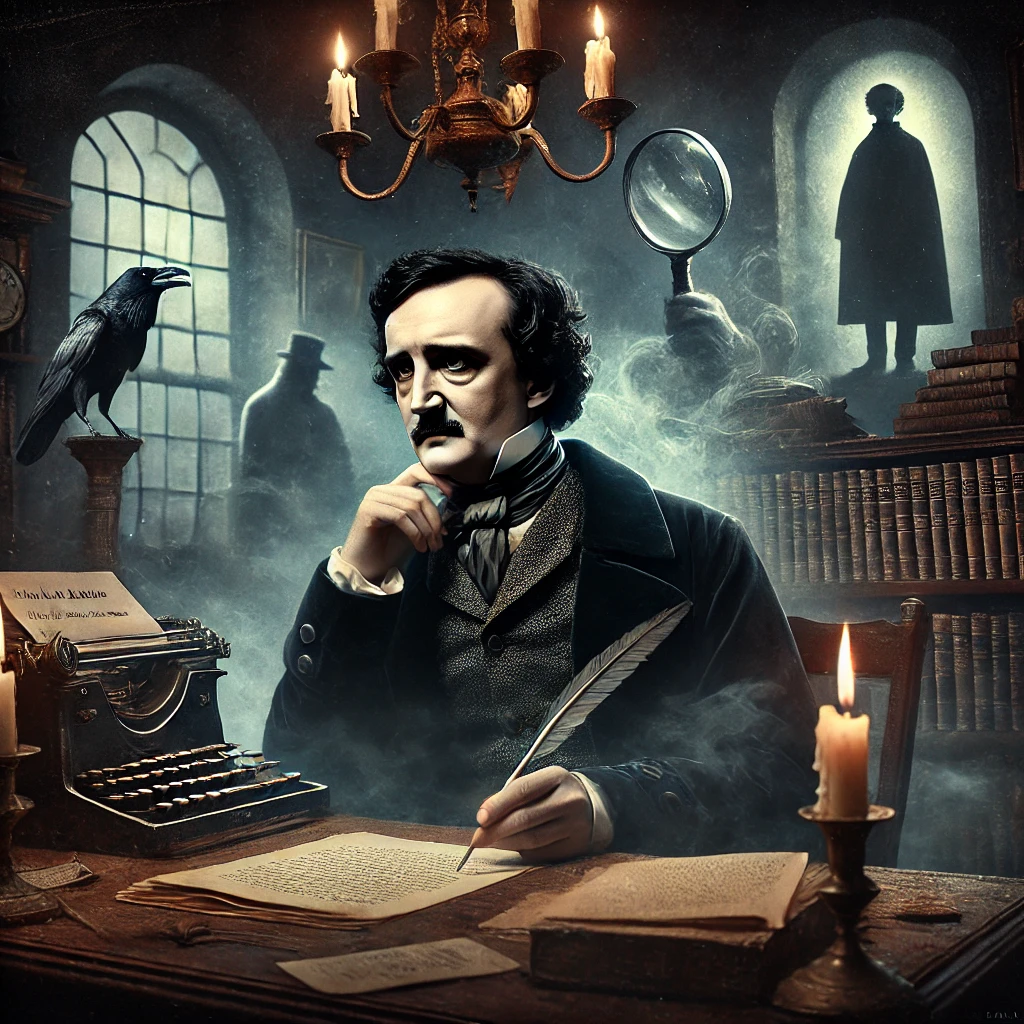
The Man Who Made Murder Mysterious

You know that moment in your favorite TV series? It’s when the detective finds the one impossible clue. That clue cracks the case wide open. Yeah? Well… you can thank Edgar Allan Poe for that.
(record scratch)
Yep. You read that right.
The Gothic author with the raven, the quill, and the haunted expression? He didn’t just invent creepy horror tales. He basically invented the modern detective story. Like many great inventions, he did it for the most relatable reason ever. He needed money.
Sure, Poe is known for spooky poems, black cats, and heartbeats under floorboards. But he’s also one of the most unlikely “Usual Suspects” in the long case file of crime fiction. Have you ever binged a murder mystery? Have you listened to a true crime podcast or a gritty whodunit? If so, you’ve walked through a door Poe built.
“To vilify a great man is the readiest way in which a little man can himself attain greatness.”
— Edgar Allan Poe, Marginalia
📍 Meet the Father of Detective Fiction

Edgar Allan Poe was born in Boston on January 19, 1809, the second child of two actors. By the age of two, he was orphaned. The Allan family of Richmond, Virginia took him in. He lived a restless life. He was a college dropout, an army deserter, and a literary rebel.
Poe’s adult years were marked by poverty. He experienced failed ventures, including a newspaper that never launched. He had a controversial marriage to his 13-year-old cousin. He also faced the death of nearly everyone he loved, including his wife Virginia. Through it all, he wrote — poetry, horror, essays, and eventually… mysteries.
And then, in 1841, everything changed.
🕵️♂️ Meet the OG Detective: C. Auguste Dupin
No fingerprints. No CSI. No Holmes, no Watson. Just The Murders in the Rue Morgue — the very first modern detective story.
Poe’s creation, C. Auguste Dupin, was a brilliant, eccentric Parisian with no official title and no interest in fame. He solved crimes because he enjoyed it. And he did it using one thing: his brain.

“It is not so much the faculty of invention as the faculty of analysis.”
— The Murders in the Rue Morgue
C. Auguste Dupin is a young Parisian gentleman of noble lineage, once wealthy but now fallen into genteel poverty. Despite his reduced circumstances, he carries himself with the quiet intensity of a man who thinks far more than he speaks. His appearance is understated: pale complexion, dark, slightly unkempt hair, and sharp, observant eyes that seem to drift off when he’s thinking — which is almost always.
Dupin moves through the world like a shadow: slowly, deliberately, and most often at night. He’s rarely seen in daylight, preferring long walks through the dimly lit streets of Paris, where the fog and gaslight suit his introspective nature. He dresses modestly but neatly — usually in a dark frock coat, high-collared shirt, and cravat, blending into the gloom with ease.
He doesn’t seek fame, reward, or even justice in the traditional sense. He solves crimes because he enjoys the mental challenge — the thrill of out-reasoning everyone else. Calm, abstracted, and sometimes eerie in his detachment, Dupin is the prototype for every cerebral detective that came after him.
“The necessary knowledge is that of what to observe.”
— The Murders in the Rue Morgue
Dupin’s Case Files
Poe only wrote three Dupin stories, but they laid the foundation for a genre:
🔎 The Murders in the Rue Morgue (1841)
The first “locked-room mystery.” A brutal, seemingly impossible murder. The police are lost. Dupin isn’t. He cracks the case using nothing but deduction — and a twist ending no one saw coming. (Hint: it’s not even a person.)
📰 The Mystery of Marie Rogêt (1842)
Inspired by a real unsolved murder in New York. Dupin solves the case using only newspaper articles — like a 19th-century true crime podcast.
✉️ The Purloined Letter (1844)
A stolen document hidden in plain sight. Dupin outsmarts everyone — not by searching harder, but by thinking smarter. This is the detective story as psychological chess match.
🧠 The Poe Method: What He Invented (and How He Thought)
Before Sherlock. Before CSI. Before mind palaces and murder boards — there was Poe’s playbook.
In The Murders in the Rue Morgue, Poe lays out his detective philosophy before the mystery even begins:
“It is not so much the faculty of invention as the faculty of analysis.”
“The necessary knowledge is that of what to observe.”
In plain English:
Great detectives don’t rely on instinct — they rely on focused observation, cold logic, and pattern recognition. Poe saw solving a crime like solving a puzzle — and he gave future writers a toolkit to work with.
Poe’s tool box for detective authors
Here’s what he gave us:
- 🧩 The Genius Outsider
Dupin isn’t a cop — just a brilliant guy who sees what others don’t. Sound familiar? (cough Sherlock) - 🗣️ The Sidekick Narrator
His unnamed friend records the cases and lets Dupin shine. The original Watson. - 👁️ The “I See Everything” Moment
That scene where the detective notices one tiny clue that cracks the case? Poe invented that. - 🔐 The Locked-Room Mystery
A subgenre was born in one story. There was a murder in a sealed room, with no way in or out. - 🪞 The Big Reveal
The detective gathers everyone and explains how it all went down — step by step. - 🧠 Logic Over Action
Poe’s detective wins with brainpower, not brawls. No guns. No car chases. Just deduction. - ♟️ Crime-Solving as Chess Match
Poe compared analytical thinking to strategy games. These games include whist or chess. They are not flashy, but deeply strategic.
❓ So Why Did the Master of Mystery Stop?
After three revolutionary stories, Poe just… stopped writing detective fiction. Why?
Short answer: money.
Detective stories didn’t pay as well as terrifying tales about burials and black cats. The genre wasn’t hot yet. He was ahead of his time.
He started a fourth Dupin story, The Light-House, but only one cryptic page remains. It might be the greatest unsolved case in literary history.
🎬 From Page to Screen: Poe’s Detectives Reimagined
Poe’s horror stories get the spotlight, but his detective legacy keeps slipping into pop culture:
in A Study in Scarlet (1887), Sherlock Holmes takes a jab at C. Auguste Dupin, Edgar Allan Poe’s famous detective:
“Dupin was a very inferior fellow.”
“That trick of his of breaking in on his friend’s thoughts is really very showy. He does this with an apropos remark after a quarter of an hour’s silence. It is superficial. He had some analytical genius, no doubt; but he was by no means such a phenomenon as Poe appeared to imagine”
— Sherlock Holmes, A Study in Scarlet by Arthur Conan Doyle
📚 Context:
Holmes is speaking to Dr. Watson, who has just compared him to Poe’s Dupin. Holmes bristles at the comparison, suggesting that Dupin’s approaches were more performance than precision.
Despite this dig, Holmes is clearly a literary descendant of Dupin, and Conan Doyle openly acknowledged Poe’s influence. The moment is often read as Holmes trying to distance himself from a predecessor he very much resembles.
Movies and Television:
- 🦇 The Murders in the Rue Morgue (1932) – Horror-style adaptation with Bela Lugosi. Fun, but missed the detective angle.

- 🎭 Vincent Price Poe Films (1960s) – The Raven, House of Usher, etc. Big Gothic energy.
- 🕵️ The Raven (2012) – John Cusack plays Poe tracking a killer inspired by his own stories. Fun, dark, and full of Easter eggs.

- ⚖️ The Fall of the House of Usher (Netflix, 2023) – This series presents a new take on Dupin. He is depicted as a prosecutor taking down a corrupt dynasty. Intense and unexpected.

- 🐶 Wishbone (1995): “The Pawloined Paper” – Yes, a dog reenacts The Purloined Letter. And it’s awesome.

- 😂 The Simpsons: Treehouse of Horror – The Raven, read by James Earl Jones. Surprisingly moving.

All information can be seen on imdb.com
Poe’s Greatest Hits (That Aren’t The Raven)
Everyone knows The Raven (and if you don’t, just say “Nevermore” dramatically and you’re caught up). But Poe’s true genius shines in short stories that mix dread, guilt, and mystery:
- The Tell-Tale Heart – A murder. A confession. A heartbeat you can’t silence.
- The Black Cat – Domestic drama meets psychological horror, with a side of animal revenge.
- The Fall of the House of Usher – Gothic family drama with haunted real estate.
- The Purloined Letter – The original intellectual crime caper. (Spoiler: sometimes the answer is right in front of you.)
And of course:
- The Murders in the Rue Morgue – The blueprint for every detective story that followed.
⚰️ Poe’s Own Mystery: His Final Case
Poe didn’t just write about strange deaths — he became one.
In 1849, he was found delirious in Baltimore, wearing someone else’s clothes, mumbling nonsense. He died days later. Cause? Unknown.
Theories?
- Alcohol
- Rabies
- Cooping (a voting scam)
- Murder
It’s still unsolved — which somehow feels like the perfect Poe ending.
🏛️ Visit the Evidence
You can still trace Poe’s shadow:
- The Poe Museum – Richmond, VA
- Poe’s Gravesite – Baltimore, MD
- The Bronx Cottage – His last home
✅ Wait—Can I Use Poe’s Stories?
Absolutely. His works are in the public domain:
- ✔️ Read, share, remix freely
- ✔️ No copyright issues
- ✔️ Perfect for classroom projects, YouTube shorts, or haunted musicals
Great starting points:
Books & Collections
- The Complete Works of Edgar Allan Poe
A definitive collection of Poe’s poetry, short stories, criticism, and essays. Available in various editions — look for annotated versions for helpful context. - A Modern Detective by Edgar Allan Poe (Penguin Little Black Classics):
This is a slim and affordable edition. It includes The Murders in the Rue Morgue, The Purloined Letter, and The Mystery of Marie Rogêt.
Publisher: Penguin Books, 2015.
🧠 Articles & Biographies
- Britannica – Edgar Allan Poe Biography
A solid, general reference overview of Poe’s life, work, and literary significance.
🔗 britannica.com/biography/Edgar-Allan-Poe - The Poetry Foundation – Edgar Allan Poe
A concise biography with a literary focus, plus links to selected poems.
🔗 poetryfoundation.org/poets/edgar-allan-poe
🧩 The Verdict? Guilty As Charged.
So, next time you enjoy a mystery with a twist, remember the detective. They solve the unsolvable with nothing but thought. Tip your hat to the man who started it all.
Smart. Dark. Brilliant. Broke. A little unhinged.
Poe didn’t just create a detective — he created the idea of one. He walked that foggy alley first, with a candle and a very sharp pen.
Case closed.
“The boundaries which divide Life from Death are at best shadowy and vague.”
— The Premature Burial

Ready to Follow the Clues?
You’ve met the man who turned logic into literature and gave the detective his first magnifying glass. Now it’s your turn.
🔍 Want to read the first detective story ever written?
Start with The Murders in the Rue Morgue. It still holds up.
📚 Curious how deep the rabbit hole goes?
Dive into The Complete Works of Edgar Allan Poe. You can also grab a pocket copy of A Modern Detective and carry his madness with you.
🧠 Want to see where today’s mystery tropes were born?
Revisit Poe’s stories through a modern lens — and you’ll start spotting Dupin’s fingerprints everywhere.
🗣️ Have a favorite Poe story or theory about his mysterious death?
Tell us in the comments — or raise a glass (or a raven) in his honor.
Because the man is long gone…
But the case?
Still wide open.
Would you prefer if I completed the entire series of Usual Suspects? Or would you prefer to explore other authors from various categories? These categories include Usual Suspects, Forgotten Footprints, Fading Ink, and the author behind the name. Then, return to Usual Suspects. Let me know in the comments.








Hello Gumshoe! On the track or authors? leave us reply!