The Man Who Gave the Detective a Past (and a Personality)

“The cleverest agent of the police is chance.” — L’Affaire Lerouge worlds-
Before Holmes, Before Poirot… There Was Lecoq
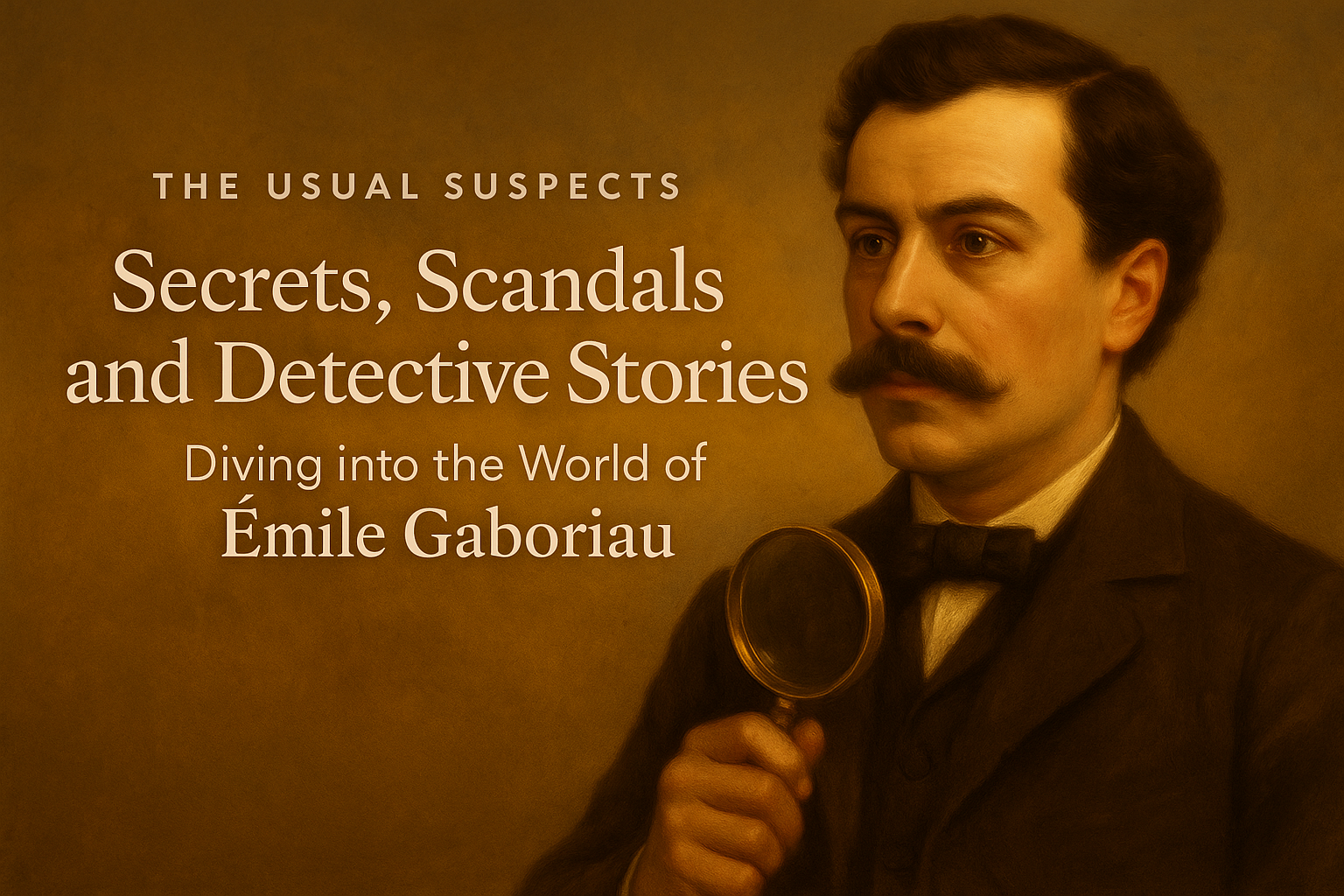
Holmes did not have a magnifying glass yet. Poirot had not straightened his mustache. Before whodunit was even a word — there was Émile Gaboriau. He wrote about hard facts, red herrings, and brilliant detectives back when the idea of solving crime through logic was still new
.Edgar Allan Poe gave us the mind of the detective. Wilkie Collins built the rules of the modern mystery. Gaboriau added soul and psychology. And he did it all while inspiring a genre that would eventually span continents, media, and centuries.
You might not know his name, but every detective novel you love? It traces back to him.
📜 Biography: From Clerk to Crime Fiction King

Émile Gaboriau was born on 9 November 1832, in Saujon, France. He began his adult life working as a legal clerk. It was not glamorous. However, it planted the seeds for his obsession with crime, justice, and investigation.
“The real tragedies of life are acted at the family fireside. This often happens under the shelter of the law itself. In these days, traitors wear gloves. Scoundrels cloak themselves in public esteem. Their victims die broken-hearted but smiling to the last. What I have just related to you is almost an every-day occurrence; and yet you profess astonishment.” FIle no.113
He began publishing in newspapers and quickly turned heads with serialized novels that merged real police procedures with page‑turning suspense. His breakout hit L’Affaire Lerouge (1866) introduced many techniques we now associate with detective fiction. These include careful deduction, evidence‑based logic, red herrings, and complex motives. He is often seen as the Father of French Detective Novels.
But his life ended abruptly. On 28 September 1873, he died in Paris. He suffered from pulmonary apoplexy (a sudden hemorrhage, possibly linked to lung disease). He was just 40 years old. His early death meant many planned works were never completed. Yet, he already left a lasting mark in his short career.
📚 Major Works
- .🕵️♀️ The Lerouge Affair (1866)
- A widow is found murdered in her home. Lecoq’s mentor, Tabaret (aka Père Tireauclair), helps unravel the mystery using deductive logic — making this arguably the first full-length modern detective novel in French.


Monsieur Lecoq (1869)
- A man is arrested at a seedy cabaret after a violent murder. But nothing adds up — not his identity, his motives, or his silence. Lecoq begins to pull threads that lead into France’s dark aristocratic secrets.


- Le Dossier 113, La Corde au Cou, Les Esclaves de Paris – Expanded his universe of crime and detection.


The Mystery of Orcival (1867)
A noblewoman is found dead in a garden. The police leap to conclusions — but Lecoq suspects a more tangled truth.
The Honor of the Name (1867)
A tale of false accusations, personal vengeance, and political manipulation unfolds. Lecoq returns to defend not just a suspect. He defends the idea of justice itself.
🧠 The Legacy
- A Study in Scarlet (1887) features a moment where Arthur Conan Doyle has Sherlock Holmes dismissing Émile Gaboriau’s fictional detective. Holmes makes a snide remark about Monsieur Lecoq:
“He angrily said, “Lecoq was a miserable bungler.” Holmes continued, “He had only one thing to recommend him, and that was his energy. That book made me positively ill. The question was how to identify an unknown prisoner. I could have done it in 24 hours. It took Lecoq six months or so. It might be made a textbook for detectives to teach them what to avoid.”
Gaboriau was one of the first to introduce the detective as a professional figure, working within an organized system.
- Gaboriau’s fiction reflected Parisian police realism — influenced by actual Sûreté techniques.
- He pioneered multi-perspective narration, forensic detail, and psychological motive before they were mainstream in crime fiction.
🕵️ Monsieur Lecoq: The Prototype Detective
Holmes had a violin. Poirot twirled a moustache. Before these famous detectives, Monsieur Lecoq was already solving crimes. He used forensic thinking and police strategy.

Who Was He?
Monsieur Lecoq is Gaboriau’s signature detective — a former criminal who reforms and joins the French police. Inspired by real-life French detective Vidocq, Lecoq blends street smarts with forensic thinking and strategic manipulation. He is a clever detective working for the French Sûreté. He shows up in L’Affaire Lerouge, and is fully realized in Monsieur Lecoq. He uses observation, logic, disguise, and psychology to get to the truth — a far cry from the armchair detective.
Key Traits:
- Methodical investigation over dramatic instinct
- Master of disguise and infiltration
- Emotionally invested in justice, not just solving puzzles
- He has a backstory. Unlike Poe’s Dupin, Lecoq is a fleshed-out character with a past and professional evolution.
- He investigates using science. Fingerprints, footprints, timelines — Lecoq brings logic to the crime scene.
- He thinks in layers. His method involves psychological profiling and social context — way ahead of his time.
“Given a crime, with all the circumstances and details, I construct, bit by bit, a plan of accusation. I do not guarantee this plan until it is entire and perfect. If a man is found to whom this plan applies exactly, then the author of the crime is found. Otherwise, one has laid hands upon an innocent person.” — *The Widow Lerouge worlds-best-detective-crime-and-murder-mystery-books.com
Lecoq was one of the first literary detectives. He worked the case, laying the groundwork for modern procedural fiction.
🎬 Pop Culture Connections: Gaboriau on Screen, Air, and Stage
His name isn’t as widely known today. Yet, Gaboriau’s stories have been adapted into many works. They have inspired spiritual successors across decades and languages.
Film & Television
- L’Affaire Lerouge (1913, 1932, 1967) – Multiple French adaptations, from early silent cinema to 60s noir
- Monsieur Lecoq (1914, 1967) – Lecoq hit the screens in both silent film and television
- Les Cinq Dernières Minutes (French TV, 1950s–90s) – Crime procedurals echoing Gaboriau’s narrative logic
- Gaboriau adaptations on French television (ORTF & Antenne 2) – Often aired alongside adaptations of Balzac and Dumas
Radio & Literature
- BBC Radio occasionally airs detective retrospectives referencing Lecoq and early French detective fiction
- Numerous Sherlock Holmes retrospectives cite Lecoq as a foundational influence
In Translation
- His works are still in print (and public domain), with modern introductions by mystery scholars and publishers like Dover and Pushkin Press
- Popular among mystery reading circles, university courses, and true crime fiction historians
🗂️ What Made Gaboriau Different?
✅ The Psychological Element: He didn’t just focus on clues but on motive, emotion, and identity.
✅ Social Commentary: His stories often highlighted class divides, corrupt institutions, and the fragility of reputation.
✅ Serialized Suspense: Like Dickens and Collins, he published in newspapers — keeping readers on edge, week by week.
✅ Law + Logic = Justice: His detectives argued with evidence, not instinct
Like those imperceptible insects which, having once penetrated the root of a tree, devour it in a single night. Suspicion, when it invades our minds, soon develops itself. It destroys our firmest beliefs.” — File No. 113 Goodreads+1
🎯 Final Word: Why Gaboriau Still Matters
Gaboriau did for detective fiction what Beethoven did for classical music: he added depth, structure, and complexity.
He didn’t just invent clever puzzles — he asked why people committed crimes. He gave us detectives who observed, questioned, and doubted. And he made readers work for the solution.
If you’ve ever read a mystery where the detective walks into a drawing‑room. The detective then logically explains everything. In such cases, you’re reading in Gaboriau’s shadow.

📚 References & Further Reading
- Project Gutenberg – Émile Gaboriau Collection
Free full-text versions of L’Affaire Lerouge, Monsieur Lecoq, and others
https://www.gutenberg.org/author/Gaboriau,+Émile - LibriVox Audiobooks
Public domain audio recordings of Gaboriau’s novels
https://librivox.org/author/325?primary_key=325&search_category=author&search_page=1&sort_order=alphabetical - The Cambridge Companion to Crime Fiction (2003) – Edited by Martin Priestman
Discusses Gaboriau’s influence on later detective fiction - A Study in Scarlet by Arthur Conan Doyle
Holmes’s infamous reference to Lecoq: “A miserable bungler…” - “From Gaboriau to Simenon: A Century of French Detectives”
This is a French Crime Fiction Overview. It is from the BnF (Bibliothèque nationale de France).
https://gallica.bnf.fr - “Detective Fiction and the Rise of Forensic Science”
– Scholarly article on how Gaboriau anticipated modern criminology
🙋 Your Turn!
Have you read any of Gaboriau’s novels? Does Lecoq hold up next to Holmes or Dupin?
📌 Tag a fellow crime fiction fan and bring Gaboriau back into the spotlight where he belongs.
Ready to Meet the Man Who Inspired Sherlock?
Think Gaboriau is just a footnote in mystery history? Think again. Discover how Monsieur Lecoq laid the groundwork for every detective who followed — from Holmes to Hercule Poirot.
📚 Explore Gaboriau’s cases. Follow the clues. Decide for yourself.
👉 Dive deeper into our archive or start reading L’Affaire Lerouge for free now!
🕵️♂️ Explore More Forgotten (and Found) Detectives
📖 Read L’Affaire Lerouge on Project Gutenberg








Hello Gumshoe! On the track or authors? leave us reply!