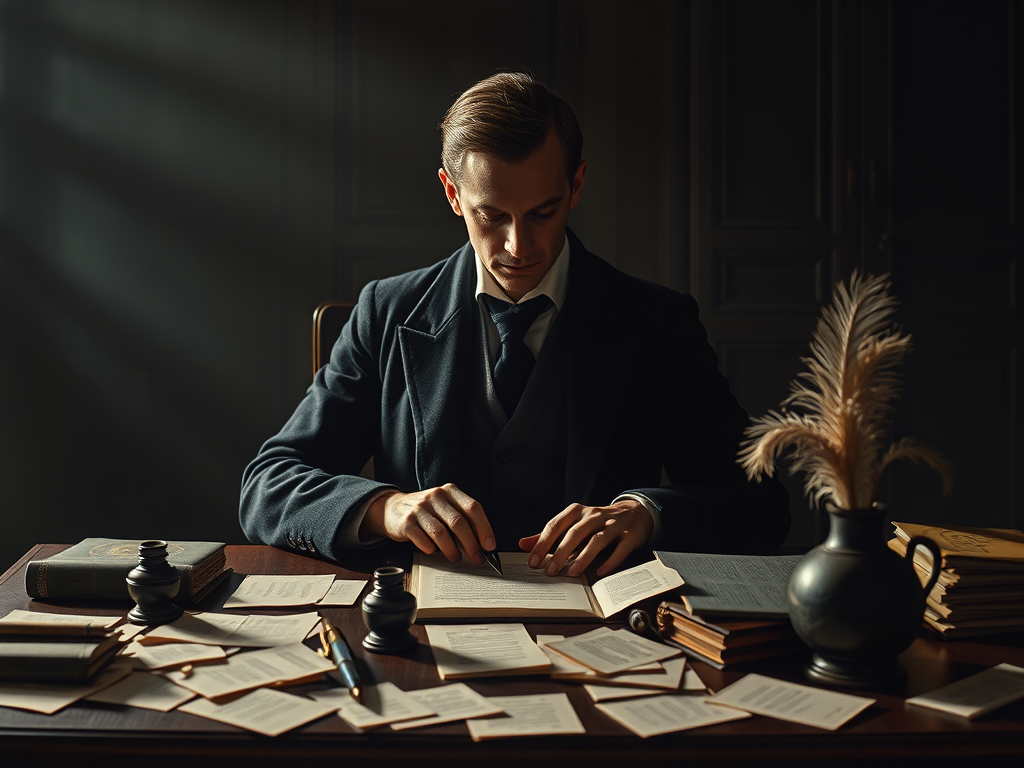
(Charles Warren Adams, 1833–1903)
The Vanishing Name Behind the First Detective Novel

🕵️ Introduction
A man named Charles Felix wrote the first detective novel before anyone had ever heard of Sherlock Holmes. He then disappeared behind his pseudonym.
More than a century passed. Scholars finally uncovered the truth. His real name was Charles Warren Adams. Yet, the ink on his identity had long since faded.
Alias Profile
In 1862, an unsigned story appeared in the British magazine Once a Week.
It was called The Notting Hill Mystery, and it looked nothing like the popular serialized tales of its day.
There were no melodramatic villains, no swooning heroines — just evidence.
Letters, diary entries, chemical analyses, witness statements: every page read like a detective’s file.
It was the first time a crime story had used logic instead of luck to solve a mystery.
Readers didn’t know it yet. The detective novel had just been born. The author, however, had disappeared behind a pseudonym.
🕵️♂️ The Hidden Hand Behind the Name
“Charles Felix” was listed as the author.
For more than a century, no one knew who that was.
Was he a journalist? A lawyer? A police officer writing in secret?
In 2011, the mystery was solved: Charles Felix was Charles Warren Adams, a London solicitor, publisher, and philanthropist.
A man of reason — and restraint — Adams hid behind his pen name to protect his reputation.
In Victorian England, crime fiction wasn’t considered respectable.
A lawyer writing about poison and deceit would have been seen as unprofessional, even indecent.
So Adams did what any good detective would do: he covered his tracks.
“Each fragment of evidence is but a clue to be tested, not a truth to be trusted.”
— The Notting Hill Mystery (1862)
🕰️ Timeline of a Vanished Identity
- 1833 – Charles Warren Adams is born in London.
- 1862 – The Notting Hill Mystery serialized anonymously in Once a Week.
- 1863 – Published in book form — the first English detective novel.
- 1866 – Adams publishes Velvet Lawns under his real name, unnoticed.
- 2011 – Researchers confirm Adams as the true author of The Notting Hill Mystery.
📖 Why He Hid His Name
Victorian society valued propriety above all.
A gentleman of the law writing about criminal deception was practically scandalous.
While others like Dickens dabble in social crime tales, a solicitor had to stay spotless.
By using a pseudonym, Adams preserved his public reputation — and accidentally created one of literature’s greatest mysteries.
For more than 150 years, The Notting Hill Mystery circulated without a name attached to it.
🔍 The Notting Hill Mystery
The Notting Hill Mystery is often hailed as the first full detective novel in English. It predates Wilkie Collins’s The Moonstone by several years.
It tells the story of R. Henderson, an insurance investigator unraveling a suspicious death through diary entries, correspondence, witness statements, and chemical reports. Presented as an assembled case file, it invited readers to play detective. This was long before such interactivity was a staple of crime fiction.
This documentary structure and reliance on scientific reasoning marked a turning point. Adams’s background in law lent the novel an authenticity absent in earlier moral or Gothic tales.
⚖️ Why He Belongs to the Fading Ink
- Although Adams’s authorship is now known, the name “Charles Felix” was the only identity visible to Victorian readers.
- His anonymity meant he received no recognition during his lifetime.
- Even today, his contribution remains overshadowed by those who followed, his ink literally and figuratively faded from the record.
- Under the archive’s classification, he perfectly embodies The Fading Ink — the writer who vanished behind his alias.
📚 Legacy
- Credited as the prototype of the modern detective novel.
- Inspired later case files and epistolary mysteries.
- Reintroduced to modern audiences through the British Library Crime Classics series (2012 edition).
He disappeared behind a pseudonym. This makes his story as mysterious as his fiction. He is a detective of the genre. His own identity became a case to solve.
What Made It Revolutionary
The Notting Hill Mystery was more than a clever plot — it was a blueprint.
- 🧾 Documentary Style: Told through letters, depositions, and lab reports — an early version of the “case file” novel.
- 🧪 Forensic Reasoning: The first to use scientific evidence in solving a crime.
- 🧩 Puzzle Construction: Each chapter built like a legal argument, where logic revealed the culprit.
It wasn’t about chase scenes or confessions — it was about deduction.
Adams invented the idea of proof as plot.
The Rediscovery
In 2011, British Library curator Philip Errington and journalist Alison Flood traced the clues. Adams’s 1866 novel Velvet Lawns listed him as both author and publisher. It matched handwriting, style, and business records linked directly to The Notting Hill Mystery.
The mystery was solved at last:
Charles Warren Adams had been hiding in plain sight.
“The first true detective novel was written by a man who didn’t sign his own.”
— The Guardian, 2011
Then, in January of 2011, The New York Times published an article about Felix. It stated that the mystery of his identity was solved. I couldn’t get the article. The author of the Mystery File blog put a link to it on his page. Alternatively, you can visit the Times website and create an account to download the article.
🧭 Modern Connection
- In today’s storytelling, The Notting Hill Mystery reads like a true-crime dossier: pieced-together fragments, rational deduction, and quiet dread.
- It feels almost contemporary — the podcast logic of the 1860s.
- Every unsolved mystery podcast owes something, unknowingly, to “Charles Felix.”
- You can download the Notting Hill Mystery through Project Gutenberg or as an Ebook.
Editor’s Reflection
Charles Warren Adams wasn’t seeking fame. He built the detective story quietly, like a lawyer constructing a case — detail by detail, clue by clue. He didn’t live to see his influence. However, his fingerprints are everywhere. They are found in Holmes’s logic. You can see them in Poirot’s deductions. They can be found in every modern mystery that begins with a clue.
🖋️ Sources & References
- British Library: The Notting Hill Mystery facsimile edition (2012).
- Haycraft, Howard. Murder for Pleasure: The Life and Times of the Detective Story. D. Appleton-Century, 1941.
- The Times Literary Supplement, “The Mystery of Charles Felix” (1952).
- Oxford Companion to Crime and Mystery Writing, ed. Rosemary Herbert.
- University of Leeds Digital Archive, Once a Week serial (1862–63).
- The New York Times: Who Was Charles Felix? A Mystery Solved.. January 7th, 2011.
- The Guardian, Alison Flood — “Charles Felix revealed as author of first English detective novel” (2011).
- British Library Archives — Once a Week serialization, 1862–63.
- Philip Errington, “The Identification of Charles Felix,” Notes and Queries, Oxford University Press (2011).
- The Cambridge Companion to Crime Fiction, Martin Priestman, ed.
- Project Gutenberg — The Notting Hill Mystery, public domain edition.
💬 🖋️ Explore more cases in The Fading Ink. Discover where hidden pens, lost manuscripts, and literary secrets return to the light.
No verified portrait exists. The author card uses symbolic imagery from Victorian publishing archives.








Hello Gumshoe! On the track or authors? leave us reply!