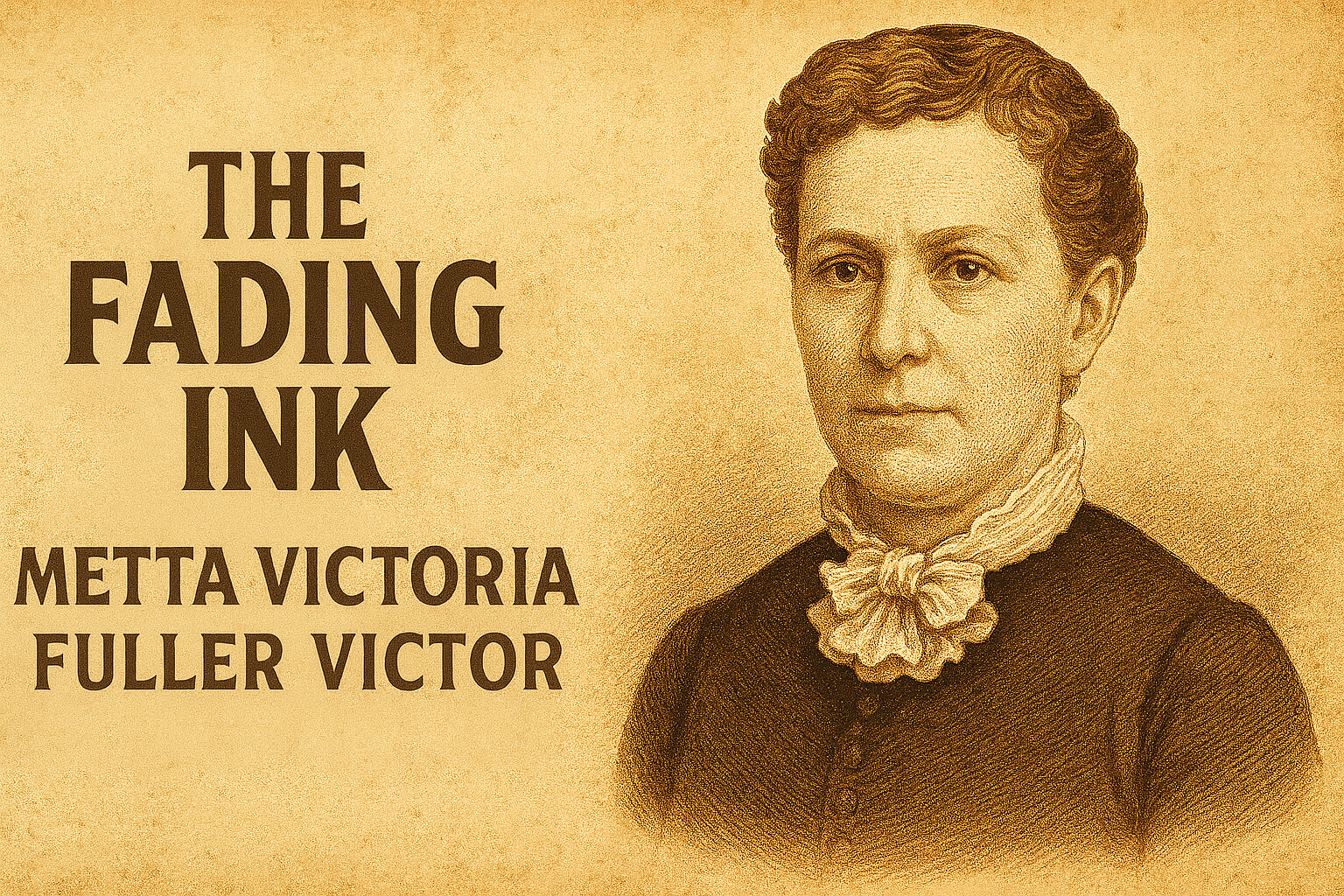
Metta Victoria Fuller Victor
Pseudonyms: Seeley Regester, Walter T. Gray, Mark Victor
Author of the First American Detective Novel

🎨 AUTHOR PORTRAIT

This is the Official Existing Portrait of authoress Metta Victoria Fuller Victor.
Introduction
Before the great American detectives walked the page, one woman quietly changed the future of the genre. This was before the hardboiled gumshoes and the scientific sleuths. She did this behind a mask.
Writing as Seeley Regester, Metta Victoria Fuller Victor produced what many scholars now call the first American detective novel. Yet her real name almost vanished from publishing history.
Biography
Metta Victoria Fuller Victor (1831–1885) was a prolific 19th-century American writer. Her career spanned poetry, sensational fiction, temperance novels, and domestic dramas. Most significantly, she contributed to early detective fiction.
She was born in Ohio and raised in a family of writers. She published her first work as a teenager. She went on to produce over 100 novels under various names.
She married journalist and publisher Orville Victor, joining a literary household deeply engaged in mid-century American popular fiction. Her versatility made her one of the most productive writers of her generation. Nonetheless, her reliance on pseudonyms made her one of the most easily forgotten.
Her Pseudonyms
Metta published widely under names like:
- Seeley Regester (most important)
- Walter T. Gray
- Mark Victor
- Unknown/anonymous signatures in periodicals
Her use of pseudonyms was typical for women writing crime, sensation, or politically charged stories. These genres were not considered “respectable” for female authors at the time.
Her contributions were buried behind the mask. This placed her firmly in The Fading Ink section of the Detective authors’ archive.
Key Work: The Dead Letter (1866)
This novel is one of the earliest American detective novels, predating Anna Katharine Green and appearing just after Poe’s tales.
Published under the pseudonym Seeley Regester, it features:
- a persistent amateur investigator
- a murder mystery with hidden motives
- coded messages
- a clairvoyant child (a rare early device)
- a structured investigation with clues, interrogations, and a final reveal
Victor’s blending of romance, Gothic tension, and investigation helped shape the American branch of detective narrative.
📚 Other Works You Should Know About
Metta Fuller Victor’s career was vast. Here are her most important works beyond The Dead Letter:
🔎 Detective / Mystery
- The Figure Eight (1866) — companion mystery to The Dead Letter.
- Numerous early crime-adjacent serials in The New York Ledger.
🔥 Sensation & Domestic Fiction
- Miriam, the Avenger (1858)
- Passion and Crime (1860s)
- The Blighted Heart (1860s)
🏹 Dime Novels & Frontier Mysteries
(published under pseudonyms including Walter T. Gray)
- Westerns
- frontier adventures
- morally themed crime stories
🕊️ Social Reform & Anti-Slavery Fiction
- Maum Guinea, and Her Plantation Children (1861) — a bold anti-slavery novel read across America.
- The Senator’s Son
- The Two Families
Her range was extraordinary — few writers of her era moved so confidently between genres.
📖 Why She Vanished
Because so much of her work was:
- unsigned
- serialized
- published under house names
- or hidden behind male pseudonyms
Her career became nearly impossible to trace.
The detective genre began celebrating its founding fathers. Victor’s name simply wasn’t there. Her contributions were not small. Her signature wasn’t visible.
Her disappearance from the record is a perfect example of how women built genres that later forgot them.
🕯️ Legacy
Today, scholars recognize Metta Fuller Victor as:
- The first American detective novelist
- A major architect of early mystery narrative
- A pioneer of serialized fiction, dime-novels, and sensation stories
- A versatile writer whose female characters often drove the moral and emotional core of her fiction
She didn’t just write the first American detective story. She helped shape the habits of American popular fiction for decades.
“Before Holmes, before Chandler, before Christie — there was Metta.”
Why She Belongs in The Fading Ink
Metta Victoria Fuller Victor checks all of the Fading Ink criteria:
- She published under multiple pseudonyms
- Her true authorship remained obscured for decades
- Her most important work (The Dead Letter) was not credited to her
- She significantly influenced early detective fiction but received no lasting recognition
- Her real name faded from the record until scholars uncovered it in the 20th century
She is the very definition of “fading ink” — a writer whose stories survived even as her name dissolved.
Her Broader Influence
Victor’s contributions include:
- establishing early norms of American detective storytelling
- blending domestic and investigative fiction
- employing coded letters, secret motives, and planted clues
- presenting one of the earliest “case-based” narratives
- inspiring later American mystery authors
While overshadowed by Poe and later Green, Victor’s work fills a crucial gap in the evolution of the genre.
Modern Connection
Victor fits naturally into today’s interest in:
- rediscovered women writers
- early female contributions to crime fiction
- masked or anonymous creators
- “hidden figures” in literary history
Her work anticipates modern psychological mysteries and domestic thrillers. The Dead Letter reads like an early blueprint for American investigative fiction.
Verdict
Status: Case Reopened — identity confirmed.
Archive Placement: Forgotten Footprints — Beginnings.
Classification: First American Detective Novelist.
Profile: Restored to her rightful place in the history of mystery fiction.
📚 REFERENCES
Primary Texts
- Regester, Seeley (Metta Victoria Fuller Victor). The Dead Letter. 1866.
- Victor, Metta Victoria Fuller. Maum Guinea, and Her Plantation “Children.” 1861.
- The Figure Eight (1869) — Accessible via archive collections and digital libraries
Biographical & Scholarly Sources
- Gascogne, Melanie. “Recovering Metta Victor.” Legacy: A Journal of American Women Writers.
- O’Reilly, Elizabeth. Early American Crime Writing. Cambridge University Press.
- Wolfe, Heather. “Pseudonymous Women of the 19th Century.” Folger Shakespeare Library.
- Johannsen, Albert. The House of Beadle and Adams and Its Dime and Nickel Novels. University of Oklahoma Press.
- Haycraft, Howard. Murder for Pleasure.
- Rzepka, Charles. Detective Fiction. Polity Press.
- Catherine Ross Nickerson (ed.), The Cambridge Companion to American Crime Fiction — Contains essential background on early American crime writing and situates Victor’s contributions within the broader development of the genre
- Lucy Sussex, Women Writers and Detectives in Nineteenth-Century Crime Fiction — This book provides historical context on female authors. It highlights figures like Victor and their pioneering role in detective fiction.
Biographical and Historical Resources
- Archival materials and biographical records on Metta Victoria Fuller Victor and her pseudonyms (including Seeley Regester)
- Academic journal articles discussing Victor’s place in early American detective fiction (JSTOR, MLA, or equivalent open-access sources)
Conclusion
Metta Victoria Fuller Victor was one of the earliest women to shape American detective fiction. Her name remains largely obscured behind the pen names she used. She adopted these pen names to survive and succeed in a male-dominated literary world. Her groundbreaking novel The Dead Letter introduced one of the first sustained detective narratives in the United States. It blended intuition and emotional intelligence. It also included progressive ideas about women’s roles within investigative work. Though overshadowed by later giants of the genre, Fuller Victor’s contributions reveal a writer ahead of her time. She was ambitious and versatile. Fearless in experimenting across genres, she was determined to carve her own path through the literary landscape.
We restore a key piece of detective fiction’s early evolution by bringing her back into the conversation. We invite readers to look beyond the usual names. They should consider the hidden pioneers who shaped the genre long before it became a global phenomenon.
Rediscover the Hidden Architects of Detection
If Fuller Victor’s story intrigued you, stay with us. We continue unearthing the forgotten authors who helped build the detective genre from the shadows.
📚 Explore the next case file in our Forgotten Footprints series. Another overlooked voice is waiting. It is ready to be brought back into the light.
From famous authors to forgotten ones—the search continues…
.








Hello Gumshoe! On the track or authors? leave us reply!