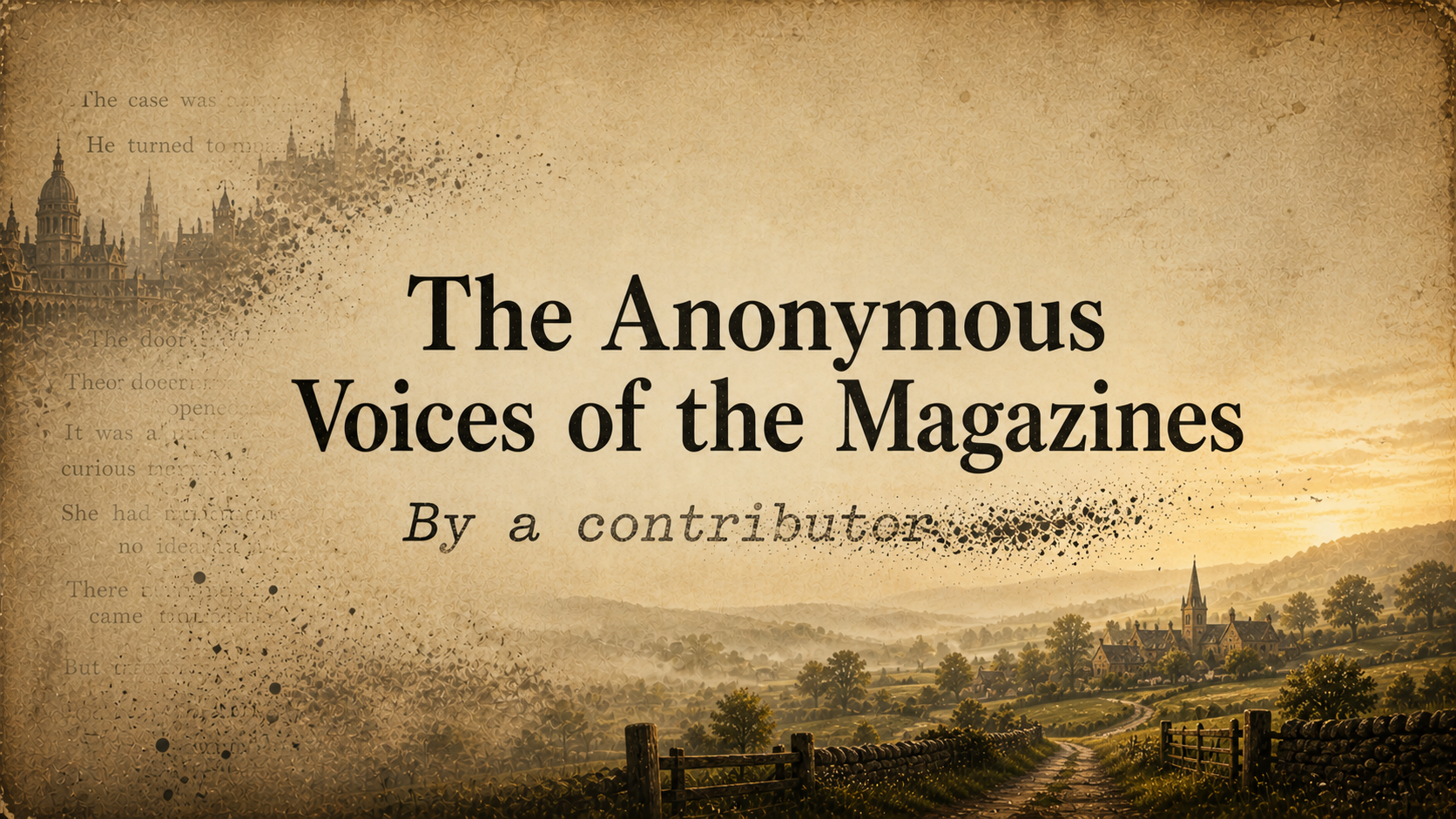
The Byline That Wasn’t There
In the great age of magazines—when stories filled the pages of publications like The Strand Magazine, Pearson’s Magazine, and The Windsor Magazine—not every writer signed their name.
Some appeared once.
Others returned again and again.

But instead of recognition, they were given something else:
- “By a contributor”
- “By a correspondent”
- “From our own writer”
- Or nothing at all
In these pages, authorship did not disappear all at once—
it faded, line by line.
Men without Names

Many of the unsigned stories of the period were written by men whose names never followed their work.
They were not occasional contributors. In most cases, they were embedded in the magazine world itself:
- Journalists
- Staff writers
- Regular contributors paid by the line
Their role was practical: produce stories quickly, reliably, and in volume.
Detective fiction—especially in short form—fit this model perfectly. A case could be introduced, developed, and resolved within a single issue, making it ideal for writers working under tight deadlines.
In this system, the emphasis was on output rather than authorship. Stories circulated widely, shaping readers’ expectations and helping define the rhythm of the genre.
The writers, however, remained in the background—present in every issue, but rarely acknowledged beyond the page.
Women Behind the Curtain

Women were not rare in these publications. They wrote regularly, contributed across genres, and participated fully in the growing market for short fiction.
But their presence did not always come with visibility.
For some, anonymity was a practical decision. Publishing under a name—especially a recognizably female one—could affect how their work was received, where it was placed, or whether it was accepted at all.
Others moved between visibility and obscurity:
- Publishing anonymously in some issues
- Signing their work in others
- Appearing in editorial records, but not always in print
These were not always permanent absences—but unstable ones.
The result was a different kind of disappearance.
Not through volume alone, but through conditions that made authorship less consistent, less visible, or easier to lose over time.
And yet, their work remained.
Across detective sketches, short mysteries, and atmospheric tales, these writers helped shape the tone and range of magazine fiction—often leaving only partial traces behind.
Stories Without Ownership
These were not isolated cases or rare anomalies. Anonymous and unsigned fiction formed a regular part of the Sherlockian-era publishing model.
Magazines depended on a steady flow of content. Detective fiction—short, engaging, and adaptable—fit naturally into this demand.
What mattered was what a story delivered:
- A mystery introduced quickly
- A problem developed within limited space
- A resolution that satisfied the reader by the final page
In this context, authorship was secondary.
Many pieces were:
- Published without attribution
- Printed once, then not collected
- Absent from later indexes or archives
As a result, they rarely entered a lasting canon. Instead, they existed within the rhythm of publication—read in the moment, then replaced by the next issue.
Their influence, however, was real.
They helped shape expectations: pacing, structure, and the compact form of the detective case were refined through repetition and variation across these pages. They also contributed to the reading habits that would carry forward into the next era.
What they lacked in attribution, they made up for in presence.
Over time, that presence faded.
Without reprints or consistent records, many of these stories—and the people behind them—slipped out of view, leaving only scattered traces in the pages where they first appeared.
Traces That Remain
Not all of these stories disappeared completely.
A number have survived—scattered across bound volumes, archives, and modern digital collections—often without clear attribution.
What remains is rarely a full body of work. Instead, we find fragments:
- Isolated detective stories preserved in magazine archives
- Reprinted pieces detached from their original context
- Texts carrying only editorial labels or partial attributions
In some cases, the story survives—but not the name.
In others, a name appears—but cannot be reliably connected to anything beyond a single publication.
These fragments offer a glimpse into what once filled the pages of the magazines: compact mysteries, urban sketches, and short investigations built for immediate reading.
They are not enough to reconstruct a career.
But they are enough to confirm that these voices were there.
The Final Fade
At the edge of the Sherlockian era, authorship does not always end with a name.
In some cases, it never fully appears.
There are no identities to recover here.
No signatures to trace back.
No lives to reconstruct from scattered records.
Only stories—once printed, once read, and often left behind.
What remains is incomplete:
- A page in an archive
- A line without attribution
- A voice that cannot be placed
Beyond that, the trail breaks.
And where the author should be, there is only absence.
A Change of Scene
Beyond these fading pages, the setting itself begins to shift.
The crowded streets, the editorial offices, the constant rhythm of publication—these begin to recede.
The city grows quieter.
In its place, new landscapes emerge:
- Villages
- Country houses
- Parishes where everyone is known… or believes they are
Between these two worlds stands World War I.
The war reshapes societies, disrupts publishing, and alters the way stories are told—and read. When detective fiction returns in the years that follow, it does so with a different rhythm and a different sense of order.
The anonymous voices of the magazines fade.
In the next era, authors step forward once more.
Names matter again.
And far from the noise of the city, a new kind of mystery begins to take shape.
Question for the Reader
If a story carries no name… does it still belong to someone—or only to the era that produced it?
Navigation
Previous: Voices of The Strand Magazine
Next: The Golden Age — Introduction
References
- The Cambridge Companion to Crime Fiction — Martin Priestman
- The Rivals of Sherlock Holmes — edited by Alan K. Russell
- Archives of The Strand Magazine
- Archives of Pearson’s Magazine
- Archives of The Windsor Magazine
- The British Library — periodical collections








Hello Gumshoe! On the track or authors? leave us reply!