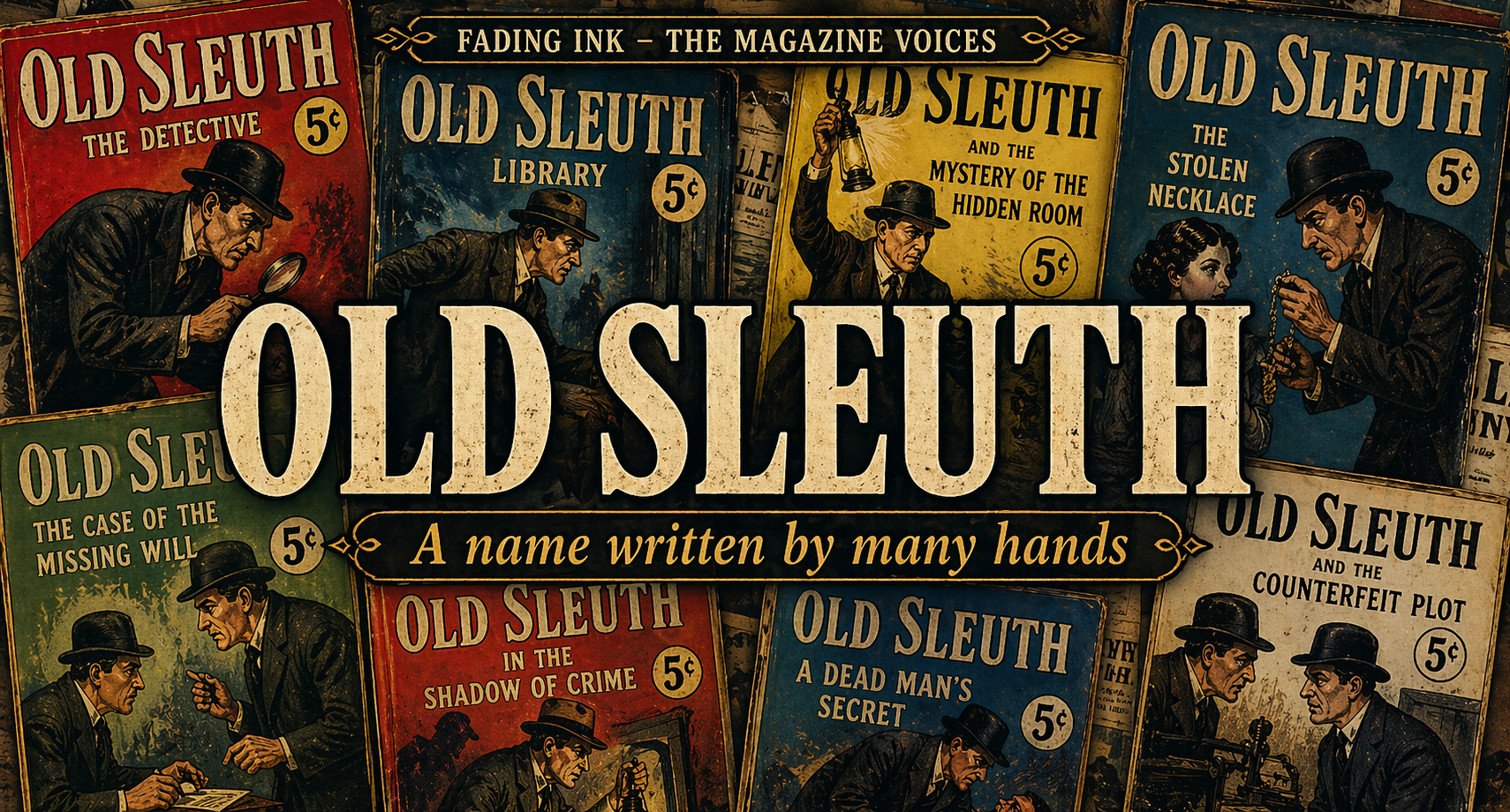
Old Sleuth
The detective who lived as long as the stories did
Introduction
He appeared in story after story, solving crimes with quiet confidence—always there when needed. And yet, no one could point to the man who created him.

Old Sleuth was not a single author’s invention, but a shared creation—a detective who lived as long as the stories that carried his name.
Life of a Name
Old Sleuth does not have a birthplace or a grave—but he does have a timeline.
The name first emerged in the early 1870s, during the booming era of American dime novels. These cheap, fast-paced publications fed a growing appetite for crime stories, adventure, and recurring heroes.
For years, Old Sleuth thrived in this environment:
- appearing regularly
- solving case after case
- becoming a familiar figure to readers
For a time, the name was everywhere—but it would not last forever.
The Hands Behind the Name
If Old Sleuth had no single creator, he was not entirely without direction.
Behind the name stood a rotating group of writers working for Street & Smith, one of the major forces in popular fiction at the time. Their task was simple: produce stories quickly, consistently, and in large numbers.
One of the figures most often associated with Old Sleuth is Harlan Page Halsey, a prolific contributor believed to have written many of the early stories.
But attribution in this world is uncertain.
Other writers—many now lost to history—also took up the name, continuing the character across years of publication. Each added something:
- a tone
- a method
- a way of resolving a case
None of them owned Old Sleuth.
But for a time, they shaped him.
The Detective
Old Sleuth is not defined by eccentricity or brilliance—but by experience.
Across the stories, he appears as:
- a seasoned investigator
- calm, observant, and methodical
- a man who relies on patience as much as deduction
He does not dominate a scene the way Sherlock Holmes does. There are no dramatic flourishes, no signature quirks that define him across every story.
Instead, Old Sleuth feels steady.
He asks questions.
He follows leads.
He pieces together the truth without spectacle.
This lack of a fixed personality is not a weakness—it is a result of how he was written.
Because multiple authors took on the role, Old Sleuth remained flexible:
- adapting slightly from story to story
- shaped by different voices
- consistent enough to be recognized, but never fully individualized
Readers did not return to him for surprise.
They returned because they knew what he represented:
A case that would be solved.
What This Brought to Detective Fiction
Old Sleuth represents a quiet but important shift in how detective fiction was created—and consumed.
The Detective as a Brand
For one of the first times, readers followed a name rather than an author.
Old Sleuth showed that a detective could exist independently of the person writing the story—returning again and again, no matter who was behind the page.
Industrial Storytelling
These stories were not crafted slowly—they were produced.
The system behind Old Sleuth:
- relied on a system of shared authorship
- prioritized speed and consistency
- treated fiction as an ongoing product
This approach helped pave the way for pulp publishing and recurring figures like Nick Carter.
The Cases (Selected Stories)
While many Old Sleuth stories have been lost or scattered across dime novel publications, a number of titles have survived, offering a glimpse into the kinds of cases that defined the character.
Among them are:
- Old Sleuth, the Detective; or, The Mystery of the Missing Man
- Old Sleuth’s Greatest Case
- Old Sleuth and the Hidden Crime
These stories reflect the typical structure of the series: a central mystery, a methodical investigation, and a clear resolution delivered by an experienced and reliable detective.
Rather than building toward a single defining case, Old Sleuth’s identity emerged from repetition—each story reinforcing the same promise: a mystery would be solved.
The Author Fades
The character endured and the stories circulated widely, but the writers behind them were never the focus and were often forgotten entirely. In this system, the name mattered—the author did not.
Media and Legacy
Old Sleuth does not have a lasting presence in modern media.
There are no major adaptations, no definitive version of the character, and no widely recognized canon that continues to circulate today.
And yet, his influence remains.
He helped establish:
- the idea of recurring detectives in serialized fiction
- the structure of ongoing, case-driven storytelling
- the commercial model that would later define pulp magazines
Figures like Nick Carter would build on this foundation—becoming more visible, more structured, and more enduring.
Old Sleuth, by contrast, faded with the system that created him.
The End of a Name
Old Sleuth did not age, retire, or meet a final case. Instead, his “end” can be traced to the final years of his publication history.
The name first appeared in the early 1870s and continued for decades, but by the closing years of the 19th century, appearances had grown increasingly rare. The last known Old Sleuth stories are generally dated to the late 1890s, marking the effective end of the character’s run.
There was no final case written to close his career—no moment designed as an ending. As the world of dime novels gave way to new forms of popular fiction, Old Sleuth simply disappeared from the pages that had sustained him.
In that sense, his “death” was not written into a story, but into the history of publishing itself.
Conclusion
Old Sleuth stands at the edge of detective fiction’s evolution—not remembered like the great names, but not entirely forgotten either. Instead, he remains a reminder of a different kind of storytelling, one built on repetition, collaboration, and anonymity. It was a system where the name carried the stories, while the people behind it quietly disappeared.
References
- Cox, J. Randolph. The Dime Novel Companion: A Source Book. Greenwood Press, 2000.
- Nevins, Jess. Encyclopedia of Pulp Heroes. MonkeyBrain Books, 2017.
- Street & Smith publishing histories and archival material
- Various surviving dime novel collections and reprints
Question for Readers
When a character is written by many hands, does it lose something…
or does it become something no single author could create?
Next Case
From one shared name to another—
but this time, louder, longer-lasting, and impossible to ignore.
👉 Next Case: Nick Carter








Hello Gumshoe! On the track or authors? leave us reply!