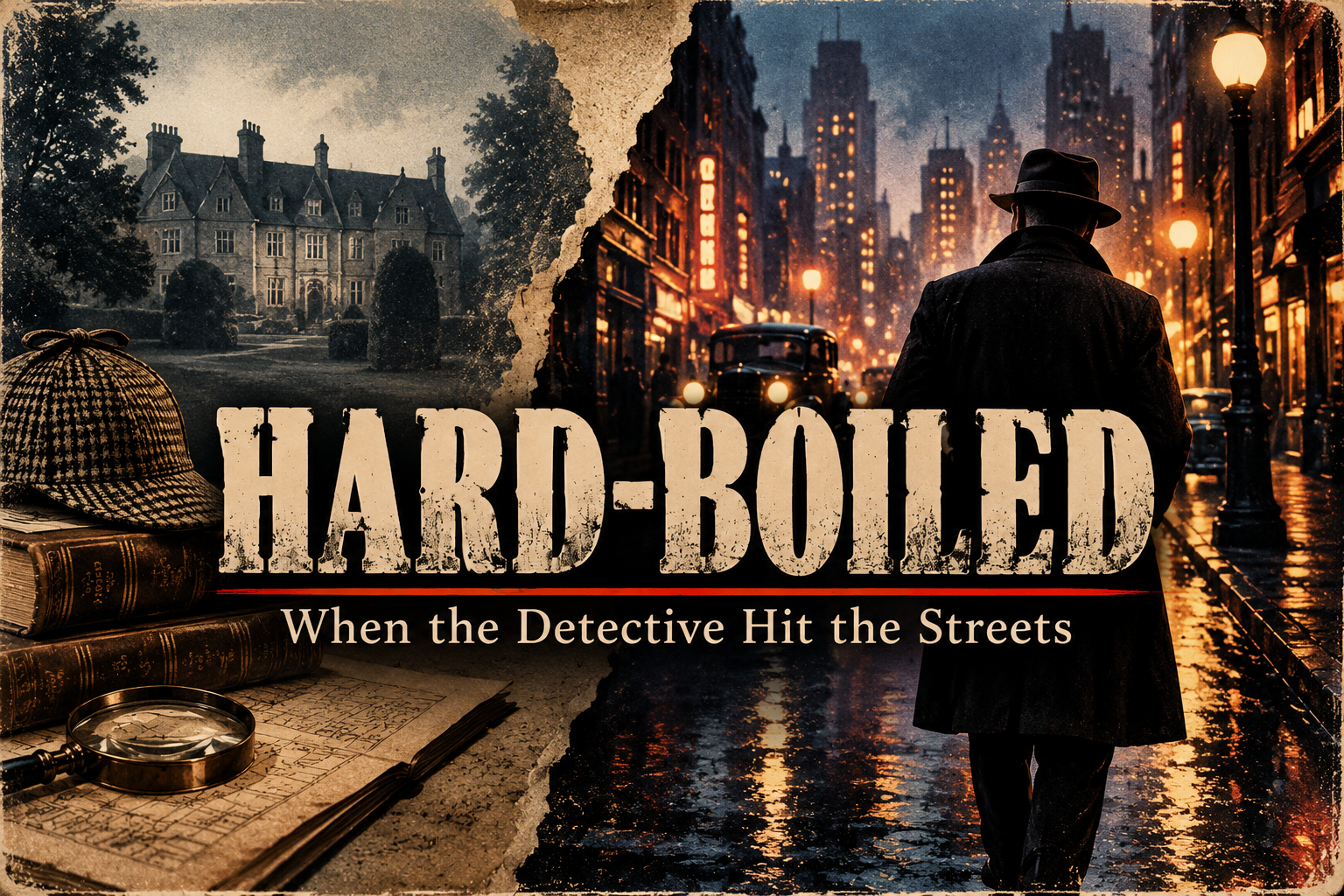
Hard-Boiled: When the Detective Hit the Streets
The detective solved murders in country houses, examined footprints in libraries, followed clues through foggy streets and reconstructed crimes over civilized conversations.
Then the city door opened.
Outside were crowded streets, cheap magazines, speakeasies, gangsters, private agencies, crooked officials, struggling workers and people who had increasingly good reasons to wonder whether respectable institutions were quite as respectable as they claimed.
Detective fiction was about to get its hands dirty.
It Didn’t Begin from Nothing
The hard-boiled detective looked new, but some of his ancestors had been walking through the Archive all along.
Edgar Allan Poe established the brilliant detective who could see what others missed. Émile Gaboriau brought investigation into the machinery of police work. Arthur Conan Doyle sent Sherlock Holmes through a modern metropolis where crime could hide behind almost any door. Arthur Morrison’s Martin Hewitt worked professionally for clients rather than waiting for mysteries to arrive on his doorstep.
Across the Atlantic, American popular fiction had traditions of its own. Frontier stories celebrated independent figures surviving dangerous landscapes through nerve, practical ability and self-reliance. Newspaper crime reporting, dime novels and detective adventures had already accustomed readers to criminals, policemen, private detectives and dangerous cities.
The hard-boiled story would borrow from several of these traditions without belonging completely to any of them.
The detective was changing because the world around him was changing too.
A New Marketplace for Crime
During the early decades of the twentieth century, inexpensive magazines reached an enormous popular audience.
Printed cheaply and sold cheaply, these magazines needed stories — lots of them. Adventure, westerns, romance, horror and crime filled their pages, giving writers a marketplace in which new kinds of popular fiction could develop quickly.
Crime stories found particularly fertile ground there.
Their detectives increasingly looked different from the brilliant amateurs and methodical investigators who had dominated earlier detective fiction. These men could be professionals working for money. They were less polished, more physical and considerably more comfortable entering places where respectable gentlemen were not supposed to go.
They investigated offices, hotels, bars, warehouses, alleys and cheap rooms. They dealt with clients who lied, policemen who resented them and criminals who did not politely wait for the final chapter to be exposed.
One magazine would become particularly important to this transformation: Black Mask.
Founded in 1920, it became one of the crucial homes of the developing hard-boiled crime story. Carroll John Daly and his detective Race Williams helped establish the tough, fast-moving private-eye figure, while writers such as Dashiell Hammett would take the developing form in new directions.
But Black Mask, Daly and Race Williams deserve a case of their own.
We will meet them next.
The Detective Had Not Left the Drawing Room
It is tempting to imagine detective fiction changing neatly from one era into another.
It didn’t.
The Golden Age and the developing hard-boiled tradition existed side by side.
While Agatha Christie, Dorothy L. Sayers, John Dickson Carr and others constructed elaborate puzzles, another kind of detective story was taking shape in America. Readers did not have to choose one and abandon the other.
Nor was the difference simply that one detective used his brain while another used his fists.
The traditional detective story often offered a reassuring possibility: however bewildering a murder appeared, it could ultimately be understood. Clues existed. Connections could be discovered. Lies could be exposed. The detective could take disorder and reveal the pattern hidden underneath it.
The hard-boiled story retained the investigation but became increasingly suspicious of the world surrounding the crime.
What if the police could be corrupt?
What if politicians could be bought?
What if the wealthy client hiring the detective was no more trustworthy than the criminal he wanted found?
And what if identifying a murderer did nothing to repair the society in which the murder occurred?
The mystery remained.
The world around it had become much harder to put back in order.
America Changes
The hard-boiled detective emerged from a particular time and place.
During the 1920s, American cities were expanding and changing rapidly. Modern business, mass entertainment, automobiles, newspapers and magazines were transforming everyday life. Huge numbers of people could encounter the same stories and celebrities through a growing popular culture.
At the same time, crime was becoming difficult to separate from some of the larger forces shaping American society.
Prohibition began nationally in 1920. It prohibited the legal manufacture and sale of most alcoholic beverages, but it did not eliminate the demand for them. Instead, an enormous illegal trade developed around bootlegging and speakeasies.
Organized criminal networks profited. Bribery and corruption could connect criminals to police officers, politicians and public officials.
This was fertile territory for a detective who existed somewhere between the official law and the criminal world.
The private detective could enter both without completely belonging to either.
His city was also very different from the contained world of the country-house mystery. It was filled with strangers. Crime could move between neighborhoods and social classes. Respectability could conceal corruption. Money could purchase influence.
A detective might begin with a missing person, a stolen object or a suspicious client and discover that the trail led far beyond the crime he had originally been hired to investigate.
Then, in 1929, the economic world collapsed.
The Depression Raises the Stakes
The Wall Street Crash did not create hard-boiled detective fiction.
It was already there.
But the Great Depression changed the America in which those stories were being written and read.
Banks failed. Businesses closed. Unemployment reached devastating levels. Families lost savings, jobs and homes. Economic security that had seemed dependable could disappear with frightening speed.
The distrust already present in hard-boiled fiction suddenly had an even larger landscape in which to operate.
Money mattered because people needed it. Work mattered because it could vanish. Wealth and respectability no longer automatically suggested stability, and institutions did not always appear capable of protecting ordinary people.
That gave the hard-boiled detective an unusual position.
He was rarely wealthy. Detecting was his job.
He took clients because he needed clients, even though experience told him that clients frequently lied. He dealt with the police without necessarily trusting them. He entered wealthy homes without being impressed by wealth and criminal territory without becoming a criminal himself.
The detective could not promise to repair the entire system.
Sometimes maintaining his own judgment was difficult enough.
The Hard-Boiled Detective Takes Shape
The new detective did not arrive fully formed.
Carroll John Daly helped establish the tough, fast-moving private eye in the pages of Black Mask. Dashiell Hammett (Usual Suspects) took the developing form in new directions, while Raymond Chandler (Usual Suspects) would later give it another of its most enduring voices.
They were part of a much larger movement. Writers experimented with different detectives, cities and kinds of crime, while magazine editors helped shape what readers came to expect from the new style.
Gradually, certain characteristics became familiar.
The detective was often a professional rather than a gifted amateur. He worked for money and moved between social worlds. His clients could lie to him. The police might help him, obstruct him or be part of the problem. Violence was a possibility rather than something safely confined to the murder that began the story.
Most importantly, solving the case did not necessarily mean restoring the world to order.
The hard-boiled detective could expose what happened.
He could not always fix what he found.
The Mean Streets Are Open
The arrival of the hard-boiled detective did not kill the Golden Age.
Poirot continued exercising his little grey cells. Locked rooms remained locked until someone discovered how they had been opened. Country houses continued producing remarkably inconvenient corpses.
But detective fiction now had another road available to it.
There might be no isolated manor.
No conveniently limited circle of suspects.
No guarantee that exposing one guilty person would restore everything that had been disturbed.
Instead, somewhere in the city, a detective was climbing the stairs to a cheap office with his name painted on the glass.
He might be underpaid.
His client was probably lying.
Someone might already be following him.
And before the case was over, he might discover that the crime he had been hired to solve was only one symptom of something much larger.
The detective had left the drawing room.
The streets were waiting.
Hard-Boiled Navigation
Introduction
→ When the Detective Hit the Streets
Before the Usual Suspects
→ Black Mask, Carroll John Daly & Race Williams
Usual Suspects
→ Hammett
→ Chandler
→ Ross Macdonald
Forgotten Footprints
→ Roster to be finalized as we research








Hello Gumshoe! On the track or authors? leave us reply!