🔎 Introduction
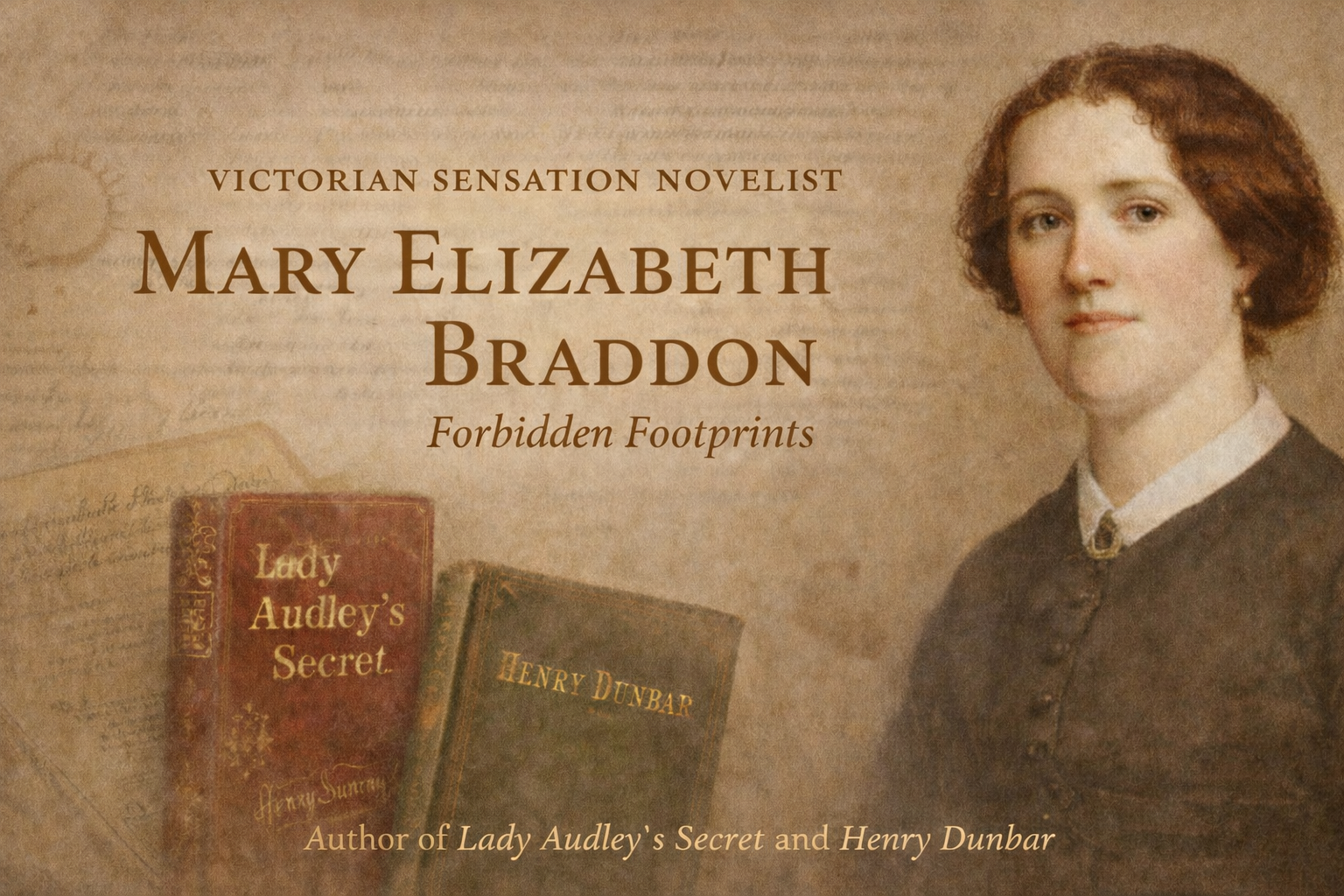
Victorian readers devoured her novels for their scandals and secrets. Few noticed she was quietly inventing a new way to investigate crime. Long before famous detectives and forensic rules, Mary Elizabeth Braddon proved that detection could be thrilling without a star sleuth. It could also be deadly without a single gunshot.

🧬 Biography
Born in London in 1835, Mary Elizabeth Braddon began her career as an actress before turning to writing. Her breakthrough came in the early 1860s, when a succession of sensation novels brought her extraordinary commercial success. Her books dominated circulating libraries, and her readership spanned Britain and beyond.
Braddon later became editor of Belgravia. It was a popular literary magazine that published fiction, essays, and poetry. These contributions were from leading writers of the day. Despite her popularity, critics often dismissed her work as sensational. They called it melodramatic. These labels would later contribute to her marginalization in literary history.
She continued writing well into the late 19th century. She died in 1915. Her reputation narrowed to a single title. Much of her broader influence faded.

National Portrait Gallery, London: Public-domain portraits of Mary Elizabeth Braddon.
Why She Matters in Detective Fiction
Mary Elizabeth Braddon was one of the most widely read novelists of the Victorian era. Her contribution to detective fiction has largely slipped from view. Best remembered today for Lady Audley’s Secret, Braddon helped shape early crime narratives. She demonstrated that investigation could unfold through social observation, moral pressure, and psychological insight. This occurred long before the rise of iconic detectives and forensic logic.
In Braddon’s fiction, detection does not begin with clues. It begins with watchfulness
🕵️♂️ Meet the Detectives
Unlike later Victorian crime writers, Braddon did not create a recurring “star detective.” Instead, her investigations are carried out by professionals, observers, and morally alert outsiders—figures who move quietly within respectable society.

In Henry Dunbar (1864), Miss Monson assumes the investigative role. She is one of the earliest examples of a professional female investigator in Victorian fiction. She works discreetly, relying on patience, observation, and social intelligence rather than authority or force. Her power lies in her ability to read people—and to wait.
Elsewhere in Braddon’s work, investigation is often distributed among lawyers, doctors, relatives, and confidants. Detection becomes a collective moral process, driven by social pressure and ethical scrutiny rather than a single deductive genius.
Braddon’s investigators are typically:
- Quietly professional rather than eccentric
- Embedded in social networks rather than isolated
- Focused on motive, behavior, and concealment
🧭 Did She Remain in Detective Fiction?
Braddon never confined herself exclusively to detective fiction, nor did she abandon it. Throughout her career, she continued to write sensation novels infused with investigative structures. Her work also expanded into romance, social realism, and family drama.
Braddon did not move toward the puzzle-driven detective story that would dominate the late 19th century. Instead, she remained committed to psychological suspense and moral inquiry. Her novels ask why crimes occur. They explore how society responds to them. These questions would later be overshadowed by method and mechanics.
As the genre shifted toward professional male detectives and formalized deduction, Braddon’s approach gradually fell out of fashion.
🎭 Themes & Style
- Tone: Domestic realism, moral irony, social critique
- Settings: Drawing rooms, inheritance offices, English countryside estates
- Investigative methods: Emotional intelligence, social pressure, guided confession
Braddon’s fiction blurs the boundary between sensation and detection. It proves that the pursuit of truth can be as thrilling as the crime itself.
📚 Key Works
Henry Dunbar (1864)
A banker’s murder, an impostor’s return, and a sustained investigation conducted through quiet professionalism and moral pressure.


Lady Audley’s Secret (1862)
This is not a detective novel in the strict sense. It is a foundational work of psychological crime fiction. The story is centered on secrecy, surveillance, and identity.


Aurora Floyd (1863)
A sensational narrative combining romance, scandal, and proto-detective curiosity.


🎬 Media Adaptations & Cultural Afterlife
Braddon’s popularity ensured that her work quickly crossed into other media.


- Lady Audley’s Secret was adapted for the Victorian stage within years of publication. It has since inspired silent films, television adaptations, and radio dramatizations, particularly in Britain.
- Aurora Floyd and other sensation novels also received 19th-century theatrical adaptations, reflecting Braddon’s close ties to the theatre.
Henry Dunbar has seen fewer modern adaptations. Its importance lies in its structural role in early detective fiction. This significance outweighs its screen legacy.
🕰️ Legacy & Place in Forgotten Footprints
Braddon sold thousands of copies during her lifetime. However, her role in the evolution of detective fiction was later overshadowed. This occurred because of figures such as Poe, Collins, and Conan Doyle. Her work occupies a crucial transitional space. Emotion, intuition, and social observation were central to investigations of guilt and motive.
She reminds us that before the microscope and magnifying glass came the moral mirror. Few writers held it up to Victorian society with greater sharpness.
⚰️ Death
Mary Elizabeth Braddon died on February 4, 1915, at the age of 79. Like most of her life, the cause of her death is largely unrecorded. Her passing marked the end of a career. It had shaped Victorian popular reading for decades. Later literary memory would narrow her legacy to only a portion of what she actually built.
📖 References and Further readings
Primary Works
- Henry Dunbar (1864)
- Lady Audley’s Secret (1862)
- Aurora Floyd (1863)
Critical & Contextual Sources
- The Maniac in the Cellar, Winifred Hughes
This is a foundational study of Mary Elizabeth Braddon. It examines Victorian sensation fiction and is used here for genre and thematic context. - The Cambridge Companion to Crime Fiction, Cambridge University Press
Consulted for historical context on early crime and detective fiction. It examines Braddon’s place within Victorian developments. - Women Writers and Detectives in Nineteenth-Century Crime Fiction
This work explores gender and authorship. It discusses the emergence of female investigators in 19th-century crime narratives. - The Penguin Book of Murder Mysteries
Consulted for genre context and the evolution of crime and detection narratives.
Archival & Institutional Resources
- National Portrait Gallery, London
Public-domain portraits of Mary Elizabeth Braddon. - British Library
Publication history, Victorian reception, and bibliographic records.
🧾 Conclusion
Mary Elizabeth Braddon’s detective fiction does not announce itself with famous sleuths or clever puzzles. Instead, it unfolds quietly—through observation, moral pressure, and the slow collapse of respectability. Her investigations remind us that crime does not always leave fingerprints. However, it always leaves traces in behavior, motive, and silence.
Braddon wrote long before detective fiction became a genre of rules and routines. She showed that the most unsettling mysteries were social ones. In revisiting her work, we recover a forgotten contributor to detective fiction. We also discover an early vision of investigation as an ethical act. This vision looks inward as often as it looks for clues.








Hello Gumshoe! On the track or authors? leave us reply!