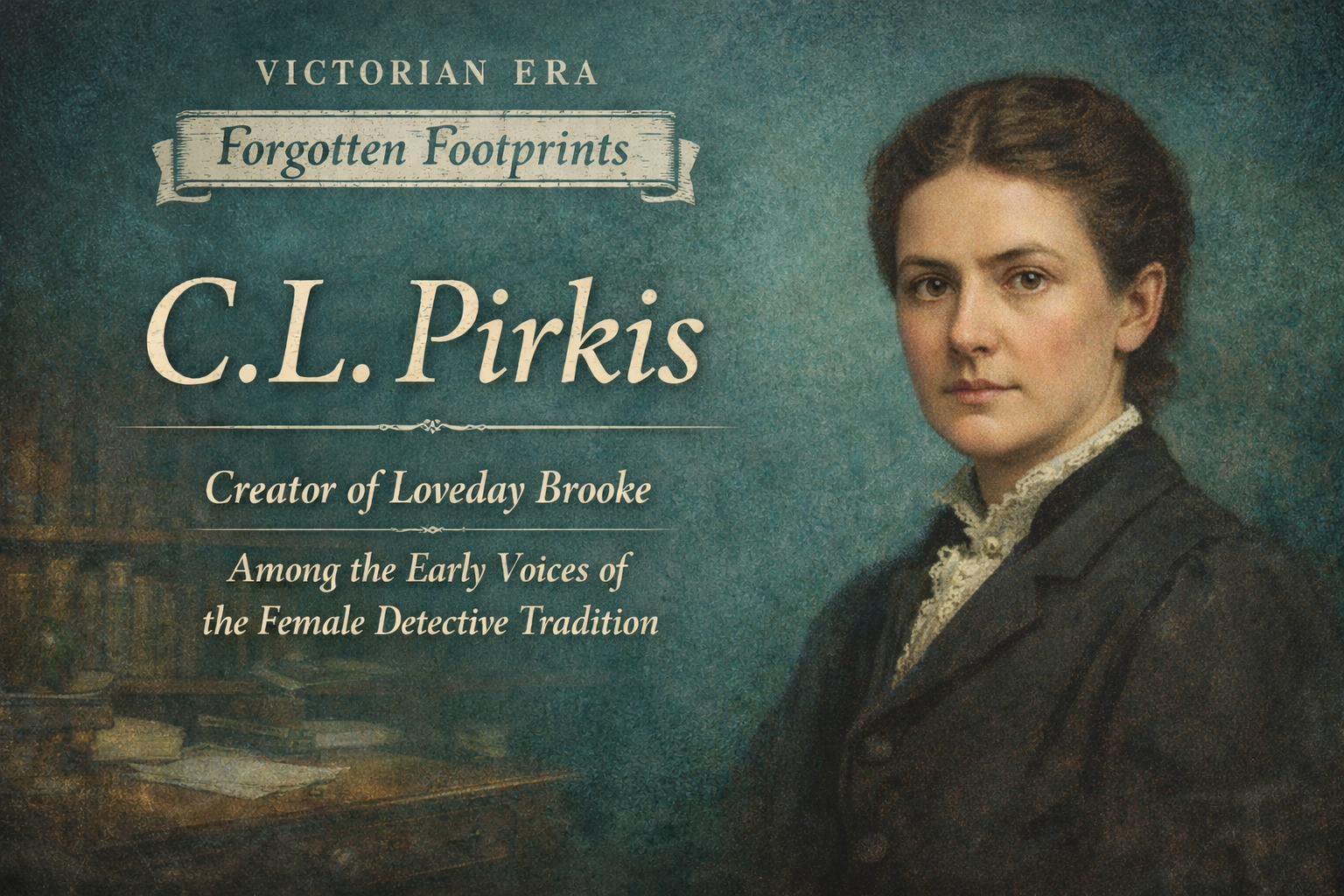
🕯 Hook
Before the Golden Age crowned its queens of detection,
before Miss Marple knitted her way through murder,
before the word “lady detective” became a marketing hook—

There was Loveday Brooke.
Calm. Observant. Professional.
And behind her stood a writer Victorian readers knew well… but history slowly misplaced.

Portrait of C.L Pirkis: Catherine Louisa Pirkis – WordFire Press
📖 Biography
Catherine Louisa Pirkis was born in 1839 and wrote during the height of the Victorian publishing boom. This was a period when magazines, serialized fiction, and circulating libraries shaped popular reading habits. Pirkis worked confidently within that expanding literary world.
She initially published in periodicals. This was before her fiction was gathered into book form. She wrote under her own name at a time when many authors — especially women — chose pseudonyms. Her prose is controlled and deliberate, favoring clear structure over sensational excess.
Unlike some of her contemporaries, Pirkis did not rely heavily on melodrama. Instead, her writing reflects careful plotting and an attention to social detail that would later become central to detective fiction.
Beyond her literary work, she was involved in animal welfare advocacy. She participated in early efforts toward humane treatment reform. This serves as a reminder that many Victorian writers were active in public causes as well as in print.
🕵️ Meet the Author’s Detective:
Loveday Brooke
Loveday Brooke is one of the earliest recurring professional female detectives in English fiction. She works for a private detective agency. She accepts assignments with the calm assurance of someone who understands both social nuance and investigative method.
Unlike many fictional women of the period, Loveday is neither romanticized nor exaggerated. She is presented as capable, practical, and observant — often relying on careful social awareness rather than dramatic confrontation.
Her cases frequently involve:
- Insurance investigations
- Domestic deception
- Social-class tensions
- Subtle identity puzzles
Loveday’s strength lies in quiet intelligence. She does not rely on theatrics. She studies people, patterns, and environments — and draws conclusions from what others overlook.
In tone and structure, her stories anticipate the more disciplined detective fiction that would emerge in the decades to follow.
📚 Major Work
The Experiences of Loveday Brooke (1893)
Originally serialized in Ludgate Magazine, the stories follow Brooke through cases involving:
- Insurance fraud
- False identities
- Domestic deception
- Social-class tensions

The structure is tight and episodic.
The tone is measured.
The solutions rely on observation rather than coincidence.


The stories bridge sensation fiction and structured detective procedure — making Pirkis a transitional figure in the genre’s development.
📚 Other Works — Beyond Loveday Brooke
Although Catherine Louisa Pirkis is most closely associated with The Experiences of Loveday Brooke, she wrote more than detective fiction.
Among her other published works is A Datchet Diamonds. This novel is crime-tinged and reflects the Victorian taste for intrigue and moral tension. Like many writers of the period, Pirkis worked within the fluid space between sensation fiction, domestic drama, and mystery.
She also contributed short fiction to magazines — the lifeblood of Victorian popular literature. These periodicals provided visibility and income, but they did not always guarantee long-term preservation.
Why Did She Vanish?
Pirkis did not build an extended franchise like some of her contemporaries. She did not create a character that remained continuously in print through the twentieth century. Much of her work appeared in magazines, and without constant reprinting, authors could quickly fall from public memory.
The rise of larger-than-life detective figures narrowed the spotlight. This was especially true for those who came to define the genre in the popular imagination. Writers like Pirkis, whose style was restrained and professional rather than dramatic, were easier for literary history to overlook.
Her disappearance was not due to insignificance. Instead, it resulted from shifting tastes. Limited reprints also contributed. Additionally, the selective nature of canon formation played a part.
🎬 Media Adaptations
Unlike many Victorian detective figures, Loveday Brooke has not received major film or television adaptations. No widely recognized screen versions of The Experiences of Loveday Brooke were produced during the twentieth century’s detective boom.
However, her stories have appeared in:
- Modern anthologies of early women detectives
- Scholarly collections of Victorian crime fiction
- Reprint editions aimed at restoring overlooked authors
The absence of large-scale adaptation contributed to the fading of Pirkis’s name from mainstream cultural memory. Without film, television, or long-running franchise revival, her work remained largely within literary circles rather than popular entertainment.
🧭 Legacy
Today, Catherine Louisa Pirkis is recognized as one of the early architects of the professional female detective in English fiction.
Loveday Brooke is a transitional figure. She bridges the gap between Victorian sensation narratives and the more structured detective fiction of the twentieth century. Her stories demonstrate that women investigators were present in the genre long before the Golden Age popularized them.
Modern scholars and editors have restored her work through reprints and anthologies, bringing renewed attention to her contribution. She may not occupy the center of the detective canon. However, her role in expanding the possibilities of the genre remains significant.
Her legacy is not one of spectacle — but of foundation.
⚰ Death
Catherine Louisa Pirkis died in 1910, at the age of seventy-one. During her lifetime, detective fiction was changing significantly. Structures became more formalized. Larger-than-life investigative figures started to dominate.
Her passing came just before the genre would move decisively into the twentieth century. It was the era that later critics would call the Golden Age. Her name gradually receded from popular circulation. However, her work remained part of the foundation for the next phase.
Conclusion
Catherine Louisa Pirkis may not occupy the brightest spotlight in detective fiction history, but her contribution remains unmistakable. She introduced a capable, professional woman. This character was at the center of the investigation when the genre was still defining itself. She made it feel natural.
Her work reflects a moment of transition: from sensation to structure, from spectacle to method. Though later figures would dominate public imagination, Pirkis helped widen the field before it narrowed again.
Forgotten — yes.
Insignificant — never.
🗂 Closing the Forgotten Footprints
The Victorian era did not produce only towering literary monuments. It also produced writers who shaped the genre in quieter ways. These authors made real contributions. Their readership was once substantial. However, their names gradually slipped from common memory.
Mary Elizabeth Braddon and Catherine Louisa Pirkis represent that delicate middle ground. They were neither anonymous nor insignificant. They published under their own names. They influenced the evolution of crime fiction. Yet they did not carry their reputations intact into the twentieth century.
Forgotten Footprints is not a category of obscurity — it is a space of recovery.
These writers remind us that literary history is selective. What survives is not always a measure of merit, but of momentum.
🔦 Next: Fading Ink
If Forgotten Footprints gathers those whose names dimmed over time, the next section moves further into shadow.
In Fading Ink, we meet authors whose identities blurred. These are writers who published under pseudonyms, masks, or anonymity. They left behind works but not always clear names.
The stories remain.
The authors do not always.
Continue to Fading Ink and follow the trail where attribution becomes uncertain and literary history grows quieter still.








Hello Gumshoe! On the track or authors? leave us reply!