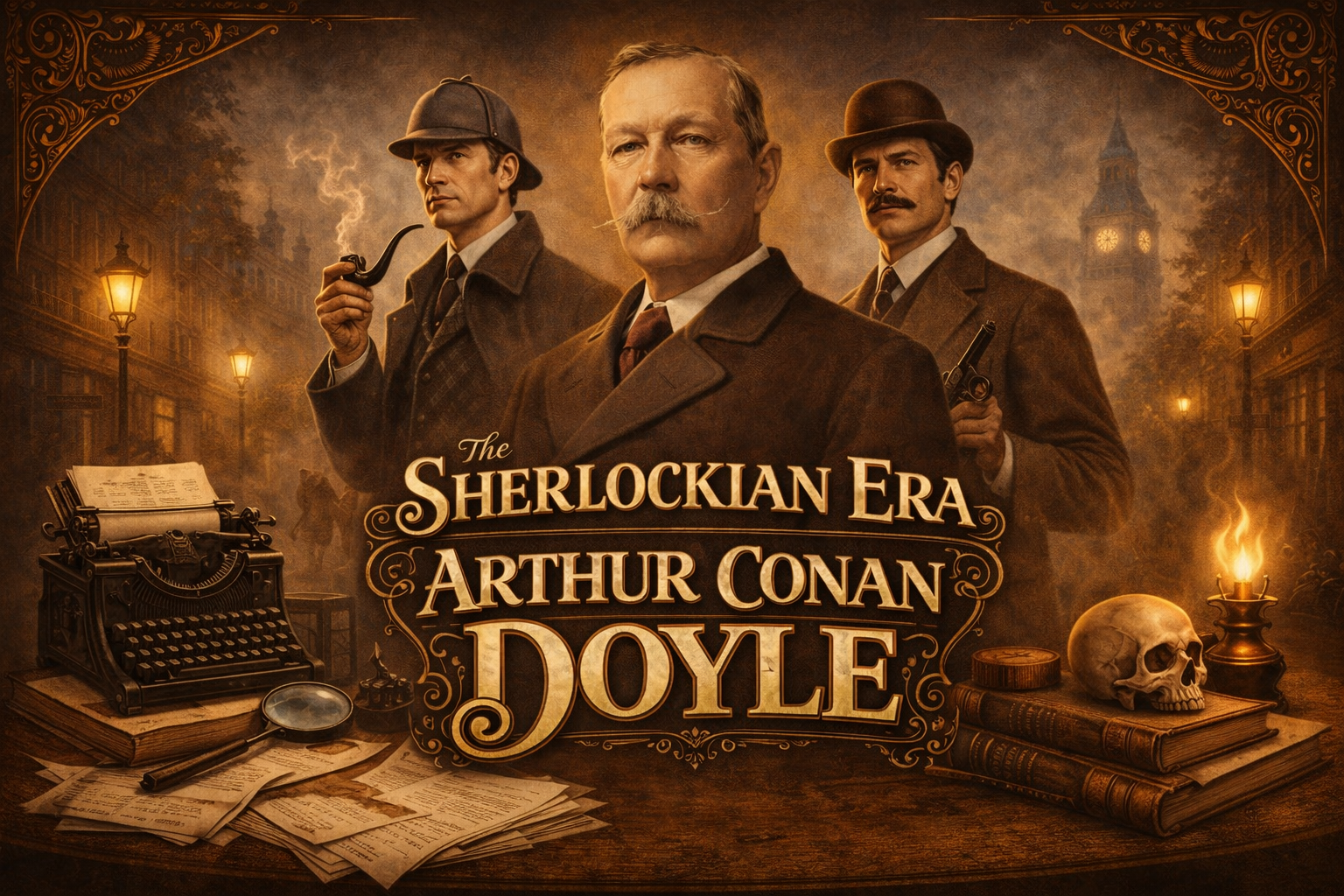
The city is alive with fog and footsteps.

Gaslight flickers against damp stone. Carriages pass in the distance. Somewhere in London, a door opens onto a narrow staircase leading to a modest flat at 221B Baker Street.
Inside, a consulting detective waits — observant, precise, impatient with error. Beside him stands a loyal companion, ready to record what the world is about to witness.
This is where modern detection took shape.
And behind that famous address stood a writer named Arthur Conan Doyle.

by Walter Stoneman, for James Russell & Sons
bromide print, circa 1916
NPG Ax39223
Biography
Arthur Conan Doyle was born in 1859 in Edinburgh, Scotland, into an Irish Catholic family. His mother, Mary Doyle, encouraged his love of storytelling. She also nurtured his interest in history from an early age. These influences would later shape both his detective fiction and his historical novels.
He studied medicine at the University of Edinburgh, where he developed a disciplined approach to observation and reasoning. One of his professors, Dr. Joseph Bell, was known for making precise deductions. He based his deductions on small physical details. This method would later inspire Sherlock Holmes.
After qualifying as a physician, Doyle opened a medical practice. Patients were few, and during long quiet hours he began writing fiction. In 1887, he introduced Sherlock Holmes in A Study in Scarlet. The character would soon transform his career.
Doyle married Louisa Hawkins in 1885, and they had two children. After her death, he later married Jean Leckie, with whom he had three more children. During the Boer War, he served as a physician in South Africa. In 1902, he was knighted for his public service.
Although Holmes brought him international fame, Doyle continued to write across genres — including historical fiction, adventure, and speculative tales.
Meet His Detective: Sherlock Holmes
In 1887, Arthur Conan Doyle introduced a consulting detective unlike any readers had seen before.
His name was Sherlock Holmes.

From the moment he appeared in A Study in Scarlet, Holmes stood apart. He noticed what others ignored. He drew conclusions from the smallest details — a stain, a footprint, the wear on a sleeve. His mind worked quickly, sometimes impatiently, always precisely.
Holmes was not a member of the police. He operated independently, offering his services to those who sought his expertise. He approached crime as a problem to be solved through careful observation, logical reasoning, and scientific knowledge.
But Holmes did not stand alone.

At his side was Dr. John Watson — physician, army veteran, and narrator of the stories. Watson served as more than a companion. Through his eyes, readers entered the world of Baker Street. His presence made Holmes’ brilliance understandable, grounded, and human.
Together, they established what would become known as the Baker Street model:
- A brilliant but unconventional detective
- A loyal companion who narrates the case
- A domestic base of operations (221B Baker Street)
- Clients who arrive with seemingly unsolvable problems
- A final explanation that reveals how every clue fits together
This structure proved remarkably durable. It would influence countless detective stories that followed — sometimes directly imitated, sometimes subtly reworked — but rarely ignored.
Expanding the World of Holmes
While Sherlock Holmes and Dr. Watson form the core of the series, Doyle gradually expanded the world around them.

One of the most intriguing additions was Mycroft Holmes, Sherlock’s older brother. Introduced in The Adventure of the Greek Interpreter, Mycroft possesses equal powers of deduction. If not greater, yet he lacks his brother’s energy. Mycroft also lacks the inclination to pursue cases. Through him, Doyle deepened the mythology of the Holmes family. He hinted at a wider network of intellect operating behind the scenes of government and empire.

In later reinterpretations, new members of the Holmes family have appeared. Enola Holmes is a younger sister imagined in modern adaptations. Though not created by Doyle, Enola reflects the enduring flexibility of the Holmes universe. It shows the universe’s ability to grow beyond its original boundaries.
What He Brought to Detective Fiction
When Sherlock Holmes appeared, he did more than solve fictional crimes.
He set the standard.
Arthur Conan Doyle gave detective fiction a clear structure through Holmes. It includes the brilliant consulting detective and the loyal narrator. It also features the carefully placed clues and the final explanation that ties every detail together.
Holmes treated crime as an intellectual challenge. He relied on observation, logic, chemistry, disguise, and an understanding of human behavior. Readers were invited to follow the clues alongside him. They sometimes tried to solve the mystery first. They often fell just short.
That structure became a blueprint.
Writers who followed would refine it, challenge it, or modernize it — but they could not ignore it. The detective story, as it evolved into the twentieth century, carried Holmes’ influence in its bones.
Even today, new adaptations, reinterpretations, and reimaginings return to the same core idea Doyle established. This core idea is that reason, carefully applied, can bring order to chaos.
Holmes became more than a character.
He became the reference point.
Some Essential Holmes Stories
Over the course of four novels and dozens of short stories, Sherlock Holmes became a fixture of popular culture. While every reader has personal favorites, several cases stand out as especially influential or enduring.


- A Study in Scarlet: marks the first appearance of Holmes and Watson. It introduces the method of deduction that would define the series.
- The Sign of the Four — expanding the partnership and deepening the detective’s world.
- The Hound of the Baskervilles — blending rational explanation with Gothic atmosphere.
- The Final Problem — where Holmes confronts Professor Moriarty in one of the most famous scenes in detective fiction.
- The Adventure of the Speckled Band — often remembered for its tension and clever resolution.


Together, these stories show the range of Doyle’s imagination. They span from urban crime to rural mystery. They include quiet deduction and dramatic confrontation.
Stepping Away from Sherlock Holmes
Success can be complicated.
By the early 1890s, Sherlock Holmes had become a sensation. Readers eagerly awaited each new story in The Strand Magazine, and the detective’s popularity continued to grow.
But for Arthur Conan Doyle, that success brought frustration.
He did not want to be known for only one character. He had ambitions beyond detective fiction. He aimed to write historical novels, adventure stories, and other literary pursuits. He felt these deserved equal recognition.
In 1893, Doyle made a bold decision. In The Final Problem, he sent Sherlock Holmes over the Reichenbach Falls in a confrontation with Professor Moriarty.
Readers were outraged.
The reaction was immediate and intense. Subscriptions were reportedly canceled. Letters poured in. Holmes’ death felt personal to many.
Eventually, Doyle relented. Years later, Holmes returned.
The episode reveals something simple and very human. Even the creator of the most famous detective in literature struggled. He found it difficult to step out of his shadow.
Beyond Sherlock Holmes
Although Sherlock Holmes dominates his legacy, Arthur Conan Doyle wrote widely across genres.
He produced historical novels such as The White Company and its companion work Sir Nigel. These works reflect his long-standing fascination with medieval history.


He also ventured into early science fiction with The Lost World. He introduced Professor Challenger, a bold and argumentative scientist. The adventures blended exploration with speculative science.

In addition, Doyle wrote adventure fiction, plays, essays, and works defending his views on spiritualism. His literary interests were broad, even if Holmes ultimately eclipsed them in public memory.
Legacy & Influence
Sherlock Holmes did not simply become popular.
He became foundational.
Through Holmes, Arthur Conan Doyle established a model of detective fiction that shaped the genre for decades. The consulting detective became a staple of crime fiction. So did the companion narrator and the carefully structured case. The climactic explanation was also crucial. These elements became part of the architecture of crime fiction.
Writers who came after Doyle contributed various elements. Some refined forensic detail. Others emphasized pure logic or shifted the setting. They all worked in conversation with Doyle’s creation.
His influence reached beyond imitation.
His brother-in-law, E. W. Hornung, created A. J. Raffles, a gentleman thief often seen as a deliberate inversion of Holmes. Where Holmes solved crimes, Raffles committed them — yet the structural similarities were unmistakable. The brilliant central figure. The loyal narrator. The intimate storytelling voice. This author will be explored in a later section of the archives.
Holmes had become a reference point — one that could be mirrored, challenged, or transformed.
By the early twentieth century, the detective story had matured into a recognizable form. And at its center stood Baker Street.
Media & Adaptations
Sherlock Holmes did not remain confined to the printed page for long. Doyle’s detective has been reinterpreted in early silent films, modern television, and international cinema. Each era reshapes him while preserving his essential qualities.
Silent-era adaptations in the early twentieth century proved that Holmes translated easily to visual storytelling. By the 1940s, Basil Rathbone had created the classic cinematic image of Holmes. He appeared complete with deerstalker and pipe in a series of widely popular films.

Later interpretations offered new tonal variations. Peter Cushing portrayed a sharper, more intense detective in The Hound of the Baskervilles. On television, Jeremy Brett delivered a performance widely praised for its faithfulness to Doyle’s original stories. His portrayal reinforced Holmes’ Victorian character and temperament.

The twenty-first century brought further reinvention.
In Sherlock Holmes and its sequel, Robert Downey Jr. presented a more physically dynamic and action-oriented Holmes, introducing the character to a new global audience.

The BBC series Sherlock stars Benedict Cumberbatch as Holmes. It also features Martin Freeman as Watson. The series transported the detective into contemporary London. It preserved his deductive brilliance.

Other adaptations explored alternative perspectives. The CBS series Elementary reimagined Watson as a woman. She was portrayed by Lucy Liu. This shifted the partnership while retaining the core investigative dynamic.

Holmes has appeared in animated and speculative settings. This includes Sherlock Holmes in the 22nd Century. The character demonstrates flexibility across genres.

A more reflective interpretation came with Mr. Holmes. Ian McKellen portrayed an aging detective confronting memory and legacy. This serves as a reminder that Holmes can evolve not only in setting, but in tone.

New series such as Watson and Young Sherlock continue to reinterpret the Holmes universe for contemporary audiences.


From Victorian London to modern cities — and even imagined futures — Sherlock Holmes remains adaptable.
Few fictional characters have endured so consistently across time and media. Despite all the reinterpretations, reinventions, and performances that followed, Sherlock Holmes began with one writer. He was sitting at a desk in late nineteenth-century Britain.
The character grew beyond the page — onto stage, screen, and into global popular culture. Arthur Conan Doyle continued to write and lecture. He pursued interests that stretched far beyond Baker Street.
Holmes would take on a life of his own.
Doyle, meanwhile, moved into the final chapters of his own.
Later Life and Death
In his later years, Doyle devoted much of his energy to causes outside detective fiction. After the losses of the First World War, he became a committed advocate of spiritualism. He lectured widely and published works in its defense.
He continued to write across genres, but Sherlock Holmes had already secured a permanent place in literary history. By the time Doyle died in 1930, the detective had outgrown his creator. He had become one of the most recognizable fictional figures in the world.
Conclusion
Arthur Conan Doyle created a character who stepped beyond his own lifetime.
Sherlock Holmes became more than a literary figure. He became a reference point for writers and readers. He also became a reference point for generations of storytellers. These storytellers would build upon the foundation laid at 221B Baker Street.
Doyle’s ambitions reached beyond detective fiction, and his life was shaped by medicine, war, history, and personal conviction. Yet it is Holmes — observant, precise, enduring — who secured his lasting place in literary history.
The door to Baker Street opened once.
It has never fully closed.
Continue Through the Sherlockian City
Baker Street was only the beginning.
Step back into the fog-lit streets and meet the other minds who shaped the Sherlockian Era. These were writers who refined forensic science. They sharpened logic and expanded the detective story in new directions.
And now a question for you:
When you think of Sherlock Holmes, what comes first? Is it the stories? the character? Or the many faces he has worn on screen?
The city still has many doors to open
References
Primary Works
Doyle, Arthur Conan. Sherlock Holmes: The Complete Novels and Stories. 2 vols.
New York: Bantam Classics, 2003.
Doyle, Arthur Conan. The White Company. London: Smith, Elder & Co., 1891.
Doyle, Arthur Conan. The Lost World. London: Hodder & Stoughton, 1912.
Biographical Sources
Doyle, Arthur Conan. Arthur Conan Doyle: A Life in Letters.
Edited by Jon Lellenberg, Daniel Stashower, and Charles Foley.
New York: HarperPress, 2007.
Miller, Russell. The Adventurous Life of Sir Arthur Conan Doyle.
New York: St. Martin’s Press, 2008.
Critical Studies
The Cambridge Companion to Crime Fiction.
Cambridge: Cambridge University Press, 2003.
The Penguin Book of Murder Mysteries.
London: Penguin Classics.
One response to “The Usual Suspects: The Sherlockian Era: Case #009: Arthur Conan Doyle”
-
[…] Arthur Conan DoyleCreator of Sherlock Holmes. As the central architect of the consulting detective model, Doyle defined the expectations of logic, observation, and fair-play reasoning. […]








Hello Gumshoe! On the track or authors? leave us reply!