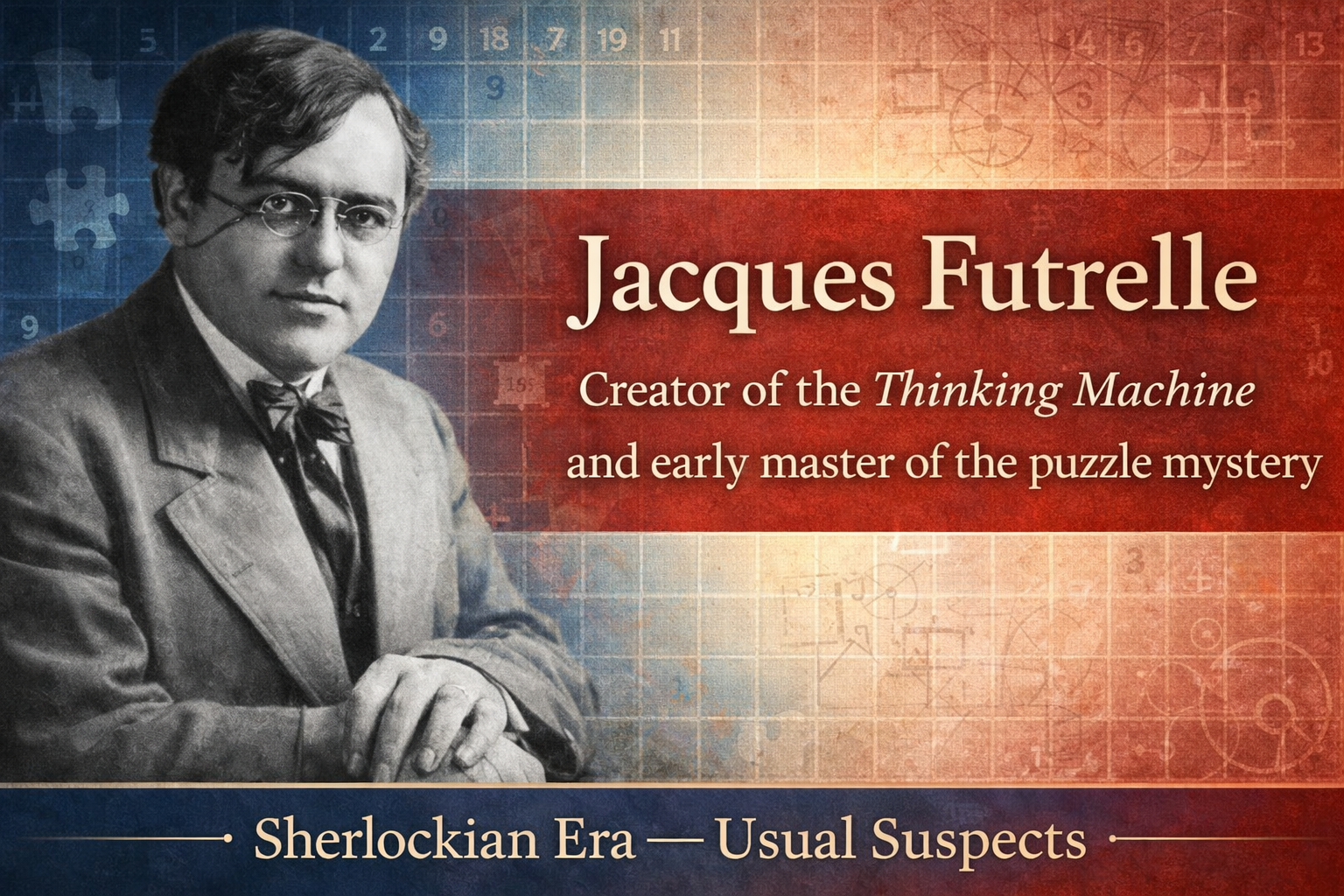
Creator of the Thinking Machine and early master of the puzzle mystery
Introduction
Some detectives rely on observation. Others rely on instinct.

But in the stories of Jacques Futrelle, crime could be solved through something even colder and more precise: pure logic.
What if a mystery could be unraveled the way a mathematician solves an equation?
Futrelle wrote at the height of the magazine era in the early twentieth century. He built stories around ingenious intellectual puzzles. These were crimes that seemed impossible. Careful reasoning revealed the solution. His mysteries challenged readers to follow every clue and test their own powers of deduction.
Long before the Golden Age’s puzzle-heavy mysteries became famous, Futrelle was showing something remarkable. Detective fiction could involve a battle of intellects. It was not just a hunt for clues. It was not just a hunt for clues.

https://www.encyclopedia-titanica.org/titanic-victim/jacques-futrelle.html?utm_source=chatgpt.com
Biography
Jacques Futrelle was born on April 9, 1875, in Pike County, Georgia, United States.
Before becoming a writer of mystery fiction, Futrelle built his career in journalism. He worked for newspapers in Atlanta, where he began as a reporter before moving into editorial work. Journalism gave him valuable experience in writing quickly, clearly, and engagingly—skills that would later shape his fiction.
By the late 1890s, Futrelle had moved north. He continued working in the newspaper world. He eventually became associated with Boston journalism. During this period, he developed a reputation as a capable writer and editor while also beginning to experiment with fiction.
Futrelle married Lily May Futrelle, who shared his literary interests and also worked as a writer and journalist. The couple would remain closely connected to the world of publishing and magazines.
At the beginning of the twentieth century, Futrelle started publishing short stories in popular American magazines. Publications such as The Boston American, The Saturday Evening Post, and The American Magazine offered significant exposure. They supplied a large audience for writers of popular fiction. Futrelle’s clever mystery stories quickly attracted attention.
His tales stood out for their ingenious logical problems. These tales also featured carefully constructed plots. Readers were challenged to follow the clues. They could solve the mystery alongside the characters.
By the early 1900s, Futrelle had established himself as one of the promising writers. He contributed to the rapidly growing field of detective and puzzle fiction.
Meet the Detective: The Thinking Machine
Among the many detectives appearing in early twentieth-century mystery fiction, one stood out. This detective had extraordinary confidence in the power of logic.
In the stories of Jacques Futrelle, the mysteries are solved by Professor Augustus S. F. X. Van Dusen, a brilliant scientist known simply as “The Thinking Machine.”
Van Dusen approaches crime very differently from many fictional detectives of the time. He doesn’t chase suspects or search dark alleys for clues. Instead, he treats each case as an intellectual challenge. It’s a problem that can be solved through careful reasoning and scientific thinking.

Physically, the professor is often described as small and somewhat fragile in appearance. He has a large, prominent head that seems almost too big for his body. This is a fitting symbol of his enormous intellect. His sharp eyes and intense expression suggest a mind constantly at work, examining every detail.
Van Dusen’s confidence in his own reasoning is legendary. He firmly believes that no problem exists that cannot be solved through logic. In some stories, he demonstrates this belief by unraveling mysteries without even leaving his chair. He relies entirely on deduction and careful analysis.

The stories are usually narrated by Hutchinson Hatch, a newspaper reporter who accompanies the professor during many of his investigations. Much like Dr. Watson in the Sherlock Holmes stories, Hatch serves as both observer and storyteller.
The choice of a reporter as narrator is particularly fitting, as Futrelle himself began his career in journalism. Through Hatch’s eyes, readers witness the professor’s extraordinary reasoning. They share in the surprise when seemingly impossible crimes are solved through nothing more than the power of intellect.
Together, the pair investigate a wide variety of puzzling cases. They handle everything from strange disappearances to crimes that appear logically impossible. The Thinking Machine demonstrates that even the most baffling mystery can yield to reason.
What He Brought to Detective Fiction
At the beginning of the twentieth century, detective fiction was evolving rapidly. Writers inspired by Arthur Conan Doyle were experimenting with new types of detectives and new ways of presenting mysteries.
Jacques Futrelle contributed to this evolution by emphasizing logic and intellectual puzzles as the central engine of his stories.
While many detectives of the era relied on observation, disguise, or physical investigation, Futrelle’s mysteries often revolved around pure reasoning. Crimes in his stories often seemed impossible at first. They appeared baffling. However, they were unraveled through careful analysis and logical deduction.
This approach helped popularize what would later become known as the puzzle mystery. These are stories in which readers are invited to follow the clues. They can attempt to solve the mystery themselves.
Futrelle was also particularly skilled at crafting ingenious problem-based plots, where the mystery itself becomes a kind of intellectual challenge. Some of his stories revolve around seemingly unsolvable situations, locked-room problems, or elaborate schemes that require precise reasoning to untangle.
These elements would later become defining features of the Golden Age of detective fiction. They influenced writers who placed a strong emphasis on fair-play puzzles and logical solutions.
Futrelle’s career was relatively brief. However, he demonstrated that detective fiction could be more than a tale of crime and investigation. It could also be a game of intellect between author and reader.
Legacy & Media
The career of Jacques Futrelle was remarkably short. However, his impact on detective fiction proved far greater than its length might suggest.
Through the adventures of Professor Augustus S. F. X. Van Dusen, Futrelle helped push the genre toward a new kind of mystery. This mystery was driven not by action or suspense alone. It was driven by pure intellectual challenge. His stories invited readers to participate in the puzzle. Readers followed each clue. They tested their own reasoning against the brilliant logic. This logic ultimately revealed the solution.
One story in particular, The Problem of Cell 13, became legendary among mystery enthusiasts. It is built around an apparently impossible situation. The mystery is solved entirely through reasoning. It remains one of the most admired puzzle mysteries ever written. Even today, the story frequently appears in anthologies of classic detective fiction.
Futrelle’s influence can also be seen in the later tradition of impossible crime stories. This branch of the genre flourished during the Golden Age. It inspired masters of intricate mystery plotting.
Yet the Thinking Machine did not remain confined to the printed page. In the early twentieth century, several of the stories were adapted during the silent film era. These adaptations brought Futrelle’s brilliant logician to cinema audiences. Later, the character appeared in radio programs. In more recent decades, the stories found new life in elaborate European audio dramas. This was particularly true in Germany. Modern radio adaptations introduced the Thinking Machine to an entirely new generation of listeners.
Even after Futrelle himself was gone, the stories continued to circulate. Additional collections of the Thinking Machine adventures appeared after his lifetime. This ensured that readers could continue to encounter one of detective fiction’s most purely logical sleuths.
His early death has also left readers and historians with one of the enduring “what ifs” of detective fiction. Many have wondered how Futrelle might have further developed the Thinking Machine had he lived longer. Would Professor Van Dusen have become one of the leading sleuths of the genre? Could he have stood alongside the great detectives who defined the decades that followed?
Futrelle has also appeared as a character in modern historical mystery fiction. In The Titanic Murders, author Max Allan Collins imagines Jacques Futrelle himself as a protagonist. He is at the center of a murder investigation aboard the RMS Titanic. The novel blends real historical figures with fictional intrigue. It turns the creator of the Thinking Machine into a detective. He solves a mystery during the ship’s fateful voyage.
In more recent years, Futrelle’s stories have also found new life through digital media. Several creators have produced narrated readings and adaptations of the Thinking Machine stories online. These adaptations introduce them to modern audiences through audio storytelling. Channels such as Neural Surfer have brought some of these classic puzzle mysteries to platforms like YouTube. This demonstrates that Futrelle’s ingenious plots can still capture the imagination of listeners. This happens more than a century after they were first published.
For a writer whose career ended so suddenly—and far too early—the legacy he left behind is a remarkable one.
Death

In April 1912, Jacques Futrelle and his wife Lily May Futrelle were on a trip to Europe. They were returning aboard the RMS Titanic.
Many people today know the tragedy through the film Titanic. It dramatizes the sinking of the great ocean liner during its maiden voyage.
On the night of April 14–15, 1912, the ship struck an iceberg in the North Atlantic. As the situation grew desperate, passengers struggled to reach the lifeboats. Futrelle helped his wife into one of the boats. He insisted that she leave the ship without him.
Lily Futrelle survived the disaster.
Jacques Futrelle did not.
He stayed behind, like many men aboard the ship. The liner slowly sank beneath the icy waters of the Atlantic. His body was never recovered.
He was 37 years old.
With his death, detective fiction lost a writer. His career had only just begun to unfold. Readers are left to wonder what new mysteries the Thinking Machine might have solved had its creator lived longer.
Conclusion
Though his career was brief, Jacques Futrelle left a distinctive mark on the evolution of detective fiction. The genre was still defining itself after Arthur Conan Doyle. During this period, Futrelle demonstrated that mysteries could be crafted as intricate intellectual puzzles.
Through the adventures of Professor Augustus S. F. X. Van Dusen, he introduced readers to a detective whose greatest weapon was not strength or courage. It was not even observation but the relentless power of logic. Stories like The Problem of Cell 13 played a crucial role in shaping the tradition of puzzle-driven mysteries. This tradition would later flourish during the Golden Age of detective fiction.
More than a century later, the Thinking Machine still fascinates readers. It appeals to those who enjoy mysteries built around clever reasoning. It also intrigues readers with seemingly impossible problems.
Yet Futrelle himself is not always as widely remembered as some of his contemporaries. His work raises an interesting question for modern readers:
Have you ever encountered the stories of the Thinking Machine, or is Jacques Futrelle a new discovery for you?
Sometimes the most intriguing figures in detective fiction history are the ones who nearly slipped through the cracks.
References
Primary Works
- Futrelle, Jacques. The Thinking Machine. New York: Dodd, Mead & Company, 1907.
- Futrelle, Jacques. The Thinking Machine on the Case. New York: Dodd, Mead & Company, 1908.
- Futrelle, Jacques. The Thinking Machine: Further Problems. New York: Dodd, Mead & Company, 1912.
Secondary Sources
- The Cambridge Companion to Crime Fiction, edited by Martin Priestman. Cambridge University Press.
- The Penguin Book of Murder Mysteries.
← Previous Author
R. Austin Freeman — Creator of Dr. Thorndyke
Next Author →
Ernest Bramah — Creator of Max Carrados








Hello Gumshoe! On the track or authors? leave us reply!