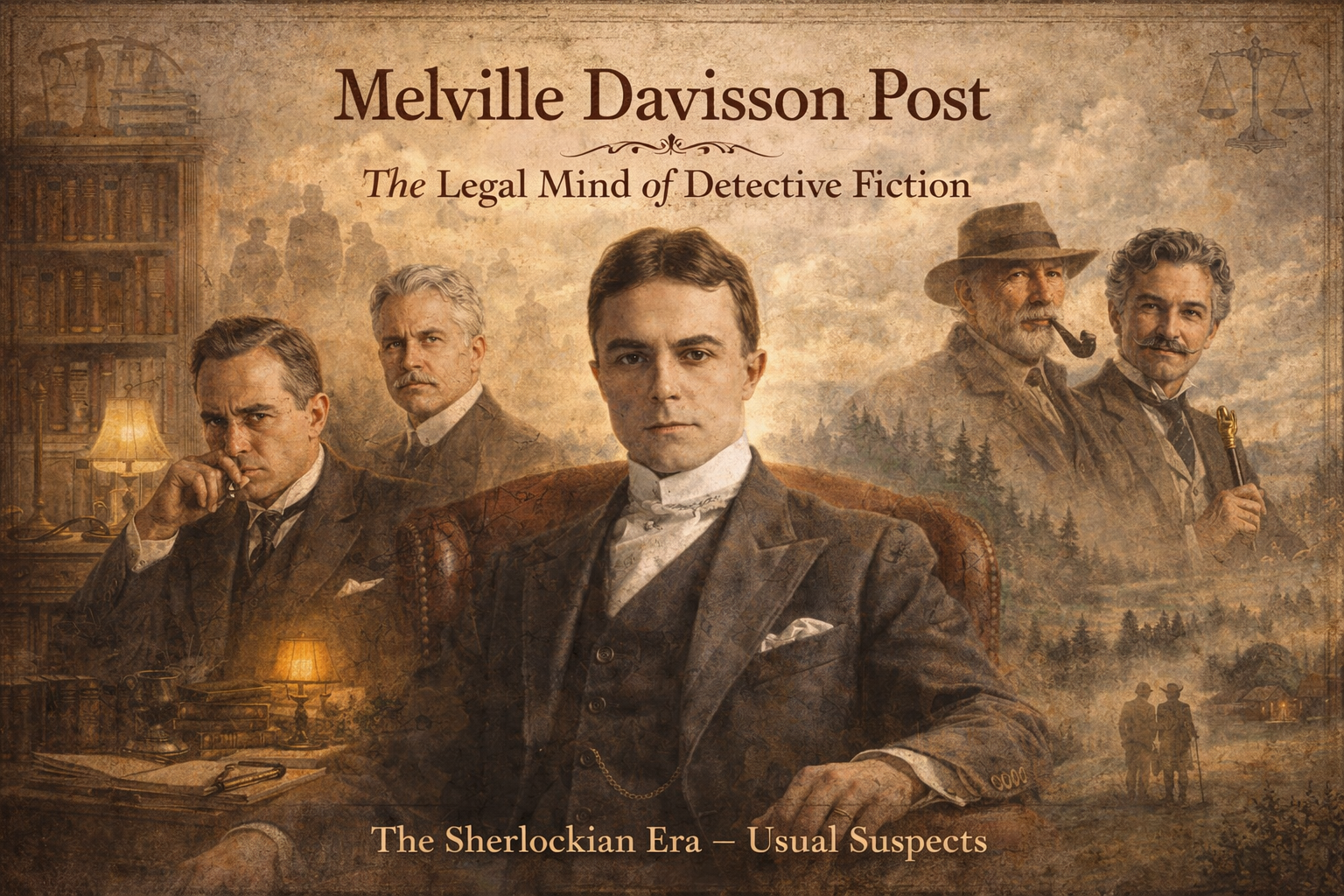
he Legal Mind Behind Early Detective Fiction
Hook
Courtroom dramas were not always television staples. Forensic science did not always dominate crime fiction. There was once a quiet, sharp-eyed lawyer who solved mysteries with logic alone.

Meet Melville Davisson Post. He was a writer who turned the law itself into a tool of mystery. Post gave detective fiction one of its most unusual perspectives.
Biography
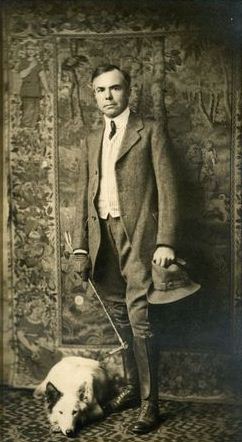
Melville Davisson Post (1869–1930) was an American author and lawyer. He was born in West Virginia. This detail would later shape the rural, grounded atmosphere of many of his stories.
Unlike many of his contemporaries, Post didn’t come from journalism or medicine (like Arthur Conan Doyle). Instead, he trained and worked as a lawyer, gaining firsthand experience with the complexities—and limitations—of the legal system.
👉 It was this experience that pushed him toward writing.
Disillusioned with how justice could be manipulated through technicalities and loopholes, Post began crafting stories that explored:
- the gap between law and justice
- the power of legal reasoning
- and the moral questions behind every crime
After leaving active legal practice, he turned to writing full time, publishing short stories in major magazines of the era. Though he never reached Doyle’s global fame, he earned a reputation for crafting intelligent, tightly constructed mysteries.
Outside of his writing career, Post was married. He devoted time to raising horses. This reflects a lifestyle rooted in the same rural sensibilities found in many of his stories.
️Post’s Investigators & Legal Minds
👉 This is where Melville Davisson Post truly stands apart.
Rather than relying on a single iconic sleuth, Post explores crime through two distinct lenses:
- the lawyer, who manipulates or navigates the legal system
- the detective, who seeks truth through observation and reasoning
Together, they create a fascinating tension:
👉 Justice can be pursued… or avoided—depending on who is in control.
The Lawyers – Masters of the Legal Maze


If Post’s detectives seek truth beyond the law…
👉 his lawyers reveal what the law can truly do—for better or worse.
Through them, Post explores a more unsettling idea:
- justice is not always guaranteed
- the law can be interpreted, stretched… even weaponized
- and intelligence can serve either side of the moral divide
️ Randolph Mason – The Anti-Detective
- A brilliant American lawyer
- Master of legal loopholes
- Uses the law to protect the guilty

👉 A rare kind of investigator—one who doesn’t solve crimes, but ensures they go unpunished.
️ Sir Henry Braxton – The Law in Balance
- A British barrister
- Works within the legal system
- Solves cases through logic and legal reasoning

Where Mason exposes the weaknesses of the law, Braxton represents its potential:
- careful
- methodical
- grounded in procedure
👉 If Mason bends the law, Braxton restores its balance.
If the lawyers manipulate justice, the detectives seek something deeper: truth itself.
Beyond the Law: The Detectives

If the lawyers test the limits of justice…
👉 Post’s detectives look beyond it—toward truth, motive, and human nature.
They do not rely solely on systems or procedures, but on:
- observation
- reasoning
- and an understanding of what drives people to commit crimes
Uncle Abner – The Moral Detective
- A rural West Virginian
- Deeply religious
- Guided by moral and philosophical reasoning

Abner observes, reflects, and ultimately reveals truth through:
- human nature
- moral consequence
- and a near-biblical sense of justice
👉 Less a detective… more a judge of the human soul.
Monsieur Jonquelle – The Observational Sleuth
- A refined, analytical investigator
- Relies on observation and deduction

Jonquelle represents a more classical approach:
- logical
- precise
- quietly methodical
👉 A restrained but effective presence in Post’s work.
The Marquis – The Aristocratic Investigator
- A gentleman of status and intellect
- Moves within elite circles
- Solves mysteries through social insight and reasoning

The Marquis offers a different lens:
- less moral than Abner
- less procedural than Braxton
- more attuned to society and behavior
👉 Where Abner looks inward, the Marquis reads the world around him.
What He Brought to Detective Fiction
Melville Davisson Post didn’t redefine detective fiction outright…
👉 but he quietly expanded its possibilities.
Law as a Tool of Mystery
Rather than focusing solely on clues or physical evidence, Post shifted attention toward:
- legal reasoning
- technicalities
- and the structure of the law itself
The mystery could unfold not just in the investigation…
👉 but in how the law is applied.
The “Inverted” Crime Story
Post was among the early writers to explore a different kind of mystery:
👉 not who committed the crime… but whether they can escape punishment
This added a new kind of tension:
- intellectual
- procedural
- and often unsettling
Moral vs Legal Truth
At the heart of Post’s work lies a recurring question:
👉 What is right… and what is lawful?
His stories explore the gap between the two, giving his work a philosophical depth that goes beyond simple puzzle-solving.
A Different Atmosphere
Especially in the Uncle Abner stories, Post moves away from urban, fast-paced mystery.
Instead, he favors:
- rural settings
- slower pacing
- reflection over action
👉 Less spectacle… more thought.
Other Works
Melville Davisson Post made significant contributions to detective fiction. He was a highly prolific writer. He produced more than 230 works over the course of his career.
His output extended well beyond mystery stories and included:
- essays
- short fiction in various genres
- and non-fiction writings
Among these is The Hidden Thing, a work dealing with German codes and secret communications during the First World War. He also wrote Dwellers in the Hills, reflecting his interest in rural life and character-driven storytelling.
Much of his writing appeared in popular magazines of the time. This demonstrates his versatility. It also shows his ability to engage a wide readership.
👉 This broader body of work reveals an author not confined to a single genre. The author is deeply engaged with ideas, place, and the structure of storytelling.
Did He Walk Away from Detective Fiction?
👉 Did Melville Davisson Post eventually turn away from detective fiction… or simply move beyond it?
Not entirely—but detective fiction did not define his entire career.
Melville Davisson Post continued writing throughout his life, producing:
- detective stories
- essays
- and other literary works
However, unlike some of his contemporaries, he did not build a long-running series centered on a single, evolving detective figure.
👉 His contributions to detective fiction remain concentrated within a distinct period of his writing life.
Legacy & Media Adaptations
Melville Davisson Post’s legacy is not defined by widespread fame…
👉 but by quiet influence and lasting curiosity.
A Presence in Detective Fiction History
His work continues to appear in:
- classic mystery anthologies
- historical studies of detective fiction
Stories featuring Uncle Abner and Randolph Mason are often included in collections such as The Rivals of Sherlock Holmes. This inclusion ensures their continued circulation.
Adaptations & Media
Post’s work has seen limited direct adaptation:
- no major film or television franchise
- no widely recognized screen portrayal
However, his influence can be felt in:
- legal dramas centered on courtroom reasoning
- stories built around loopholes and technicalities
- narratives focused on escaping justice
A Writer Ahead of His Time
Elements of his work anticipate:
- the legal thriller
- morally complex crime fiction
- inverted mystery structures
👉 Ideas that would only become widespread decades later.
Later Years & Death

In his personal life, Melville Davisson Post was married, though his wife died relatively young. The couple had one child, who died in infancy.
He continued to live in West Virginia. He maintained a strong connection to rural life. He devoted time to raising horses. This pursuit reflects the environment so often present in his stories.
Post died in 1930, at the age of 61, after a riding accident.
Conclusion
Melville Davisson Post may not be the most famous name of the Sherlockian era…
👉 but he is one of its most intriguing.
Where others focused on deduction or action, Post turned inward:
- toward the law
- toward morality
- and toward the uneasy space between the two
👉 His stories remind us that solving a mystery is not always about finding the truth. It is about understanding what that truth means.
A Question for the Reader
So where do you stand?
👉 Do you prefer a detective who seeks truth and justice, like Uncle Abner…
or one who exposes the system’s flaws—like Randolph Mason?
➡️ Next Case
If Post explored the limits of law and logic…
👉 the next case will challenge something far more fundamental.
A detective unlike any we’ve seen so far—one who proves that perception itself can be… deceptive.
➡️ Next: Ernest Bramah
📚 References
Primary Works
- Uncle Abner: Master of Mysteries
- The Strange Schemes of Randolph Mason
Secondary Sources & Context
- The Rivals of Sherlock Holmes
- The Cambridge Companion to Crime Fiction
️ Additional Reference
- The Penguin Book of Murder Mysteries








Hello Gumshoe! On the track or authors? leave us reply!