
Introduction
Some detectives became legends.
Some mysteries became classics.

But only a handful of writers became larger than the genre itself.
Agatha Christie’s stories traveled far beyond the page:
through theatres, television screens, radio dramas, audiobooks, games, and countless adaptations across generations.

To many readers, she is not simply part of detective fiction.
She is its most recognizable face.
And yet, behind the world’s most famous mysteries stood a surprisingly private woman —
one whose own life would eventually inspire fascination, speculation, and mystery of its own.
Early Life — Meeting Young Agatha
Long before she became the Queen of Crime, Agatha Christie was simply a quiet and imaginative child growing up in the seaside town of Torquay.
Born Agatha Mary Clarissa Miller in 1890, she was raised in a comfortable middle-class household where stories, books, and imagination were part of everyday life. Unlike many children of the period, Christie was educated largely at home, encouraged to read freely and explore the worlds created by her imagination.

That imagination came early.
She invented stories, imaginary companions, and little private worlds long before she ever considered becoming a writer. Her mother reportedly believed children should learn to read later in life, but young Agatha ignored that idea completely and taught herself anyway.
Books quickly became companions.
She grew up surrounded by Victorian and Edwardian literature, family conversations, visitors, music, and the quiet rhythms of English domestic life that would later echo through many of her novels.
Yet there was another side to her childhood as well:
observation.
Christie watched people carefully.
Their habits.
Their conversations.
Their small contradictions.
Years later, that attention to human behavior would become one of the foundations of her mysteries.
The peaceful world of her childhood would not last forever. The arrival of the twentieth century, war, personal heartbreak, and global change would gradually reshape both her life and her fiction.
But in those early years in Torquay, the future Queen of Crime was simply a curious child learning how fascinating people could be.
The War Years: Agatha, Archibald Christie, and a World Changing
The peaceful world of Agatha Christie’s childhood would not survive the arrival of the First World War.
Like millions across Europe, her generation suddenly found itself pulled into a conflict that reshaped everyday life entirely. The quiet rhythms of family life and seaside comfort gave way to uncertainty, separation, and loss.
During the war, Christie worked as a nurse and later as a dispenser in a hospital pharmacy. The experience would leave a lasting mark on her writing.
There, she learned about:
- medicines,
- chemical compounds,
- dosage,
- and above all, poison.
Years later, that knowledge would become one of the most recognizable features of her mysteries. Christie did not invent poison in detective fiction, but she helped transform it into one of the genre’s most memorable weapons.
Yet the war changed more than her future stories.
It also changed her personal life.
In 1914, she married Archibald Christie, a young aviator and army officer whose confidence and energy contrasted sharply with Agatha’s quieter personality. Like many wartime marriages, their relationship grew in the shadow of uncertainty and separation.

For a time, the marriage appeared happy. Agatha became Agatha Christie, the name the world would eventually know forever.
But the pressures of adulthood, fame, changing expectations, and the emotional aftermath of war slowly reshaped both their lives in ways neither could yet fully understand.
The war had introduced Christie to:
- medicine,
- suffering,
- discipline,
- and human fragility.
It had also carried her away from childhood —
and toward the complicated life of the future Queen of Crime.
Motherhood, Success, and Fracture
In 1919, Agatha Christie gave birth to her daughter, Rosalind Hicks.
For a time, Christie seemed to be building the life many women of her generation hoped for:
- marriage,
- motherhood,
- stability,
- and a growing household shaped by the uneasy peace that followed the First World War.
At the same time, another part of her life was beginning quietly but decisively.
During the war years, Christie had challenged herself to write a detective novel after hearing discussions about mystery fiction within her family. The result became:
The Mysterious Affair at Styles.
Published in 1920, the novel introduced:
Hercule Poirot —
The meticulous Belgian detective whose mustache, precision, and “little grey cells” would eventually become known around the world.
The success did not arrive overnight.
But slowly, Christie’s literary career began growing alongside her family life.
And yet beneath that outward stability, tensions were beginning to appear.
By the mid-1920s, the marriage between Agatha and Archibald Christie had deteriorated badly. Fame, emotional distance, personal change, and Archibald’s affair placed enormous strain on the relationship. Then, in 1926, Christie’s life collapsed publicly.
Shortly after her mother’s death and the breakdown of her marriage, Agatha Christie disappeared for several days, triggering one of the most famous literary mysteries of the twentieth century.
- Her abandoned car was discovered.
- Newspapers exploded with speculation.
- Search parties formed across England.
When Christie was eventually found staying at a hotel under another name, the public obsession only deepened.
Even now, historians and readers continue debating what truly happened:
- emotional breakdown,
- trauma,
- exhaustion,
- deliberate disappearance,
- or temporary memory loss.
Christie herself rarely spoke publicly about the event in detail.
The divorce from Archibald Christie followed soon afterward. It marked the painful end of one chapter of her life — but also the beginning of another. The quiet young woman from Torquay had become famous. And somewhere between literary success, personal heartbreak, and public fascination… Agatha Christie had become a mystery herself.
Travel, Adventure, and Max Mallowan
After the pain of divorce and the public storm surrounding her disappearance, Agatha Christie slowly rebuilt her life through something that had always attracted her: travel.
If the young Agatha of Torquay had once imagined distant places through books and stories, the adult Christie now began discovering them for herself. She travelled aboard the famous Orient Express, crossing Europe and into the Middle East — journeys that would later inspire some of her most famous novels.
Travel awakened another side of Christie’s imagination. Not only mystery, but movement.
- Different cultures.
- Ancient landscapes.
- Hotels filled with strangers.
- Long train journeys.
- Conversations overheard far from England.
Her mysteries began expanding beyond quiet villages and country houses into a far wider world. That growing fascination with travel and archaeology would change her life permanently.
In 1930, while visiting archaeological excavations in the Middle East, Christie met Max Mallowan,
a young archaeologist more than a decade younger than she was. The relationship surprised many people. But together, Christie and Mallowan formed one of the happiest and most stable chapters of her life.

Through Max, Christie became deeply involved in the world of archaeology:
- excavation sites,
- ancient artifacts,
- desert camps,
- restoration work,
- and long seasons spent traveling through Syria and Iraq.
Those experiences would leave visible traces across her fiction.
Novels such as:
- Murder in Mesopotamia,
- Death on the Nile,
- and Appointment with Death
carry the atmosphere of those journeys within them

Curator”s note: this is my personal vintage copy of Murder in Mesopotamia, also shown in the exhibition: Sur les traces d’Agatha Christie
Years later, Christie would revisit those memories warmly and humorously in:
Come, Tell Me How You Live — a memoir that reveals a lighter, more personal side of the woman the world knew as the Queen of Crime. By then, Christie was no longer simply observing human nature from English drawing rooms. She had become a traveler moving between worlds; between modern crime and ancient history; between mystery fiction and real archaeological discovery.
1938 — Home, Sweet Home
For all her travels across Europe and the Middle East, Agatha Christie never completely lost her attachment to England. In 1938, she and Max Mallowan purchased Greenway Estate, the riverside house in Devon that would become Christie’s beloved home for the rest of her life.
Set above the River Dart, Greenway felt both peaceful and timeless:
- gardens,
- woodlands,
- quiet paths,
- and rooms filled with books, objects, memories,
- and collections gathered during years of travel.

After years marked by:
- war,
- heartbreak,
- public fascination,
- constant movement,
- and archaeological expeditions,
Greenway became something deeply important for Christie: stability.
Friends, family, and visitors would later describe the house as warm and lived-in rather than grandly theatrical. It reflected a side of Christie often hidden behind her public reputation:
private, domestic, observant, and deeply attached to familiar routines.
And yet, even there, mystery never seemed entirely far away.
The atmosphere of Greenway Estate — isolated beauty mixed with quiet unease — can still be felt in parts of Agatha Christie’s fiction. Within those walls, Christie continued building an unforgettable collection of detectives, from global literary icons to quieter figures hidden in the corners of her work, each helping shape the many faces of her mysteries.

Today, Greenway remains one of the most tangible surviving connections to Christie’s world: not simply the home of a famous author, but the place where the Queen of Crime could briefly step away from the noise surrounding her name.
The Many Faces of Mystery
Across decades of writing, Agatha Christie created far more than a single famous detective. From meticulous investigators and quiet observers to adventurous couples and stranger, more atmospheric figures, her mysteries were carried by a remarkably varied cast of characters.
Some became literary legends.
Others slowly faded into the background over time.
But together, they helped shape the many faces of Agatha Christie’s world of mystery.
Hercule Poirot — The Little Grey Cells
Among all the detectives created during the Golden Age of detective fiction, few became as recognizable as Hercule Poirot.
With his carefully groomed mustache, immaculate suits, polished shoes, and fierce pride in order and precision, Poirot quickly stood apart from many detectives of his era.
First appearing in The Mysterious Affair at Styles, Poirot was a former Belgian police officer who fled to England during the First World War. Small in stature but enormous in personality, he solved crimes through psychology, observation, and what he famously called his “little grey cells.”

Unlike detectives who relied heavily on physical evidence or dangerous pursuits, Poirot believed that understanding human behavior mattered more than chasing clues across crime scenes, and readers responded immediately to the detective’s unusual mix of brilliance, vanity, theatricality, precision, and strange charm.
Poirot noticed:
- tiny inconsistencies,
- social tensions,
- hidden vanity,
- emotional weakness,
- and the small cracks people failed to hide behind polite appearances.
Over time, Agatha Christie placed Poirot almost everywhere imaginable, from isolated country houses and luxury trains to archaeological sites, steamships, grand hotels, quiet villages, and international conspiracies. Through him, Christie’s mysteries expanded far beyond the traditional English drawing room and into a much larger world of travel, intrigue, and human deception.
Yet Poirot’s success would eventually create a complicated relationship between detective and creator. As the years passed, Christie sometimes grew frustrated with the detective who had made her world famous, describing him at times as pompous, exhausting, and overly self-important while readers continued demanding more Poirot stories decade after decade.
That tension slowly became part of Christie’s literary life itself, and perhaps nowhere is that relationship more fascinating than in Curtain, the final Poirot novel written years before publication and locked away until the end of Christie’s life.
Poirot may have begun as a detective, but over time he became something far larger: a literary icon whose shadow followed Christie across her entire career.
Hercule Poirot — Key Cases
- The Mysterious Affair at Styles
- The Murder of Roger Ackroyd
- Murder on the Orient Express
- Death on the Nile
- Curtain
Miss Marple — The Quiet Observer
If Hercule Poirot solved mysteries through precision and theatrical logic, then Miss Jane Marple approached them through patience, observation, and an understanding of human nature shaped by village life.
Introduced in The Murder at the Vicarage, Miss Marple appeared to be little more than a harmless elderly woman living quietly in the village of St. Mary Mead. That appearance, however, concealed one of Agatha Christie’s sharpest observers of human behavior.

Where Poirot often impressed through brilliance and presence, Miss Marple relied on comparison, memory, and an almost unsettling understanding of how ordinary people behave when greed, fear, jealousy, or resentment enter their lives. To her, human nature rarely changed, and the village became a small reflection of the wider world.
Small scandals, family tensions, gossip, vanity, kindness, cruelty, and hidden grudges all reflected patterns she recognized again and again, whether in a quiet English home or at the center of a murder investigation.
Unlike Poirot, Miss Marple rarely dominated a room. People constantly underestimated her, speaking freely around her because they assumed age and gentleness meant harmlessness, and that misjudgment became one of her greatest strengths.
Through Miss Marple, Christie explored a quieter form of detective fiction, one less concerned with theatrical reveals and more focused on social observation, hidden tensions, and the darkness that could exist beneath ordinary domestic life. Yet despite her softer image, Miss Marple’s mysteries could become surprisingly cruel, melancholy, and emotionally sharp because she did not simply solve crimes — she understood people.
Miss Marple — Key Cases
- The Murder at the Vicarage
- A Murder Is Announced
- The Body in the Library
- Nemesis
Superintendent Battle — The Quiet Professional
Compared to the theatrical precision of Hercule Poirot or the quiet intuition of Miss Marple, Superintendent Battle brought something very different to Agatha Christie’s world of mystery:
professional calm.
Appearing in novels such as The Secret of Chimneys and The Seven Dials Mystery, Battle was a Scotland Yard investigator whose strength came not from eccentricity or dramatic brilliance, but from patience, discipline, and experience.

Christie often described him as physically solid and emotionally controlled, a man capable of sitting quietly through conversations while observing far more than people realized. Unlike Poirot, Battle rarely drew attention to himself, and unlike many fictional policemen of the era, he was neither foolish nor easily outmatched by amateur detectives.
That restraint became one of his defining qualities.
Battle represented the dependable investigator, someone shaped less by theatrical deduction than by years of dealing with criminals, lies, and human weakness. He moved through political conspiracies, country house intrigues, and secret organizations with a calm steadiness that grounded some of Christie’s more adventurous stories.
Through Battle, Christie explored a more procedural side of detective fiction while still preserving the atmosphere and intrigue of the Golden Age mystery. Though he never reached the legendary status of Poirot or Miss Marple, Battle remains an important part of Christie’s detective world because he reflects another side of investigation entirely: not the genius detective, but the experienced professional quietly watching the room.
Superintendent Battle: Key Cases
- The Secret of Chimneys
- The Seven Dials Mystery
- Towards Zero
Adventure and Intrigue
While many readers associate Agatha Christie with quiet villages and carefully structured drawing-room mysteries, another side of her fiction embraced movement, espionage, conspiracies, and adventure.
Through a different group of investigators, Christie explored:
- international intrigue,
- secret organizations,
- political tensions,
- missing documents,
- dangerous journeys,
- and the faster rhythms of the interwar world.
These characters moved beyond the traditional detective story into something more adventurous, often blending mystery with thriller elements and modern anxieties of the twentieth century.
Among them were:
- Colonel Race, the calm intelligence officer shaped by international intrigue;
- Tommy and Tuppence, the energetic couple who aged alongside Christie’s readers across decades of adventures;
- and Lady Eileen ‘Bundle’ Brent, whose youthful energy and curiosity helped bring a lighter, more modern spirit to some of Christie’s early thrillers.
Together, they revealed a more restless side of Christie’s imagination — one willing to step beyond country houses and into a world of secrets, travel, and danger.
Colonel Race — The International Investigator
Where Hercule Poirot often represented logic and Miss Marple embodied quiet observation, Colonel Race brought an atmosphere of international intrigue to Agatha Christie’s fiction.
Race was a soldier, intelligence officer, and experienced investigator whose world extended far beyond English villages and country houses. Calm, disciplined, and professional, he moved comfortably through political conspiracies, espionage, and dangerous investigations tied to the instability of the interwar years.

Unlike Poirot’s theatrical presence or Battle’s grounded professionalism, Race often operated in the background, revealing information carefully and maintaining an air of controlled mystery around himself. His stories frequently carried a broader sense of danger, connecting Christie’s detective fiction to thriller and adventure traditions.
Through Colonel Race, Christie explored a more international world of crime:
- luxury travel,
- hidden identities,
- political secrets,
- colonial settings,
- and murders unfolding far from the familiar safety of St. Mary Mead.
Race also appeared alongside several of Christie’s other investigators, helping create the sense that her fictional world was larger and more interconnected than many readers first realized.
Though less famous today than Poirot or Miss Marple, Colonel Race remains an important figure in Christie’s work because he represents her fascination with adventure, espionage, and the tensions of a rapidly changing twentieth century.
Colonel Race: Key Cases
- The Man in the Brown Suit
- Cards on the Table
- Death on the Nile
Tommy and Tuppence — Partners in Adventure
Among Agatha Christie’s investigators, Tommy and Tuppence brought a very different kind of energy to detective fiction. Younger, more impulsive, and often less polished than Poirot or Miss Marple, the pair moved through Christie’s world with curiosity, humor, and a sense of adventure that reflected the changing twentieth century around them.

Introduced in The Secret Adversary, Thomas Beresford and Prudence “Tuppence” Cowley first appeared as young friends struggling to find direction in postwar England. Their decision to seek excitement and opportunity quickly pulled them into espionage, conspiracies, and dangerous investigations far beyond what either expected.
Unlike many classic detectives, Tommy and Tuppence were not defined by extraordinary intellectual brilliance. Their strength came from partnership. They argued, joked, improvised, and relied on one another while navigating mysteries that often blended detective fiction with thriller and spy elements.
As Christie returned to them across decades, readers watched the pair evolve alongside the century itself. They aged, married, faced war, raised a family, and adapted to changing times in ways that made them feel unusually human compared to many long-running fictional detectives.

Their adventures allowed Christie to experiment with tone and genre, moving between espionage, light comedy, wartime anxiety, and darker mysteries hidden beneath ordinary domestic life.
Though they never reached the global fame of Poirot or Miss Marple, Tommy and Tuppence remain one of Christie’s most distinctive creations because together they transformed detective fiction into something warmer, more playful, and deeply shaped by companionship.
Tommy and Tuppence: Key Cases
- The Secret Adversary
- Partners in Crime
- N or M?
- By the Pricking of My Thumbs
- Postern of Fate
Lady Eileen ‘Bundle’ Brent — The Bright Young Adventurer
If Tommy and Tuppence reflected the adventurous spirit of the interwar years, then Lady Eileen “Bundle” Brent brought that same energy into some of Agatha Christie’s liveliest early thrillers.
Introduced in The Secret of Chimneys and returning in The Seven Dials Mystery, Bundle stood apart from many female characters of her era. Energetic, curious, witty, and socially fearless, she moved through mysteries with a confidence that felt strikingly modern for the time.

Rather than relying on formal detective skills, Bundle solved problems through instinct, determination, and an ability to move freely through aristocratic society, secret gatherings, and dangerous situations without losing her sense of humor.
Her stories blended:
- country house mystery,
- political intrigue,
- secret organizations,
- and adventure fiction,
creating a faster and more playful atmosphere than many of Christie’s later detective novels.
Through Bundle, Christie captured part of the restless spirit of the 1920s:
a world of fast conversations, late-night investigations, hidden conspiracies, and young people searching for excitement after the trauma of war.
Though she appeared in only a small number of novels, Bundle remains memorable because she represents one of Christie’s earliest experiments with adventurous modern heroines and helped shape the lighter, energetic side of her mystery fiction.
Bundle Brent: Key Cases
- The Secret of Chimneys
- The Seven Dials Mystery
Shadows and Reflections
Not all of Agatha Christie’s investigators fit comfortably within the traditional image of the detective.
Some moved through her stories like shadows, carrying an atmosphere of melancholy, coincidence, and quiet mystery. Others allowed Christie to reflect on detective fiction itself, gently questioning the genre she had helped shape across decades of writing.
These characters occupied stranger and more reflective corners of Christie’s imagination, where mysteries became less concerned with simple deduction and more interested in memory, personality, illusion, and human emotion.
Through them, Christie revealed that her fictional world could be playful, unsettling, symbolic, and surprisingly self-aware all at once.
Mr. Harley Quin — The Man in the Shadows
Among all of Agatha Christie’s recurring characters, Mr. Harley Quin remains one of the most unusual.
Unlike Poirot or Miss Marple, Quin was not a traditional detective. He did not gather suspects into drawing rooms, search for physical clues, or explain crimes through strict logic. Instead, he appeared almost mysteriously, arriving at moments when hidden truths, forgotten tragedies, or unresolved emotions needed to surface.

First appearing in The Mysterious Mr Quin, Harley Quin often acted less like an investigator and more like a catalyst. His presence encouraged others — especially Mr. Satterthwaite — to notice details, reconsider memories, and finally understand events that had remained emotionally or morally unresolved.
There was always something slightly unreal about Quin.
Christie frequently associated him with:
- shadows,
- twilight,
- theatrical imagery,
- colorful reflections,
- and sudden appearances and disappearances.
Readers are never entirely certain whether Quin is simply an unusually perceptive man or something more symbolic, almost supernatural in nature. That ambiguity became part of the character’s fascination.
Through Harley Quin, Christie explored mysteries driven less by puzzles than by emotion, regret, love, guilt, coincidence, and the hidden consequences of past actions. The stories often feel quieter, sadder, and more dreamlike than her traditional detective fiction.
In many ways, the Quin stories reveal Christie experimenting with mood and atmosphere as much as mystery itself, blending detective fiction with elements of fantasy, theatre, romance, and psychological reflection.
Though far less famous than Poirot or Miss Marple, Harley Quin remains one of Christie’s most distinctive creations because he represents the strange and haunting edge of her imagination.
Harley Quin: Key Cases
- The Mysterious Mr Quin
- The Harlequin Tea Set
Ariadne Oliver — Christie in the Mirror
Among all of Agatha Christie’s recurring characters, Ariadne Oliver may be the most personal.
A successful mystery novelist with a vivid imagination, chaotic habits, and frequent frustration toward her own famous detective, Mrs. Oliver often feels like Christie gently parodying herself within her own fiction.
Appearing in novels such as Cards on the Table and Mrs McGinty’s Dead, Ariadne Oliver frequently enters stories as an observer, participant, or uneasy assistant to investigations led by others, especially Hercule Poirot.

Unlike Christie’s more controlled investigators, Mrs. Oliver is impulsive, emotional, distracted, imaginative, and wonderfully human. She complains about deadlines, literary expectations, public opinion, and the absurd difficulties of writing detective fiction, often expressing frustrations that closely mirrored Christie’s own experiences as a world-famous author.
Her fictional detective, Sven Hjerson, became an especially clear reflection of Christie’s relationship with Poirot. Mrs. Oliver repeatedly grumbles about the character’s habits, popularity, and the fact that readers constantly demand more stories about him no matter how tired she becomes of writing them.
Through Ariadne Oliver, Christie allowed humor and self-awareness into her mysteries while quietly reflecting on the pressures of literary fame and the strange relationship between writers and the characters who begin taking over their lives.
At times amusing, chaotic, perceptive, and surprisingly insightful, Ariadne Oliver feels less like a traditional detective than a window into Christie herself.
Ariadne Oliver: Key Cases
- Cards on the Table
- Mrs McGinty’s Dead
- Dead Man’s Folly
- Hallowe’en Party
Beyond the Famous Detectives
While many of Agatha Christie’s mysteries became closely associated with recurring investigators such as Hercule Poirot or Miss Marple, Christie also created numerous memorable stories centered on one-time investigators, ordinary people, or characters drawn unexpectedly into dangerous situations.
Some were professionals.
Others were amateurs.
Some simply found themselves trapped inside mysteries they never expected to face.
Through these stand-alone characters, Christie experimented more freely with atmosphere, psychology, suspense, and narrative structure without relying on familiar detectives to guide the reader.
That freedom helped produce some of her most enduring and unsettling works — including one novel that removed the detective figure entirely.
A Mystery Without a Detective
While Agatha Christie became famous for iconic investigators such as Hercule Poirot and Miss Marple, one of her most enduring novels contains no true detective at all.
And Then There Were None removes the reassuring figure normally found at the center of detective fiction. No brilliant outsider arrives to restore order. Instead, every character becomes both suspect and potential victim as paranoia slowly takes over the isolated island.


The result is one of Christie’s darkest and most psychologically unsettling works.
Without a central detective to guide the investigation, the novel creates an atmosphere of growing fear, distrust, and inevitability in which readers lose the comforting structure usually found in classic detective fiction.
Decades later, the novel continues surviving through countless adaptations, stage productions, films, television versions, and games — proof that Christie’s mastery extended far beyond her famous detectives alone.
What Agatha Christie Brought to Detective Fiction
Few writers shaped detective fiction as deeply or as durably as Agatha Christie.
While many Golden Age authors refined the structure of the mystery novel, Christie helped transform detective fiction into something that could travel effortlessly across generations, countries, and mediums without losing its appeal.
Part of that success came from clarity. Christie understood how to construct intricate mysteries without making readers feel excluded from them. Her novels remained carefully structured and intellectually satisfying while still feeling approachable to casual readers discovering detective fiction for the first time.
She also grounded mystery in ordinary life. Rather than relying entirely on gothic villains or sensational crimes, Christie built stories around recognizable human emotions:
- jealousy,
- greed,
- fear,
- resentment,
- loneliness,
- and ambition.
Murder in Christie’s world often emerged not from monsters, but from people hiding behind ordinary appearances.
Her wartime experience as a nurse and dispenser brought unusual realism to her use of poison, helping make it one of the most recognizable elements of her fiction. At the same time, Christie continually experimented with form, moving between classic puzzle mysteries, espionage thrillers, psychological tension, adventurous conspiracies, symbolic stories, and novels that abandoned the traditional detective structure altogether, such as And Then There Were None.
Christie also expanded the possibilities of recurring investigators. Instead of relying on a single formula, she created detectives and protagonists who approached mystery in radically different ways, from Poirot’s precision and Miss Marple’s observations of village life to the adventurous partnership of Tommy and Tuppence, the strange symbolism of Harley Quin, and the self-aware humor of Ariadne Oliver.
Christie also became an important figure within the Detection Club, the famous society of mystery writers associated with the Golden Age of detective fiction. Alongside other major authors of the era, her presence within the club reflected both her influence on the genre and her place among the leading crime writers of the twentieth century.
Another of Christie’s lasting strengths was misdirection. Readers learned to distrust appearances, assumptions, narrators, and even the conventions of detective fiction itself, while several of her solutions became so influential that they permanently shaped the genre that followed.
Perhaps most importantly, Christie helped make detective fiction global. Her stories survived not only through books, but through theatre, film, television, radio, audiobooks, games, and countless adaptations that continued introducing new generations to her work long after the Golden Age itself had faded.
She did not simply become one of detective fiction’s most famous writers.
For many readers around the world, Agatha Christie became detective fiction itself.
Walking Away From Her Detectives
As the years passed, Agatha Christie’s relationship with her detectives gradually became more complicated.
Some characters quietly disappeared as Christie’s interests changed or as certain styles of mystery fell out of favor. Others simply appeared less frequently over time while new investigators and stand-alone stories took their place.
But no relationship became more complex than the one she shared with Hercule Poirot.
Readers adored Poirot, publishers depended on him, and his popularity grew into a worldwide phenomenon. Christie herself, however, sometimes became frustrated with the detective she had created decades earlier, describing him at times as pompous, exhausting, and overly self-important.
That frustration slowly found its way into her fiction.
Through Ariadne Oliver and her complaints about the fictional detective Sven Hjerson, Christie quietly reflected her own experience of becoming permanently associated with a single literary creation readers refused to let go.
Yet even while expressing irritation toward Poirot, Christie never fully abandoned him. Instead, she prepared his ending carefully through Curtain, written years before publication and kept locked away until the end of her life.
Other investigators faded more gently. Superintendent Battle, Colonel Race, and Lady Eileen ‘Bundle’ Brent slowly disappeared as Christie’s fiction evolved, while characters such as Mr. Harley Quin remained tied to a more symbolic and atmospheric side of her imagination that she explored less frequently over time.
Even Miss Marple, though deeply loved by readers, appeared more selectively in Christie’s later career.
In many ways, Christie’s detectives reflected the changing phases of her life as a writer. Some became lifelong companions. Others remained experiments tied to particular moments, moods, or literary interests.
And perhaps that is part of what makes her fictional world feel so alive:
Its characters were never entirely fixed in place but evolved, faded, returned, or quietly stepped aside as Christie herself continued to change across decades of writing.
Legacy and Media
Few writers from the Golden Age of detective fiction remained as visible across popular culture as Agatha Christie.
Long after the era itself faded, Christie’s stories continued reaching new audiences through theatre, film, television, radio, audiobooks, games, exhibitions, and streaming adaptations. Her work moved far beyond the page and became part of global popular culture in a way few mystery writers ever achieved.
What makes Christie’s legacy especially remarkable is not simply its longevity, but its ability to constantly reinvent itself. Each generation seems to rediscover Poirot, Miss Marple, and Christie’s world of mystery through new actors, new interpretations, and new forms of storytelling while the original novels continue remaining widely read across the world.
Stage and Theatre
Before many modern film and television adaptations introduced new audiences to Agatha Christie, Christie’s work had already become a major presence on stage.
Her most famous theatrical success remains The Mousetrap, a production that became one of the longest-running plays in theatrical history. First performed in London in 1952, the play turned Christie into an enduring figure not only in detective fiction, but also in modern theatre itself.


The success of The Mousetrap reflected something essential about Christie’s writing: her mysteries adapted naturally to performance. Limited settings, carefully controlled tension, hidden motives, and dramatic reveals translated remarkably well to the stage.
One of the traditions surrounding The Mousetrap is the request that audiences keep the ending secret after leaving the theatre, allowing future viewers to experience the mystery for themselves. Over the years, this secrecy became so closely tied to the play’s identity that jokes and legends even emerged claiming London cab drivers might reveal the ending to passengers who failed to tip properly.
Other Christie stories also found long lives through theatrical adaptations, allowing audiences to experience her mysteries collectively through suspense, humor, and the famous final revelations that became part of her storytelling identity.
Even decades later, Christie’s plays continue being performed around the world, proving that her appeal extends far beyond the printed page.
Film and Television
If theatre helped preserve Agatha Christie’s mysteries for live audiences, film and television transformed her detectives into global visual icons.
Across decades, Christie’s stories were adapted repeatedly through classic films, prestige television productions, modern reinterpretations, streaming series, and international adaptations, each generation reshaping Poirot, Miss Marple, and Christie’s wider world for new audiences.
Long before modern adaptations, actors such as Albert Finney and Peter Ustinov helped establish Hercule Poirot on screen through films including Murder on the Orient Express and Death on the Nile. Their portrayals introduced Christie’s detective to international audiences and helped define Poirot’s cinematic image for decades.

Among the many actors associated with Christie’s work, David Suchet remains one of the most celebrated portrayals of Hercule Poirot. Before filming began, representatives connected to Christie’s estate reportedly discussed the character in great detail with Suchet, helping shape a portrayal that many readers now consider definitive. Suchet approached Poirot with extraordinary precision, paying close attention not only to the detective’s appearance and mannerisms, but also to his emotional depth, vanity, discipline, and loneliness.
Years later, Suchet reflected on that experience in Poirot and Me, where he discussed the demands of embodying Christie’s detective across decades of television and the careful preparation that shaped his interpretation of the character.

Other adaptations explored very different interpretations of Poirot. John Malkovich presented a darker and more psychologically troubled version of the detective in The ABC Murders, while Kenneth Branagh brought Christie’s mysteries back to large-scale cinema through productions such as Murder on the Orient Express, Death on the Nile, and A Haunting in Venice, each taking increasingly stylized and atmospheric approaches to Christie’s fiction.


Miss Marple also passed through multiple generations of actresses and interpretations. Some adaptations emphasized her warmth and quiet intelligence, while others leaned more heavily into the darker social tensions hidden beneath village life.

Christie’s work continued evolving through newer productions as well, including The Seven Dials Mystery on Netflix, which brought renewed attention to Lady Eileen ‘Bundle’ Brent and Superintendent Battle. The series notably cast Martin Freeman — widely known for playing Bilbo Baggins in The Hobbit: An Unexpected Journey and its sequels — as Battle, introducing another generation of viewers to one of Christie’s quieter recurring investigators.

After Christie’s death, the preservation of her literary world continued through her family and estate, particularly through the work of her daughter Rosalind Hicks and later her grandson Mathew Prichard. Their involvement helped oversee new adaptations, exhibitions, publications, and productions while maintaining Christie’s extraordinary visibility across generations.
Radio, Audiobooks, and Games
Beyond the page and the screen, Agatha Christie’s stories also found long lives through radio productions, audiobooks, and games, allowing her mysteries to adapt naturally to new forms of storytelling.
Radio adaptations helped bring Poirot, Miss Marple, and Christie’s stand-alone mysteries to audiences through atmosphere, dialogue, and suspense alone, preserving the theatrical quality that had always existed within her writing.
Audiobooks later introduced Christie’s work to another generation of listeners. Among the voices most closely associated with Poirot were David Suchet and Hugh Fraser, whose narrations became especially popular with Christie readers and listeners. More recent audio adaptations also explored new interpretations of Poirot, including Audible productions starring Peter Dinklage in adaptations of The Mysterious Affair at Styles and The ABC Murders.

Christie’s mysteries also expanded into interactive media through video games, escape games, puzzle experiences, and hidden-object adventures inspired by the atmosphere of interwar detective fiction. Mobile games such as June’s Journey even incorporated Poirot into their broader mystery settings, showing how naturally Christie’s world continues adapting to modern forms of entertainment.

Together, these adaptations helped ensure that Christie’s mysteries remained accessible not only through reading, but through listening, exploration, and play, allowing each generation to rediscover her stories in new ways.
Christie in Popular Culture
Over time, Agatha Christie herself became almost as recognizable as her detectives.
Her image, voice, books, and mysteries gradually entered popular culture far beyond traditional detective fiction, transforming Christie into a symbol of the mystery genre itself.
Television series, documentaries, parodies, exhibitions, and literary references repeatedly returned to Christie’s world, often blending the author herself with the atmosphere of her fiction. One notable example appeared in Doctor Who’s episode “The Unicorn and the Wasp,” which playfully imagined Christie becoming involved in a mystery adventure alongside the Doctor while referencing the public fascination surrounding her temporary disappearance in 1926.

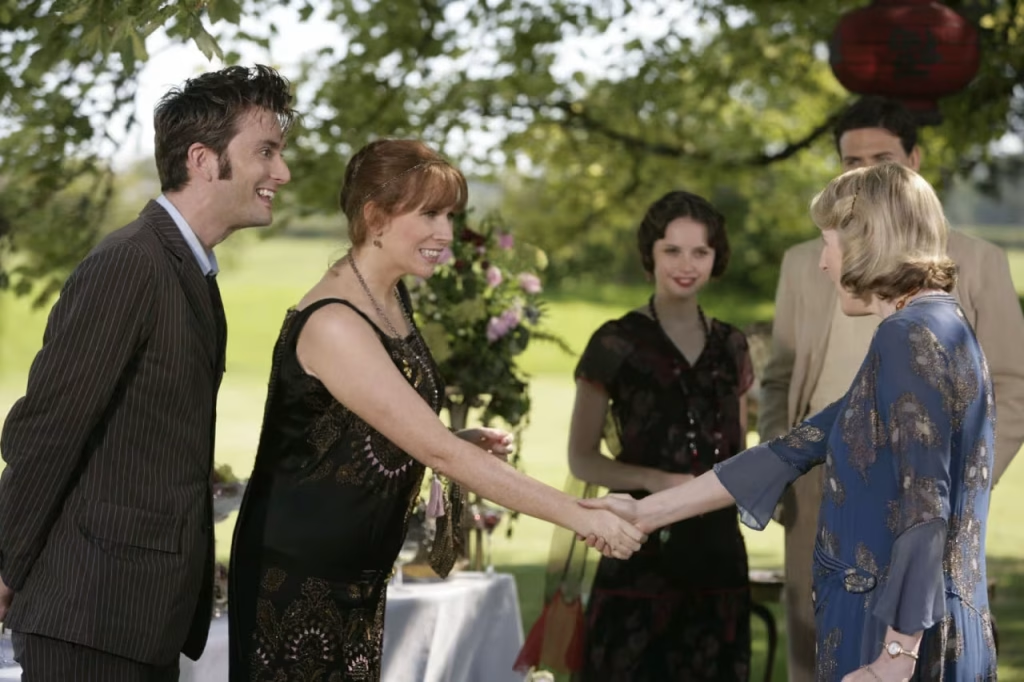
Exhibitions dedicated to Christie’s life also revealed a broader portrait of the author beyond the title of “Queen of Crime.” Visitors discovered:
- the traveler,
- the archaeologist’s companion,
- the photographer,
- the writer fascinated by the Middle East,
- and the woman whose life extended far beyond country house murders and famous detectives.

Christie’s influence also continued appearing indirectly through references, visual homages, mystery-themed events, escape rooms, and recurring tributes across modern entertainment. Even readers unfamiliar with specific novels often recognize elements associated with Christie:
- isolated mansions,
- closed circles of suspects,
- hidden motives,
- famous final revelations,
- and the image of the brilliant detective gathering suspects together before exposing the truth.
Few mystery writers became cultural symbols recognizable even to people who never read the books themselves.
Agatha Christie became one of them.
Later Years and Death
As Agatha Christie grew older, her fame continued expanding far beyond the world she had entered decades earlier with The Mysterious Affair at Styles.
Her novels remained bestsellers across the world, her plays continued drawing audiences, and Poirot and Miss Marple had become deeply embedded in popular culture. Yet despite the extraordinary success surrounding her name, Christie herself often remained relatively private, preferring quiet routines, family life, travel, and time spent between homes such as Greenway Estate.
In 1971, Christie was appointed Dame Commander of the Order of the British Empire, becoming Dame Agatha Christie. The honor reflected not only her literary success, but also the enormous cultural influence her work had achieved internationally.
During her later years, Christie’s family remained an important part of her life, particularly her daughter Rosalind Hicks and her grandson Mathew Prichard, who would later help preserve and oversee her literary legacy.
Even as age and health gradually slowed her writing, Christie continued publishing novels and remained closely associated with the fictional world she had spent decades building. Readers still eagerly awaited new mysteries, adaptations, and appearances connected to her detectives.
Agatha Christie died on January 12, 1976, at the age of 85.
Yet unlike many writers whose work slowly fades with time, Christie’s stories never truly disappeared. Her detectives continued solving mysteries for new generations through books, television, theatre, film, audiobooks, and countless adaptations that carried her work far beyond the Golden Age that first inspired it.
In many ways, Agatha Christie outlived her era.
And perhaps that is why the title “Queen of Crime” never truly left her.
Conclusion
More than a century after the publication of The Mysterious Affair at Styles, Agatha Christie remains one of the defining names of detective fiction.
Readers continue returning to her work not only for clever solutions and famous twists, but for the atmosphere she created:
- quiet villages hiding dark secrets,
- isolated mansions filled with suspicion,
- trains crossing dangerous landscapes,
- strangers bound together by fear,
- and detectives trying to restore order within worlds shaped by human weakness.
Across Poirot, Miss Marple, Tommy and Tuppence, Harley Quin, Ariadne Oliver, and many others, Christie built a remarkably varied fictional universe that continues adapting to new generations without losing the identity that made it memorable in the first place.
Some readers arrive through books.
Others through television, theatre, games, streaming adaptations, or films.
Yet somehow, the mysteries continue working.
And perhaps that is Christie’s greatest achievement:
long after the Golden Age faded into literary history, her stories never truly stopped inviting readers inside.
Questions for Readers
- Which Agatha Christie detective do you return to most often: Poirot, Miss Marple, or another investigator entirely?
- Do you prefer Christie’s classic detective puzzles, her adventurous thrillers, or her darker stand-alone mysteries such as And Then There Were None?
- Which adaptation first introduced you to Christie’s world of mystery?
References and Further Reading
Works by Agatha Christie
- The Mysterious Affair at Styles
- The Murder of Roger Ackroyd
- Murder on the Orient Express
- Death on the Nile
- The Murder at the Vicarage
- A Murder Is Announced
- And Then There Were None
- Curtain
- The Secret Adversary
- The Secret of Chimneys
- The Seven Dials Mystery
- Cards on the Table
- Murder in Mesopotamia
- The Mysterious Mr Quin
- The Complete Short Stories of Hercule Poirot
- Miss Marple: The Complete Short Stories
Biographies and Studies
- Agatha Christie: An Autobiography
- David Suchet: Poirot and Me
- Come, Tell Me How You Live
- The Secret Notebooks of Agatha Christie
- A Is for Arsenic
- The Golden Age of Murder
- Talking About Detective Fiction
- Crime Fiction
- Sur les traces d’Agatha Christie — catalogue d’exposition, Pointe-à-Callière, Montréal
Media and Adaptation Sources
- Poirot and Me
- Murder on the Orient Express
- Death on the Nile
- Agatha Christie’s :Poirot: ITV television series
- The ABC Murders (John Malkovich)
- A Haunting in Venice
- Agatha Christie’s Marple: ITV television series
- The Seven Dials Mystery (Netflix)
- Doctor Who (“The Unicorn and the Wasp”)
- June’s Journey
Official and Archival Resources
- Agatha Christie official website
- Agatha Christie Limited
- National Trust – Greenway Estate
- The Detection Club
Previous: Enter Father Brown: G.K Chesterton
Next: Queen of Crime: Dorothy L. Sayers








Hello Gumshoe! On the track or authors? leave us reply!