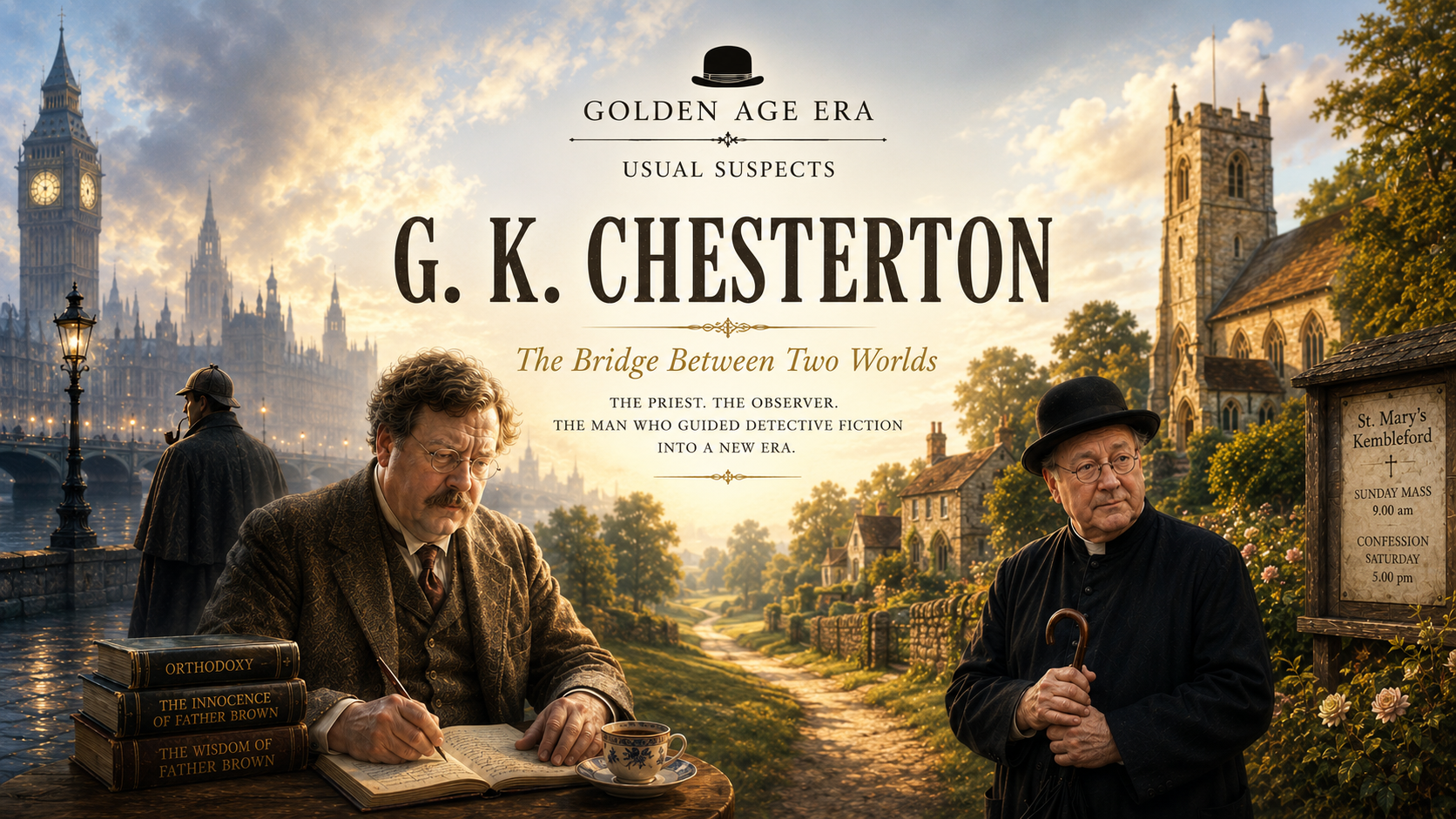
The Bridge Between Two Worlds
The gaslit streets of detective fiction had not disappeared yet.
Readers still followed brilliant investigators through crowded cities, shadowed alleyways, and dangerous corners of society. The great detective figures of the Sherlockian age continued to dominate the imagination.
But something was beginning to change.

The mysteries were growing quieter.
More intimate.
Less concerned with spectacle and more interested in the hidden weaknesses of ordinary people.
The world of detective fiction itself seemed to slow down.
The fog-covered city was no longer the only stage for mystery. Beyond it waited quieter places:
- old houses,
- small parishes,
- country roads,
- and closed circles where danger no longer came from criminal empires, but from the people sitting around the dinner table.
Detective fiction was slowly crossing into a new era.
And standing near that turning point was G. K. Chesterton.
Biography
G. K. Chesterton was born in London in 1874, at a time when detective fiction itself was still evolving. The great Victorian writers had already helped shape the foundations of the genre, and Sherlock Holmes would soon dominate popular imagination, but Chesterton grew into literature from a very different direction.

From an early age, he showed strong interests in art, literature, philosophy, and debate. Religious influences were also present in parts of his family background, including a maternal grandfather who had been a clergyman, an environment that may have helped shape some of the moral and spiritual questions that later appeared throughout his writing.
He studied at the Slade School of Art for a time, though writing gradually became the center of his life. Journalism soon became an important part of his career. He worked for major newspapers including the Daily News and later the Illustrated London News, where his essays, commentary, and observations helped establish him as one of the most recognizable literary voices of his era.
Physically imposing, energetic, and known for his sharp wit, Chesterton quickly developed a reputation as both a writer and public intellectual. He wrote constantly and moved easily between politics, religion, social criticism, history, poetry, fantasy, literary criticism, and fiction
Chesterton was also known for his strong opinions and willingness to challenge ideas he considered dangerous or dehumanizing. During a period when eugenics gained support among some political and intellectual figures, he openly criticized attempts to treat human beings as social problems to be managed scientifically.
As the years passed, spiritual and philosophical questions became increasingly important in his life and writing. Chesterton eventually converted to Catholicism in 1922, a decision that would strongly influence many of his later works and ideas.
Yet beneath the public debates and larger-than-life personality was a writer deeply interested in human behavior and moral contradictions. Chesterton was fascinated by the fears, weaknesses, pride, and hidden motives that shaped ordinary people.
Those interests would eventually become central to the detective fiction for which he is now best remembered.
Rather than focusing only on sensational crimes or dramatic displays of deduction, Chesterton approached mystery stories through psychology, morality, symbolism, and human nature itself. In doing so, he helped guide detective fiction away from the purely dramatic adventures of the Sherlockian age and toward the quieter, more intellectual mysteries that would soon define the Golden Age.
Literary Career and Other Works
Before becoming closely associated with detective fiction, G. K. Chesterton had already built an enormous literary career.
Essays, journalism, poetry, literary criticism, fantasy, biographies, social commentary, and religious writings all became part of his growing body of work. Chesterton wrote constantly, moving easily between subjects and genres while developing a style filled with humor, paradox, and memorable observations.
He also became known for public debates and literary discussions with many of the important intellectual figures of his era, helping establish himself as one of the most recognizable English writers of the early twentieth century.


Among his best-known non-detective works was The Man Who Was Thursday, a strange and highly original novel blending mystery, philosophy, thriller, and surreal adventure. Even today, the book remains difficult to place neatly into a single genre.
Chesterton’s literary criticism was equally influential. His writings on Charles Dickens helped renew appreciation for the Victorian novelist during the early twentieth century and reflected Chesterton’s lasting interest in morality, society, and human character.
Yet for all the range of his writing, Chesterton would ultimately leave one of his most lasting marks through detective fiction.
Enter Father Brown
When G. K. Chesterton introduced Father Brown in The Innocence of Father Brown, readers encountered a detective very different from the brilliant investigators who had dominated earlier detective fiction.
Father Brown was not physically imposing, dramatically eccentric, or openly intimidating. Small, quiet, and often overlooked by the people around him, the priest appeared almost ordinary at first glance.
That appearance, however, concealed an unusually deep understanding of human nature.

Rather than relying mainly on scientific analysis or theatrical deductions, Father Brown approached mysteries through psychology, morality, observation, and personal insight. He paid attention to fears, pride, guilt, temptation, and the contradictions hidden beneath everyday behavior.
In many cases, criminals underestimated him completely.
Chesterton also gave his detective stories a tone that felt different from many earlier mysteries. The danger was often quieter, the settings more intimate, and the crimes closely tied to human weakness rather than vast criminal conspiracies or sensational adventures.
Instead of chasing criminals through crowded city streets or dramatic underworlds, Father Brown often found himself moving through small villages, isolated homes, quiet churches, private disputes, and seemingly ordinary encounters where guilt and violence hid beneath the surface of everyday life.
Yet despite the quieter tone, the stories remained intellectually playful. Chesterton filled the mysteries with paradoxes, hidden meanings, misleading appearances, and moral questions that challenged both the characters and the reader.
Over time, Father Brown would become one of the most recognizable detectives in mystery fiction and one of the important figures standing between the Sherlockian world and the fully developed Golden Age that followed.
Father Brown Stories and Collections
Over the years, G. K. Chesterton published multiple collections featuring Father Brown, gradually building one of the most recognizable detective series of the early twentieth century. Across five major collections and additional later material, Chesterton wrote more than fifty Father Brown stories.


The main Father Brown collections include:
- The Innocence of Father Brown
- The Wisdom of Father Brown
- The Incredulity of Father Brown
- The Secret of Father Brown
- The Scandal of Father Brown
Additional stories and unpublished material would later appear in collections assembled after Chesterton’s death, including:
- The Donnington Affair
- The Mask of Midas
Although individual stories varied in tone and complexity, the series consistently blended mystery, paradox, morality, and psychological insight in ways that helped distinguish Father Brown from many other detectives of the era.
What He Brought to Detective Fiction — Part I
G. K. Chesterton helped make detective fiction feel more human.
Before him, many mysteries focused heavily on criminal schemes, dramatic confrontations, brilliant deductions, or the pursuit of dangerous figures moving through crowded cities and shadowed streets. Chesterton kept the mystery and the intellectual game, but his stories often turned their attention toward something quieter:
human weakness.
Father Brown did not simply look for clues. He tried to understand people and the weaknesses that shaped them, whether it was fear, guilt, pride, greed, desperation, or self-deception.
In Chesterton’s stories, these human contradictions became just as important as footprints, missing objects, or locked rooms.
That approach gave Chesterton’s mysteries a very different atmosphere from many earlier detective stories. The crimes often felt smaller and more intimate on the surface, yet emotionally and morally they could become deeply unsettling.
Instead of focusing mainly on criminal masterminds or sensational adventures, Chesterton frequently explored the contradictions hidden inside seemingly ordinary individuals. In many Father Brown stories, the real mystery was not simply how the crime happened, but why someone crossed the line in the first place.
What He Brought to Detective Fiction — Part II
G. K. Chesterton also helped change the atmosphere of detective fiction.
Earlier mysteries often unfolded in dangerous cities filled with criminal networks, dramatic pursuits, and larger-than-life villains. Chesterton moved many of his stories toward quieter and more enclosed settings where tension came from ordinary people and the secrets they tried to hide.
In Father Brown’s investigations, mystery could emerge from a quiet parish, a family dispute, or a seemingly peaceful home hiding guilt, resentment, or deception beneath the surface.
That atmosphere would later become one of the defining features of the Golden Age. Villages, isolated communities, private homes, and carefully controlled circles of suspects would soon dominate much of detective fiction during the 1920s and 1930s.
At the same time, Chesterton kept a strong sense of playfulness within his mysteries through paradoxes, misleading appearances, and hidden meanings that constantly challenged the reader.
In many ways, Chesterton stood between two eras of detective fiction. The Sherlockian world had not vanished completely, but the foundations of the Golden Age were already beginning to appear.
What He Brought to Detective Fiction — Part III
G. K. Chesterton also introduced readers to a very different kind of detective.
Earlier investigators often stood out through dramatic intelligence, scientific demonstrations, or forceful personalities. Father Brown, by contrast, appeared quiet, ordinary, and easily overlooked.
That simplicity became one of his greatest strengths.
People often underestimated him, allowing him to notice the fears, contradictions, and hidden motives others failed to see. Instead of relying on spectacle or intimidation, Father Brown approached mysteries through patience, observation, and an understanding of human behavior.
In Chesterton’s stories, solving the crime was not only about discovering what happened, but understanding why someone crossed the line in the first place.
That quieter and more psychological approach helped shape many of the mystery traditions that would later flourish during the Golden Age.
Legacy and Influence — Part I
Long after his lifetime, G. K. Chesterton remained an important figure not only in detective fiction, but in English literary culture more broadly.
His essays, criticism, debates, and religious writings continued to be discussed well beyond the early twentieth century, while Father Brown secured a lasting place within classic mystery fiction.
Unlike many detective writers remembered mainly for a single character or series, Chesterton’s influence spread across several literary worlds at once, from criticism and philosophy to fantasy and journalism.
Legacy and Influence — Part II
Chesterton’s literary criticism also left a lasting mark.
His admiration for Charles Dickens was especially important at a time when some critics had begun to dismiss the Victorian novelist as outdated or overly sentimental. Through essays and criticism, Chesterton helped renew interest in Dickens and reintroduced many readers to the energy, humor, and humanity found in his work.
An article Chesterton later wrote for the Encyclopædia Britannica further reflected the respect he had earned as a literary critic and public intellectual during his lifetime.
Legacy and Influence — Part III
Chesterton’s influence also reached later writers and thinkers outside detective fiction.
His writings on philosophy, morality, and religion left a strong impression on several twentieth-century authors, including C. S. Lewis, who later acknowledged Chesterton as an important intellectual influence on his own spiritual journey and eventual conversion to Christianity.
Even readers who disagreed with Chesterton’s opinions often recognized the energy, wit, and originality of his ideas. His ability to combine humor, paradox, morality, and storytelling helped keep his work visible long after many of his contemporaries faded from public attention.
Legacy and Influence — Part IV
Within detective fiction, G. K. Chesterton helped shape the transition between the Sherlockian world and the quieter, more psychological mysteries that would later define much of the Golden Age.
His stories showed that detective fiction could remain intellectually playful while also becoming more intimate, philosophical, and deeply connected to human behavior. Mystery no longer depended only on brilliant deductions or dangerous criminal schemes. Ordinary people, hidden motives, moral contradictions, and quiet settings could become just as compelling.
That influence can still be felt in many later mysteries where atmosphere, character, and human weakness matter just as much as the puzzle itself.
Chesterton’s influence could also be seen directly within later Golden Age detective fiction. John Dickson Carr, one of the great masters of the locked-room mystery, greatly admired Chesterton and partly modeled his detective Dr. Gideon Fell on Chesterton himself.
Media and Adaptations — Part I
The Father Brown stories quickly moved beyond the printed page.
Over the decades, G. K. Chesterton’s detective appeared in radio dramas, films, television productions, stage adaptations, and audio recordings that introduced the character to new generations of audiences.

Some of the earliest adaptations emerged during the age of black-and-white cinema and radio. Among the best known was the 1954 film Father Brown starring Alec Guinness, whose quiet and reflective portrayal helped shape the character’s screen identity for many viewers. Guinness would later become associated with another famous intellectual investigator through his portrayal of George Smiley in adaptations of John le Carré’s spy novels.
An earlier black-and-white adaptation, Father Brown, Detective, featured Walter Connolly as Father Brown. Connolly would later go on to portray Nero Wolfe, creating another interesting link between classic detective adaptations of the period.

The stories also adapted naturally to radio dramas and audiobook productions. Their atmosphere, dialogue, and psychological tension translated well to audio, helping Father Brown remain present across multiple generations of listeners and viewers.
Media and Adaptations — Part II
Father Brown continued to appear in new adaptations throughout the second half of the twentieth century as interest in classic mystery fiction remained strong.
One notable television adaptation arrived in 1974 with Father Brown starring Kenneth More. The series introduced Chesterton’s detective to a new generation of television viewers while preserving much of the quieter and reflective atmosphere associated with the original stories.

The character also remained active through radio dramas and audio productions, where the dialogue-driven nature of the mysteries adapted especially well to sound. Audiobook editions and dramatized performances continued to keep Father Brown present for listeners long after the original stories were published.
Interest in the character later expanded internationally through additional adaptations, including the German series Pfarrer Braun, which reimagined the detective for modern audiences while still preserving the idea of a thoughtful priest uncovering secrets hidden beneath ordinary community life.

Decades after Chesterton first introduced Father Brown, the character continued to move naturally between print, radio, television, and recorded performances, showing the lasting flexibility and appeal of the stories across multiple generations.
Media and Adaptations — Part III
One of the most recognizable modern interpretations of Father Brown arrived with the long-running BBC series Father Brown starring Mark Williams, known to many viewers for playing Arthur Weasley in the Harry Potter films.
Beginning in 2013, the series grew into one of the most successful modern adaptations of a classic literary detective, running for well over a decade and producing more than 140 episodes.

While the show expanded and modernized parts of the original material, it preserved many of the qualities that made Chesterton’s detective distinctive, including quiet observation, moral insight, and an understanding of human nature that often allowed Father Brown to uncover truths others failed to see.
The success of the adaptation introduced Father Brown to a new generation of viewers, many of whom later discovered G. K. Chesterton’s original stories through the television series.
Over time, the BBC adaptation became one of the strongest modern connections between classic detective fiction and contemporary mystery audiences.
Media and Adaptations — Part IV
Father Brown’s influence also continued to appear outside traditional detective adaptations.
References to G. K. Chesterton and his detective stories appeared in later works of fiction, comics, and popular culture, showing how deeply the character remained connected to the broader history of mystery fiction.
Father Brown’s influence also extended into later detective fiction itself. References to the character appeared in works by other mystery writers, including Agatha Christie, whose Tommy and Tuppence stories briefly acknowledged Chesterton’s famous priest detective.
The character would also help inspire later religious and spiritual investigators in mystery fiction, many of whom followed the idea that understanding human nature could be just as important as solving the puzzle itself.
Chesterton himself even participated in the long literary fascination surrounding The Mystery of Edwin Drood, inviting fictional detectives including Father Brown to imagine solutions to Dickens’s unfinished mystery.
Chesterton’s cultural presence also extended beyond traditional detective fiction. In The Sandman, Neil Gaiman briefly connects an image of Chesterton to the character Gilbert/Fiddler’s Green, a small but memorable literary reference that reflects Chesterton’s continuing presence within later fantasy and literary culture.


Decades after the original stories were published, Father Brown remained recognizable not only as a classic literary detective, but as part of the larger cultural landscape surrounding mystery fiction itself.
Later Years and Death
In his later years, G. K. Chesterton remained active as a writer, lecturer, and public figure. Despite ongoing health problems, he continued producing essays, criticism, religious writings, and fiction while maintaining the energetic public presence that had made him one of the best-known literary voices of his era.
Chesterton was married to Frances Blogg, who remained an important part of his life and career for many years. The couple had no children.
Near the end of his life, Chesterton received additional public recognition when Pope Pius XI invested him as a Knight Commander with Star of the Papal Order of St. Gregory the Great, reflecting the importance his writings had achieved within Catholic intellectual life.
By the time of his death in 1936, Chesterton’s influence extended far beyond detective fiction. Writers, readers, critics, and public figures across several literary worlds recognized the impact of his work and ideas.
A memorial service was held for him at Westminster Cathedral before he was later buried in Beaconsfield, the town where he had spent many of his later years.
Conclusion
G. K. Chesterton never approached detective fiction in quite the same way as many of the writers around him.
Where others focused on brilliant deductions, dangerous criminals, or elaborate schemes, Chesterton looked inward. His mysteries explored fear, guilt, pride, morality, and the hidden contradictions within ordinary people. Through Father Brown, he helped show that detective fiction could remain intellectually playful while also becoming quieter, more reflective, and deeply human.
In many ways, Chesterton stood at the threshold between two great eras of mystery fiction. The fog-covered streets of the Sherlockian world still lingered in the distance, but the road toward the Golden Age had already begun to open.
And standing there, almost quietly, was a small priest who understood people better than they understood themselves.
Question for Readers
Do you see G. K. Chesterton more as the final great voice of the Sherlockian era… or as one of the first true writers of the Golden Age?
References and Suggested Reading
Works by G. K. Chesterton
- The Complete Father Brown Stories
- The Man Who Was Thursday
Detective Fiction and Literary Context
- The Golden Age of Murder
- Talking About Detective Fiction
- The Cambridge Companion to Crime Fiction
Adaptations and Media
- Father Brown — BBC adaptation starring Mark Williams
- The Sandman: The Doll’s House — 30th Anniversary Edition, DC Vertigo.
Previous: The Golden Age Era — The Usual Suspects
Next: The Four Queens of Crime: Agatha Christie








Hello Gumshoe! On the track or authors? leave us reply!