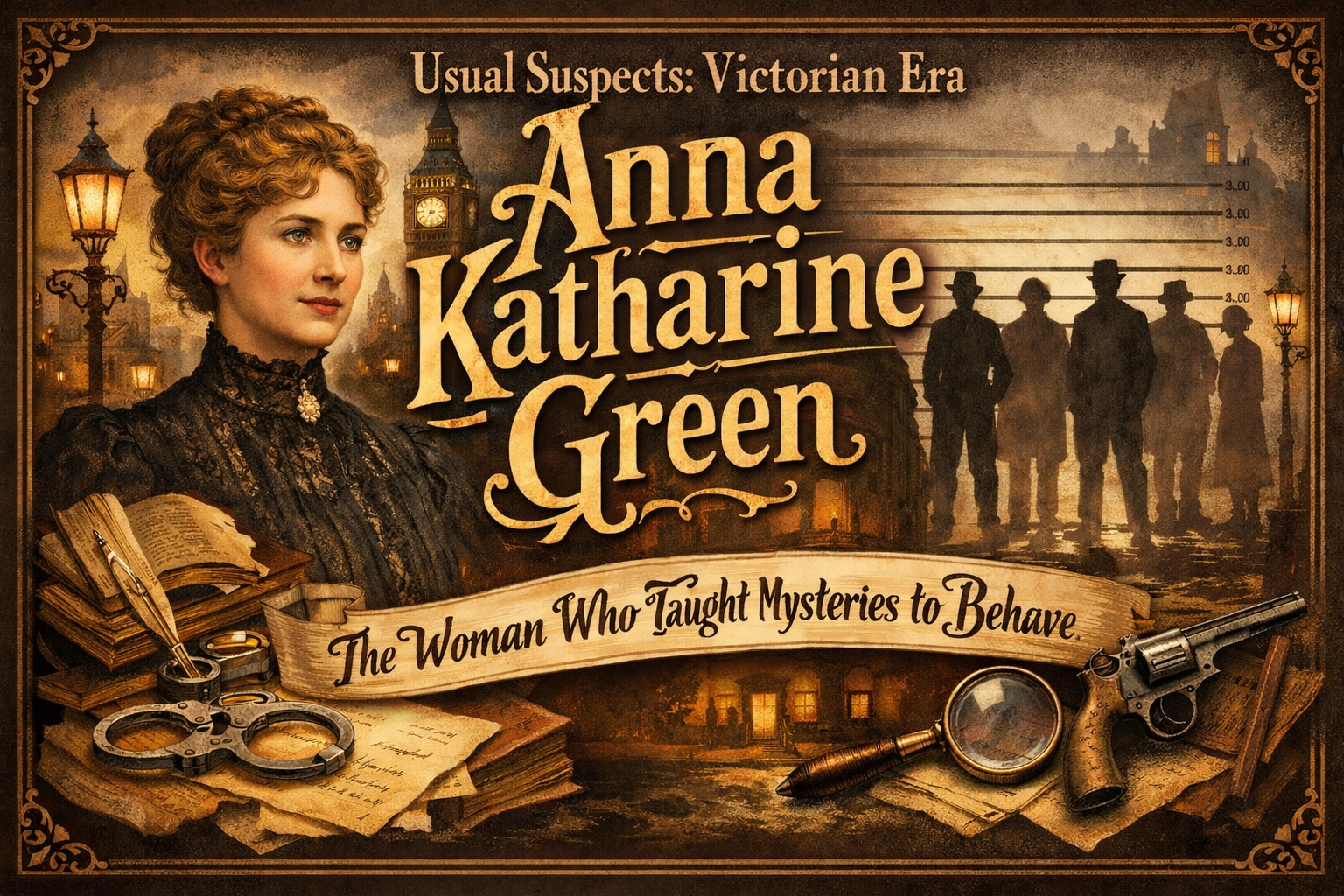
The Mother of the American Detective Novel

The Woman who taught Mysteries how to behave
Sherlock Holmes had not yet set foot on Baker Street. Detectives did not follow strict rules. Clues did not have to add up. Crime fiction did not pretend to be fair with its readers. An American woman quietly walked in and said, “Let’s do this right.”
Long before crime novels became a literary staple, Anna Katharine Green was crafting tightly plotted mysteries. She developed professional investigators and used courtroom logic and clue-based detection. Readers couldn’t get enough of it. Today, her name is less familiar to the general public, but her influence is everywhere. While she did not invent Crime Fiction, she DID discipline it. And once you see her fingerprints, you start spotting it everywhere.

Anna Katherine Green, three-quarter length portrait, seated, facing slightly right. , None. [Between 1870 and 1890] [Photograph] Retrieved from the Library of Congress, https://www.loc.gov/item/94510667/.
Biography: A Proper Victorian Mind with a Rebellious Pen
Anna Katherine Green was born in New York, in 1846, into a well-educated family. She grew up in a household where law and logic were part of everyday life. Her father was a well-known lawyer and poet. His work gave her early exposure to legal reasoning, courtroom procedures, and the mechanics of justice. This knowledge would later become central to her fiction.
Green was educated in the Ripley Female College in Vermont. She showed literary talent early on. However, like many women of her time, she faced limited professional options. Writing fiction became both an outlet and a career. In 1878, she published The Leavenworth Case. This novel would unexpectedly transform her life. It also changed the future of detective fiction in America.
The book was an immediate success, praised for its intricate plotting and realism. From that moment on, Green became a full-time writer. She produced dozens of novels and short stories. Her career spanned more than forty years. The Leavenworth Case is often credited as one of the first true detective novels in American literature.
British readers were embracing sensation novels and amateur sleuths. Meanwhile, Green was already treating detective fiction like a serious puzzle. It deserved precision, structure, and respect for the reader.
Her Detective Fiction: Order, Logic and Fair Play
The Leavenworth Case is often cited as the first truly successful American detective novel. It introduced readers to a complex murder investigation. Readers encountered multiple suspects and red herrings. The story included a methodical uncovering of truth. These are all elements we now take for granted.


Green believed mysteries should play fair. No magical revelations. No last-minute villains pulled from thin air. If the solution existed, the readers had already seen the pieces.
Green went on to write more than 30 detective novels, refining her style with each new case.
Key Detective novels
- The Leavenworth Case (1878)
- A Strange Disappearance (1880)
- Hand and Ring (1884)
- The Filigree Ball (1886)
- The Affair Next Door (1897)
- The Circular Study (1900)
Her stories emphasized:
- logical deduction
- Legal testimony
- Witness Statements
- motive and character psychology
- careful placement of clues
- Domestic spaces (Bedrooms, staircases, drawing room)
Green did not rely on coincidence or melodrama. She treated crime as a puzzle to be solved. She trusted her readers to follow along.
Meet Her Detectives: Before Holmes, Before Poirot
Ebenezer Gryce
Green’s most enduring investigator, Gryce is a professional police detective — observant, methodical, persistent and deeply experienced. Unlike the flamboyant detectives who would follow, Gryce works quietly, piecing together facts through persistence rather than showmanship.

Ebenezer Gryce is not a flashy detective—and that’s entirely the point.
He is a professional investigator, older, reserved, and quietly formidable. Gryce works methodically, favoring patience and accumulation of evidence over dramatic insight. He listens more than he speaks. He watches more than he acts. He rarely reveals his conclusions until the case forces his hand.
Physically, Green describes him as unassuming and somewhat stern, a man who blends easily into the background. He does not command attention through brilliance or eccentricity; instead, he earns authority through experience and persistence. Criminals underestimate him. Witnesses forget him. That is his advantage.
Gryce’s strength lies in:
- Careful observation
- Repetition of inquiry
- Legal and procedural knowledge
- Psychological understanding of motive
He is deeply grounded in real investigative work, often operating alongside lawyers, coroners, and courts. Unlike later fictional detectives, he does not exist outside the system—he is the system.
Importantly, Gryce is not infallible. He makes mistakes, revises conclusions, and relies on corroboration. This realism was radical for its time and set him apart from sensational or melodramatic sleuths of earlier fiction.
🧠 Why Gryce Matters
Ebenezer Gryce represents a turning point:
- One of the earliest recurring professional detectives in fiction
- A clear ancestor of procedural detectives
- A model that predates Sherlock Holmes by nearly a decade
- Proof that detective fiction could be methodical, serious, and credible
If Green taught detective fiction how to behave, Gryce showed what that behavior looked like in practice.
He set an important precedent: the detective as a working professional, not an eccentric outsider.
👒 Who Is Amelia Butterworth?
Amelia Butterworth first appears in That Affair Next Door (1897). From the start, she is nothing like the detectives who came before her. She is a respectable, middle-class, unmarried woman of society—precisely the person Victorian culture trained itself to ignore.


Green turns that invisibility into a weapon.

Amelia is intelligent, curious, opinionated, and deeply observant. She lives comfortably within the rules of polite society, but she does not accept them as limits on her mind.
She notices:
- Who doesn’t behave as expected
- Which social conventions are being bent—or broken
- What women say when men are not listening
- What people assume she cannot possibly understand
Her investigations rely less on formal authority and more on social access. Drawing rooms, parlors, staircases, servants’ corridors—these are her crime scenes.
🧠 A Different Kind of Detection
Amelia does not interrogate suspects.
She listens.
She does not demand answers.
She observes contradictions.
She is keenly aware of human behavior, especially the small hypocrisies and unspoken rules of Victorian life. Where male detectives often focus on physical evidence, Amelia excels at social evidence—tone, timing, discomfort, and motive hidden behind manners.
In many ways, she anticipates later Golden Age detectives who solve crimes by understanding people rather than overpowering them.
✨ Why Amelia Butterworth Matters
Amelia Butterworth is one of the earliest fully realized female detectives in fiction. She is not a novelty. She is not a gimmick. She is not a sidekick.
She is:
- Competent without apology
- Curious without being reckless
- Observant without being theatrical
Most importantly, she is taken seriously by the narrative itself, even when other characters underestimate her.
Green does not ask the reader to excuse Amelia’s intelligence. She simply lets it work.
Selected Quotations
Green’s writing is precise and deliberate, often reflecting her fascination with logic and justice:
“Circumstances are like facts; they are stubborn things.”
Her prose may be restrained, but it is always purposeful — every detail matters.
Did Anna Katharine Green Stay with Detective Fiction?
Yes — and decisively so.
Some Victorian writers experimented briefly with crime before moving on. Unlike them, Anna Katharine Green remained committed to detective fiction throughout her career. She continued writing detective novels well into the 20th century, producing 30 books in her career. While she did write poetry and occasional non-mystery works, her reputation and legacy were built squarely on crime and detection.
She never abandoned the genre she helped define until readership tastes began shifting towards faster-paced, more sensational mysteries.
Other Works & Media
Green’s novels were widely read in her lifetime and continued to circulate well into the early 20th century. Unlike Doyle and later Golden Age writers, her work has not been adapted as extensively as some of her successors. A few early silent-era movies existed, but most of her stories stayed on the page. Nonetheless, her stories influenced generations of crime writers. This influence is particularly strong in the United States.
While best known for Crime Fiction, Green did write:
- Poetry
- Short stories
- Occasional non-detective tales
Many of her novels are now available in public-domain editions.
Death: A quiet exit for a Foundational Mind.
Anna Katharine Green died in 1935 at the age of 88. By the time of her death, detective fiction had exploded into a global phenomenon. This success was built, in no small part, on foundations she helped lay decades earlier.
Why She Still Matters
Green proved that detective fiction could be:
- intellectually rigorous
- commercially successful
- grounded in realism
She influenced both male and female writers who followed, even if her name slowly faded from popular memory. Without Green, the evolution of American crime fiction would look very different.
She belongs firmly among the Victorian Usual Suspects.
References & Further Reading
- The Cambridge Companion to Crime Fiction
- Green, Anna Katherine: The Leavenworth Case(1878)
- The Penguin Book of Murder & Mysteries (Otto Penzler, ed.)
- Rzepka Charles J.: Detective Fiction
- The Rivals of Sherlock Holmes
- Encyclopedia Britannica entry on Anna Katherine Green
- Public-domain editions of The Leavenworth Case and later Gryce novels
Conclusion — The Mind Behind the Method
Anna Katharine Green didn’t just write mysteries—she taught the genre how to behave. Long before detective fiction became a game of logic and fair play, she laid down important standards. Clues must matter. Deductions must be earned. Readers deserve honesty from the author.
Her influence is everywhere, even when her name is not. Professional detectives, structured investigations, and psychologically grounded motives all trace back to her work. There is also the quiet confidence that a mystery can be solved.
If Victorian detective fiction is the foundation of the genre, then Anna Katharine Green helped pour the concrete. And it still holds.
🕵 Follow the Clues Back to the Source
By the time Anna Katharine Green had established the rules of modern detective fiction, the genre had been developed. It was ready for something else—a face.
Across the Atlantic, British writers took the logical framework Green helped define. They began shaping detectives who were not just competent, but unforgettable. The Victorian era in Britain would transform method into mythology, turning investigation into character—and detectives into legends.
📚 Start with The Leavenworth Case and see how modern detective fiction began taking shape.
🔍 Then explore the Victorian era further. Familiar names shine in this era. Quieter pioneers like Green reveal just how deep the roots really go.
The investigation continues.
← Previous: The Victorian Era – Usual Suspects
Next →: Arthur Morrison
One response to “The Usual Suspects: The Victorian Era: Case #005: Anna Katharine Green”
-
[…] Anna Katharine GreenThe detective fiction of this era was the most fully formed. It included legal reasoning. There were recurring investigators and carefully structured cases. […]








Hello Gumshoe! On the track or authors? leave us reply!