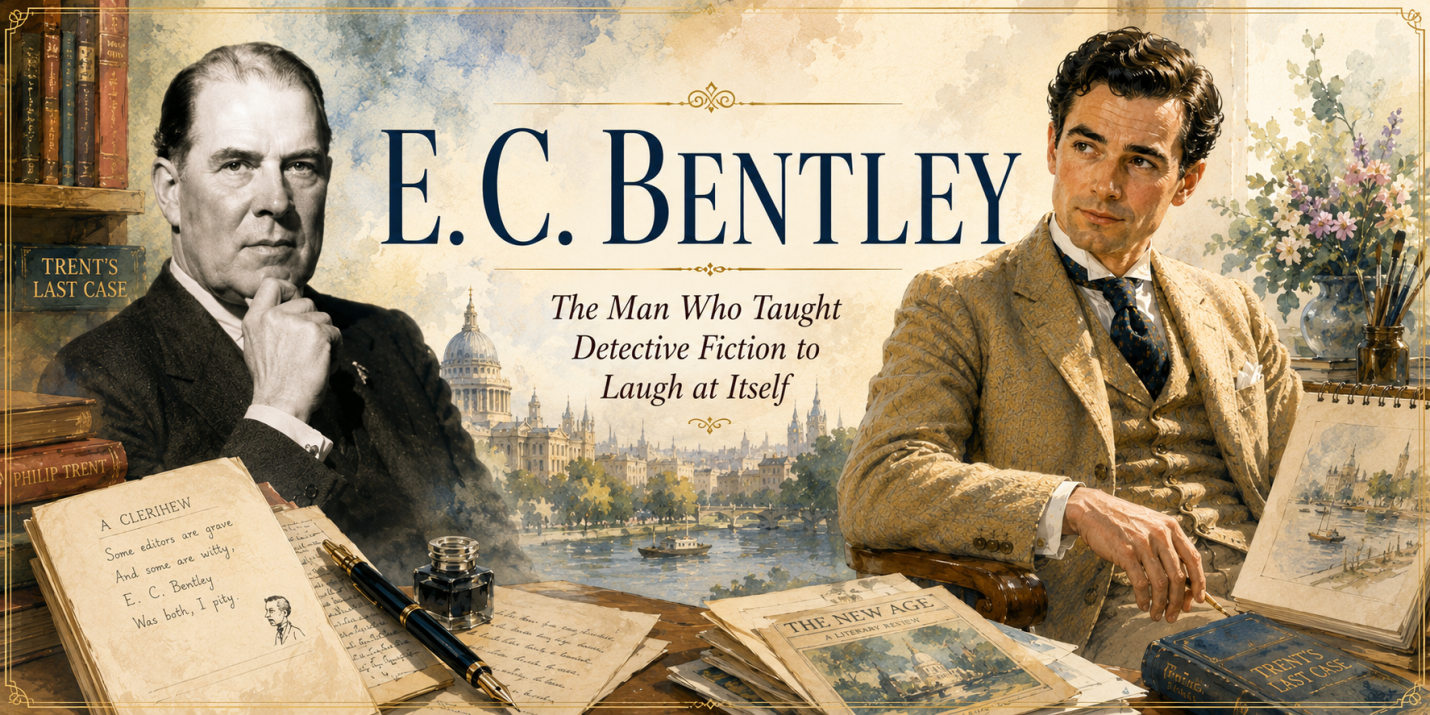
The Man Who Taught Detective Fiction to Laugh at Itself
Introduction
Detective fiction has always loved certainty. A crime is committed, clues are gathered, and a brilliant investigator arrives to reveal the truth. The mystery is solved, order is restored, and the reader is left with the comforting sense that everything makes perfect sense.
E. C. Bentley admired that tradition, but he also saw room to play with it. Writing at the beginning of the twentieth century, he approached detective fiction with intelligence, humor, and a willingness to question some of its assumptions. The result was a body of work that left a lasting impression on the genre and helped influence many of the writers who followed.
Although Bentley never became as famous as some of the great names of the Golden Age, his place in detective fiction history remains secure. Sometimes an author is remembered not for the number of books they wrote, but for the fresh perspective they brought to the genre.
Biography
Edmund Clerihew Bentley was born in London on July 10, 1875. He attended St Paul’s School before continuing his studies at Merton College, Oxford. While there, he formed a friendship with a fellow student named G. K. Chesterton. The two men shared a love of literature, humor, and debate, and their friendship would continue for decades.

After graduating, Bentley entered journalism, a profession that would remain central to his career. He worked for several newspapers, including the Daily Telegraph, earning a reputation as a skilled writer and observer. Journalism provided a steady living, but it was only one part of his literary life.
Bentley first gained public attention through humor rather than mystery. While still a young man, he created a playful poetic form that became known as the clerihew, a short four-line poem that humorously reimagined famous historical and literary figures. The form was introduced to a wider audience in Biography for Beginners (1905), a collection that helped establish Bentley’s reputation as a witty and original literary voice. He later returned to the format in More Biography (1929) and Baseless Biography (1939), ensuring that the clerihew remained closely associated with his name throughout his career.
His literary interests extended beyond poetry. Bentley wrote essays, criticism, and journalism, building a reputation as a thoughtful commentator and man of letters long before readers associated his name with detective fiction. By the early twentieth century, he was already well established in London’s literary circles. Detective fiction was only one of many interests, but it would eventually become the work for which he is best remembered.
In 1913, Bentley turned his attention to detective fiction. The novel that followed would introduce a memorable investigator and help establish Bentley as one of the important transitional figures between the age of Sherlock Holmes and the Golden Age of detective fiction.
Meet the Detective: Philip Trent
Philip Trent seems familiar at first glance. He is intelligent, observant, well educated, and capable of unraveling a complicated mystery. Readers encountering him for the first time might expect another great detective in the tradition of Sherlock Holmes.
Trent, however, is very much his own character.

An artist, journalist, and occasional investigator, he approaches mysteries with curiosity, common sense, and a distinctly human perspective. His background as an artist gives him an eye for detail, while his experience as a journalist encourages him to question appearances and seek out different points of view.
Trent appeared in only a handful of stories and novels, including Trent’s Last Case (1913), Trent’s Own Case (1936), written with H. Warner Allen, and Trent Intervenes (1938). Despite the small size of the series, the character left a lasting impression on detective fiction and helped secure Bentley’s place in the history of the genre.
Essential Cases of Philip Trent
Readers looking to explore Bentley’s detective fiction do not need to tackle a long series. Philip Trent appeared in only a small number of works, making it easy to experience the character’s complete career.
Trent’s Last Case (1913)
Bentley’s most famous novel and one of the most influential detective stories ever written. For most readers, this is the essential starting point.
Trent’s Own Case (1936)
Written with H. Warner Allen, this novel reunites readers with Trent more than two decades after his first appearance.
Trent Intervenes (1938)
A collection of short stories featuring Trent. Although less famous than the novels, it offers additional insight into Bentley’s detective and his approach to mystery fiction.
What He Brought to Detective Fiction
By the early twentieth century, detective fiction had already produced a number of brilliant investigators. These characters could spot clues others missed, follow complex chains of logic, and arrive at solutions with remarkable confidence. Readers admired them, and many writers followed the formula with great success.
Bentley took a different approach.
Rather than presenting the detective as an infallible genius, he emphasized the role of assumptions, emotions, and simple human error. Intelligence remained important, but even the cleverest investigator could reach the wrong conclusion.
This shift allowed Bentley to introduce a subtle sense of humor into detective fiction. He respected the genre and its traditions, yet he was willing to gently question some of its assumptions. The detective story could still be clever and satisfying without treating its investigators as flawless masters of deduction.
In many ways, Bentley taught detective fiction that it was acceptable to smile at itself. His stories demonstrated that mystery novels could remain fair, intelligent, and entertaining while also acknowledging the limitations of their heroes. That perspective would influence many of the writers who helped define the Golden Age.
His greatest contribution was not a particular detective, clue, or plot device. It was a fresh way of looking at the detective story itself.
Walked Away?
Not exactly.
Unlike many Golden Age writers, Bentley never devoted his career entirely to detective fiction. Journalism, poetry, essays, and literary criticism remained important parts of his professional life, and he continued to write in a variety of forms throughout his career.
There is little evidence that he abandoned detective fiction out of frustration or dissatisfaction. Instead, mystery writing seems to have occupied a place alongside his many other literary interests. While other authors built large fictional worlds around recurring detectives, Bentley remained a writer whose attention was divided across several genres.
In the end, Bentley’s reputation would come to rest largely on a single detective novel. For many writers, that might have been a limitation. For Bentley, it was enough to secure a lasting place in the history of the genre.
Legacy and Media
Although E. C. Bentley never achieved the commercial success of some Golden Age writers, his influence on detective fiction was considerable. Trent’s Last Case earned the admiration of many authors who would go on to define the genre, including Agatha Christie, Dorothy L. Sayers, Ronald Knox, and R. Austin Freeman. Their praise helped secure Bentley’s reputation as one of the key figures linking the Sherlock Holmes era to the Golden Age.
His standing within the mystery community was reflected in his connection to the Detection Club. Following the death of G. K. Chesterton, Bentley succeeded his friend as president of the organization, a position that reflected the respect he enjoyed among fellow crime writers.
Bentley’s most famous novel also found success beyond the printed page. Trent’s Last Case was adapted several times for film, including a 1929 version directed by Howard Hawks and a 1952 adaptation starring Orson Welles, Michael Wilding, and Margaret Lockwood. More than simple curiosities, these productions helped keep Bentley’s best-known work in the public eye long after its original publication.

Today, Bentley is remembered not for the size of his bibliography but for the lasting impact of a single novel. His work demonstrated that detective fiction could be clever, entertaining, and self-aware all at once. More than a century after its publication, Trent’s Last Case remains one of the landmark novels of the genre.
Later Years and Death
Bentley remained active as a writer throughout his later years, continuing to contribute journalism, essays, and literary criticism while maintaining his place within Britain’s literary community. Although detective fiction brought him lasting recognition, it remained only one part of a career that spanned several forms of writing.
He outlived many of the literary figures who had shaped his early career, including his close friend G. K. Chesterton. As the decades passed, Bentley witnessed detective fiction evolve from the era of Sherlock Holmes into the Golden Age and beyond.
Edmund Clerihew Bentley died on March 30, 1956, at the age of eighty. By the time of his death, he had earned the respect of both readers and fellow writers, securing a place among the important figures in the history of detective fiction.
Conclusion
E. C. Bentley occupies a unique place in detective fiction. He was not the most prolific writer of mysteries, nor did he create a long-running series that dominated bookshelves for decades. Yet his influence on the genre far exceeded the size of his bibliography.
Through Philip Trent and his approach to the detective story, Bentley helped introduce a greater sense of humanity, humor, and self-awareness into mystery fiction. In doing so, he challenged assumptions that many readers took for granted and helped prepare the way for the Golden Age that followed.
More than a century after his most famous novel first appeared, Bentley remains an important reminder that sometimes a fresh perspective can change a genre as effectively as an entire library of books.
Can a detective still be brilliant if they are capable of making mistakes?
Primary Sources
- Bentley, E. C. Trent’s Last Case. Various editions.
- Bentley, E. C. Trent’s Own Case (with H. Warner Allen). Various editions.
- Bentley, E. C. Trent Intervenes. Various editions.
- Bentley, E. C. Biography for Beginners. 1905.
- Bentley, E. C. More Biography. 1929.
- Bentley, E. C. Baseless Biography. 1939.
Secondary Sources
- Edwards, Martin. The Golden Age of Murder.
- James, P. D. Talking About Detective Fiction.
- Scaggs, John. Crime Fiction.
- Rzepka, Charles J. Detective Fiction.
- Spehner, Norbert. Le Détectionnaire.
Online Resources
- Encyclopaedia Britannica – E. C. Bentley.
- The Detection Club.
- Shedunnit – “Trent’s Last Case.”
Previous: Freeman Wills Crofts
Next: H. C. Bailey








Hello Gumshoe! On the track or authors? leave us reply!