The Writers Who Made Crime Fiction Hard-Boiled
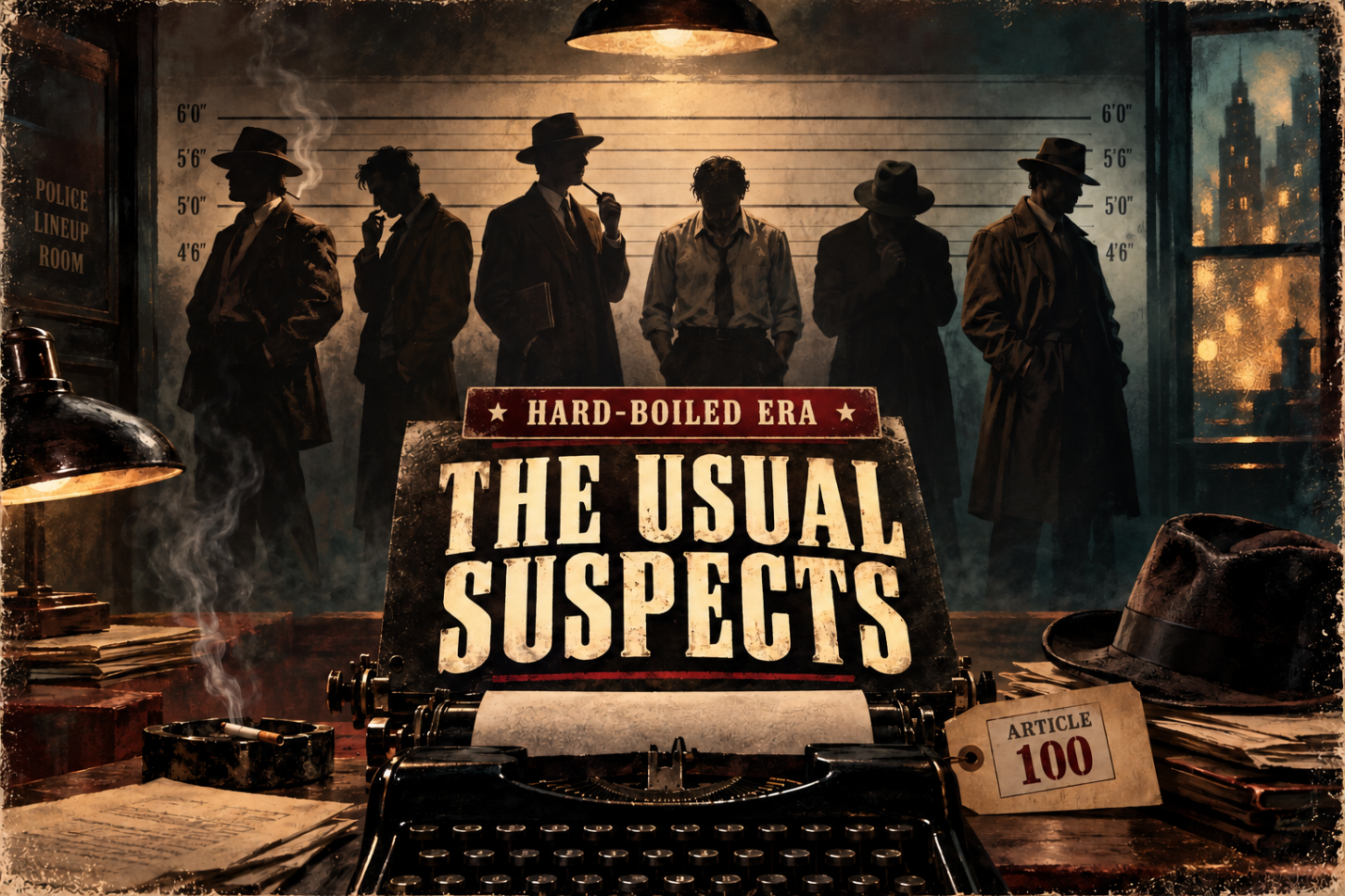
Put hard-boiled, noir and pulp crime fiction in a police lineup, and certain faces are impossible to miss.
Carroll John Daly is there near the beginning, giving the hard-boiled detective one of his earliest unmistakable forms in Race Williams. Dashiell Hammett follows, stripping the crime story of its remaining illusions and giving it a new authority. Raymond Chandler brings poetry to its toughness. James M. Cain sends ordinary people down roads from which there is no return, while Cornell Woolrich transforms suspense into a waking nightmare. Mickey Spillane makes the whole thing louder, angrier and impossible to ignore.
They did not all write from the same perspective. Some followed private detectives through corruption and violence; others stayed close to criminals, victims and desperate people trapped by desire, fear or their own mistakes. The distinctions between hard-boiled fiction, noir and pulp are important, but they are best understood through the writers who shaped them.
These are the names that still define the territory.
Article One Hundred
There is something fitting about reaching the Detective Authors Archive’s one-hundredth article here.
The trail has already taken us through the earliest experiments in detective fiction, the mysteries of the Victorian period, the long shadow cast by Sherlock Holmes and the elaborate puzzles of the Golden Age. We have followed celebrated detectives, recovered forgotten investigators and looked behind the names of authors who were not always quite who they appeared to be.
Each period changed the detective story, introducing new investigators, new rules and new ways for readers to follow the trail.
But hard-boiled fiction brought a different kind of energy to the investigation.
Its foundations were laid while the Golden Age mystery was still flourishing. This was not one tradition ending neatly before another began. The country-house puzzle and the hard-boiled crime story developed alongside one another, responding to different surroundings and different anxieties. One offered the hope that disorder could be studied and corrected. The other was far less certain that corruption ended when the murderer was identified.
The hard-boiled detective could solve a case without solving the world that produced it.
That tension gave the fiction its power.
Hard-Boiled, Noir and Pulp
The three terms are often placed together, but they are not interchangeable.
Pulp first describes the inexpensive magazines in which enormous quantities of popular fiction appeared. Their pages carried adventure, westerns, horror, science fiction, romance and crime. They offered writers room to experiment, repeat, sharpen and sometimes completely transform familiar ideas. Much of the material disappeared with the magazines that printed it. Some of it altered crime fiction forever.
Hard-boiled fiction developed a recognisable voice and attitude within that world. Its investigators were rarely protected observers. They were threatened, deceived, beaten and occasionally corrupted by the cases they pursued. Action mattered, but so did endurance. The detective continued because someone had to keep asking questions—even when the answers offered little comfort.
Noir turned the angle of vision. Its central figure might not be a detective at all, but a criminal, a victim, an accomplice or an otherwise ordinary person making one ruinous choice after another. The question was no longer simply whether the truth could be uncovered. Sometimes the real question was whether anyone could escape what had already been set in motion.
The boundaries between these traditions were never secure. Pulp supplied the marketplace. Hard-boiled fiction supplied some of its most enduring voices. Noir carried its fatalism into novels, films and the wider cultural imagination. Writers moved between them, borrowed from them and complicated every definition devised to contain them.
That is exactly why the territory remains so compelling.
The Names That Remained
The Usual Suspects are not simply the bestselling writers of their period, nor are they all equally familiar today. They are here because their work left fingerprints.
Carroll John Daly helped establish the hard-boiled private eye before the form had settled into its familiar shape. Hammett demonstrated what the new crime story could accomplish in the hands of a writer who understood violence, corruption and human weakness. Chandler created a voice so distinctive that generations of imitators followed it. Cain proved that a powerful crime novel required neither a professional detective nor the promise of justice. Woolrich found terror in chance, isolation and time running out. Spillane created a private eye whose fury reflected a harsher postwar mood.
Others would deepen the psychological wounds, follow crime into changing suburbs and cities, or reshape the private investigator for a new generation. Some refined the form. Some challenged it. Some made it respectable, while others made respectability beside the point.
Together, they gave crime fiction characters, voices and patterns that it continues to revisit.
The Lineup Begins
The writers ahead were not the only people walking these streets. Beyond them wait pioneers who have been pushed into the background, pulp authors whose enormous output has nearly vanished, and distinctive voices that never received the lasting recognition given to their more famous contemporaries. Their turn will come in Forgotten Footprints.
Other entries will examine names, partnerships and identities that require a closer look behind the mask.
After one hundred articles, the investigation is far from over.
The Usual Suspects are ready for questioning.








Hello Gumshoe! On the track or authors? leave us reply!