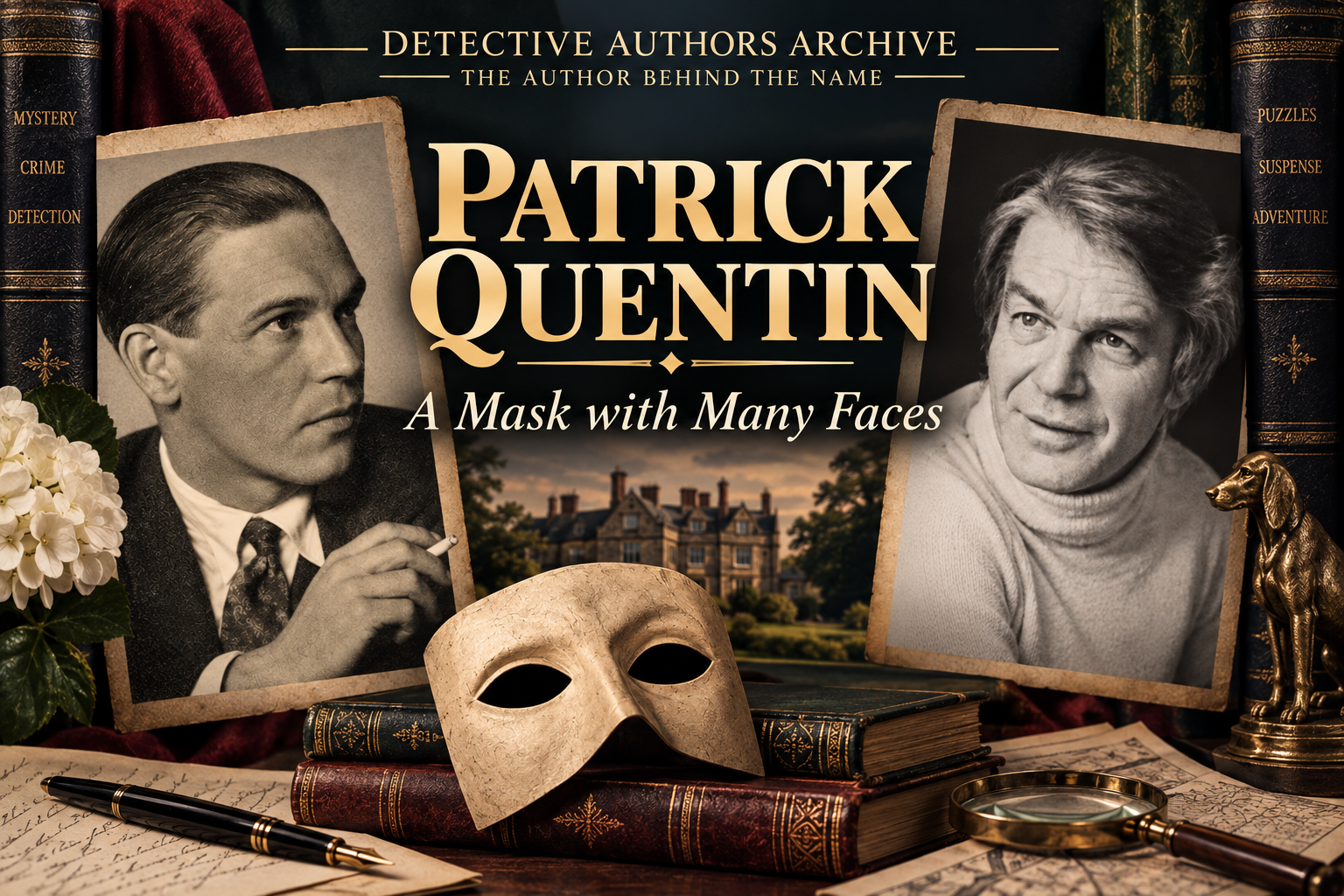
A Mask with Many Faces
Pick up a Patrick Quentin mystery and the name on the cover looks straightforward enough. An author, a title, a murder waiting to be solved.
Except Patrick Quentin was never quite that simple.

Behind the name stood a changing group of writers, other pseudonyms, several very different detectives and a partnership that would eventually leave just one man carrying the identity forward.
For once, the first mystery is not inside the book.
It is the name on the cover.
First Face: Richard Wilson Webb
The story of Patrick Quentin does not begin with Patrick Quentin.
It begins with Richard Wilson Webb.
Born in England in 1901, Webb eventually crossed the Atlantic and settled in the United States, where he pursued a career far removed from murder mysteries. He worked in the pharmaceutical industry in Philadelphia, becoming an executive while beginning, almost simultaneously, a second career in crime fiction.

In 1931, Webb joined forces with Martha Mott Kelley to write Cottage Sinister. But the novel did not appear under either of their names. Instead, they created a new author: Q. Patrick.
Even that first mask carried something of its creators inside it. Kelley was known as “Patsy,” Webb as “Rick” or “Rickie,” and “Patrick” grew out of the combination of their nicknames. The mysterious Q was added largely because Webb liked it — he considered it an unusually intriguing letter.
The partnership did not last. Kelley married and withdrew from the collaboration, while Webb kept both his interest in detective fiction and the name they had created together.
Q. Patrick did not disappear when one of the people behind the name walked away.
Instead, Webb found another face to put behind the mask.
The Changing Face of Q. Patrick
With Q. Patrick established, Richard Wilson Webb began building a career behind the name. But unlike an ordinary pseudonym, Q. Patrick would never belong neatly to a single writer.
After Martha Mott Kelley left, Webb worked briefly with Mary Louise White Aswell and also wrote independently. The name remained constant even as the authorship behind it changed.
Then, in the mid-1930s, Hugh Callingham Wheeler joined Webb. Their partnership would prove far more enduring—and Q. Patrick would soon be only one of the names they shared.
Second Face: Hugh Callingham Wheeler
Hugh Callingham Wheeler was born in London in 1912, eleven years after Richard Webb. Like Webb, he eventually crossed the Atlantic and made his life in the United States, becoming an American citizen in 1942.

Wheeler’s path to crime fiction was not an obvious one. He worked in a variety of jobs before writing became his profession, but by the mid-1930s he had entered Webb’s orbit and begun collaborating with him under the Q. Patrick name.
The partnership proved much more durable than Webb’s earlier collaborations. Wheeler was not simply another temporary contributor to an established pseudonym. As the two men worked together, their literary partnership expanded, and with it came new names, new detectives, and increasingly ambitious novels.
Eventually, Wheeler would become the more important of the two to the survival of Patrick Quentin. But in the beginning, he was the newcomer—joining a writing identity that Richard Webb had already been wearing for several years.
A New Name: Patrick Quentin
By 1936, Webb and Wheeler were ready to add another name to their growing collection of identities. Patrick Quentin made his appearance with Puzzle for Fools.
The new pseudonym also brought a new detective world. At its centre was Peter Duluth, a Broadway producer recovering from alcoholism in a private hospital when murder intrudes upon his treatment. Peter would soon be joined by Iris, and together they became the characters most closely associated with Patrick Quentin.
The choice of a new name did not mean that Q. Patrick was being abandoned. Webb and Wheeler continued to use it, while Patrick Quentin developed alongside it. Before long, another pseudonym—Jonathan Stagge—would join them.
What had begun with one shared name was becoming something closer to a small stable of imaginary authors, each attached to a different corner of Webb and Wheeler’s crime fiction.
And Patrick Quentin would be the one that lasted.
Behind Another Name: Jonathan Stagge
Patrick Quentin was not the last name Webb and Wheeler would put on a book.
Also in 1936 came Jonathan Stagge, another shared pseudonym and another distinct branch of their detective fiction. If Patrick Quentin became associated principally with Peter and Iris Duluth, Jonathan Stagge would become the name attached to Dr. Hugh Westlake, a country doctor repeatedly drawn into murder investigations.
The arrangement could easily look bewildering from the outside. Q. Patrick, Patrick Quentin and Jonathan Stagge appeared to be three different crime writers. Behind them, however, stood overlapping combinations of the same writers, with Webb and Wheeler at the centre of the increasingly elaborate arrangement.
Nor were the three names simply interchangeable labels. Each developed its own characters and series, allowing Webb and Wheeler to move between different kinds of detective story without crowding everything beneath a single signature.
Of the three masks, Patrick Quentin would ultimately prove the most durable. But for a time, all three existed side by side—three apparent authors occupying the shelves where considerably fewer real ones stood.
Meet the Detectives: Peter and Iris Duluth
Peter Duluth enters detective fiction at one of the lowest points of his life. A successful Broadway producer, he has been devastated by the death of his first wife in a fire and has turned to alcohol to cope. When Puzzle for Fools opens, he is undergoing treatment in a private psychiatric hospital, frightened, vulnerable and very far from the emotionally detached amateur sleuth.
It is there that he meets Iris Pattison. She has troubles of her own, having entered the hospital after witnessing her father’s suicide. Their relationship therefore begins not with the usual sparkling society encounter of the period, but with two damaged people meeting while each is trying to recover. Iris later becomes an actress in one of Peter’s theatrical productions, and by the end of their second case she becomes Iris Duluth.

Marriage does not turn them into a conventional husband-and-wife detective team. Peter generally narrates, and murder is intensely personal to him. He rarely investigates simply because a puzzle has caught his intellectual interest: again and again, he becomes involved because he, Iris, or someone he cares about is threatened or suspected. His emotional involvement—and the possibility that he could lose what he has rebuilt—gives his investigations an urgency quite different from the cool reasoning of many Golden Age detectives.
Iris is no decorative Watson. She has a strong appetite for investigation herself and is quite capable of following a mystery even when Peter would prefer that she did not. Their marriage is also unusually adult for the period. They tease, argue and worry about one another, but their physical attraction is openly part of their relationship. Contemporary and later commentary has repeatedly singled out the combination of witty dialogue, romantic and sexual tension, and darker subject matter in the Duluth novels.
Nor do Peter and Iris remain frozen in place between cases. Peter serves during the Second World War; the couple endure separation, reunion, jealousy and serious strains on their marriage. Later books increasingly put their relationship itself under pressure. The mysteries consequently follow not only a succession of murders but the changing life of a couple over many years.
The theatre remains Peter’s natural world, but perhaps the most distinctive thing about the Duluths is that neither is invulnerable. Peter and Iris can be frightened, compromised, jealous, mistaken and endangered. They don’t stand comfortably outside the crime and explain it.
More often, they are caught inside it.
Notable Cases
Puzzle for Fools (1936) — The beginning: Peter’s treatment, his vulnerability and his first meeting with Iris.
Puzzle for Players (1938) — Murder enters Peter’s professional world, bringing the mystery into the theatre and Broadway environment that will remain central to the Duluths.
Puzzle for Fiends (1946) — Peter’s psychological vulnerability becomes part of the mystery itself as memory loss leaves him unable to trust completely what he knows—or what he may have done.
Puzzle for Pilgrims (1947) — The Duluth marriage comes under serious strain, showing how far Peter and Iris have travelled from the two damaged strangers who first met in Puzzle for Fools.
Meet the Detectives: Dr. Hugh Westlake and Dawn
Dr. Hugh Cavendish Westlake is a country doctor rather than a professional detective. A widower living in the small community of Kenmore, he knows the sort of place where a physician is admitted into homes, hears family confidences and encounters people at their most vulnerable. Murder is hardly part of his practice, but his position gives him an unusually intimate view of the lives around him.
Westlake is not alone on his investigations. His young daughter Dawn is one of the most distinctive features of the series. Ten years old when the stories begin, she is precocious, energetic and irrepressibly curious—the sort of child Spehner aptly describes as a hurricane. Webb and Wheeler themselves were considerably less sentimental: in the earlier books, Westlake sometimes calls her “Brat.”

Dawn is more than comic relief or a child conveniently left behind while her father investigates. Her curiosity repeatedly carries her into the mysteries, sometimes accidentally supplying information her father needs and sometimes becoming directly involved in uncovering the truth. Her presence also changes Westlake himself. He may be the rational doctor examining clues, but he is simultaneously a father responsible for a daughter who has an alarming talent for getting close to danger.
There is a professional policeman in their world as well: Inspector Cobb, Westlake’s friend and frequent ally. But Westlake’s medical background gives him his own route into an investigation. He observes people as a physician as much as a detective, while his respectable profession makes his presence in homes and communities seem natural rather than intrusive.
The Westlake mysteries also inhabit a somewhat darker landscape than the domestic father-and-daughter arrangement might suggest. Rural settings, isolated communities and touches of the macabre or eerie repeatedly surround their investigations. Against that atmosphere, Dawn supplies energy and humour without making the danger disappear.
Over nine novels, Dawn grows from about ten to twelve while her father remains the steady centre of their unusual partnership. He brings medical knowledge, experience and adult judgment.
Dawn brings the hurricane.
Notable Cases
Murder Gone to Earth (1936) — The beginning of the series, establishing Westlake, Dawn and the small-community world in which their investigations will unfold.
Turn of the Table (1940) — Séances and apparently supernatural menace give the mystery an eerie atmosphere while Westlake himself becomes personally compromised.
The Scarlet Circle (1943) — A particularly macabre entry, using graves, mysterious circles and strange lights to push the Westlake series toward Gothic territory.
Death’s Old Sweet Song (1946) — A series of murders patterned around the old song “Green Grow the Rushes, O,” with Dawn herself contributing an important piece of information to the investigation.
Meet the Detective: Timothy Trant
Lieutenant Timothy Trant of the New York City police seems, at first glance, almost too polished for the homicide squad. Born into a well-to-do family and the son of a physicist, he was educated at Princeton and trained as a lawyer before abandoning the law for police work. Murder—and particularly the behaviour of murderers before they are caught—proved considerably more interesting to him.
Trant is handsome, well dressed, socially assured and entirely at ease among the wealthy people who frequently populate his cases. He can move through their drawing rooms and parties without looking like an outsider who has arrived to ask awkward questions. The result is an unusual kind of policeman: part homicide detective, part gentleman sleuth, with the authority of the badge hidden beneath considerable charm.

But the charm can be deceptive. Trant’s investigations are persistent and carefully controlled, and he does not always allow the people around him—or the reader—to know what he is thinking. His questioning can appear to point relentlessly toward one suspect, sometimes an apparently innocent one, while his real target remains concealed until he is ready to reveal it.
That makes him markedly different from Peter Duluth. Peter is emotionally caught inside his mysteries; Trant arrives to untangle them. Where Peter can be frightened, compromised or desperate, Trant generally retains control, observing the weaknesses and evasions of the people around him with intelligence, wit and a degree of sympathy. Even those guilty of murder can interest him as human beings rather than merely names awaiting arrest.
Trant also proved unusually portable. He began under the Q. Patrick name, but he did not remain confined there. He later crossed into novels published as Patrick Quentin, sometimes entering Peter Duluth’s world itself. In that sense, Trant became a thread running between two of the identities Webb and Wheeler had created.
Peter and Iris stumble into murder. Hugh Westlake encounters it in the community around him.
Timothy Trant goes looking for the murderer.
Notable Cases
Death for Dear Clara (1937) — An early Trant case that establishes the polished professional policeman operating comfortably among socially prominent suspects.
Death and the Maiden (1939) — A strong example of the social and psychological side of Trant’s investigations, with respectable appearances concealing considerably less respectable motives.
Return to the Scene (1941) — Trant works backward through an earlier crime, emphasizing patient questioning and psychological investigation rather than personal involvement.
The Man with Two Wives (1955) — A later Trant investigation from Wheeler’s solo period, by which time the detective had migrated from Q. Patrick to the surviving Patrick Quentin name.
The Partnership Behind the Names
For more than a decade, Richard Webb and Hugh Wheeler maintained an unusually productive collaboration. Novels and short stories appeared regularly, while their fiction gradually became more ambitious. The puzzle remained important, but character, emotion and psychology increasingly moved closer to the centre of the crime.
The partnership itself was changing as well.
During the 1940s, Webb’s contribution began to diminish and Wheeler assumed an increasingly large share of the writing. The change was gradual rather than abrupt, but by the end of the decade the elaborate arrangement they had built together was beginning to contract.
Jonathan Stagge was the first major casualty. The Three Fears (1949) brought Hugh Westlake and Dawn’s nine-novel series to an end. Q. Patrick followed soon afterward, with Danger Next Door marking the end of the novels published under that name.
By the early 1950s, Webb had withdrawn from writing altogether. A collaboration that had produced detective fiction for more than fifteen years was over.
But the author they had created together did not disappear with it.
Patrick Quentin remained—and Hugh Wheeler was now alone behind the name.
What They Brought to the Crime Scene
The different detectives Webb and Wheeler created gave them more than a collection of recurring characters. They provided three distinctly different ways of entering a murder mystery.
Peter and Iris Duluth live inside the crime. Their investigations threaten their marriage, their careers, their friends and sometimes Peter’s own understanding of himself. The solution matters, but so does what surviving the mystery will cost them.
Hugh Westlake and Dawn encounter murder through the world around them. Westlake’s profession gives him access to homes, illnesses and confidences, while Dawn’s irrepressible curiosity carries her through boundaries that adults might hesitate to cross. Their cases bring murder into family and community.
Timothy Trant approaches it from the opposite direction. He is the professional outsider who arrives because a crime has been committed. Controlled, socially polished and psychologically observant, he enters other people’s lives deliberately and begins pulling at their secrets.
Across those different approaches, Webb and Wheeler increasingly allowed emotion and psychology to share the stage with the puzzle. Their detectives could be frightened, compromised or personally invested in the outcome. Relationships changed. Consequences carried from one book to another.
The mystery was still there to be solved.
But the people solving it no longer had to stand safely outside it.
One Mask Left
By the early 1950s, Hugh Wheeler was writing alone.
Richard Webb’s withdrawal ended the partnership, but it did not end Patrick Quentin. Instead, Wheeler kept the name that had become the most durable of their shared identities and continued publishing beneath it.
The change behind the byline also brought a change in emphasis. The elaborate puzzle had never disappeared entirely, but Wheeler increasingly moved toward psychological suspense: troubled marriages, divided loyalties, jealousy, guilt and the possibility that danger might come from someone already close to the protagonist. Timothy Trant survived the transition, appearing in later Patrick Quentin novels, but Wheeler was no longer dependent on a continuing detective to hold the books together.
Patrick Quentin therefore outlived both the partnership and the system of multiple pseudonyms that had produced him. What had once been one name among several became Wheeler’s principal identity as a crime novelist.
It lasted until 1965. Family Skeletons, featuring Timothy Trant, became the final novel published as Patrick Quentin.
By then, however, Hugh Wheeler’s career was already beginning to move in another direction.
The man who had spent so many years writing behind borrowed names was approaching the period in which his own name would become the famous one.
Beyond the Page
Patrick Quentin’s mysteries did not remain confined to the page.
Peter and Iris Duluth first reached the screen in Homicide for Three (1948), a Republic Pictures adaptation of Puzzle for Puppets. Warren Douglas played Peter and Audrey Long played Iris in a story that turns the couple’s long-delayed honeymoon into another encounter with murder. The film preserved not only the Duluths but their names, something later adaptations would not always do.

A considerably more lavish production followed with Black Widow (1954). Written, produced and directed by Nunnally Johnson for Twentieth Century-Fox, it brought together Van Heflin, Gene Tierney, Ginger Rogers and George Raft. Peter and Iris survived the transition to the screen, although Hollywood changed their surname from Duluth to Denver. Heflin’s Peter remained a Broadway producer, keeping an important connection to the theatrical world of the novels.

The Duluths crossed the Atlantic as well. Puzzle for Fiends became the British film The Strange Awakening (1958), starring Lex Barker. The adaptation retained the novel’s central amnesia premise but renamed Peter Duluth as Peter Chance, another example of filmmakers freely reshaping the characters while preserving the psychological machinery of the original story.

Wheeler’s later solo work also attracted filmmakers. The Man in the Net, published as Patrick Quentin in 1956, reached cinemas three years later. Directed by Michael Curtiz and starring Alan Ladd and Carolyn Jones, the film centres on a man whose wife’s disappearance leaves him suspected of murder. It belonged firmly to the more psychologically driven suspense fiction Wheeler had increasingly pursued under the Patrick Quentin name.

The screen versions were rarely exact reproductions. Names changed, circumstances shifted and plots were reshaped. What survived particularly well was the element Webb and Wheeler had increasingly brought to the centre of their fiction: murder not simply as a puzzle to be solved, but as something capable of turning marriages, friendships and familiar lives into sources of suspicion.
Later Years
By the time Patrick Quentin disappeared from the shelves, Hugh Wheeler was already moving toward a very different kind of writing career.
The change was not as unlikely as it might first appear. Theatre had been present in his detective fiction for years, particularly in the world of Peter Duluth. But Wheeler eventually exchanged fictional Broadway producers for Broadway itself, writing for the stage under his own name.
His greatest successes came in the 1970s.
Wheeler wrote the book for Stephen Sondheim’s A Little Night Music (1973), winning the Tony Award for Best Book of a Musical. He followed it with a revised book for Candide (1974), which brought him another Tony.

He reunited with Sondheim for Sweeney Todd: The Demon Barber of Fleet Street (1979). That collaboration earned Wheeler his third Tony Award for Best Book of a Musical.

It was an extraordinary second career. The writer who had spent decades concealed behind Q. Patrick, Jonathan Stagge and Patrick Quentin was now receiving some of the theatre’s highest honours under the name Hugh Wheeler.
Wheeler died in 1987, while Richard Webb had died more than twenty years earlier, in 1966. By then their partnership belonged to the history of detective fiction, but the books they had created together had begun finding new generations of readers.
Legacy
Patrick Quentin occupies an unusual place in the history of crime fiction.
The name belonged neither to one writer nor to one fixed period of collaboration. It emerged from a succession of partnerships, survived the departure of one of its principal creators, and ultimately became the working identity of Hugh Wheeler alone. Along the way, the writers behind it also produced books as Q. Patrick and Jonathan Stagge, creating a bibliographical puzzle almost worthy of one of their detectives.
More important than the names, however, were the stories beneath them.
Peter and Iris Duluth brought vulnerability into the detective partnership. Hugh Westlake and Dawn placed murder within the intimate world of family and community. Timothy Trant offered yet another approach: the polished professional investigator deliberately entering other people’s secrets. Together, they allowed Webb and Wheeler to explore the detective story from remarkably different angles.
Their fiction also helped loosen some of the boundaries of the traditional Golden Age puzzle. Clues and solutions remained important, but so did damaged relationships, fear, jealousy, guilt and psychological uncertainty. The person investigating a murder could be emotionally entangled in it rather than safely standing outside.
Today Patrick Quentin is less immediately recognizable than many of the great names of the period, while Hugh Wheeler is often remembered primarily for his later work in the theatre. Yet behind that single name lies a substantial crime-writing career spanning decades, several detectives, multiple pseudonyms and an authorship that changed without the fictional author disappearing.
Patrick Quentin may have been invented.
The body of work behind the name was very real.
The Mask Comes Off
Patrick Quentin was never one person. The name changed hands, changed voices and changed with the detective story itself.
Behind the mask were several writers.
Patrick Quentin was the mystery they created together.
References
Books
- Bourdier, Jean. Histoire du roman policier. Éditions de Fallois, 1996.
- Spehner, Norbert. Le Détectionnaire. Alire, 2016.
Online Sources
- Boston University, Howard Gotlieb Archival Research Center. Hugh Wheeler Papers.
- Stark House Press. Patrick Quentin.
- Classic Crime Fiction. Patrick Quentin Bibliography.
- Stop, You’re Killing Me! Patrick Quentin / Timothy Trant Bibliography.
- American Film Institute Catalog. Homicide for Three (1948); Black Widow (1954).
- Simon & Schuster. Patrick Quentin — Author Biography.
- Tony Awards. Hugh Wheeler — Awards and Nominations.
Navigation
← Previous: John Rhode / Cecil Street
↑ Back to: The Author Behind the Name
↑ Golden Age of Detective Fiction
Next Era →: Hard-Boiled, Noir & Pulp








Hello Gumshoe! On the track or authors? leave us reply!