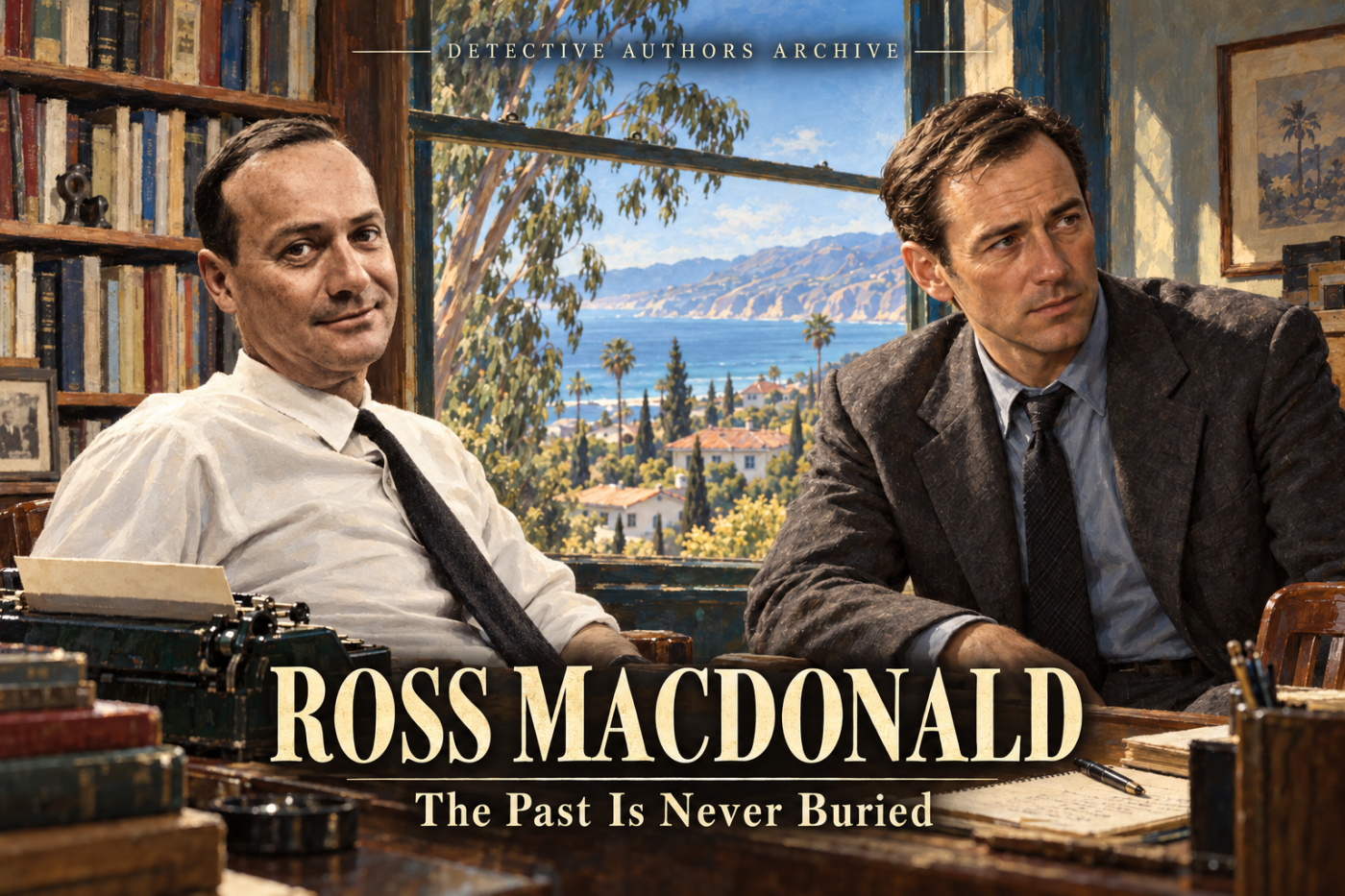
The Past Is Never Buried
A missing person. A troubled marriage. A family with something to hide. For Lew Archer, a routine assignment can open a door onto a tragedy that began long before anyone hired a detective.

Behind Ross Macdonald was Kenneth Millar, a writer whose path to California began with an unsettled childhood in Canada. Hammett and Chandler helped point him toward detective fiction. But before Lew Archer could begin looking into other people’s pasts, Millar had a complicated history of his own.
The Man Behind the Name
Kenneth Millar was born on December 13, 1915, in Los Gatos, California, to Canadian parents. The family returned to Canada when he was still very young, but his childhood offered little stability. His father left, and his mother eventually placed him in the care of relatives. Moving between households in Ontario, Millar grew up with a sense of displacement that would remain with him long after he found a permanent home.

He attended Kitchener Collegiate Institute, continued his education, and travelled in Europe. In 1938, he married Margaret Sturm, later known to readers as the crime novelist Margaret Millar. Their daughter, Linda, was born the following year.
Millar pursued graduate studies at the University of Michigan, taught, and served in the United States Navy during the Second World War. His academic interests included literature, and he eventually earned a doctorate in English.
He and Margaret settled in Santa Barbara, California. Returning to his birth state carried a particular meaning for Millar: during his unsettled Canadian childhood, California had become an imagined home, a place to which he felt he belonged despite having grown up elsewhere.
Enter John Ross Macdonald
Kenneth Millar’s name appeared on his first four novels, beginning with The Dark Tunnel in 1944. Trouble Follows Me, Blue City, and The Three Roads followed. These early books gave him room to experiment with suspense, violence, and troubled identities while working under the influence of writers he admired.
A change came with The Moving Target in 1949. Millar introduced a California private investigator named Lew Archer—and signed the book John Macdonald.
The new name helped distinguish his books from those of Margaret Millar, whose own career was already established. But it brought another difficulty: there was also a crime writer named John D. MacDonald. John Macdonald became John Ross Macdonald, then finally Ross Macdonald, the name he settled on by The Barbarous Coast in 1956.
The name was taking shape, and so was the partnership that would define his career. Archer had his first assignment. Others would follow.
Meet Lew Archer
Lew Archer knows how to ask a question—and when to let someone keep talking. A former policeman turned private investigator, he earns his living following people, checking stories, and finding what his clients cannot find for themselves. Often, the most useful clue comes from someone who needs to be heard.
Born in 1913, Archer served with the Long Beach police before entering private practice. Divorced and living largely alone, he reveals relatively little about his own life. His name carries a nod to Hammett’s Miles Archer, Sam Spade’s murdered partner in The Maltese Falcon, but Macdonald gives him a character and a working method of his own.

Archer can take a beating, handle a gun, and press an unwilling witness. His early cases give him plenty of opportunities to prove it. He also thinks his way through an investigation, testing explanations against the evidence and revising them when something fails to fit. An impression may start him down a trail; it cannot settle the case.
His work takes him through Southern California, from Los Angeles to coastal communities and the fictional Santa Teresa. He notices the landscape as closely as the people moving through it. He recognizes plants and birds, cares about the natural world, and has a taste for Japanese art—small details that give this solitary detective a life beyond his assignments.
As the series develops, his patience and capacity for sympathy become increasingly distinctive. Frightened children, embittered parents, and people caught in their own lies draw his attention. He wants to understand how they arrived at this point, even when that understanding makes an easy judgment impossible.
Yet Archer remains a working detective. Sympathy does not release him from the need to establish what happened. He follows the connections until a crime can be explained, knowing that an explanation may come too late to mend the lives around it.
Beyond Lew Archer
Macdonald occasionally entrusted an investigation to someone outside the private detective’s profession. In Meet Me at the Morgue (1953), probation officer Howard Cross becomes involved in a kidnapping case that draws him into a web of concealed identities and violence. His work gives him a particular concern for people whose guilt others may be too quick to assume.
In The Ferguson Affair (1960), Bill Gunnarson, a defence lawyer, follows a stolen-property charge into a much larger criminal affair. Here, the route into detection begins with the responsibility to defend a client. Both novels give Macdonald another way into the California world his readers know through Archer.
Lew Archer’s Notable Cases
Archer’s assignments often begin with a practical request: find someone, investigate a stranger, discover who sent a threatening letter. These cases show how far such requests can take him.
The Moving Target (1949)
Archer is hired to find Ralph Sampson, a wealthy man who has disappeared. The search takes him from a troubled household into a California world of money, exploitation, and competing loyalties. His first novel establishes the detective’s ability to move between privileged homes and the people who live in their shadow.
The Drowning Pool (1950)
A woman asks Archer to investigate a letter threatening to expose her infidelity. What begins as a discreet inquiry draws him into a household where money gives one generation power over the others. Beyond the family estate, competing interests have their own designs on its future.
The Galton Case (1959)
The search for a long-missing son raises questions about a young man’s identity and claim to a family fortune. A pivotal novel, it ties Archer’s investigation to the longing for a lost past.
The Chill (1964)
A missing bride leads Archer into an investigation of deaths separated by decades. One of Macdonald’s most intricate mysteries, it turns on hidden connections and carefully maintained stories.
The Underground Man (1971)
As wildfire sweeps the California hills, Archer searches for a missing child. The immediate danger draws him into a family history whose consequences are still unfolding.
What Macdonald Brought to the Detective Novel
Macdonald made family history central to the hard-boiled investigation. A disappearance or murder could send Archer back through decades of estrangement, concealed relationships, and choices whose consequences had fallen on children who knew nothing of their origins. The past supplied more than a motive: it shaped the lives Archer was trying to understand.
That understanding still depended on detective work. Macdonald built intricate plots in which identities, testimony, and apparently separate events gradually fitted together. A revelation could change both the direction of the case and the reader’s judgment of someone involved. The puzzle and the human story developed together.
Archer’s sympathy gave those discoveries a particular weight. He could recognize suffering in someone who had also caused it, or see how a victim’s actions had harmed another person. Establishing guilt remained necessary, but it rarely explained everything.
Southern California gave Macdonald a setting where people could appear to begin again. Prosperity, a new home, or a different name promised distance from earlier troubles. Archer’s inquiries tested that promise, finding the old connections beneath the new life.
Macdonald also looked beyond the household to the damage surrounding it. Wildfire in The Underground Man and an oil spill in Sleeping Beauty bring the California landscape directly into Archer’s investigations. The coast and hills belong to the lives he encounters, and their destruction broadens the consequences of human carelessness and greed.
Through these investigations, Macdonald widened the emotional reach of the private-eye novel. Archer could solve the case before him; the people left behind still had to live with what he had uncovered.
Later Years — Archer’s Last Case
Macdonald’s growing recognition came alongside profound personal loss. His daughter, Linda, died in 1970 at the age of thirty-one. Her death devastated both parents, and their grandson became an increasingly important part of their lives. While they were grieving, The Underground Man appeared in 1971. Eudora Welty’s enthusiastic review helped bring the novel—and its author—to a wider readership.
Two more Archer novels followed: Sleeping Beauty in 1973 and The Blue Hammer in 1976. In the latter, an assignment involving a missing painting draws Archer into the history of an artist and the people connected to him. It became Macdonald’s final completed novel, closing a series that had begun twenty-seven years earlier with The Moving Target.
Alzheimer’s disease eventually made further writing impossible. Margaret continued her own work after her husband could no longer pursue his, but the illness brought his career to an end.
Kenneth Millar died on July 11, 1983, in Santa Barbara, aged sixty-seven. His final years returned the focus to the man behind the author’s name: a husband, father, and grandfather whose private life had remained closely bound to his fiction.
Legacy — Beyond the Mean Streets
Ross Macdonald became one of the defining names of American detective fiction, regularly placed alongside Hammett and Chandler. His achievement helped strengthen the case for reading a detective novel as both an absorbing mystery and a serious exploration of human lives. Writers such as Eudora Welty championed his work, while later crime authors—including Sue Grafton, George Pelecanos, and James Ellroy—have acknowledged his importance.
Lew Archer offered a lasting model for the private investigator whose strength includes emotional insight. His investigations carried the genre into suburban homes and across generations, opening paths that later writers would explore in their own settings.
Macdonald’s place in the literary tradition also survives through renewed editions. The Library of America collected eleven Archer novels in three volumes, bringing his work together with essays that illuminate his approach to detective fiction.
His work also continues in audio editions, allowing listeners to experience Lew Archer’s investigations through narration as well as print.
Lew Archer on Screen
Paul Newman brought Macdonald’s detective to the cinema under a different surname: Lew Harper. In Harper (1966), directed by Jack Smight, The Moving Target became a film featuring Lauren Bacall and Julie Harris. Newman returned in The Drowning Pool (1975), directed by Stuart Rosenberg, with Joanne Woodward and Anthony Franciosa.


Television kept the Archer name. Peter Graves played him in the television film The Underground Man (1974), directed by Paul Wendkos. Brian Keith then took the role in Archer (1975), a short-lived series of six episodes.


These adaptations gave Archer several screen faces, with Newman’s Harper becoming the best-known. In the books and audiobooks, readers and listeners can still meet the detective through his own voice: observant, questioning, and attentive to the lives unfolding around him.
Case Closed
A client comes to Lew Archer with a problem. By the time he leaves, the question has changed: how did these people come to hurt one another, and how long have they been living with the consequences?
Ross Macdonald gave that question a lasting place in detective fiction. His cases reward the reader who follows the clues, but their discoveries reach beyond the identity of a killer. Someone’s past becomes another person’s present.
Archer closes the case. The people remain.
References
Books and Audiobooks Consulted
- Baudou, Jacques, and Jean-Jacques Schleret, eds. Le Polar. Guide Totem. Larousse. Ross Macdonald entry, pp. 264–265.
- Bourdier, Jean. Histoire du roman policier. Éditions de Fallois. p. 209.
- Deleuse, Robert. Les maîtres du roman policier. Bordas. Ross Macdonald entry, p. 110.
- Lee, Susanna. Detectives in the Shadows: A Hard-Boiled History. Macdonald discussion, p. 86; references to his influence, pp. 94–95.
- Macdonald, Ross. The Drowning Pool. New York: Vintage Books, Vintage Crime/Black Lizard, 1996. Originally published by Alfred A. Knopf, 1950.
- Macdonald, Ross. The Moving Target. Audiobook. Audible.
- Moore, Lewis D. Cracking the Hard-Boiled Detective: A Critical History from the 1920s to the Present. Especially pp. 76–85 and 261–263.
- Nickerson, Catherine Ross, ed. The Cambridge Companion to American Crime Fiction. Cambridge University Press. Especially Sean McCann’s “The Hard-Boiled Novel,” pp. 55–56; additional discussion, p. 140.
- Rzepka, Charles J. Detective Fiction. Especially pp. 221–224.
- Scaggs, John. Crime Fiction. The New Critical Idiom. Especially pp. 67–68, 72, and 74.
- Spehner, Norbert. Le Détectionnaire. Lew Archer entry.
Online Sources
- Penguin Random House. Meet Me at the Morgue and The Ferguson Affair. Publisher descriptions of Howard Cross and Bill Gunnarson.
- Penguin Random House. Lew Archer series. Novel descriptions.
- Penguin Random House Library Marketing. The Underground Man.
- EBSCO. “Ross Macdonald.” Biographical information and the development of his pseudonym.
- Library of America. Ross Macdonald: Four Novels of the 1950s.
- Library of America. The Ross Macdonald Collection: Eleven Classic Lew Archer Novels.
- Nolan, Tom. “Ross Macdonald, Perpetual Stranger in His Native California.” Library of America.
- Nolan, Tom. “Ross Macdonald, Margaret Millar, and the Traumas That Encompassed Literature and Life.” Library of America.
- Nolan, Tom. “Professional Triumph and Personal Tragedy: When Ross Macdonald Went Underground.” Library of America, October 24, 2017.
- Whitaker, Joseph D. “Mystery Writer Ross Macdonald, 67, Dies.” The Washington Post, July 1983.
← Previous: Raymond Chandler
Next: Mickey Spillane →








Hello Gumshoe! On the track or authors? leave us reply!