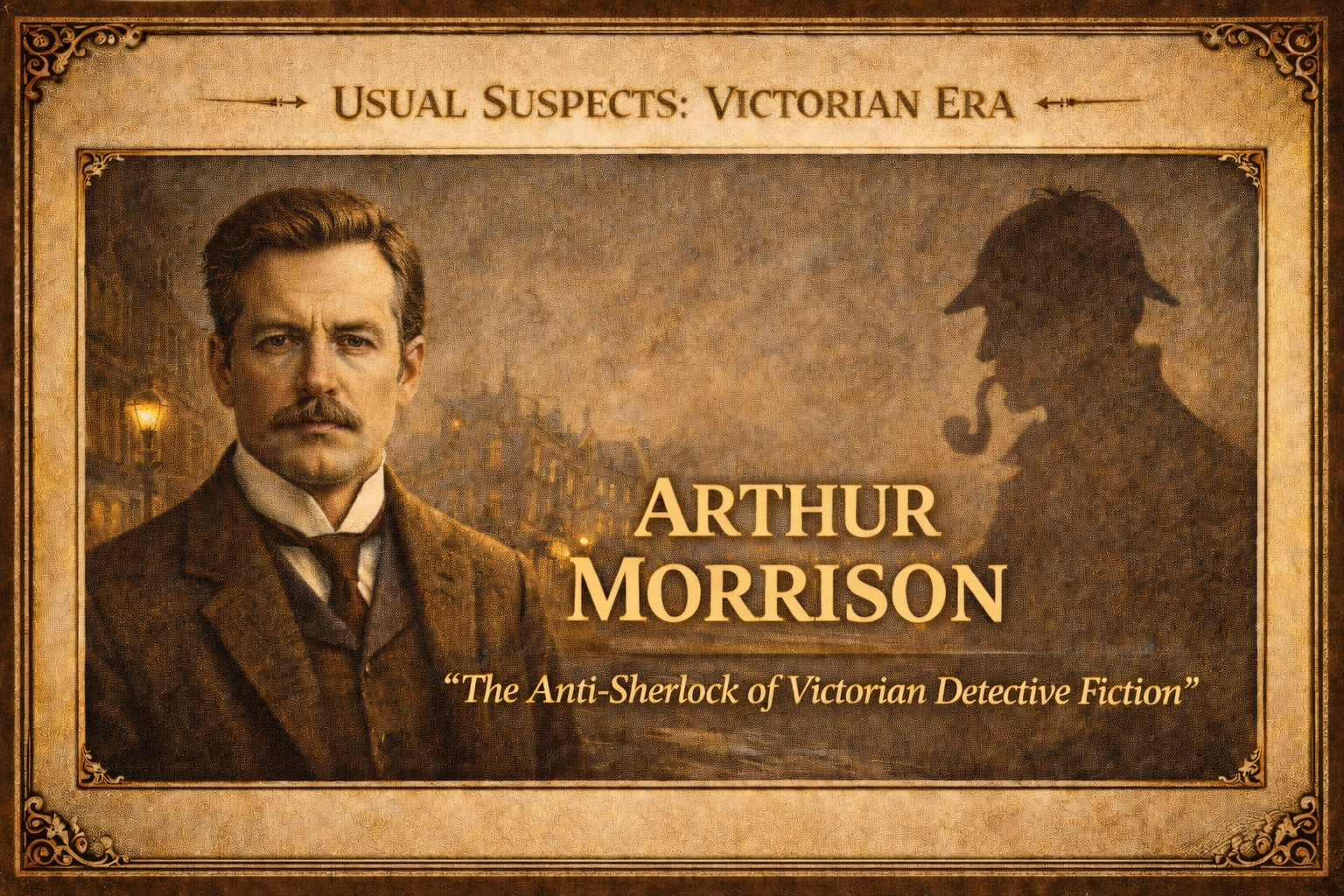
The Anti-Sherlock of Victorian Crime

Introduction
Sherlock Holmes dazzled readers with violin solos and brilliant deductions. Meanwhile, another detective was quietly doing the real work. This work was methodical, practical, and stubbornly ordinary. Arthur Morrison didn’t want a genius detective. He wanted a believable one. And in doing so, he created one of the most important counterweights to Holmes in Victorian crime fiction.

Biography
Arthur Morrison was born in 1863 in Poplar, in London’s East End. It was a working-class district far removed from the genteel worlds inhabited by many Victorian literary detectives. His upbringing exposed him early to poverty and overcrowding. He also learned the daily mechanics of urban survival. These experiences would profoundly shape both his fiction and his philosophy of crime writing.
Morrison was largely self-educated, leaving school at a young age and training himself through voracious reading. He started his professional life as a journalist. He wrote for periodicals such as The National Observer and The Pall Mall Gazette. Journalism taught him discipline, observation, and skepticism—skills that later became central to his approach to detective fiction.
Why Detective Fiction?
Morrison came to detective fiction reactively, not romantically. By the early 1890s, Sherlock Holmes dominated popular crime literature. Morrison openly objected to what he saw as an increasingly theatrical and implausible model of detection. He believed that Holmes’s feats, while entertaining, distorted public understanding of how investigations actually worked.
Martin Hewitt was Morrison’s answer.
Rather than inventing a brilliant eccentric, Morrison deliberately created a detective who relied on:
- Careful observation
- Logical inference
- Interviews and physical evidence
- A deep understanding of human behavior
In short, Morrison wanted detective fiction to “behave”—to operate within the boundaries of realism. His stories were intended not as puzzles powered by genius, but as demonstrations of professional method.
His Detective: Martin Hewitt:
The Detective Who Refused to Be Brilliant

Martin Hewitt was created as a deliberate rejection of the late-Victorian cult of the genius detective. Where other fictional investigators dazzled with intellectual fireworks, Hewitt worked quietly, methodically, and professionally. He was not designed to impress—he was designed to convince.
Occupation & Role
Martin Hewitt is a professional consulting detective, operating independently rather than as an amateur or gentleman sleuth. His cases come from clients, not curiosity, and his motivation is practical rather than intellectual. Detection is his trade, not his hobby.
This professional framing was unusual at the time. It helped form the idea of detection as skilled labor rather than inspired brilliance.
Methods of Detection
Hewitt’s approach is grounded in process, not intuition. His investigations typically involve:
- Careful examination of physical evidence
- Logical reconstruction of events
- Interviews and observation of behavior
- Elimination of improbable explanations
He is openly skeptical of speculative theorizing and dislikes premature conclusions. Unlike more theatrical detectives, Hewitt often emphasizes what cannot be known as much as what can.
In many stories, he dismantles seemingly clever explanations by pointing out overlooked practical details—a quiet but devastating technique.
Personality & Temperament
Martin Hewitt is calm, composed, and unemotional. He does not seek attention, avoids dramatic confrontation, and shows little interest in impressing others with his intelligence. His confidence comes from experience, not ego.
He is also notably anti-romantic. Hewitt views crime as a human problem with human causes, not as an abstract puzzle. This gives his stories a grounded, sometimes almost documentary tone.
Relationship to Sherlock Holmes
Hewitt is often described as an “anti-Holmes,” and this is entirely intentional. Arthur Morrison designed him as a corrective to what he saw as increasingly implausible feats of deduction.
Where Holmes leaps, Hewitt verifies.
Where Holmes astonishes, Hewitt explains.
This contrast does not make Hewitt inferior—only different. In many ways, he represents what Morrison believed real detectives actually did.
Narrative Role
Most Martin Hewitt stories are told through a narrator who observes rather than participates. This reinforces Hewitt’s professionalism and keeps the focus on method over personality. The detective is central, but never dominating.
The result is a series that feels procedural long before the term existed.
Importance in Detective Fiction
Martin Hewitt stands as one of the earliest fully realized realistic detectives in English crime fiction. He bridges the gap between early sensation fiction and the modern procedural, anticipating later police-centered narratives and methodical investigators.
He never achieved the cultural immortality of Sherlock Holmes. However, Hewitt’s influence can be felt wherever crime fiction values process, plausibility, and professional restraint.
Key Detective Works
Morrison introduced Hewitt in short stories rather than novels, reinforcing the case-by-case, professional nature of his work.
Notable titles include:
- Martin Hewitt, Investigator (1894)
- The Adventures of Martin Hewitt (1896)
- The Red Triangle (1903)


These stories focus on observation, interviews, physical evidence, and logical reconstruction—elements that would later become staples of modern crime fiction.
Did Morrison Continue Writing Detective Fiction?
No—at least not exclusively.
Although Martin Hewitt brought Morrison fame, he gradually moved away from detective fiction. Morrison increasingly focused on social novels, essays, and historical works, often addressing class inequality and urban hardship. Detective fiction became only one part of his literary output, not his defining identity.
This move away from genre fiction was partly ideological. Morrison did not view detective stories as inferior. However, he increasingly saw his role as exposing social injustice. He preferred this over entertaining readers with crime narratives.
Other Works
Outside crime fiction, Morrison wrote several novels. One notable work is A Child of the Jago (1896). It offers a stark portrayal of slum life that shocked Victorian readers with its realism. These works cemented his reputation as a serious social writer rather than a genre specialist.
This shift likely contributed to his later marginalization within detective fiction history.
Media & Adaptations
Martin Hewitt did make the leap to the screen. The character appeared in several television adaptations. The most notable was in the BBC series The Rivals of Sherlock Holmes. In it, Hewitt was explicitly positioned as Holmes’s contemporary—and competitor.

Image found on:
https://cult-tv-lounge.blogspot.com/2017/04/the-rivals-of-sherlock-holmes-martin.html
Later Life and Death
In his later years, Morrison withdrew from literary life and focused on art collecting and historical scholarship, particularly Japanese prints. He lived quietly and published little in his final decades.
Arthur Morrison died in 1945, at the age of 82, from natural causes. By the time of his death, detective fiction had evolved dramatically. His contributions were foundational. Nonetheless, they were largely overshadowed by the enduring cultural dominance of Sherlock Holmes.
Legacy
Arthur Morrison’s legacy rests on realism by design. In an era dominated by brilliant, theatrical detectives, Morrison deliberately created a professional investigator. This investigator relied on patience, evidence, and method rather than genius. Through Martin Hewitt, he introduced a new model of detection. This model was grounded in logic and routine. It quietly shaped the future of crime fiction.
Although overshadowed by Sherlock Holmes and later remembered more for his social novels, Morrison’s influence endured. His work anticipated the modern procedural. It remains a key reference point for understanding how detective fiction evolved beyond eccentric heroes. This evolution moved toward realistic investigation.
Conclusion
Arthur Morrison didn’t create the most famous detective of the Victorian era. However, he may have created one of the most important. In a genre increasingly dominated by brilliance and eccentricity, Morrison reminded readers that crime isn’t solved by genius alone. It requires patience, logic, and human understanding.
Want to know more?
If you’re curious about the roads not taken in detective fiction, Arthur Morrison is an essential stop. He explored detectives who worked quietly while others took center stage. Dive into Martin Hewitt’s cases and discover Victorian crime without the violin solos.
References
- The Rivals of Sherlock Holmes – Dover ed.
- The Cambridge Companion to Crime Fiction – edited by Martin Priestman
- Victorian Detective Fiction – various scholarly essays
- Contemporary periodicals and Morrison’s collected works
Previous: Anna Katharine Green
Next →: George R. Sims
3 responses to “The Usual Suspects: The Victorian Era: Case #006: Arthur Morrison”
-
[…] Arthur MorrisonA quiet counterpoint to brilliance, favoring patience, restraint, and professional routine. […]
-
[…] Usual Suspects […]
-
please write comments in the comments section of the Page. Thank you
-








Hello Gumshoe! On the track or authors? leave us reply!