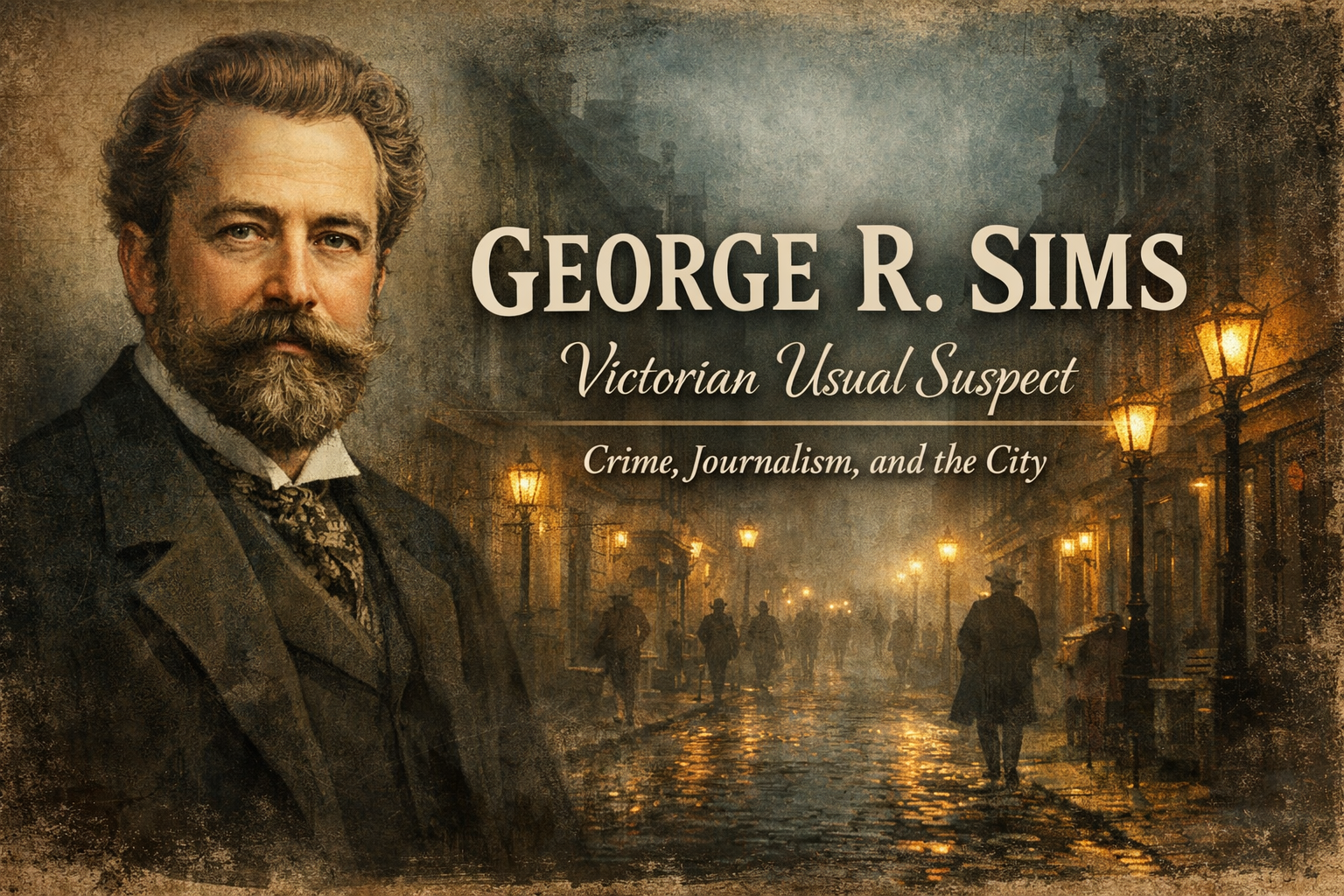
The Man Who Took Detective Fiction to the Streets

Introduction
Victorian detective fiction is often linked to drawing rooms, quiet logic, and carefully controlled revelations.
George R. Sims preferred the street.
Sims was a journalist first and a storyteller second. He brought crime out of the parlor and into the fog, noise, and urgency of London itself. His work stands at the crossroads. It merges detective fiction and urban reportage. Orderly investigation is filtered through the chaos of real life.

Biography
A Proper Victorian Career, Lived at Street Level
George R. Sims was born in London in 1847. It was a rapidly changing city. Industrial progress and extreme poverty existed side by side. Unlike many of his literary contemporaries, Sims did not approach crime as an abstract puzzle. He encountered it firsthand, through the streets, courts, and institutions of Victorian London.
Sims began his career as a journalist, quickly developing a reputation for vivid, emotionally charged writing. He worked for several newspapers and magazines, gaining particular attention for his investigations into urban poverty, crime, and social injustice. These were not detached reports. Sims placed himself close to his subjects. He described slums, lodging houses, and criminal underworlds using language designed to shock middle-class readers into awareness.
This journalistic work shaped Sims’s entire literary outlook. He believed writing should engage, disturb, and provoke response. For Sims, crime was not just a mystery to solve. It was a symptom of social failure, economic hardship, and moral neglect.
Alongside his investigative journalism, Sims became widely known for his satirical persona Dagonet, writing for Punch magazine. Through Dagonet, Sims commented on politics, society, and crime with wit and sharp observation. While not detective fiction, this voice cemented his public identity and broadened his readership far beyond traditional novel audiences.
Sims was enormously popular during his lifetime. His books sold well, his journalism reached wide audiences, and his name was widely recognized by Victorian readers. Detective fiction evolved toward more formalized structures in the early twentieth century. The emergence of iconic detectives contributed to this trend. As a result, Sims’s work gradually slipped from the center of the canon.
Today, he occupies a crucial transitional position. He is a writer who helped bridge sensation fiction, crime journalism, and emerging detective narrative. He captured a version of Victorian crime that was immediate, emotional, and inseparable from the city itself.
His Detective Fiction
Sims wrote crime and detective stories that balanced investigation with atmosphere. While his plots followed recognizable investigative patterns, they were driven by urgency and realism rather than pure intellectual puzzle.
His detective fiction emphasizes:
- observation over abstraction
- lived urban experience
- moral complexity
- social context surrounding crime
Rather than presenting crime as a neat riddle, Sims framed it as part of a wider social landscape.
Investigators and Narrative Voices
Unlike some of his contemporaries, Sims did not rely on a single iconic detective figure. Instead, he often used:
- journalists
- observers
- police figures
- narrators close to the action
This approach allowed him to move fluidly between detection, reportage, and moral commentary — a hallmark of his style.
The Street-Level & Sensational Side
(Why Sims Feels Different)
This is where Sims stands apart.
Sims used his journalistic experience to embrace sensationalism. He did not use it as spectacle for its own sake. Instead, Sims used it as a tool to capture attention and provoke response. His writing is fast, vivid, and sometimes deliberately unsettling.
He wrote about:
- slums and lodging houses
- violence and desperation
- the human cost of crime
This street-level focus brought detective fiction closer to the realities of Victorian London. Other writers refined the rules of the genre. Sims tested its limits by showing how crime fiction engages directly with social reality.
Why This Still Fits Victorian Detective Fiction
Sims belongs in Victorian Usual Suspects because:
- he wrote crime-centered narratives
- he engaged directly with investigation, policing, and criminal psychology
- he influenced how crime fiction could reflect real urban conditions
But unlike Green or Morrison, Sims:
- resisted formal detective mythology
- favored immediacy over method
- treated crime as experienced, not solved from a distance
Did He Stay with Detective Fiction?
Sims continued to write crime and detective material throughout his career. His work always overlapped with journalism and social commentary. He never confined himself to pure puzzle mysteries, preferring instead to explore crime as part of a broader social fabric.
Influence and Legacy
George R. Sims occupies a transitional place in Victorian detective fiction. He helped connect:
- early crime journalism
- sensation fiction
- developing detective narratives
Sims was later overshadowed by more formalized detective figures. However, he influenced how crime stories could reflect the city itself. This legacy echoes in later noir and hard-boiled traditions.
Media & Popular Culture
During his lifetime, George R. Sims was far better known to the general public than many of his fellow crime writers. His work circulated widely through newspapers, magazines, and public readings. This made him a familiar voice rather than a niche literary figure.
His detective fiction has not generated the type of long-running film or television adaptations seen with later authors. However, Sims’s stories were part of the broader Victorian culture of crime entertainment. This included illustrated magazines, serialized fiction, and stage melodrama. His influence is felt less through direct adaptations. It is more pronounced in the sensational, urban crime storytelling that followed in the late nineteenth and early twentieth centuries.
Many of his works are now available in public-domain editions. This availability helps preserve his role in the popular, street-level side of Victorian crime writing.
Other Works
Although best known today for sensational crime writing and social exposés, George R. Sims maintained a wide-ranging literary career. He worked as a journalist, poet, dramatist, satirist, and crime writer, moving easily between popular entertainment and social commentary. This versatility made him one of the most visible and commercially successful writers of his time.
Some of his other works include:
- In the Workhouse: Christmas Day (commonly known as Christmas Day in the Workhouse)
- Song from Arcadia
- The Lifeboat
- ’Ostler Joe
Death
George R. Sims died in 1922 at the age of 75.
By the time of his death, detective fiction had shifted toward more formalized structures and iconic investigators. Writers like Conan Doyle dominated the genre. The sensational, journalistic style Sims championed began to fade from prominence.
Yet Sims had already left his mark. He captured a version of Victorian crime fiction that was immediate and emotional. It was deeply rooted in the life of the city. This serves as a reminder that detective fiction did not evolve along a single, orderly path.
Conclusion
George R. Sims reminds us that Victorian detective fiction was not a single, orderly tradition. Alongside logic and restraint, there was urgency, sensation, and the street.
Sims brought crime from the drawing room into the city. This shift expanded what detective fiction could be. It also broadened the audience it could speak to.
Want to know more?
Explore the Victorian Usual Suspects to discover the many paths detective fiction took before settling into familiar forms.
Some followed rules.
Others walked the streets.
References & Selected Editions
Primary Works by George R. Sims


- Rogues and Vagabonds (1880)
A key example of Sims’s crime-focused writing, blending social observation with accounts of criminal life. Frequently cited for its street-level realism and moral urgency. - Horrors of the Poor (1883)
One of Sims’s most influential works of social investigation. It exposes the realities of urban poverty and crime in Victorian London. Included here for context and influence rather than strict detective fiction. - Dagonet columns in Punch (collected editions)
Sims’s long-running journalistic persona. These writings offer satirical and observational commentary on crime, society, and urban life. While not detective fiction, these writings shaped his public voice and crime-writing approach.
Secondary Sources & Context:
George R. Sims does not feature prominently in later detective anthologies. However, he is regularly cited in discussions of Victorian crime journalism and sensation fiction. This reflects his role on the edges of formal detective tradition.
- The Rivals of Sherlock Holmes (various editions)
This book provides useful context. It helps in understanding the breadth of Victorian crime writing beyond formal detective figures. - The Cambridge Companion to Crime Fiction – edited by Martin Priestman
- Victorian Crime, Madness and Sensation (selected essays)
Background reading on the sensational and journalistic strands of nineteenth-century crime literature. - Public-domain Victorian magazine archives
Contemporary illustrations and serialized publications that reflect how Sims’s work originally reached readers. - George R. Sims : englishverse.com: an overview of Sims as a poet.
Notes on Visual Material
Whenever feasible, original or early book covers are used for Rogues and Vagabonds. They are also used for Horrors of the Poor and collected Dagonet editions. These covers visually represent Sims’s work. These editions reflect his role as a popular, widely read writer rather than a creator of a single iconic detective.
Previous: Arthur Morrison
Next: Grant Allen
2 responses to “The Usual Suspects: Victorian Era: Case #007: George R. Sims”
-
[…] George Robert SimsCrime shaped by the city — journalism, social observation, and popular readership. […]
-
ok
-








Hello Gumshoe! On the track or authors? leave us reply!