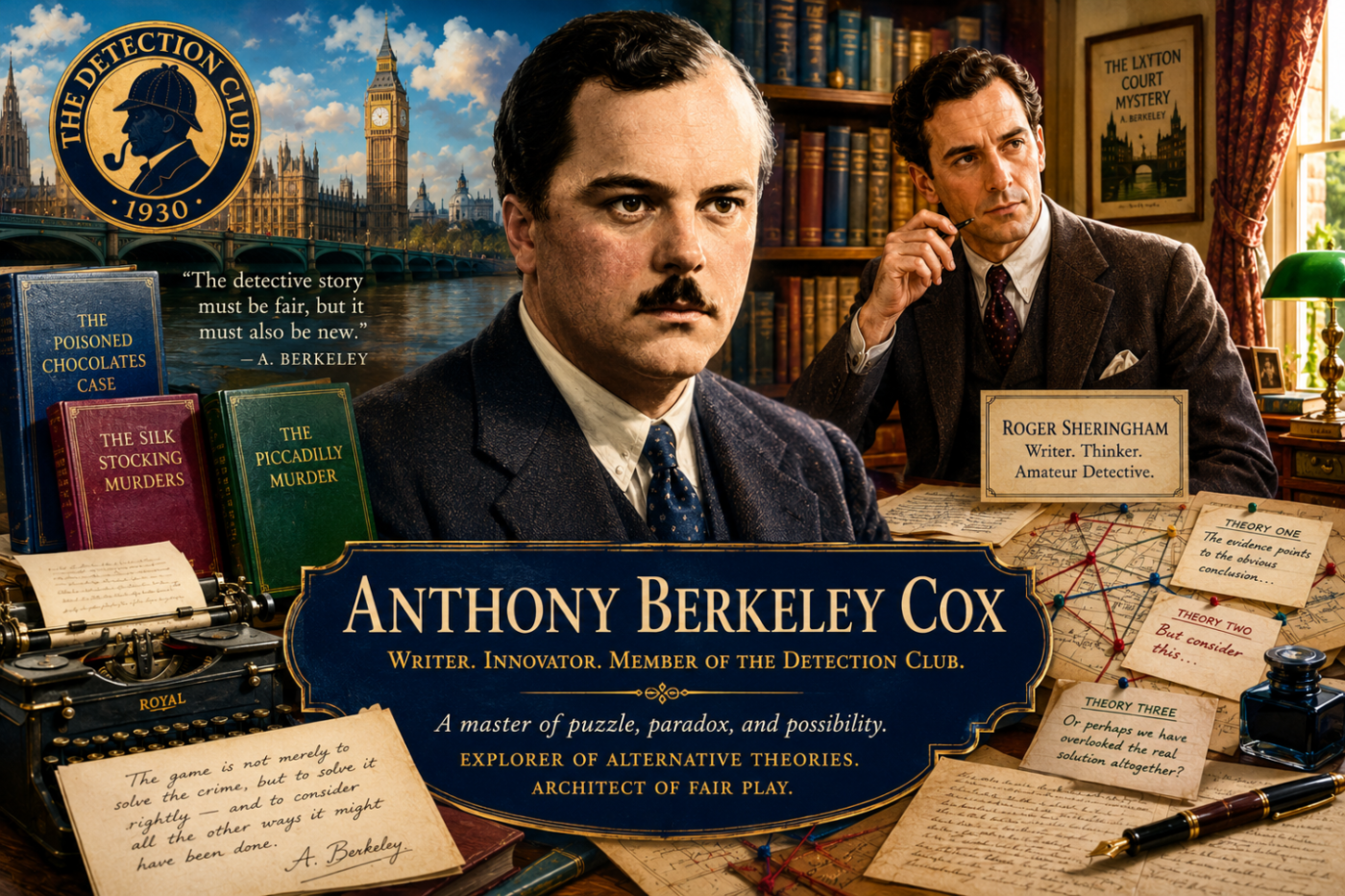
The Man Who Changed the Rules
Some writers mastered the detective story. Anthony Berkeley Cox questioned it.
At a time when the Golden Age was refining the art of the mystery puzzle, Berkeley was busy experimenting with the genre’s possibilities. He explored new structures, challenged readers’ expectations, and approached crime fiction from angles that many of his contemporaries had never considered.

While other writers perfected the game, Berkeley kept asking how it might be played differently. The result was a body of work that helped expand the boundaries of detective fiction and secured his place among the most influential voices of the Golden Age.
A Life in Crime Fiction

Anthony Berkeley Cox was born in Watford, England, on July 5, 1893. Educated at Sherborne School and later at University College, Oxford, he developed a love of literature, humor, and writing that would remain with him throughout his life.
Like many of his generation, Berkeley’s early adulthood was shaped by the First World War. He served in the British Army, an experience shared by many future Golden Age crime writers. After the war, he turned to journalism and writing, building a career that allowed him to explore a wide range of interests and sharpen the wit that would later become one of his trademarks.
In the 1920s, detective fiction was enjoying a surge in popularity, and Berkeley decided to try his hand at the genre. His first mystery novel, The Layton Court Mystery (1925), introduced readers to Roger Sheringham, the amateur detective who would become his best-known creation. More novels followed, and Berkeley quickly established himself as one of the most inventive voices of the Golden Age.
As his career developed, he became increasingly interested in experimenting with the conventions of crime fiction. Some of his most influential works would challenge traditional detective-story formulas and explore the psychology of crime in ways that were unusual for the period.
By the 1930s, Berkeley had become a central figure in British detective fiction. His influence extended beyond his own novels through his involvement with fellow mystery writers and his role in helping shape the direction of the genre during its most celebrated era.
The Detection Club
Anthony Berkeley Cox was more than a successful mystery writer. He was also one of the architects of the Golden Age detective story.
In 1930, Berkeley became one of the founding members of the Detection Club, a group that brought together many of the leading crime writers of the era. Among its members were Agatha Christie, Dorothy L. Sayers, G. K. Chesterton, and other authors who would help define detective fiction for generations of readers.

Dorothy L. Sayers and the Club mascot, Erica
The club was created as both a social gathering and a professional association. Members met to discuss mysteries, exchange ideas, and celebrate the craft of detective fiction. While the organization became famous for its playful traditions and ceremonies, it also reflected a shared commitment to fair play and well-constructed mysteries.
Berkeley played an important role in the club’s early years and was widely respected by his fellow writers. His influence extended beyond his own novels as he helped shape discussions about where detective fiction had been—and where it might go next.
For readers looking back today, the Detection Club remains one of the defining institutions of the Golden Age, and Berkeley stood at its very beginning.
While Berkeley helped shape detective fiction through his work with the Detection Club, his greatest influence came from the stories he wrote himself. At the center of many of those stories was an amateur detective who stood apart from many of his contemporaries.
Unlike the infallible sleuths that often dominated Golden Age mysteries, Roger Sheringham was intelligent, opinionated, and occasionally wrong. Those qualities helped make him one of the era’s most distinctive detectives and provided Berkeley with a perfect vehicle for exploring new ideas in crime fiction.
Meet the Detective: Roger Sheringham
If Hercule Poirot is meticulous, Lord Peter Wimsey is charming, and Roderick Alleyn is professional, Roger Sheringham is something else entirely.
Introduced in The Layton Court Mystery (1925), Sheringham is an amateur detective, writer, and keen observer of human behavior. Intelligent and confident, he enjoys solving mysteries but often approaches them in a very different way from many of his Golden Age contemporaries.

He can be opinionated, stubborn, and occasionally blinded by his own theories. Rather than weakening the character, these flaws make him feel surprisingly modern.
Sheringham was the ideal detective for Anthony Berkeley Cox. Through him, Berkeley could explore different approaches to crime fiction, challenge conventional thinking, and remind readers that solving a mystery is rarely as straightforward as it first appears.
While he may not be as famous today as Poirot or Wimsey, Roger Sheringham remains one of the most distinctive detectives of the Golden Age and an important part of Berkeley’s legacy.
Inspector Moresby
The character most closely associated with Roger Sheringham is Inspector Moresby of Scotland Yard. While not present in every story, Moresby appears in several of Berkeley’s mysteries and often serves as a professional counterpart to Sheringham’s amateur investigations.

Unlike the close partnerships found in some Golden Age series, the relationship between Sheringham and Moresby is not built on friendship or admiration alone. Their interactions often highlight the contrast between official police methods and Sheringham’s more independent approach to solving crimes.
Although he never achieved the fame of characters such as Inspector Japp, Bunter, or Inspector Fox, Moresby remains an important part of Berkeley’s detective fiction and one of the key recurring figures in the Roger Sheringham stories.
Essential Roger Sheringham Mysteries
Readers interested in Roger Sheringham may wish to begin with the following novels:


- The Layton Court Mystery (1925)
- The Wychford Poisoning Case (1926)
- The Silk Stocking Murders (1928)
- The Piccadilly Murder (1929)
- The Poisoned Chocolates Case (1929)
- Murdered in the Basement (1932)
What He Brought to Detective Fiction
Many Golden Age writers worked within the established rules of detective fiction. Anthony Berkeley Cox was more interested in seeing how far those rules could be stretched.
At a time when readers expected a mystery to follow a familiar path, Berkeley experimented with structure, perspective, and the very nature of the detective story. His novels often encouraged readers to question assumptions and consider the possibility that the most obvious explanation might not be the correct one. Rather than presenting detective fiction as a rigid formula, he treated it as a genre full of possibilities.
This spirit of experimentation can be seen in Roger Sheringham’s investigations. Through him, Berkeley explored the uncertainty that often lies behind the process of detection.
As his career progressed, Berkeley became increasingly interested in the psychological side of crime. Instead of focusing solely on who committed a murder, he explored why people commit crimes and how guilt, fear, and motivation shape human behavior. In doing so, he helped open the door to forms of crime fiction that would become increasingly important in the decades that followed.
While many of his contemporaries perfected the classic mystery puzzle, Berkeley expanded the boundaries of what detective fiction could be. His influence can be seen not only in Golden Age mysteries but also in later psychological suspense novels and crime stories that place as much emphasis on character and motive as on the final solution.
Did He Walk Away?
Anthony Berkeley Cox never completely abandoned crime fiction, but over time his interests began to shift.
While his early success came through traditional detective stories featuring Roger Sheringham, Berkeley became increasingly fascinated by the psychological side of crime. Rather than focusing solely on the puzzle of identifying a culprit, he explored questions of motive, guilt, and human behavior.
This evolution led him to write several novels under the pen name Francis Iles. These works often moved away from the classic detective-story formula and placed greater emphasis on the criminal and the circumstances surrounding the crime. In many ways, they reflected Berkeley’s growing interest in pushing the boundaries of the genre.

As a result, Berkeley gradually became less associated with the traditional detective novel that had helped establish his reputation. Yet this was not a rejection of crime fiction. Instead, it reflected his desire to explore new possibilities within the genre.
Legacy & Media
Anthony Berkeley Cox may not be as widely recognized today as Agatha Christie or Dorothy L. Sayers, but his influence on crime fiction remains significant.
Many of the ideas that Berkeley explored during the Golden Age would become increasingly important in later decades. His interest in psychological motives, unconventional structures, and alternative approaches to the mystery novel helped broaden the possibilities of the genre. Writers who focused on the criminal mind, moral ambiguity, or the human consequences of crime were following paths that Berkeley had helped to open.
His work also found its way beyond the printed page. Under his Francis Iles pen name, Before the Fact was adapted by director Alfred Hitchcock into the 1941 film Suspicion, starring Cary Grant and Joan Fontaine. The film remains the most famous screen adaptation associated with Berkeley’s work and introduced one of his stories to a much wider audience.

Another of his novels, Trial and Error, was adapted into the film Flight from Destiny, while his detective fiction also appeared on radio and television. Roger Sheringham reached television audiences through adaptations of Berkeley’s stories, and The Poisoned Chocolates Case later received a BBC radio dramatization.

Among mystery readers, The Poisoned Chocolates Case remains Berkeley’s best-known novel and is frequently cited as one of the classic detective stories of the Golden Age. His Francis Iles novels continue to attract attention for their innovative approach to crime and suspense, while his role in the Detection Club and his influence on later writers have secured his place in the history of the genre.
Today, Berkeley is remembered not only as a talented mystery writer but also as one of the authors who helped expand the boundaries of detective fiction itself.
Later Years & Death
As the Golden Age of detective fiction drew to a close, Anthony Berkeley Cox remained an important figure in the crime-writing world. Although he never achieved the enduring public fame of some of his contemporaries, his work continued to be read and discussed by mystery enthusiasts and fellow writers.
In his later years, Berkeley gradually withdrew from the central spotlight of detective fiction. By then, however, he had already left a lasting mark on the genre through his novels, his experiments with crime storytelling, and his role in the Detection Club.
Anthony Berkeley Cox died in London on March 9, 1971, at the age of seventy-seven. While his name is sometimes overshadowed by other Golden Age giants, his influence remains visible in the evolution of detective and psychological crime fiction.
Today, he is remembered as one of the writers who challenged convention, expanded the possibilities of the mystery novel, and helped shape one of detective fiction’s most celebrated eras.
Conclusion
Anthony Berkeley Cox may not be the first name that comes to mind when readers think of the Golden Age of detective fiction, but his contribution to the genre is difficult to overlook. As a novelist, a founding member of the Detection Club, and the creator of Roger Sheringham, he helped leave a lasting mark on one of mystery fiction’s most celebrated eras.
Whether through his detective stories, his psychological crime novels, or the influence he had on fellow writers, Berkeley’s work continues to reward readers willing to look beyond the most famous names of the Golden Age.
A Question for the Reader
Have you read any of Anthony Berkeley Cox’s mysteries, and if so, which one would you recommend to a new reader?
Anthony Berkeley Cox spent much of his career questioning the rules of detective fiction and exploring where the genre might go next. Yet many of his contemporaries believed those rules were worth preserving and refining.
As we leave the Pillars of the Golden Age behind, we turn to the writers who helped define and strengthen the classic detective story. Few defended the mystery puzzle more passionately than S. S. Van Dine, creator of Philo Vance and one of the most influential voices of the era’s Inner Circle.
References
Books by Anthony Berkeley Cox
- Berkeley, Anthony. The Layton Court Mystery. London: Collins, 1925.
- Berkeley, Anthony. The Poisoned Chocolates Case. London: Collins, 1929.
- Berkeley, Anthony. The Silk Stocking Murders. London: Collins, 1928.
- Berkeley, Anthony. The Piccadilly Murder. London: Collins, 1929.
- Berkeley, Anthony. Trial and Error. London: Hodder & Stoughton, 1937.
Books by Francis Iles
- Iles, Francis. Malice Aforethought. London: Victor Gollancz, 1931.
- Iles, Francis. Before the Fact. London: Victor Gollancz, 1932.
Non-Fiction Sources
- Edwards, Martin. The Golden Age of Murder. London: Collins Crime Club, 2015.
- James, P. D. Talking About Detective Fiction. New York: Alfred A. Knopf, 2009.
- Scaggs, John. Crime Fiction. London: Routledge, 2005.
- Rzepka, Charles J. Detective Fiction. Cambridge: Polity Press, 2005.
Film and Media
- Suspicion. Directed by Alfred Hitchcock. RKO Radio Pictures, 1941.
- Flight from Destiny. Directed by Vincent Sherman. Warner Bros., 1941.
- BBC Radio. The Poisoned Chocolates Case. Radio adaptation, 1984.
← Previous: Pillar of the Golden Age: John Dickson Carr
Next: Enter the Inner Circle →








Hello Gumshoe! On the track or authors? leave us reply!