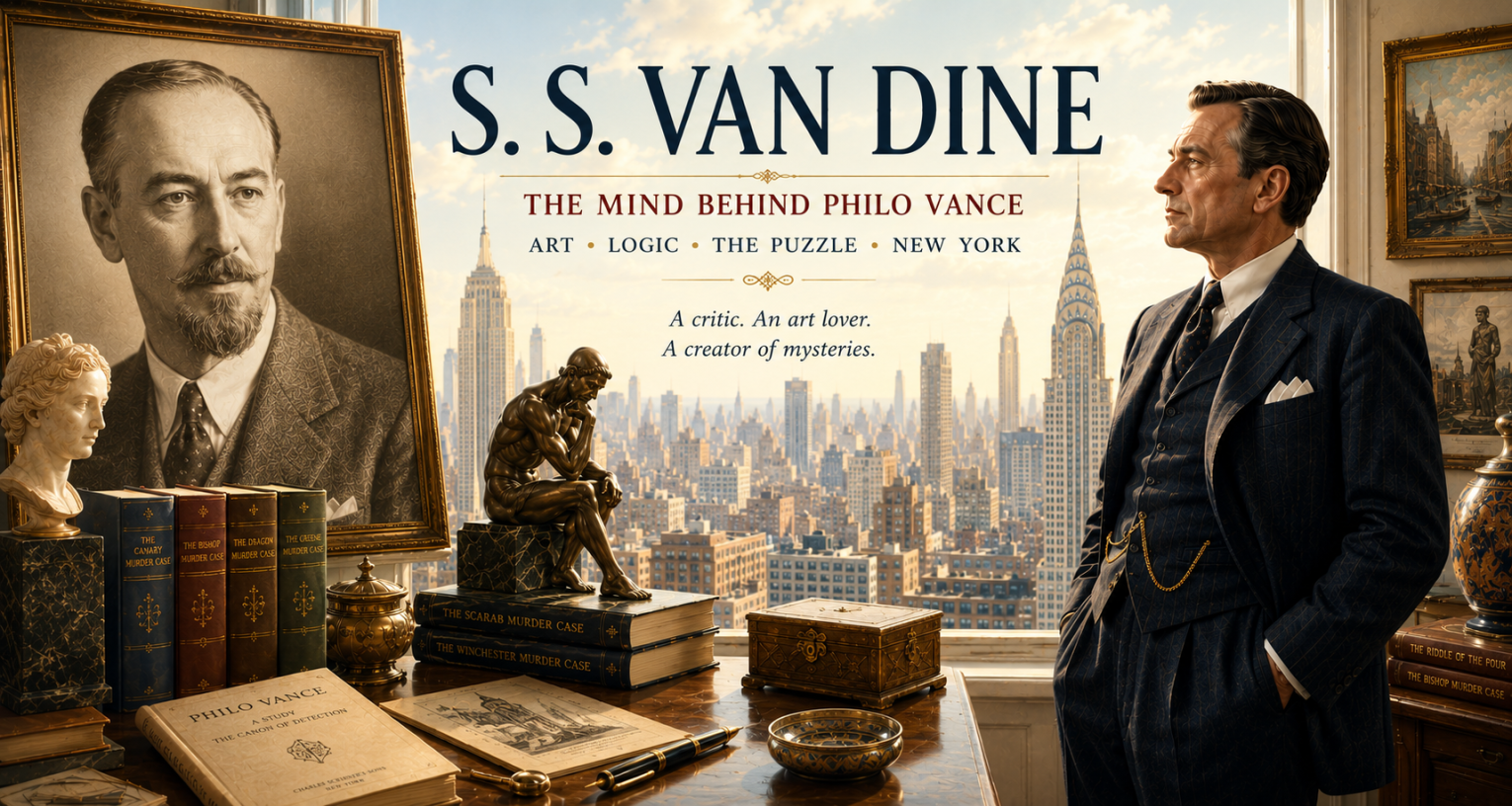
The Man Who Wrote the Rules
Introduction
Most detective writers create mysteries. A few create detectives who become famous. Very few attempt to define the entire genre.
During the 1920s, detective fiction was booming. Readers devoured stories of murders, clues, and brilliant investigators. New authors appeared on both sides of the Atlantic, each trying to solve the puzzle in a slightly different way. Yet one writer believed the detective story was more than entertainment. To him, it was a game governed by principles, logic, and fair play.
Under the name S. S. Van Dine, he became one of the most successful mystery writers of his generation. His novels helped shape the Golden Age, and his ideas about detective fiction became almost as famous as the stories themselves. In 1928, he published a set of twenty rules for detective fiction that would influence, inspire, and frustrate mystery writers for decades to come.
Many of those rules have been challenged, ignored, or broken. Yet nearly a century later, readers and writers are still debating the same question that fascinated Van Dine:
What makes a detective story fair?
Biography
The Critic Before the Novelist
S. S. Van Dine was the pen name of Willard Huntington Wright, an American writer, editor, and critic born in Virginia in 1888. Long before he became known for detective fiction, Wright had established himself in literary and artistic circles, building a career that seemed far removed from murder mysteries and amateur detectives.
After attending school in California, Wright developed a strong interest in literature, art, and culture. He worked as a journalist and editor, contributing to a variety of publications while developing a reputation as an intelligent and often outspoken critic. His interests ranged from literature to painting, and he wrote extensively about modern art at a time when new artistic movements were challenging traditional ideas.

Unlike many future mystery writers, Wright did not begin as a storyteller. He approached books as a critic first, examining how they were constructed, what they attempted to achieve, and whether they succeeded. He enjoyed analysis as much as narrative, and he was rarely shy about expressing his opinions.
This critical mindset would eventually shape his approach to detective fiction. Long before he wrote a mystery novel, Wright was already asking questions about what made a work successful, what made it fail, and whether clear principles could be used to judge it. Years later, he would bring those same questions to one of the most popular literary genres of his day.
Illness, Reading, and a New Direction
During the early 1920s, Wright’s life took an unexpected turn. A period of poor health forced him to step back from the demanding pace of his professional work and spend an extended period recovering.
Confined for long stretches of time, Wright turned increasingly to books. Among his reading were large numbers of detective novels, a genre that was growing rapidly in popularity on both sides of the Atlantic. What began as a way to pass the time soon became something more.

True to his nature, Wright approached detective fiction as a critic as much as a reader. He admired novels that played fair with their audience, constructed convincing puzzles, and rewarded careful observation. At the same time, he grew frustrated with stories that relied on coincidence, withheld important information, or sacrificed logic for surprise.
As he worked his way through mystery after mystery, Wright began to think seriously about the strengths and weaknesses of the genre. What made one detective story satisfying while another felt disappointing? Could the detective novel be judged by standards of its own? And if so, what should those standards be?
Rather than simply criticize the genre from the sidelines, Wright decided to try his hand at writing a detective novel himself. The decision would change the course of his career and eventually introduce mystery readers to one of the most famous detectives of the Golden Age.
The Birth of S. S. Van Dine
By the mid-1920s, Wright had moved beyond simply analyzing detective fiction. He was ready to put his ideas into practice.
To separate his mystery writing from his earlier work as a critic and editor, he adopted the pen name S. S. Van Dine. Under this new identity, he began work on a detective novel that would allow him to test his theories about fair play, logic, and the construction of a satisfying mystery.
The result was The Benson Murder Case, published in 1926. The novel introduced readers to a new kind of detective and quickly attracted attention. More importantly, it demonstrated that Wright’s interest in detective fiction was more than a critical exercise. He could not only discuss the genre—he could write it.
The success of the novel established S. S. Van Dine as a new voice in detective fiction and encouraged him to continue developing both his detective and his ideas about the genre itself. Over the next few years, his reputation grew rapidly, and he became one of the most widely discussed mystery writers of the late 1920s.
As his popularity increased, so did his confidence in the detective story as a distinct literary form. Wright believed that mystery fiction followed principles different from those of adventure novels, romances, or general fiction. It was a game between author and reader, and like any game, he believed it worked best when both sides understood the rules.
At the center of that game stood a detective who reflected many of his creator’s interests: intelligent, cultured, analytical, and convinced that even the most puzzling crime could be solved through reason.
Meet the Detective: Philo Vance
At the center of S. S. Van Dine’s novels stood Philo Vance, one of the most famous detectives of the late 1920s and early 1930s.
A wealthy New Yorker with a passion for art, literature, history, and psychology, Vance was far removed from the image of the hard-working policeman or private investigator. He had no official position, carried no badge, and rarely relied on physical action. Instead, he approached crime as an intellectual challenge, believing that careful observation and logical reasoning could reveal the truth behind even the most puzzling murder.

Vance’s knowledge often extended far beyond criminal investigation. He could discuss rare books, paintings, ancient history, dog breeds, or scientific subjects with equal confidence. To some readers, this made him fascinating. To others, it made him seem overly self-assured. Either way, he was unlike most detectives of his era and impossible to ignore.
Van Dine’s Rule
“The detective himself, or one of the official investigators, should never turn out to be the culprit.”
Today, the rule may seem obvious, but it reveals how Van Dine viewed the detective’s role. The detective was not meant to mislead the reader. Instead, he served as a guide through the puzzle, helping uncover the truth one clue at a time.
Van Dine’s Rule
“The solution of the problem must be arrived at by logical deductions—not by accident or coincidence.”
This principle sits at the heart of every Philo Vance investigation. Vance succeeds not because he is lucky, but because he notices details others overlook and follows them to their logical conclusion.
Van Dine’s Rule
“There must be but one detective—that is, but one protagonist of deduction.”
Van Dine believed that the detective story worked best when a single mind guided the investigation. Readers should know whose reasoning they were following and whose conclusions they were expected to evaluate. While police officers, witnesses, and companions might assist, the intellectual burden of solving the mystery belonged to the detective alone.
Philo Vance was designed with this principle in mind. Though he worked alongside District Attorney Markham and Sergeant Heath, it was Vance’s observations and deductions that ultimately unraveled the mystery.
For readers of the 1920s, this combination of intelligence, culture, and analytical thinking proved enormously appealing. Philo Vance quickly became one of the best-known detectives of the Golden Age and helped establish S. S. Van Dine as one of the leading mystery writers of his generation.
The Supporting Cast
Although Philo Vance occupied the center of the investigation, he was supported by a small group of recurring characters who helped define the series.

The most unusual member of this circle was S. S. Van Dine himself—or at least a fictionalized version of the author. Acting as narrator, Van Dine accompanied Vance through his investigations and presented the events to the reader. Much like Dr. Watson in the Sherlock Holmes stories, he served as an observer, recording clues, conversations, and deductions while allowing the detective to remain the focus of the narrative.

Another important figure was District Attorney John F.-X. Markham. Intelligent, capable, and well connected, Markham frequently turned to Vance when confronted with particularly baffling crimes. Although their methods sometimes differed, the two men shared a mutual respect.

The third major member of the cast was Sergeant Ernest Heath of the Homicide Bureau. Practical and experienced, Heath represented the viewpoint of the working police officer. His occasional skepticism toward Vance’s theories provided a useful contrast to the detective’s more intellectual approach.
Together, these characters formed the core of the Philo Vance series and helped readers follow the detective’s investigations.
Essential Philo Vance Mysteries
Over the course of a dozen novels, Philo Vance became one of the most popular detectives of the late 1920s and early 1930s. While the series enjoyed enormous success in its day, a handful of titles remain the most frequently discussed by mystery readers and historians.
- The Benson Murder Case (1926)
- The Greene Murder Case (1928)
- The Bishop Murder Case (1929)
- The Scarab Murder Case (1930)
- The Kennel Murder Case (1933)
Among these, The Kennel Murder Case is often regarded as Van Dine’s finest novel and remains the title most commonly recommended to modern readers. Together, these works showcase the puzzle-driven mysteries, logical deductions, and fair-play principles that made Philo Vance one of the defining detectives of the Golden Age.
What He Brought to the Golden Age
Many Golden Age writers helped popularize detective fiction. S. S. Van Dine went a step further: he helped popularize the idea that detective fiction should play fair with its readers.
In 1928, he published what became known as the Twenty Rules for Writing Detective Stories. Some of these principles remain influential today, while others have aged poorly or were challenged by later writers. Taken together, however, they provide a fascinating glimpse into how one of the Golden Age’s most successful authors believed a mystery should be constructed.
Van Dine’s Rule
“The reader must have equal opportunity with the detective for solving the mystery.”
This idea became one of the foundations of Golden Age detective fiction. Readers were expected to receive the clues needed to solve the case, even if recognizing their importance was another matter entirely.
The principle helped create what became known as the “fair play” mystery. Rather than relying on hidden evidence or information withheld from the audience, the best detective stories challenged readers to compete with the detective on equal terms.
Many writers embraced this approach, and it remains one of the most enduring aspects of the classic detective novel.
Another principle championed by Van Dine was the importance of clues. If readers were expected to compete with the detective, they needed access to the evidence on which the solution depended.
Van Dine’s Rule
“All clues must be plainly stated and described.”
To modern readers, this may sound like common sense. Van Dine argued that authors should not hide crucial evidence from their audience or introduce important facts at the last moment. The challenge should come from interpreting the clues, not from discovering information that had been kept secret.
This approach helped shape many of the classic mysteries of the Golden Age. Readers learned to pay attention to small details, seemingly innocent conversations, and objects that might later prove significant.
Another lasting contribution of Van Dine was his belief that a detective novel should function as a carefully constructed puzzle.
For Van Dine, the mystery was not simply a story about crime. The crime provided the starting point, but the true focus was the process of solving it. Every clue, witness statement, and piece of evidence had a purpose within a larger design.
Van Dine’s Rule
“The problem of the crime must be solved by strictly naturalistic means.”
Van Dine believed that detective fiction should rely on reason rather than the supernatural, miraculous coincidences, or impossible explanations. However strange a crime might appear at first, the solution ultimately had to make sense.
This emphasis on logic helped shape what many readers now think of as the classic Golden Age mystery: a seemingly impossible problem, a collection of clues, a list of suspects, and a solution that ties everything together.
The Twenty Rules
Many mystery writers had opinions about detective fiction. Van Dine was unusual because he put those opinions into writing. In 1928, he published the Twenty Rules for Writing Detective Stories, a set of guidelines that attempted to define what made a detective novel fair, logical, and satisfying.
Some of the rules reflected ideas that remain familiar today. Others were very much products of their time. Together, however, they became one of the most famous manifestos in the history of detective fiction.
Nearly a century later, readers and writers still return to these rules—not necessarily because they agree with all of them, but because they raise an interesting question:
Should a detective story follow rules, or should it be free to break them?
Walked Away?
For a time, Van Dine’s vision of detective fiction seemed remarkably successful. His novels sold widely, Philo Vance became one of the most famous detectives of the era, and many readers embraced the fair-play puzzle mysteries he championed.
Yet literary tastes rarely stand still.
Some of Van Dine’s ideas have endured. Readers still expect clues to matter, solutions to make sense, and mysteries to play fair with their audience. These principles remain at the heart of many detective novels today.
Other rules, however, have not aged as well.
Van Dine’s Rule
“A love interest should have no place in a detective story.”
Van Dine believed that romance distracted from the puzzle. While many Golden Age writers shared this view, others proved that mystery and character development could successfully coexist.
Van Dine’s Rule
“A servant must not be chosen as the culprit.”
Like several of Van Dine’s rules, this reflected assumptions of its time. Modern readers are generally less interested in restrictions about who can or cannot be guilty and more interested in whether the solution feels convincing and fair.
Van Dine’s Rule
“There must be no long descriptive passages, no literary dallying with side issues, and no subtly worked-out character analyses.”
This rule reveals how strongly Van Dine prioritized the puzzle above all else. Many later writers took a different approach, placing greater emphasis on atmosphere, psychology, relationships, and character development alongside the mystery itself.
Not every rule survived. The conversation they started, however, never really ended.
Legacy & Media
Although Philo Vance is less widely known today than Hercule Poirot, Lord Peter Wimsey, or Miss Marple, his influence on detective fiction remains significant.
Several Philo Vance novels were adapted for the screen during the early decades of cinema. Among the actors who portrayed the detective were William Powell and Basil Rathbone, years before Rathbone became closely associated with Sherlock Holmes. Adaptations of The Canary Murder Case, The Bishop Murder Case, and The Kennel Murder Case introduced Vance to audiences far beyond the readership of the novels.


The character also appeared in radio dramas and other adaptations, demonstrating just how popular the series had become during its peak years.
Unlike many of his Golden Age contemporaries, however, Philo Vance has not enjoyed a major modern revival. While classic mystery fans continue to rediscover the novels and early film adaptations, the character has rarely appeared in new film or television productions in recent decades.
This does not diminish Van Dine’s importance. If anything, it highlights an unusual aspect of his legacy. Today, his influence is often felt less through new adaptations of Philo Vance than through the ideas he helped popularize about fair play, clues, and the construction of detective fiction itself.
Readers interested in the origins of the classic puzzle mystery often find themselves returning to Van Dine—not only for the adventures of Philo Vance, but for the lasting impact his work had on the genre that followed.
Later Years & Death
The remarkable success of the early Philo Vance novels proved difficult to maintain. As detective fiction evolved during the 1930s, new styles and new writers began to attract readers, while Van Dine remained largely committed to the approach that had made him famous.
Willard Huntington Wright died in New York on April 11, 1939, at the age of fifty, following years of declining health.
Although his career was relatively brief, his influence on detective fiction proved lasting. Through Philo Vance and the ideas he championed, Van Dine helped shape the classic puzzle mystery and left a lasting mark on the Golden Age of detective fiction.
Conclusion
S. S. Van Dine occupies a unique place in detective fiction. He was not only a bestselling mystery writer and the creator of Philo Vance, but also one of the few authors who attempted to define the genre itself.
Some of his ideas have endured. Others have been challenged, ignored, or replaced. Yet the questions he asked about fairness, clues, and the relationship between reader and detective continue to shape mystery fiction today.
Whether one agrees with his rules or not, Van Dine remains an important figure in the story of the Golden Age—a writer whose influence extended far beyond the pages of his novels.
What do you think?
Should detective fiction follow rules, or are the best mysteries the ones that know when to break them?
References
Primary Sources
- S. S. Van Dine, The Bishop Murder Case.
Secondary Sources
- Jean Bourdier, Histoire du Roman Policier.
- Martin Edwards, The Golden Age of Murder.
- P. D. James, Talking About Detective Fiction.
- Norbert Spehner, Le Détectionnaire.
Navigation
← Previous: Enter the Inner Circle
Next: Freeman Wills Crofts →








Hello Gumshoe! On the track or authors? leave us reply!