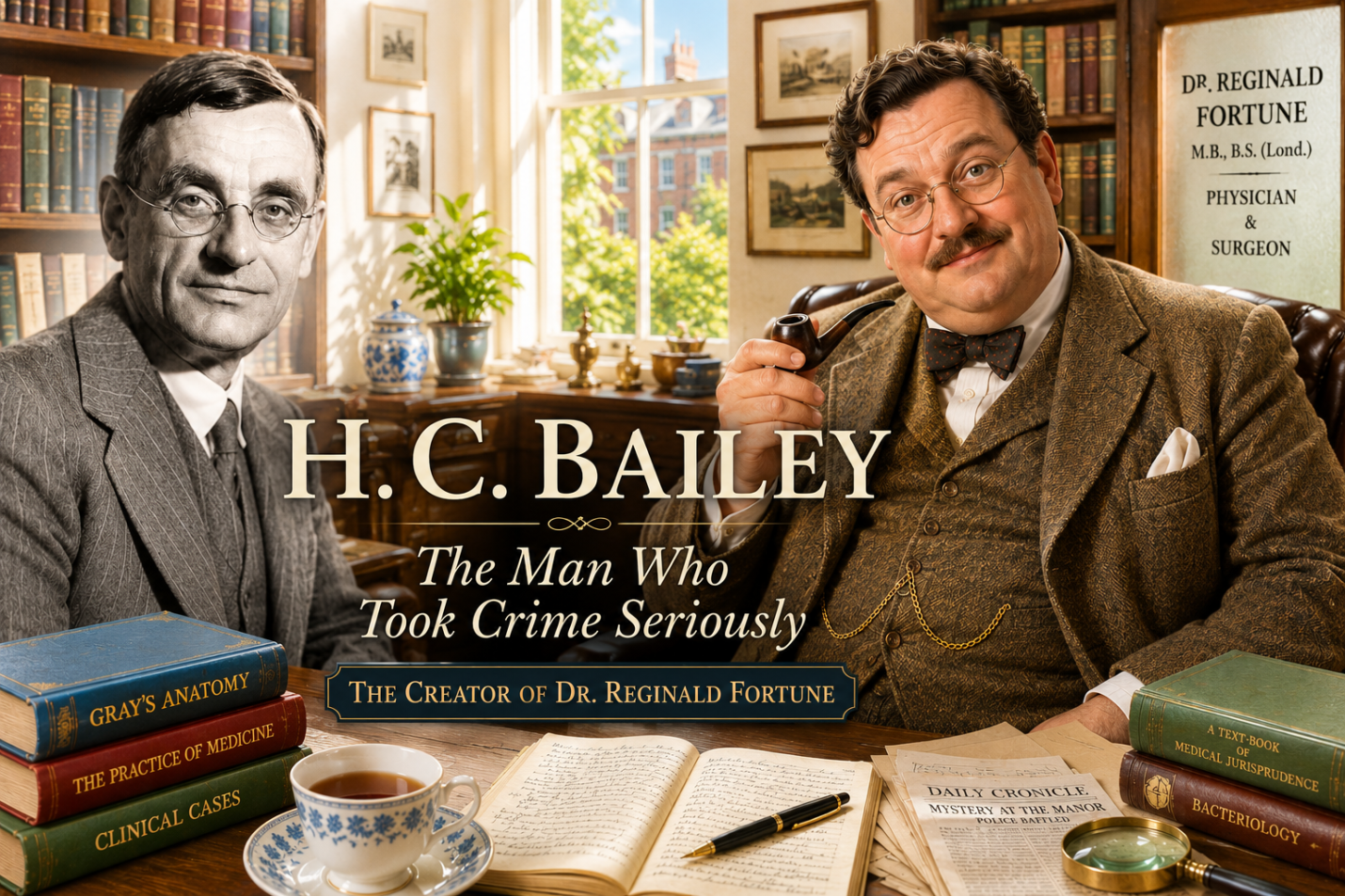
The Man Who Took Crime Seriously
Introduction
Some detective writers are impossible to miss. Their books fill bookstore shelves, their detectives appear on television, and their names remain familiar long after their deaths. Others occupy a quieter place in literary history. Their work continues to be read, and their names still appear in discussions of detective fiction, yet they are far less familiar to modern readers than they once were.

H. C. Bailey belongs to that second group. Today, many readers know little about him, yet his name continues to appear whenever enthusiasts and historians explore the Golden Age of detective fiction.
This raises an interesting question. What was it about Bailey’s work that allowed him to remain part of the conversation when so many once-popular writers gradually faded from view? To answer that, we need to examine the life, career, and mysteries of a writer who still occupies a curious place in the history of the genre.
Biography
When looking at H. C. Bailey’s early life, it is easy to experience a sense of déjà vu. Like several other Golden Age writers, he received a good education, worked as a journalist, and eventually became a novelist. Readers who have followed the Detective Authors Archive for a while may feel as though they have heard this story before.
The more we looked at Bailey’s background, the more a different question emerged. If his education and career followed a familiar path, what was it that made him memorable? Freeman Wills Crofts brought his experience as an engineer to detective fiction. Anthony Berkeley became known as a founder of the Detection Club. Dorothy L. Sayers built a public reputation that extended far beyond her mysteries. Bailey seems different.

Born in London in 1878, Bailey studied at Oxford before beginning a career in journalism. He later turned to fiction, writing historical novels before becoming associated with detective stories. These facts help sketch the outline of his career, but they do not fully explain why his name continues to appear in discussions of Golden Age crime fiction.
In fact, the more we examined Bailey’s early life, the less it seemed to provide an obvious answer. Unlike some of his fellow writers, he left behind no single defining profession, public role, or larger-than-life reputation that immediately explains his place in the genre. If the answer is not found in the biography, perhaps it is found elsewhere. To understand why Bailey is still remembered, we need to follow the trail into the mysteries themselves.
From Historical Fiction to Detective Fiction
Before becoming associated with detective fiction, Bailey wrote in several different genres, including historical fiction. At first glance, this seems like an important clue. Perhaps the answer to Bailey’s enduring reputation lies somewhere in those earlier works.
The problem is that Bailey was hardly alone. The deeper we explore the Golden Age, the more we encounter writers who moved freely between genres. Some wrote historical fiction, others essays, journalism, adventure stories, plays, or works that had little connection to detective fiction at all. In that respect, Bailey was following a well-traveled path rather than carving out a unique one.
In other words, this may be a red herring.
Writing outside detective fiction tells us something about Bailey’s career, but it does not explain why his name continues to appear in discussions of the genre. The more we examined his early work, the more another clue began to stand out.
Rather than building his reputation through a single breakthrough novel, Bailey first found success through a series of detective short stories. If the answer to our investigation is not hidden in his early career, it may be waiting there instead.
Meet the Detective
The clue that emerged from Bailey’s detective fiction was not a particular novel, but a character. Reggie Fortune first appeared in a series of short stories and quickly became the figure most closely associated with Bailey’s work.
At first glance, Fortune seems easy to categorize. He is a doctor rather than a police officer, and his medical training often helps him notice details that others overlook. Yet many detectives have come from professional backgrounds, and a medical degree alone does not explain why readers remained loyal to the series for more than two decades.
The answer appears to lie in the man himself.

Plump, talkative, and fond of good food, Fortune lacks the cold precision often associated with fictional detectives. He can seem whimsical, absent-minded, and even slightly foolish. That appearance is deceptive. Beneath it lies a sharp observer whose understanding of character frequently proves as valuable as any physical clue.
What made Fortune memorable was not simply his ability to solve mysteries, but the way he approached them. He paid close attention to motives, weaknesses, fears, and moral choices. Crimes interested him, but so did the people behind them. Over time, readers returned not only for the puzzles, but for the detective himself.
As our investigation continued, one thing became increasingly clear. Reggie Fortune was more than a recurring detective. He was the lens through which Bailey explored the people caught up in crime.
What He Brought to the Genre
As our investigation continued, the trail finally began to lead somewhere.
Many Golden Age writers are remembered for a specific contribution. Freeman Wills Crofts refined the procedural mystery. S. S. Van Dine became associated with the rules of detective fiction. E. C. Bentley challenged established conventions with Trent’s Last Case.
Bailey’s contribution appears less obvious, but no less important.
While he never abandoned the mystery itself, Bailey approached crime as something more than an intellectual exercise. His stories repeatedly return to questions of responsibility, justice, cruelty, and consequence. The mystery matters, but so do the lives damaged by it.
This perspective shaped Reggie Fortune as much as it shaped the stories. Fortune is particularly drawn to those who cannot easily defend themselves, and his concern for victims sometimes extends beyond the strict requirements of detection. For Bailey, solving a crime and achieving justice were not always the same thing.
That moral seriousness sets many of his stories apart. Even when the plots are entertaining or light-hearted, there is often a strong sense that crime has real victims and real consequences. Cruelty is rarely treated lightly, especially when it affects children or vulnerable adults.
If Bailey remains part of the conversation today, this may be one reason why. He reminded readers that detective fiction was not only about discovering who committed the crime. It was also about confronting the harm that crime leaves behind.
Legacy & Media
For a writer admired by Agatha Christie and Dorothy L. Sayers, H. C. Bailey left surprisingly little behind in terms of media adaptations. Unlike Poirot, Lord Peter Wimsey, Albert Campion, or Father Brown, Reggie Fortune never became a regular presence on television or in film. A handful of radio productions introduced the character to new audiences, but Bailey’s work never developed the extensive adaptation history enjoyed by some of his contemporaries.
At first glance, that absence might suggest a fading reputation. Yet the evidence points in a different direction.
Long after many once-popular detective writers disappeared from discussion, Bailey’s name continued to appear in histories of crime fiction and studies of the Golden Age. His stories remained available through reprints and anthologies, while critics and historians continued to examine his work.
While not every history of detective fiction gives Bailey significant attention, his work continues to attract interest from writers, critics, and readers who explore the Golden Age beyond its most famous names.
Perhaps most telling is the respect he earned from fellow writers. Christie admired him. Sayers admired him. Modern historians of detective fiction continue to discuss his stories and his detective. While Bailey never achieved the public recognition enjoyed by the most famous names of the Golden Age, he earned something different: a lasting place in the genre’s history.
His legacy rests less on adaptation and popularity than on reputation. Bailey may never have become a household name, but he remains one of those writers whose work continues to reward readers willing to look beyond the most famous figures of the Golden Age.
Where to Start
Readers curious about H. C. Bailey are best served by beginning with Reggie Fortune.


Call Mr. Fortune (1920) introduced the character and marked the beginning of Bailey’s long association with detective fiction. The collection offers a first glimpse of the doctor-detective who would become the defining figure of Bailey’s career.
Many readers also recommend Mr. Fortune, Please, a collection that showcases Bailey’s strengths and provides an excellent introduction to the series.
Those who enjoy the early stories can then explore Bailey’s later Fortune collections and novels. With roughly ninety-five stories featuring the detective, there is no shortage of material for readers who find themselves drawn to his work.
Later Years
As detective fiction evolved and new trends emerged, Bailey continued writing the stories that had established his reputation. Reggie Fortune remained at the center of his work, appearing in a long-running series of stories and novels that extended well into the 1940s.
Unlike some of his contemporaries, Bailey never became a prominent public figure within the genre. By nature a private man, he preferred a quieter life centered on his family and his writing. While other members of the Detection Club enjoyed social gatherings and public literary friendships, Bailey was more comfortable working away from the spotlight.
His final Reggie Fortune stories appeared in the years following the Second World War, bringing to a close one of the longest-running detective series of the Golden Age. Bailey died in 1961 at the age of eighty-two.
Conclusion
When we began this investigation, the answer was not immediately obvious. Bailey’s background seemed familiar, his path into writing resembled that of many other Golden Age authors, and several promising clues quickly proved to be red herrings.
The answer emerged elsewhere.
It appeared in Reggie Fortune, a detective whose understanding of people was as important as his ability to solve mysteries. It appeared in stories that treated crime as more than a puzzle and refused to ignore its human consequences. And it appeared in Bailey’s strong sense of justice, which gave his work a distinctive tone even among his fellow Golden Age writers.
Bailey never achieved the public fame of Christie or the enduring media presence of Poirot. Yet his work continued to earn the respect of readers, writers, and critics who looked beyond the most famous names of the genre.
Perhaps that is why his name never entirely disappeared. While others are remembered for a detective, a puzzle, or a famous adaptation, Bailey is remembered for something less obvious but no less important: his belief that crime fiction was ultimately about people.
Questions for Readers
🔍 Have you ever read a Reggie Fortune story? If so, what was your first impression of the detective?
⚖️ Do you prefer detectives who focus strictly on solving the mystery, or those who are equally concerned with justice and the people affected by crime?
🕵️♂️ Can a detective be too concerned with morality, or does that make a character more interesting?
💭 After reading about Bailey, do you think his reputation rests more on Reggie Fortune or on the themes explored in his stories?
References
Primary Works
- Bailey, H. C. Call Mr. Fortune.
- Bailey, H. C. Mr. Fortune, Please.
- Bailey, H. C. Reggie Fortune stories and novels.
Books
- Edwards, Martin. The Golden Age of Murder.
- James, P. D. Talking About Detective Fiction.
- The Cambridge Companion to Crime Fiction.
- Spehner, Norbert. Le Détectionnaire (relevant Bailey entries).
Articles and Online Resources
- Contemporary and modern articles discussing Reggie Fortune and H. C. Bailey.
- Radio and adaptation records where available.
Previous: E. C. Bentley
➡️ Next: Patricia Wentworth








Hello Gumshoe! On the track or authors? leave us reply!