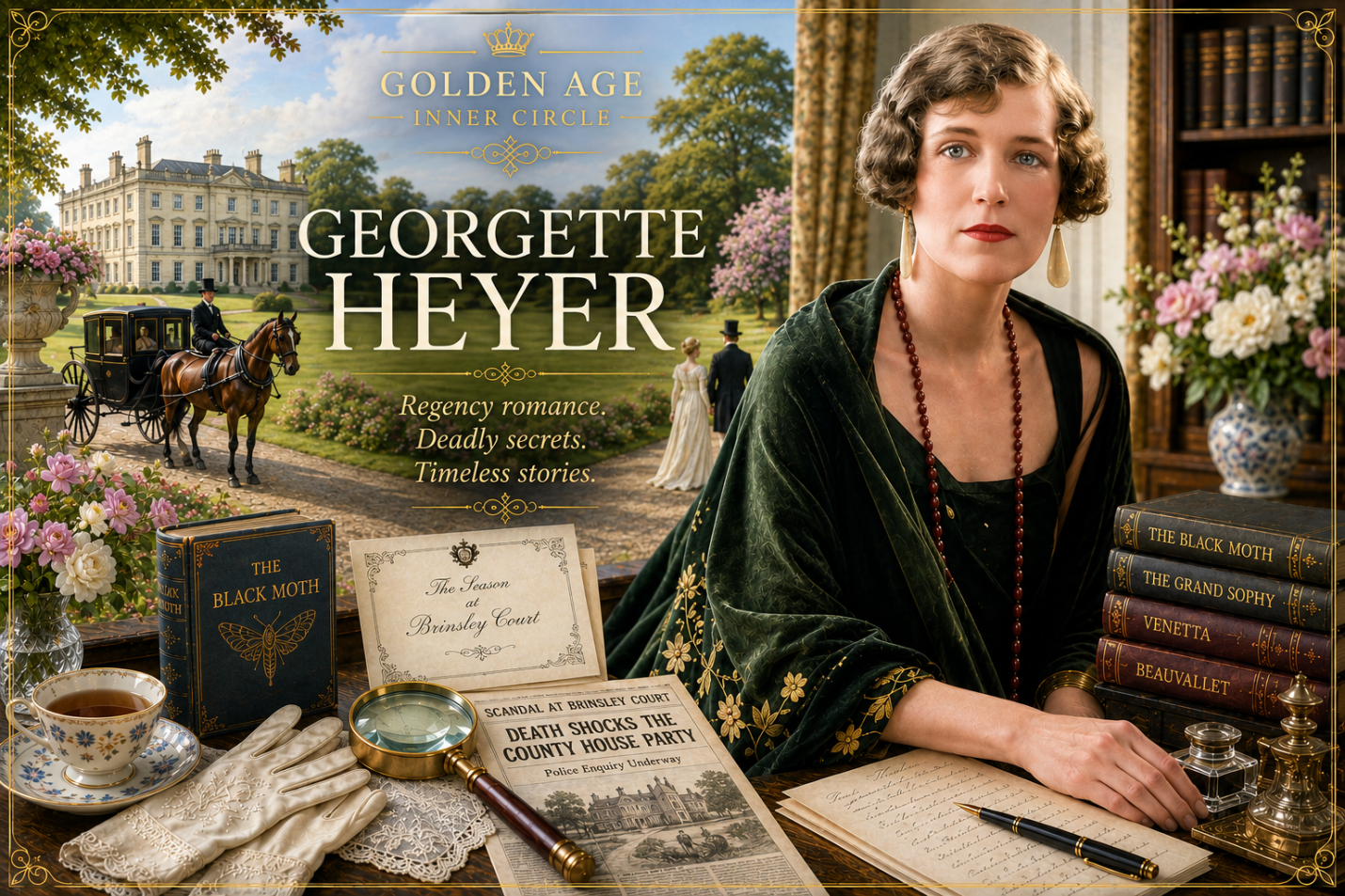
Beyond Regency Romance: The Detective Fiction of Georgette Heyer
Imagine mentioning Georgette Heyer to a room full of readers.
Most will immediately think of elegant Regency ballrooms, witty conversations, and the novels that helped define an entire genre of historical romance. Few, however, realize that alongside those celebrated stories, Heyer also wrote some of the Golden Age’s most entertaining detective fiction.

Her mysteries are filled with eccentric families, sharp dialogue, impossible inheritances, and clever police investigations. They possess the same keen eye for character that made her romances famous, but replace courtship with murder and scandal with carefully hidden motives.
Beyond Regency Romance, another Georgette Heyer is waiting to be discovered—one whose detective novels deserve a place alongside the finest mysteries of the Golden Age.
Early Life
Georgette Heyer was born on August 16, 1902, in Wimbledon, London. She grew up in a close-knit middle-class family where books and storytelling were part of everyday life. Her father, George Heyer, was a schoolmaster who encouraged his children’s interest in literature, while her mother, Sylvia Watkins Heyer, fostered a warm and supportive home.

Unlike many writers of the Golden Age, Heyer did not attend university. Instead, she received much of her education at home before briefly attending Westminster School for Girls. Her formal schooling ended earlier than expected, but by then she had already developed a remarkable love of history, language, and literature.
That passion found an outlet in an unexpected way. To entertain her younger brother Boris, she began writing a historical adventure set in the eighteenth century. The manuscript impressed her father, who encouraged her to seek publication. In 1921, when she was only nineteen years old, it appeared as The Black Moth.
The novel proved an immediate success and launched a career that would span more than five decades. Although Heyer would eventually become synonymous with Regency romance, she never saw herself as writing simple love stories. She immersed herself in historical research, striving to recreate the language, customs, fashions, and social conventions of the period with unusual accuracy. That meticulous attention to detail would later become one of the defining features of both her historical fiction and her detective novels.
Building a Literary Career
The success of The Black Moth gave Georgette Heyer something few young writers ever receive: the opportunity to make a living through fiction. Rather than treating her first novel as a youthful achievement, she continued writing with remarkable discipline, publishing regularly throughout the 1920s and 1930s.
Historical fiction quickly became her specialty. Fascinated by the Regency period, Heyer immersed herself in letters, diaries, newspapers, memoirs, and works of history to recreate the era with unusual accuracy. She paid close attention not only to historical events but also to everyday details, from clothing and transportation to manners, vocabulary, and social customs.
Over the following decades, she produced a remarkable catalogue of historical novels. Works such as Regency Buck (1935), Arabella (1949), The Grand Sophy (1950), Frederica (1965), and The Unknown Ajax (1959) became enduring favourites, admired for their wit, memorable characters, and meticulous historical detail. Together, they helped establish the modern Regency romance and secured Heyer’s reputation as one of the genre’s most influential writers.
Yet Heyer refused to confine herself to a single genre. While historical novels remained her greatest commercial success, she also enjoyed constructing intricate detective stories. The same careful plotting that brought order to eighteenth-century society proved equally effective when arranging murders, suspects, and hidden motives.
Unlike many of her Golden Age contemporaries, Heyer did not spend years working in journalism, law, medicine, or another profession before turning to fiction. Writing was not a second career—it was her profession almost from the beginning. That lifelong dedication allowed her to develop two parallel literary identities: one celebrated for historical romance, the other quietly admired by readers of detective fiction.
Turning to Detective Fiction
By the early 1930s, Georgette Heyer had already established herself as a successful historical novelist. She could easily have continued writing only Regency romances, yet she chose to explore another literary challenge: detective fiction.
The decision was hardly surprising. The 1930s marked the height of the Golden Age of Detective Fiction, when readers eagerly followed the latest mysteries by Agatha Christie, Dorothy L. Sayers, Margery Allingham, and many others. Clever puzzles, eccentric suspects, and carefully constructed plots had become enormously popular, and Heyer was an enthusiastic reader of the genre herself.
Writing detective novels also appealed to a different side of her imagination. Historical fiction demanded extensive research and painstaking attention to historical detail. Detective fiction, by contrast, offered the pleasure of constructing an intricate puzzle—balancing clues, motives, and alibis until every piece fell into place. It required precision rather than historical reconstruction, but it rewarded the same careful planning.
Perhaps most importantly, Heyer discovered that her greatest strengths translated naturally into crime fiction. Her gift for lively dialogue, memorable families, and sharply observed social relationships became just as effective in stories of murder as they had been in tales of courtship. The drawing room remained, but now someone might be found dead in it.
Rather than abandoning one genre for another, Heyer wrote both side by side. Historical romances remained her principal body of work, while detective fiction became a parallel creative outlet—allowing her to satisfy a different kind of literary curiosity without ever losing the wit and craftsmanship that defined her writing.
Meet the Detectives
Unlike many Golden Age writers, Georgette Heyer did not build her detective fiction around a single iconic sleuth. Instead, she introduced a small group of capable police investigators who appear across several novels, each bringing a calm, professional presence to increasingly complicated cases.
Superintendent Hannasyde
Heyer’s first recurring detective was Superintendent Hannasyde of Scotland Yard. Polite, patient, and quietly observant, Hannasyde is not a flamboyant genius in the mould of Hercule Poirot or Lord Peter Wimsey. He succeeds through careful questioning, methodical investigation, and an ability to see through the deceptions of respectable society.

Hannasyde appears in several of Heyer’s early mysteries, including Footsteps in the Dark, Why Shoot a Butler?, No Wind of Blame, Detection Unlimited, Duplicate Death, and They Found Him Dead. His calm professionalism provides a steady contrast to the colourful suspects who surround him.
Inspector Hemingway
Later, Heyer introduced Inspector Hemingway, who gradually became her best-known detective. More outspoken and informal than Hannasyde, Hemingway possesses a dry wit and an instinct for reading people. He enjoys puncturing inflated egos and is rarely impressed by wealth or social position.

Among his investigations are Envious Casca, The Unfinished Clue, A Blunt Instrument, Duplicate Death, No Wind of Blame, Behold, Here’s Poison, and Detection Unlimited. His conversational style and understated humour make him one of Heyer’s most engaging investigators.
More Than the Detective
In many Georgette Heyer mysteries, however, the detective is only part of the appeal. The real fascination lies in the cast of suspects: quarrelsome families, eccentric relatives, wealthy patriarchs, ambitious heirs, and long-buried secrets. Heyer’s talent for dialogue and characterisation ensures that every household feels alive long before a murder disrupts it.
This balance gives her detective fiction a distinctive flavour. The investigators provide the structure, but it is the people around them—their rivalries, loyalties, and hidden motives—that make the mysteries memorable. As in her historical novels, Heyer’s greatest gift was not simply telling a story, but creating characters readers enjoy spending time with, even when one of them turns out to be the murderer.
Where to Begin
If you’re new to Georgette Heyer’s detective fiction, an easy approach is to begin with either of her two recurring investigators. Both offer classic Golden Age puzzles, memorable characters, and the sparkling dialogue for which Heyer became famous.
Superintendent Hannasyde


Why Shoot a Butler? (1933)
One of the best introductions to Hannasyde. A chance discovery of a body leads to a classic country-house mystery filled with secrets, misunderstandings, and carefully hidden motives.
The Unfinished Clue (1934)
An excellent example of Heyer’s talent for creating an eccentric household of suspects. The isolated setting, sharp dialogue, and intricate puzzle make it one of her most enjoyable mysteries.
Inspector Hemingway


Envious Casca (1941)
Frequently considered Heyer’s finest detective novel, this story follows Inspector Hemingway as he investigates the murder of a wealthy patriarch surrounded by relatives who all seem to have a motive. It perfectly balances humour, character, and mystery.
A Blunt Instrument (1938)
A clever investigation with an engaging cast and a tightly constructed plot. Hemingway’s dry wit and practical approach make him an ideal guide through the tangled relationships at the heart of the case.
Whichever detective you choose, you’ll soon discover that Georgette Heyer’s mysteries deserve to be remembered alongside the better-known works of the Golden Age. They combine ingenious puzzles with lively conversation and richly drawn characters, offering a rewarding introduction to an often-overlooked side of her career.
What Georgette Heyer Brought to the Golden Age
Georgette Heyer entered detective fiction at a time when the genre was flourishing, yet she never attempted to imitate her contemporaries. Instead, she brought with her the qualities that had already made her historical novels so successful, giving her mysteries a distinctive voice within the Golden Age.
Memorable Characters
Rather than relying on eccentric detectives alone, Heyer created lively casts of suspects whose personalities often became just as memorable as the crimes themselves. Family rivalries, old resentments, hidden romances, and conflicting ambitions ensure that every investigation feels rooted in believable human relationships.
Sparkling Dialogue
Few Golden Age writers matched Heyer’s ear for conversation. Her novels are filled with quick wit, understated humour, and exchanges that reveal character as effectively as they advance the plot. Even scenes of interrogation often carry a lightness that makes the stories especially enjoyable to read.
Social Observation
Much like her historical fiction, Heyer’s detective novels pay close attention to the manners and expectations of British society. Class, family obligation, reputation, and inheritance frequently shape both the motives for murder and the way characters respond to it, adding depth beyond the central mystery.
A Balance Between Character and Puzzle
Heyer’s mysteries never lose sight of the puzzle, but neither do they sacrifice character for cleverness. Her detective novels combine carefully constructed investigations with believable people, demonstrating that a satisfying mystery can be both intellectually engaging and richly entertaining.
A Tale of Two Legacies
Few writers achieve lasting success in a single genre. Georgette Heyer accomplished it in two.
Her historical novels remained continuously popular, inspiring generations of readers and establishing her as one of the pioneers of Regency romance. For many, her name became inseparable from elegant ballrooms, witty conversations, and meticulously researched historical settings.
Yet alongside that celebrated body of work stood another achievement. Throughout the Golden Age of Detective Fiction, Heyer wrote a remarkable series of mysteries that displayed the same wit, sharp characterisation, and careful plotting found in her historical novels. While these detective stories earned the admiration of mystery readers, they never reached the same level of recognition as her Regency fiction.
In many ways, Heyer’s greatest success became her greatest challenge. The extraordinary popularity of her historical novels gradually overshadowed her detective fiction, leaving many readers unaware that she had written mysteries at all.
Today, those detective novels continue to be rediscovered by Golden Age enthusiasts. They remind us that Georgette Heyer’s literary legacy extends far beyond the Regency drawing room. She was not simply one of the architects of historical romance—she was also a gifted mystery writer whose work deserves a place among the notable voices of the Golden Age.
Perhaps Georgette Heyer’s story is not one of a forgotten author, but of a forgotten legacy. The Detective Authors Archive invites readers to rediscover that other half of her remarkable career.
Legacy and Media
Georgette Heyer’s literary influence extends across two genres. While her historical novels helped shape the modern Regency romance, her detective fiction remains an appreciated part of the Golden Age by readers who enjoy classic British mysteries built on character, wit, and fair-play plotting.
Although Georgette Heyer’s detective novels have seen relatively few screen adaptations, some have reached audiences through BBC radio dramas, introducing new listeners to her mysteries while preserving the wit and atmosphere of the original stories.
Critics and readers alike continue to praise Heyer’s gift for dialogue, memorable characters, and intricate plotting—qualities that distinguish both her historical novels and her detective fiction. While her romances brought her international fame, her mysteries have earned a lasting place among enthusiasts of classic crime.
Today, Georgette Heyer’s detective novels continue to remind readers that one of the twentieth century’s best-known historical novelists was also a remarkably accomplished mystery writer. With many of her mysteries available in print, ebook, and audiobook formats, discovering this lesser-known side of her work has never been easier.
Later Years
By the 1960s and early 1970s, Georgette Heyer had become one of Britain’s most successful novelists. Her historical fiction enjoyed an international readership, while her detective novels continued to attract loyal fans of classic crime.
Despite her success, Heyer remained an intensely private person. She rarely gave interviews, avoided publicity whenever possible, and preferred to let her books speak for themselves. Unlike many celebrated authors, she showed little interest in cultivating a public image, choosing instead to devote her time to writing and research.
Georgette Heyer died on July 4, 1974, at the age of seventy-one. She left behind two remarkable literary legacies: one that transformed the Regency romance into a lasting literary tradition, and another that enriched the Golden Age of Detective Fiction with wit, memorable characters, and carefully crafted mysteries.
Although readers around the world continue to celebrate her historical novels, her detective fiction remains a rewarding discovery for anyone willing to look beyond her best-known reputation.
Conclusion
For many readers, Georgette Heyer will always be remembered as the queen of Regency romance. Yet to stop there is to miss another remarkable chapter of her literary career.
Her detective novels reveal the same wit, keen observation, and gift for memorable characters that made her historical fiction so enduring. They remind us that beneath the elegant drawing rooms, imposing country houses, and formidable family matriarchs lies another world—one where sharp conversation is matched by carefully hidden motives, and where murder is never far from the tea table.
If modern audiences delight in stories of aristocratic families, sprawling estates, and strong-willed dowagers, they may find that Georgette Heyer has been waiting for them all along. Her mysteries offer all the charm of that world, with the added satisfaction of an ingenious Golden Age puzzle.
Beyond Regency romance lies another Georgette Heyer. The Detective Authors Archive invites you to meet her.
Questions for Readers
- Before reading this article, did you know that Georgette Heyer wrote detective fiction, or did you only know her as a Regency novelist?
- After discovering this side of her work, are you tempted to pick up one of her mysteries?
- Do you think an author’s most famous work can sometimes overshadow other equally rewarding books?
- Have you ever discovered a favorite author had written in a completely different genre?
- Which other well-known author do you think deserves to be remembered for a lesser-known part of their work?
References
Primary Works
- Why Shoot a Butler?
- The Unfinished Clue
- A Blunt Instrument
- Envious Casca
Reference Books
- Martin Edwards, The Golden Age of Murder
- Norbert Spehner, Le Détectionnaire
- The Cambridge Companion to Crime Fiction
- The Georgette Heyer Official Website
- The Georgette Heyer Society
- BBC (for information on the radio adaptations)
Navigation
← Previous: Patricia Wentworth – The Quiet Observer of Crime
Next →: Nicholas Blake – Poetry, Psychology, and Murder








Hello Gumshoe! On the track or authors? leave us reply!