
The Poet Who Solved Murders
Introduction
Imagine a writer whose reputation was built not on murder mysteries but on carefully chosen words and celebrated verse. Then imagine that same writer turning to detective fiction—not as a brief diversion, but as a second career.

That writer was Nicholas Blake. His novels earned a place among the notable voices of the Golden Age, yet today his name is often less familiar than those of many of his contemporaries. His work offers the chance to meet an author who followed an unusual path into detective fiction.
Sometimes the road to a great mystery begins not with a crime, but with a poem.
Early Life
Long before readers knew him as Nicholas Blake, he wrote under his own name: Cecil Day-Lewis. Born in Ireland in 1904, he spent much of his childhood in England after the death of his mother when he was only four years old. Raised by his father, a clergyman, he grew up in an environment that valued education, language, and literature.

Day-Lewis attended the University of Oxford, where he became part of a generation of young writers who would leave a lasting mark on twentieth-century English literature. His early poetry collections established him as a talented and thoughtful voice. During these years, he also worked as a teacher and editor while continuing to build his literary reputation.
By the early 1930s, Cecil Day-Lewis was already earning recognition as a poet. Few could have guessed that he would soon begin a second career under a different name—one that would make him a respected figure in detective fiction as well.
The Birth of Nicholas Blake
By the early 1930s, Cecil Day-Lewis had established himself as a respected poet, but poetry alone rarely provided a dependable income. Detective fiction, meanwhile, was flourishing, offering writers both a wide readership and greater financial security.
Rather than publish crime novels under his own name, Day-Lewis adopted the pseudonym Nicholas Blake. The choice allowed him to keep his literary and detective careers separate while giving him the freedom to explore a different style of writing.
The experiment quickly became a success. His first detective novel, A Question of Proof (1935), was well received and launched a mystery-writing career that would continue alongside his work as a poet for decades to come.
Meet the Detective
Nicholas Blake’s best-known creation is Nigel Strangeways, an amateur detective who first appeared in A Question of Proof (1935). Blake based Strangeways’ physical appearance on the poet W. H. Auden, describing him as having sand-coloured hair and blue eyes.

Unlike many of the era’s investigators, Strangeways is neither a police officer nor a professional detective. He approaches mysteries as an intelligent observer, relying on careful reasoning, broad knowledge, and a genuine curiosity about human nature.
Although he possesses the sharp mind expected of a Golden Age detective, Strangeways balances logical deduction with psychological observation, giving the series a distinctive tone among the mysteries of the period.
Strangeways remained Blake’s principal detective throughout his mystery-writing career. As the series progressed, his personal life also evolved, allowing readers to follow important moments beyond the mysteries themselves. This sense of continuity gave the series a depth that distinguished it from many detective novels of the period.
Notable Cases
For readers interested in exploring the series, these novels provide an excellent introduction to Nigel Strangeways:
- A Question of Proof (1935) – The first appearance of Nigel Strangeways and the novel that introduced Blake’s detective to readers.
- Thou Shell of Death (1936) – A mystery whose title is drawn from The Revenger’s Tragedy, reflecting Blake’s literary background.
- The Beast Must Die (1938) – Blake’s best-known novel and the basis for several film and television adaptations.
- The Smiler with the Knife (1939) – A politically charged mystery that demonstrates Blake’s willingness to explore themes beyond the traditional country-house puzzle.
- The Private Wound (1968) – The final Nigel Strangeways novel, bringing the detective’s long career to a thoughtful conclusion.
What He Brought to Detective Fiction
Nicholas Blake entered detective fiction from an unusual direction. By the time he began writing mysteries, Cecil Day-Lewis had already earned recognition as a poet. Rather than leaving that world behind, he brought it with him. His novels display a love of language and literature, and even their titles reveal those influences. Thou Shell of Death, for example, takes its name from The Revenger’s Tragedy, reflecting Blake’s belief that detective fiction belonged within the broader literary tradition.
Yet Blake never allowed literary ambition to overshadow the mystery itself. His novels remain firmly rooted in the fair-play tradition while giving increasing attention to character, motivation, and the emotional consequences of crime. As the Nigel Strangeways series developed, understanding people became just as important as solving the puzzle.
Blake also believed detective fiction deserved serious consideration. He argued that the genre reflected broader changes in society rather than serving as simple escapist entertainment. Whether readers agreed with his views or not, they reveal an author who saw the detective novel as capable of combining intellectual challenge with genuine insight into human nature.
Walked Away?
Unlike some of his contemporaries, Nicholas Blake never truly left detective fiction behind. New Nigel Strangeways novels continued to appear alongside his poetry, allowing him to maintain two successful literary careers for more than three decades.
As the years passed, however, his priorities gradually shifted. His growing reputation as a poet eventually led to his appointment as Poet Laureate in 1968, a role that naturally demanded more of his time and attention. That same year saw the publication of his final Nigel Strangeways novel, bringing the series to a close without any dramatic break from the genre.
Rather than abandoning detective fiction, Blake simply allowed the series to reach its natural conclusion. His career reflects not a rejection of crime writing, but the successful balancing of two literary worlds.
Legacy & Media
Although Nicholas Blake is less widely read today than some of his Golden Age contemporaries, his work continues to attract admirers of classic detective fiction. Nigel Strangeways remains one of the distinctive amateur detectives of the period, and Blake’s contribution is still recognized in histories of the genre.

His novels have also enjoyed a lasting life beyond the printed page. Several stories have been adapted for film, television, and radio, demonstrating their enduring appeal. The best-known screen version remains Que la bête meure, directed by Claude Chabrol and based on The Beast Must Die. While Chabrol made the story distinctly his own, the film introduced Blake’s fiction to a wider international audience. More recent adaptations have shown that interest in his work continues well into the twenty-first century.
For French-speaking readers, however, Blake has remained less accessible than many of his contemporaries. Only seven of the Nigel Strangeways novels were translated into French, leaving much of the series unavailable to those who do not read English. Even so, his novels continue to reward readers who discover them.
Later Years
As the years passed, Cecil Day-Lewis successfully balanced his two literary careers. While Nicholas Blake remained a respected name among mystery readers, Day-Lewis’s reputation as a poet continued to grow. In 1968, he was appointed Poet Laureate of the United Kingdom, one of the highest honours in British literature.
His personal life also entered a new chapter. After the end of his first marriage, he married actress Jill Balcon. Their children also pursued creative careers: Daniel Day-Lewis became an Academy Award-winning actor, while Tamsin Day-Lewis established herself as a documentary filmmaker and writer.
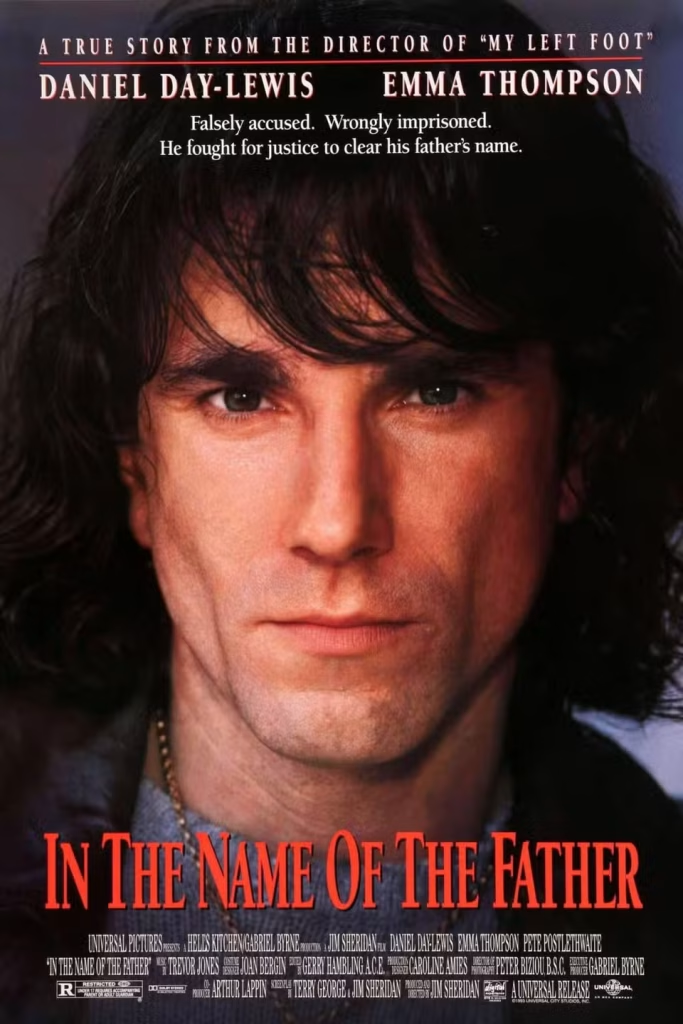

Cecil Day-Lewis died in 1972 at the age of sixty-eight. Remembered both as an accomplished poet and as the creator of Nicholas Blake, he left behind a body of work that continues to occupy a distinctive place in the history of Golden Age detective fiction.
Conclusion
Nicholas Blake proved that detective fiction could combine carefully constructed mysteries with rich characterization and literary ambition. Through Nigel Strangeways, he created a detective who evolved over time, allowing each investigation to explore not only the crime itself but also the people caught within it.
His work may be less familiar today than that of some of his contemporaries, yet it continues to reward those who seek it out. Blake’s novels remain thoughtful, intelligent, and distinctive, reminding us that some of the finest mysteries are not always the most famous.
Questions for Readers
- Do you enjoy detective novels that focus as much on character as on the mystery itself?
- Do literary references and classical allusions add to a mystery for you, or do you prefer a more straightforward detective story?
References
Primary Works
- A Question of Proof
- Thou Shell of Death
- The Beast Must Die
- The Smiler with the Knife
- The Private Wound
Reference Works
- Martin Edwards. The Golden Age of Murder.
- Lee Horsley (ed.). The Cambridge Companion to Crime Fiction.
- John Scaggs. Crime Fiction.
- Norbert Spehner. Le Détectionnaire.
Additional Resources
- Detection Club (history and membership).
- Contemporary editions and publication records of Nicholas Blake’s novels.








Hello Gumshoe! On the track or authors? leave us reply!