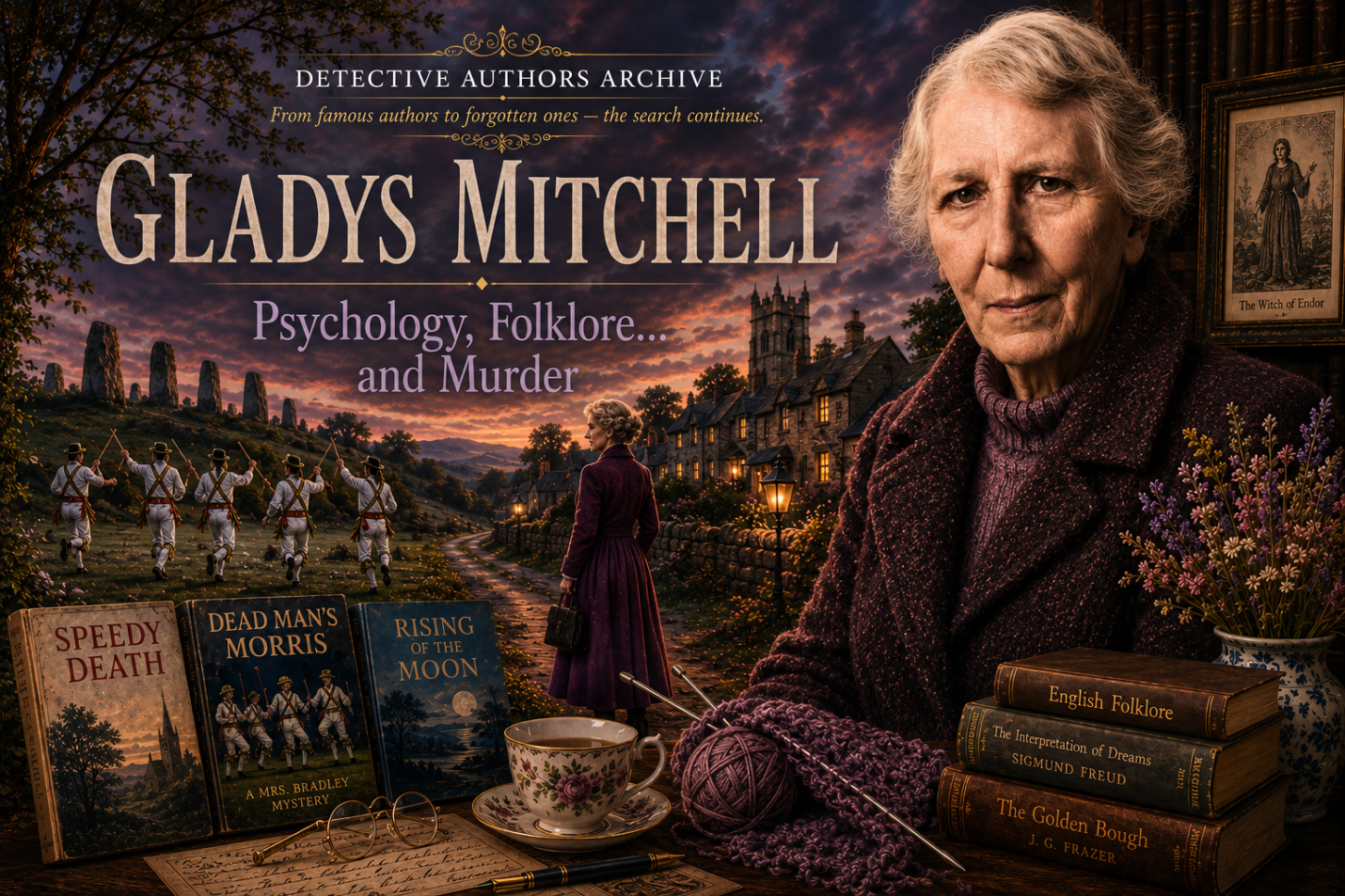
Psychology, Folklore… and Murder
The Golden Age of detective fiction is often associated with ingenious puzzles, fair-play mysteries and carefully ordered worlds where reason ultimately prevails. Gladys Mitchell belonged to that tradition, but she rarely followed the expected path.

Teacher, headmistress and prolific novelist, Mitchell spent more than fifty years expanding the possibilities of detective fiction without abandoning the qualities that made the genre so enduring. Respected by her fellow members of the Detection Club and celebrated for her originality, she established herself as one of the Golden Age’s most distinctive voices.
Today, her novels continue to intrigue readers who discover that the familiar world of classic detective fiction can still hold unexpected surprises.
The Author Behind the Mysteries
Gladys Maude Winifred Mitchell was born on April 21, 1901, in Cowley, near Oxford, before moving with her family to Brentford, west of London, during her childhood. From an early age she displayed a lively imagination, reportedly winning a writing competition while still at school. After studying at Goldsmiths’ College and later at University College London, she embarked on a career in education that would span more than four decades.

Mitchell taught English, history and physical education before eventually becoming headmistress at Matthew Arnold School in Staines. Although teaching remained her profession, writing increasingly became her passion. Four unpublished novels failed to find a publisher before Victor Gollancz accepted Speedy Death, introducing readers to one of detective fiction’s most unconventional investigators.
Alongside her work in the classroom, Mitchell cultivated an extraordinary range of interests. Psychology, particularly the theories of Sigmund Freud, fascinated her, as did archaeology, medieval architecture, folklore and beliefs surrounding witchcraft and the supernatural. Rather than remaining hobbies, these subjects became the foundations of her fiction, giving her mysteries a distinctive atmosphere that set them apart from those of her contemporaries.
Inside the Detection Club
Gladys Mitchell joined the Detection Club in 1933 following the death of the Reverend Victor Whitechurch. Sponsored by Anthony Berkeley and Helen Simpson, she entered a society that was gradually broadening its horizons beyond its original circle of largely Oxbridge-educated writers. The following year, Margery Allingham also joined, helping to shape a new generation within the Club.
Known affectionately to friends as “Mike,” Mitchell quickly became an enthusiastic participant in Club life. She greatly admired Helen Simpson, describing her as one of the most brilliant, witty and intellectually gifted members, and even allowed Simpson to give Mrs. Bradley her middle name, Adela, during one of the Club’s collaborative projects.
Mitchell also became one of the Detection Club’s most valuable chroniclers. She later recalled Dorothy L. Sayers’ irritation with Anthony Berkeley’s playful parody of Lord Peter Wimsey, remembered how the presence of Sir Norman Kendal spared members awkward questions from curious policemen during their crime reconstructions, and fondly recounted attending Sayers’ play The Devil to Pay before the Second World War brought its run to an early end.
Through memories such as these, Mitchell became not only a participant in the Detection Club’s history but also one of its most valuable chroniclers.
Meet the Detective
Few detectives of the Golden Age make a stranger first impression than Mrs. Beatrice Adela Lestrange Bradley. Introduced in Speedy Death (1929), she is described by one startled observer as “a little old, shrivelled, clever, sarcastic” woman who, in an earlier age, “would have been smelt out as a witch.” Although only fifty-seven in her first appearance, she already possesses the ageless quality that would define the series, seeming to change remarkably little over the decades. A descendant of a woman executed for witchcraft, Mrs. Bradley embraces the uncanny without ever abandoning reason, combining psychology, folklore and intuition in ways unlike any other detective of the period.
Her appearance is deliberately unsettling. Spehner likens her to a sinister pterodactyl with the smile of the Cheshire Cat, while Mitchell repeatedly emphasizes her wrinkled features and unconventional looks. Yet this intimidating exterior is balanced by a soft, rich voice and an uncanny ability to win the confidence of children and animals. A passionate knitter and an elegant, sophisticated woman, Mrs. Bradley constantly overturns expectations, refusing to fit the comforting image of the elderly amateur detective.

Professionally, she is a psychologist who directs her own clinic and serves as a consultant to the Home Office. The author of A Small Handbook of Psychoanalysis, she cheerfully offers discounted copies to policemen in her very first investigation, revealing the dry humour that runs throughout the series. Her methods blend Freudian psychology, careful observation, calculated manipulation and, when it suits her purposes, a touch of theatrical mystification. Beneath her sarcasm lies the patience of a hunter, content to watch suspects reveal themselves before delivering the final blow.
Mrs. Bradley is also a woman who defies convention. Independent, highly educated and remarkably modern in outlook, she combines scientific curiosity with an enduring fascination for folklore, the supernatural and ancient traditions. That unusual balance makes her one of the most distinctive investigators of the Golden Age, standing comfortably alongside Poirot, Miss Marple and Lord Peter Wimsey while remaining unlike any of them.
Essential Cases
Mitchell announced from the very beginning that she had no intention of following the usual rules. Speedy Death (1929) opens with what appears to be a familiar country-house mystery before overturning expectations through a plot driven as much by psychology and identity as by physical clues. Introducing Mrs. Bradley at the same time, the novel established the blend of wit, psychological insight and unconventional thinking that would become Mitchell’s trademark.


Dead Man’s Morris (1936) demonstrates her delight in combining seemingly unrelated elements into a single mystery. Set in rural Oxfordshire, it mixes Morris dancing, local folklore, pig farming, a murderous boar, secret passages and village legends into a story that somehow remains both entertaining and coherent. Few Golden Age writers were willing to take readers in such unexpected directions.
Education, one of Mitchell’s lifelong passions, takes centre stage in Death at the Opera (1934), where her experience as a teacher informs the mystery while exploring the tensions beneath academic life. Meanwhile, The Rising of the Moon (1945) returns to Brentford, the town where Mitchell grew up, weaving psychological suspense into a setting she knew intimately.


Whether drawing on folklore, psychology, education or personal experience, Mitchell never allowed herself to repeat the same formula. Every Mrs. Bradley novel offered readers another opportunity to discover just how far detective fiction could stretch without losing sight of the mystery at its heart.
Beyond Mrs. Bradley
Although Dame Beatrice Bradley became her most famous creation, Gladys Mitchell was far from a one-series author. She wrote historical novels under the pen name Stephen Hockaby, including Marsh Hay and Grand Master. As Malcolm Torrie, she created the detective Timothy Herring, whose adventures began with Heavy as Lead. She also published several books for younger readers under her own name, among them The Malory Secret and Holiday River.
Taken together, these works reveal a writer whose interests reached well beyond the boundaries of the traditional mystery novel. Whether writing historical adventures, children’s stories or detective fiction, Mitchell remained fascinated by the complexities of human nature and the unexpected paths a story could take.
A Lasting Legacy
From the beginning of her career, Gladys Mitchell refused to treat detective fiction as a fixed formula. While many of her contemporaries perfected familiar patterns, she explored subjects that were often considered uncomfortable for the period. Working within the standards of public decency expected of her day, she wove Freudian psychology, sexuality, repression, folklore and ancient traditions into mysteries that challenged readers as much intellectually as they did logically.

That originality never diminished. After retiring from teaching in 1961, Mitchell devoted herself entirely to writing. Free from the demands of the classroom, she continued the adventures of Mrs. Bradley while also pursuing historical fiction, children’s literature and other projects that reflected the breadth of her literary interests. Even after decades as a published author, she showed little interest in repeating herself, preferring to explore new ideas, settings and characters.
Gladys Mitchell died in 1983, leaving behind one of the longest-running detective series of the Golden Age. Her final completed Mrs. Bradley novel, The Crozier Pharaohs, was published posthumously in 1984, bringing to a close a remarkable literary journey that had begun fifty-five years earlier with Speedy Death.
From Page to Screen
Gladys Mitchell’s work reached television long after Mrs. Bradley first appeared in print. Between 1998 and 2000, the BBC produced five episodes of The Mrs Bradley Mysteries, starring Diana Rigg as the unconventional detective. Although the series adapted only a handful of novels and often took considerable liberties with the original stories, Rigg’s elegant and mischievous performance introduced Mrs. Bradley to a new generation of viewers and remains the character’s best-known screen incarnation.
Mitchell’s work also found its way to younger audiences. Her children’s novel The Malory Secret was adapted for British television in 1951, demonstrating that her storytelling appealed well beyond detective fiction. While neither adaptation developed into a long-running franchise, both reflected the versatility of an author whose imagination was equally at home solving murders, exploring history and writing adventures for younger readers.
Case Closed?
Gladys Mitchell is remembered as one of the most imaginative voices of the Golden Age. At a time when detective fiction often followed familiar patterns, she demonstrated just how flexible the genre could be, blending psychology, folklore, humour and the unexpected without ever losing sight of the mystery itself. Mrs. Bradley remains unlike any other detective of her era, and Mitchell’s novels continue to reward readers willing to venture beyond the conventions of the classic whodunit. Her work stands as a reminder that detective fiction can be every bit as inventive, surprising and unconventional as the crimes it seeks to solve.
If you’ve never met Mrs. Bradley, perhaps it’s time to make her acquaintance. And if you’re already familiar with her, which of her remarkable investigations would you recommend to someone discovering Gladys Mitchell for the first time?
References
- Edwards, Martin. The Golden Age of Murder. London: Collins Crime Club, 2015.
- Spehner, Norbert. Le Détectionnaire : Le Dictionnaire des personnages du roman policier. Québec: Alire, 2014.
- Gladys Mitchell Tribute Site. (Biography, bibliography and publication chronology.)
Further Reading
Mrs. Bradley Mysteries
- Speedy Death (1929)
- Dead Man’s Morris (1936)
- Death at the Opera (1934)
- The Rising of the Moon (1945)
- The Crozier Pharaohs (1984)
Beyond Mrs. Bradley
- Marsh Hay (1933) (as Stephen Hockaby)
- Grand Master (1939) (as Stephen Hockaby)
- Heavy as Lead (1966) (as Malcolm Torrie)
- The Malory Secret (1950)
- Holiday River (1948)








Hello Gumshoe! On the track or authors? leave us reply!