From Impossible Children to Impossible Murders
Sometimes the most familiar writers are the ones we never recognize.
Generations of readers have grown up with the adventures of Nurse Matilda, while countless mystery fans have admired the intricate puzzles of the Golden Age. Few realize that these two worlds were created by the same imagination.

How did one author become known for both magical children’s stories and carefully constructed detective fiction? And why is one side of her work remembered far more often than the other?
To answer those questions, we need to meet the remarkable writer behind them: Christianna Brand.
A Life Between Continents
Christianna Brand was born Mary Christianna Milne in 1907. Although she is remembered today as one of Britain’s finest Golden Age crime writers, her early life was far from settled. Because of her father’s work, she spent part of her childhood in India before later returning to England, giving her an upbringing that stretched across two very different worlds.

Like many future detective novelists, Brand did not begin her career as a full-time writer. Before publishing her first novel, she held a variety of jobs, including modelling, sales, and later working as a receptionist. Along the way, she encountered people from many different walks of life—observations that would later enrich the characters and situations in her fiction.
Her path to detective writing was anything but planned. During the 1930s, she began experimenting with crime fiction, gradually developing a style that combined fair-play clues with intricate plotting and memorable characters. Her debut novel quickly attracted attention, announcing the arrival of a fresh and confident voice during one of detective fiction’s most competitive eras.
By the time the Golden Age reached its height, Christianna Brand had established herself among a remarkable generation of mystery writers. While she never achieved the commercial fame of some of her contemporaries, she earned the lasting admiration of fellow writers and devoted readers for mysteries that continue to challenge even experienced armchair detectives.
Meet the Detective
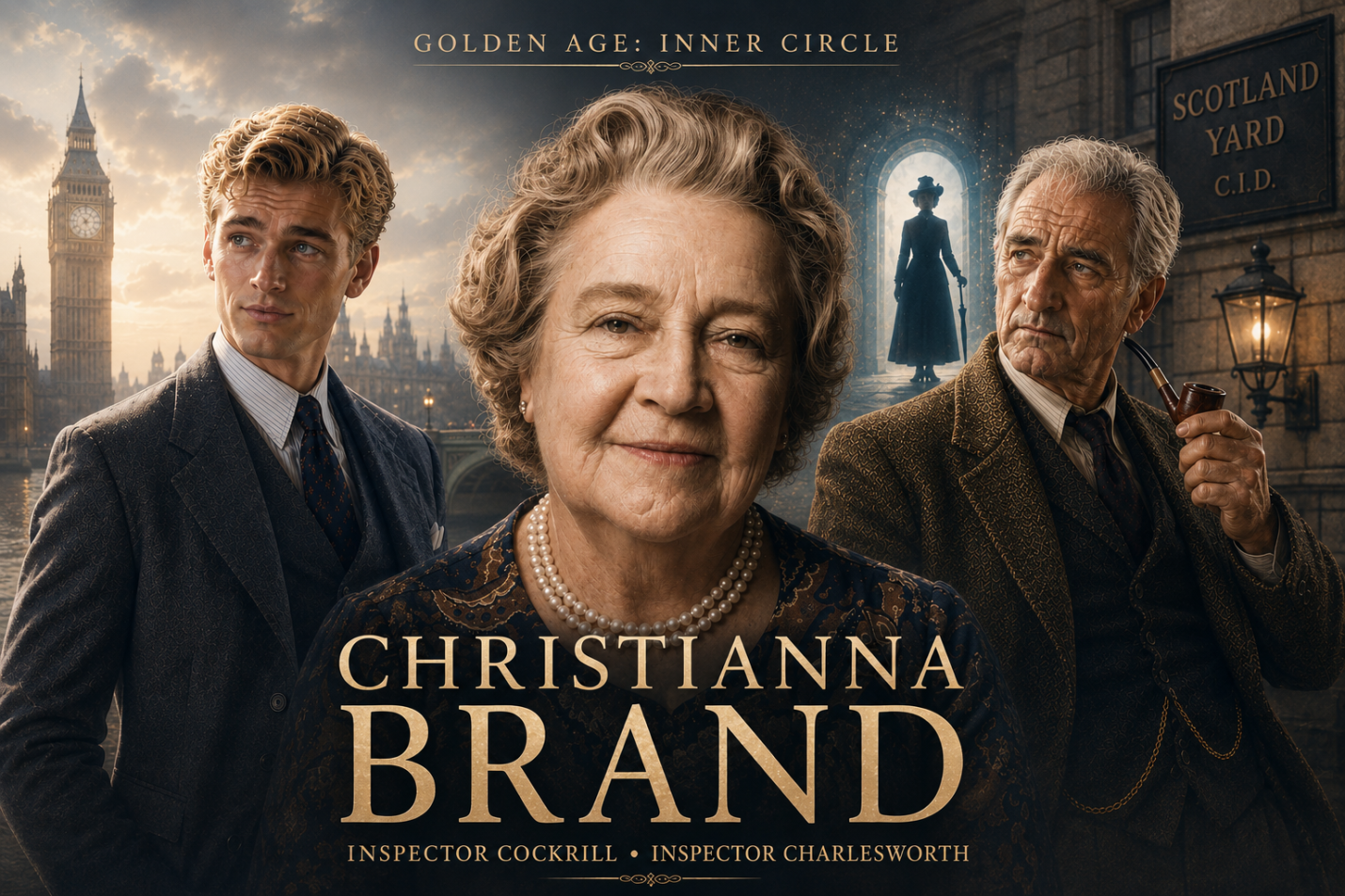
Christianna Brand is best remembered for Inspector Cockrill, a veteran police detective whose sharp mind is matched by an unassuming appearance.
Unlike many fictional detectives, Inspector Cockrill is not a glamorous figure. Christianna Brand presents him as an experienced Scotland Yard inspector whose appearance reflects years spent investigating crime rather than cultivating style. With his white hair, small brown eyes, prominent nose, well-worn overcoat, battered hat, and fingers stained by years of cigarette smoking, he looks every inch the veteran policeman. It is an appearance that often leads people to underestimate him.

That impression, however, is deceptive. Behind his weathered exterior lies a remarkably perceptive investigator who relies on patience, careful observation, and a deep understanding of human nature. Cockrill rarely dominates a room through force of personality. Instead, he allows suspects to reveal themselves, quietly untangling lies and motives until the truth emerges.
Cockrill made his debut in Heads You Lose (1941) and returned in several of Brand’s best-known novels, including Green for Danger, Tour de Force, and Fog of Doubt. Across these investigations, readers encounter country houses, hospitals, seaside settings, and isolated communities where almost everyone has something to hide.
Although Inspector Cockrill became Brand’s signature detective, she was not afraid to experiment. A handful of novels introduced other investigators or focused more on the mystery itself than on a recurring detective. Even so, Cockrill remains the character most closely associated with her name and the one through whom she produced some of the Golden Age’s most memorable puzzles.
His Entourage
One of the things that sets Inspector Cockrill apart from detectives such as Poirot, Wimsey, or Campion is that he has no permanent companion or assistant. Instead, each investigation introduces a new cast of suspects, witnesses, police officers, and local figures whose lives become entangled in the mystery.
This ever-changing ensemble became one of Christianna Brand’s greatest strengths. Whether the setting is a hospital, a country house, a seaside resort, or a quiet village, the supporting characters are never mere background figures. Each has believable motives, conflicting personalities, and carefully hidden secrets, making it exceptionally difficult for both Cockrill and the reader to separate the innocent from the guilty.
Rather than relying on a familiar supporting cast, Brand allowed every new mystery to stand on its own, creating fresh relationships and tensions that kept her stories unpredictable from one novel to the next.
Other Detectives
Although Inspector Cockrill became Christianna Brand’s best-known investigator, he was not the only detective to appear in her fiction. Throughout her career, Brand occasionally introduced other Scotland Yard inspectors, each bringing a different personality and perspective to her mysteries.
Inspector Charlesworth
Brand’s first novel, Death in High Heels (1941), introduced Inspector Charlesworth of Scotland Yard. Unlike the seasoned Cockrill, Charlesworth is young, handsome, and impeccably turned out. His charm and dashing appearance make him popular with women, but his lack of experience often proves exasperating to his senior colleagues. Eager to establish himself, he sometimes allows enthusiasm to outrun judgment—a sharp contrast to Cockrill’s patient, methodical approach.

Charlesworth would later return and even work alongside Inspector Cockrill in two novels, allowing Brand to contrast the confidence of youth with the wisdom that comes from long experience.
Inspector Chucky
Brand also introduced Inspector Chucky in two later mysteries. Although he forms part of her detective fiction, he never achieved the recognition of either Cockrill or Charlesworth. Unlike those two investigators, Chucky receives very little physical description in the novels, making it difficult to establish a definitive literary portrait.
Rather than speculate about his appearance, we have chosen to let readers imagine Inspector Chucky for themselves. His inclusion nevertheless reflects Brand’s willingness to experiment with different investigators instead of relying exclusively on a single detective throughout her career.
What Made Christianna Brand Different?
Many Golden Age writers built clever mysteries, but Christianna Brand had a remarkable talent for making readers question everything they thought they knew. Just when a solution seemed obvious, a new clue or an unexpected revelation would force them to start all over again.
One of the greatest pleasures of reading a Brand novel is that the clues are there from the beginning. She plays fair with the reader, but she is exceptionally skilled at hiding the truth behind believable suspects, convincing motives, and carefully timed surprises. Even experienced mystery fans often find themselves fooled until the final chapters.
Brand also excelled at creating tension. Her stories are not simply puzzles waiting to be solved. The people caught up in her mysteries feel real, with believable fears, rivalries, and secrets. Whether the setting is a busy hospital, a quiet village, or a country house, she creates an atmosphere where almost anyone could be guilty—and where no one feels completely safe.
Perhaps her greatest strength was finding the right balance between character and puzzle. Some Golden Age authors focused almost entirely on the mechanics of the mystery, while others gave greater attention to their characters. Christianna Brand managed to do both. Her novels invite reaso lock itÉ
ders to solve the crime while also drawing them into the lives of the people involved.
That combination of ingenious plotting, memorable characters, and genuine suspense is why books such as Green for Danger continue to be recommended to readers discovering Golden Age detective fiction today.
Essential Cases
If you would like to discover Christianna Brand’s detective fiction, these novels offer the best introduction to her work.
🟢 Green for Danger (1944)
Widely regarded as Brand’s masterpiece, this classic hospital mystery remains the best place to begin.
🟢 Heads You Lose (1941)
A memorable investigation featuring both Inspector Cockrill and the young Inspector Charlesworth, showcasing the contrast between experience and youthful confidence.
🟢 Tour de Force (1955)
An ingenious island mystery that demonstrates Brand’s talent for combining psychological insight with intricate plotting.
🟢 Death of Jezebel (1948) (Optional fourth)
One of Cockrill’s most unusual and theatrical investigations, often recommended by long-time Brand readers.
Beyond the Detective
Although Christianna Brand earned her reputation through detective fiction, she proved that her imagination was not limited to murder mysteries. Later in her career, she turned to children’s literature, creating a character who would become just as memorable to a very different audience.
In 1964, Brand introduced Nurse Matilda, a mysterious nanny whose unusual appearance and quiet wisdom help transform unruly children into better versions of themselves. Unlike many magical characters, Nurse Matilda never stays longer than necessary. Once the children have learned the lessons they need, she quietly disappears in search of the next family in need of her help.

Brand returned to the character in Nurse Matilda Goes to Town (1967) and Nurse Matilda Goes to Hospital (1974), completing a trilogy that has delighted generations of young readers. While these books could hardly be more different from her detective novels, they reveal the same careful storytelling, memorable characters, and ability to keep readers engaged from beginning to end.
For many modern audiences, Brand’s children’s books became familiar through the Nanny McPhee films starring Emma Thompson, who also wrote the screenplays. Although the films expand and reshape the original stories, they remain faithful to the heart of Brand’s creation, introducing Nurse Matilda to a new generation of readers and moviegoers.


Few authors leave a lasting mark on two completely different genres. Christianna Brand accomplished exactly that, earning a place in both the history of Golden Age detective fiction and the world of classic children’s literature.
Later Years
As the Golden Age of detective fiction gradually gave way to new styles of crime writing, Christianna Brand remained an active writer, even though her output became less frequent. Her career had already established her as one of the most inventive mystery novelists of her generation, and readers continued to seek out both her novels and short stories.
Although she published less often during her later years, Brand never lost her gift for storytelling. Whether writing an intricate murder mystery or a tale for young readers, she remained committed to creating memorable characters and carefully crafted plots.
Christianna Brand died in 1988 at the age of 80. By then, she had earned the respect of mystery readers for her ingenious detective fiction while also leaving an unexpected legacy in children’s literature. Her career stands as a reminder that a writer’s imagination need not be confined to a single genre.
Legacy & Media
Christianna Brand’s reputation has endured for two very different reasons. Mystery readers continue to seek out her detective novels for their ingenious plots, memorable characters, and fair-play mysteries, while generations of families have come to know her through the adventures of Nurse Matilda.
Among her detective works, Green for Danger remains her most celebrated novel. Its successful film adaptation helped bring Brand’s detective fiction to a wider audience and is still regarded as one of the classic mystery films of the 1940s. It also remains one of the novels most often recommended to readers discovering her work for the first time.

Brand’s children’s stories found new life decades later through the Nanny McPhee films, written by and starring Emma Thompson. While the films expand upon the original books, they sparked renewed interest in Brand’s work and introduced Nurse Matilda to millions of viewers around the world.
More than three decades after her death, Christianna Brand’s stories continue to find new readers. Whether someone begins with the intricate puzzles of Inspector Cockrill or the quiet wisdom of Nurse Matilda, they are discovering the work of a writer whose storytelling has stood the test of time.
Conclusion
Christianna Brand may never have achieved the household recognition of Agatha Christie or Dorothy L. Sayers, but she earned something just as lasting: the admiration of readers who appreciate a well-crafted mystery. Her novels continue to reward careful reading, proving that some of the best detective stories are also the most surprising.
Yet Brand’s legacy extends far beyond the crime genre. From the ingenious investigations of Inspector Cockrill to the gentle wisdom of Nurse Matilda, she demonstrated a remarkable ability to captivate readers of all ages.
If you have never read Christianna Brand before, where will you begin? Will you follow Inspector Cockrill as he unravels an impossible murder, or discover the timeless charm of Nurse Matilda? Whatever your choice, you will be meeting an author whose imagination continues to delight readers decades after her books were first published.
References
Primary Works
- Brand, Christianna. Death in High Heels. 1941.
- ———. Heads You Lose. 1941.
- ———. Green for Danger. 1944.
- ———. Tour de Force. 1955.
- ———. Fog of Doubt. 1957.
- ———. The Honey Harlot. 1978.
- ———. Nurse Matilda. 1964.
- ———. Nurse Matilda Goes to Town. 1967.
- ———. Nurse Matilda Goes to Hospital. 1974.
Reference Works
- Edwards, Martin. The Golden Age of Murder.
- Spehner, Norbert. Le Détectionnaire.
- The Cambridge Companion to Crime Fiction
Film & Television
- Green for Danger (1946).
- Nanny McPhee (2005).
- Nanny McPhee Returns (2010; released in the UK as Nanny McPhee and the Big Bang).
Navigation
Previous: Nicholas Blake
Next: Michael Innes








Hello Gumshoe! On the track or authors? leave us reply!