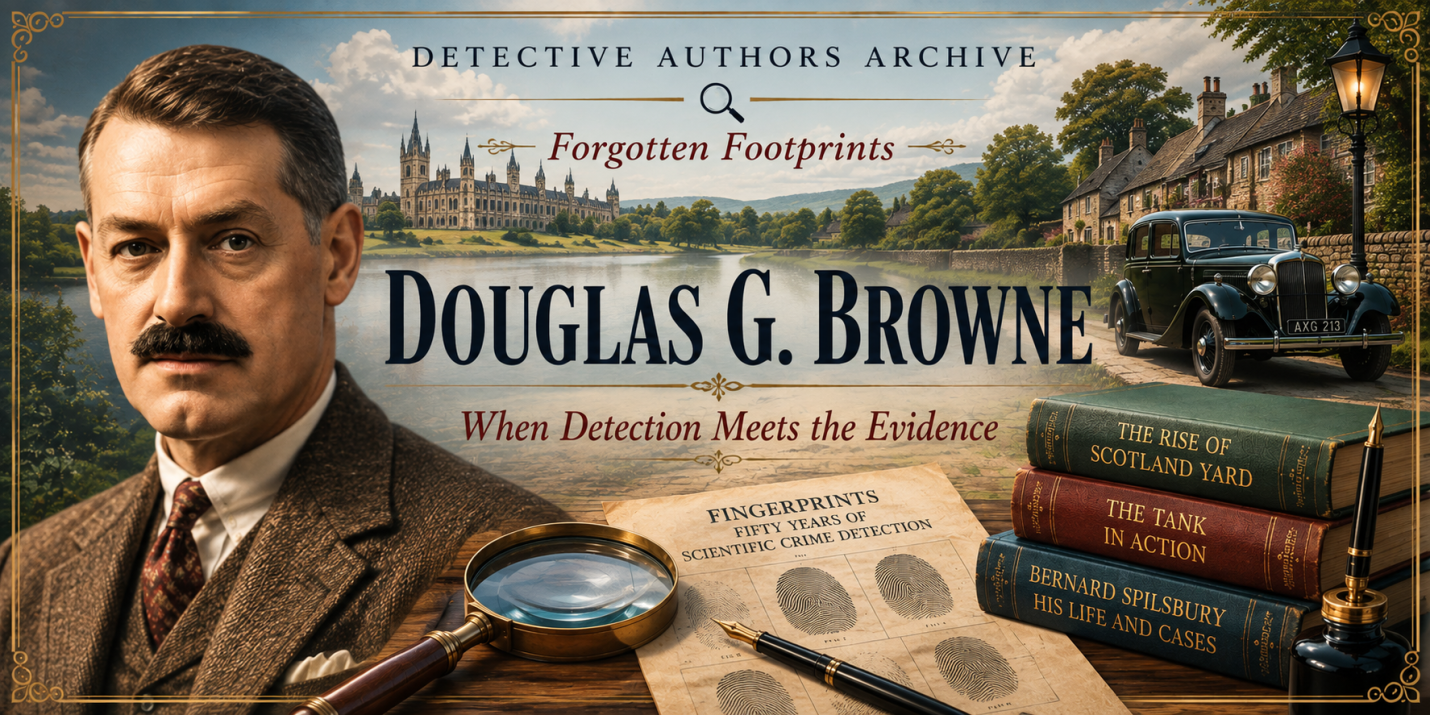
When Detection Meets the Evidence
Introduction
The Golden Age delighted in ingenious murders, carefully planted clues and solutions waiting to be uncovered. Douglas G. Browne knew that world well, but his fascination with crime did not stop at the boundaries of fiction.

For Browne, the puzzle was only part of the attraction. Behind it lay evidence, investigation and the realities of crime — a world he explored from more than one direction throughout his career.
Today, Browne sits quietly among the forgotten figures of the Golden Age. But follow the evidence, and a rather more interesting writer begins to emerge.
Biography
Douglas Gordon Browne was born in 1884 into a family already closely connected with the arts. His father was the illustrator Gordon Browne, while his grandfather was Hablot K. Browne, better known as “Phiz,” whose illustrations became closely associated with the novels of Charles Dickens. Douglas himself was initially brought up to become a painter, but at the age of twenty-seven he turned towards writing, beginning with short stories shortly before the First World War.


Image 1:Hablot K. Browne: Phiz Browne Image 2: Gordon Browne: Illustration dated 1882.
The war interrupted that developing literary career. Browne served with the Tank Corps, where he became a reconnaissance officer. In September 1918, during operations near Inchy-en-Artois and Sancourt, his reconnaissance and leadership helped guide tanks into position under difficult conditions. His service earned him the Military Cross, awarded for conspicuous gallantry and devotion to duty. His wartime experience later provided material for The Tank in Action (1920), an account of armoured warfare drawing partly upon events he had witnessed himself.

Browne’s interest in crime also extended beyond fiction. Among his nonfiction works were a biography of forensic pathologist Sir Bernard Spilsbury, written with E. V. Tullett; Fingerprints: Fifty Years of Scientific Crime Detection; The Rise of Scotland Yard; and a biography of judge and barrister Sir Travers Humphreys.
The Detection Club
Douglas G. Browne’s path into the Detection Club was unusually contentious. By the late 1940s he was an experienced crime writer, yet the question of whether his work met the Club’s standards prompted a debate among its members.
The novel at the centre of the discussion was What Beckoning Ghost?, a Harvey Tuke mystery involving a mysterious drowning in the Serpentine. E. R. Punshon had read the book and considered Browne worthy of membership, but not everyone was convinced. The disagreement concerned one of the central principles of Golden Age detection: had Browne given the reader a fair opportunity to solve the mystery?
Dorothy L. Sayers proposed turning the disagreement into a formal debate. She and Punshon would argue the case for Browne, while Milward Kennedy and Anthony Gilbert would take the opposing side as advocati diaboli. For Sayers, the exercise also offered the Club an opportunity to examine what constituted fair play in detective fiction rather than simply discuss a prospective member.
Whatever doubts had been raised, Browne ultimately passed the test. He was elected to the Detection Club in 1949. The timing, however, came relatively late in his career: only three more detective novels followed his admission.
Meet the Detectives
Major Hemyock
Browne’s first recurring detective was Major Hemyock, an archaeologist and amateur investigator. Rather than belonging to the police, Hemyock approaches crime from outside the official machinery of detection, although his investigations can bring him into cooperation with professional officers.
His archaeological background is particularly appropriate for a detective: his work depends upon examining what has been left behind and determining what those traces reveal. In The Dead Don’t Bite, Hemyock assists Superintendent Myrtle in a case that begins with stolen jewellery hidden in a museum and develops around a suspicious prehistoric skeleton and a succession of deaths.
Hemyock appeared in a small series during the 1930s, including The Dead Don’t Bite (1933), The Looking-Glass Murders (1935), and The May-Week Murders (1937).
Harvey Tuke
Browne later introduced Harvey Tuke, whose connection with crime was professional rather than amateur. Tuke works as a legal assistant to the Department of Public Prosecutions, placing him closer to the machinery of British justice than his predecessor.
Tuke could present an intimidating figure. Contemporary descriptions give him an almost Mephistophelean appearance, and he is capable of using that presence when dealing with reluctant witnesses. Yet the severity is deceptive: beneath it lies a fundamentally kindly man. His wife, Yvette, also appears in the series and provides a counterbalance to his more formidable manner.
Tuke became Browne’s more enduring detective, appearing in seven novels between Death Wears a Mask (1940) and Death in Seven Volumes (1958). Among them was What Beckoning Ghost?, the novel that later became the focus of the Detection Club’s debate over Browne and the question of fair play.
Notable Cases
The Dead Don’t Bite (1933)
An early Major Hemyock mystery, The Dead Don’t Bite brings Browne’s interest in archaeology directly into his detective fiction. Rather than simply giving Hemyock an unusual profession, Browne makes the examination and interpretation of physical remains part of the mystery itself.

The May-Week Murders (1937)
Cambridge provides the setting for The May-Week Murders. During the celebrations of May Week, Sir Vyvyan Rowsell-Hoggs is found stabbed in a dark lane, while an expensive pendant belonging to his wife disappears. Suspicion falls upon a missing man with an old grievance against the victim, but Hemyock is not convinced that the obvious suspect is necessarily the guilty one.
Behind the immediate crime lies the Nine Bright Shiners, a university dining club whose members established a trust fund for their future children before the First World War. Twenty years later, deaths and changing fortunes have altered the lives of those involved, bringing old connections back into the investigation.

Too Many Cousins (1946)
A series of apparently accidental deaths within one family attracts Harvey Tuke’s attention in Too Many Cousins. Three of six cousins who stand to benefit from a substantial inheritance have died, leaving Tuke to consider whether coincidence — or one of the surviving relatives — is responsible.
Browne places the mystery against wartime London, where government work, laboratories, voluntary service and altered living arrangements form part of everyday life. The familiar Golden Age combination of family, money and suspicious deaths is therefore played out against a society changed by war.

Legacy
Browne’s reputation faded quietly rather than through any obvious critical rejection. His detective fiction gradually slipped out of circulation, while neither of his recurring investigators acquired the lasting recognition that might have kept the books before new generations of readers. Nor does there appear to have been a significant history of screen or radio adaptations to give the stories a second life.
His nonfiction proved more durable. Browne’s work on policing and forensic investigation continued to be cited long after his mysteries became difficult to find. Fingerprints, in particular, has continued to attract attention as a history of scientific crime detection, while his studies of Scotland Yard and figures from British criminal justice have retained value as historical sources.
Browne died in 1963. His obscurity today seems less the result of being deliberately forgotten than of being gradually overtaken by time: the novels disappeared from circulation, the detectives faded with them, and the writer of mysteries became less visible than the historian of real crime.
Case Closed
Douglas G. Browne may have slipped from the shelves, but he was never merely a name in the margins of the Golden Age. His work was read, discussed and even debated by the writers who helped define detective fiction in his time.
Today, finding Browne requires a little more digging. For an archaeologist’s creator, perhaps that is strangely appropriate.
References
Books
- Bourdier, Jean. Histoire du roman policier. Éditions de Fallois, 1996.
- Edwards, Martin. The Golden Age of Murder: The Mystery of the Writers Who Invented the Modern Detective Story.
- Evans, Curtis. Masters of the “Humdrum” Mystery: Cecil John Charles Street, Freeman Wills Crofts, Alfred Walter Stewart, and the English Detective Novel.
Online Sources
- Classic Crime Fiction. “Douglas G. Browne Bibliography.”
- Cross-Examining Crime. “The May-Week Murders (1937) by Douglas G. Browne.”
- Kirkus Reviews. Too Many Cousins.
- FictionFan’s Book Reviews. “What Beckoning Ghost? by Douglas G. Browne.”
- Classic Mystery. “The Dead Don’t Bite by Douglas G. Browne.”
- Open Library. Douglas G. Browne.
- The Guardian. James McCreet, “Top 10 Victorian Detective Stories.”
- Tank Corps historical material. Douglas G. Browne.
Previous: Christopher Bush
Forgotten Footprints —
Golden Age Next: Anthony Wynne








Hello Gumshoe! On the track or authors? leave us reply!