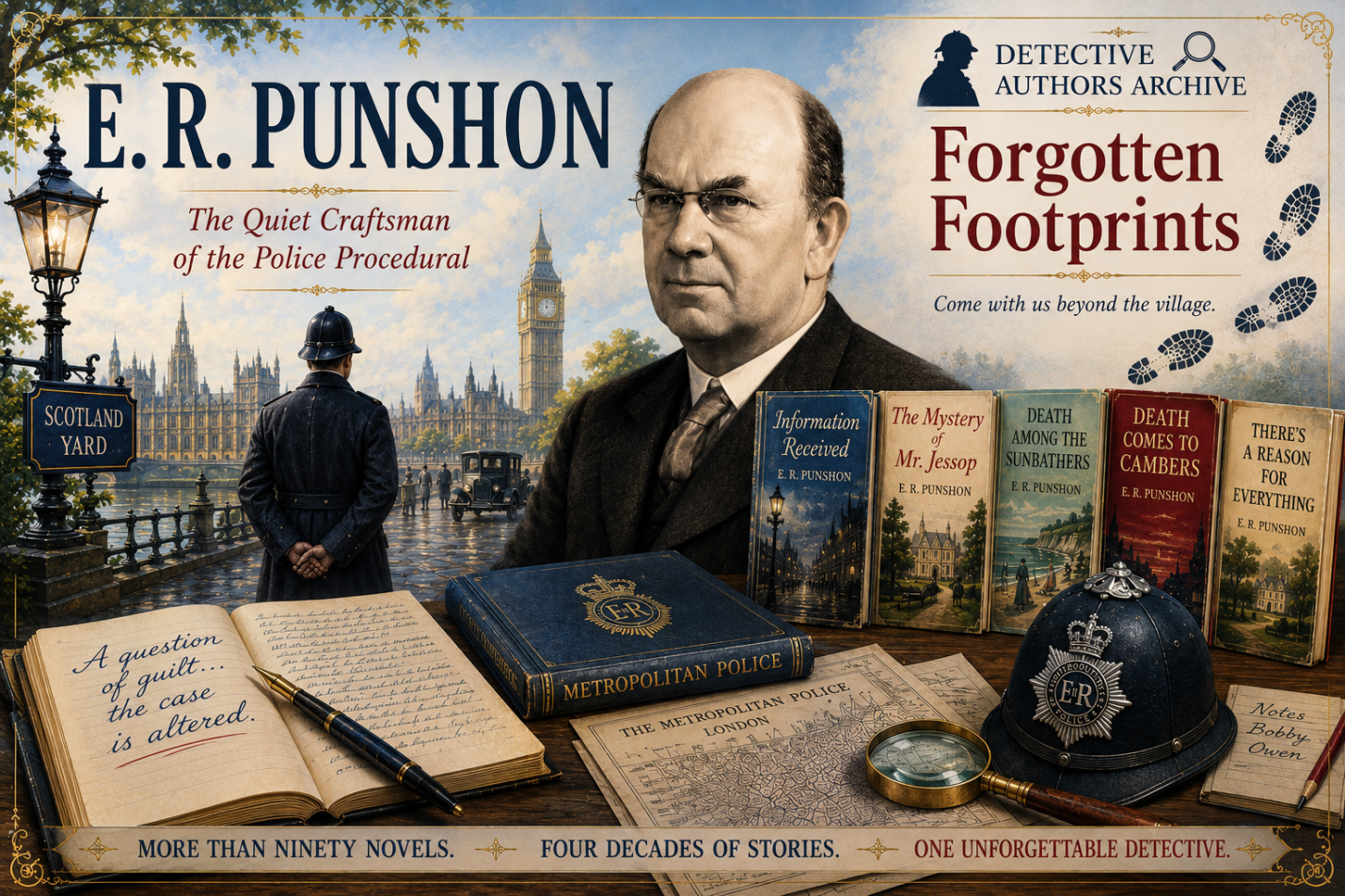
The Greatest Mystery Is Why He Was Forgotten
Introduction
The greatest mystery surrounding E. R. Punshon is not one found in his novels. It is how an author once read by thousands gradually slipped from view.
During the Golden Age of detective fiction, E. R. Punshon was a familiar name on bookshop shelves. Over the course of more than dozens of novels, he created Inspector Bobby Owen, one of the era’s longest-running detectives, and established himself as one of Britain’s most prolific mystery writers.

Yet today, his name is rarely mentioned alongside Agatha Christie, Dorothy L. Sayers, John Dickson Carr, or Ngaio Marsh. While many of his contemporaries became enduring icons of the genre, Punshon’s reputation slowly faded, leaving behind a remarkable body of work waiting to be rediscovered.
That is precisely why he deserves to open our journey through Forgotten Footprints. His novels remind us that the history of detective fiction was shaped not only by its most celebrated names, but also by talented writers whose contributions have quietly slipped beyond the spotlight.
It is time to follow E. R. Punshon’s footprints once again.
The Author Behind the Name
E. R. Punshon’s journey to becoming a novelist was far from conventional. Leaving school at the age of fourteen, he found work in a London office before seeking a new life in Canada, where he hoped to make his fortune as a farmer. The venture proved unsuccessful and, penniless, he worked his passage back to Britain aboard a cattle ship.

Back in England, Punshon turned to writing in the hope of earning a living. His fortunes changed dramatically when he won one of the earliest literary prizes ever offered through open competition. The award launched a long and remarkably productive literary career, during which he published more than ninety novels and also wrote under the pseudonym Robertson Halkett.
E. R. Punshon’s success earned him the respect of his fellow authors. Sponsored for membership in the Detection Club by Anthony Berkeley and Margaret Cole, he became an active member of the organisation and eventually served as its Honorary Secretary. Martin Edwards describes him as an affable and popular figure among his colleagues, reflecting the esteem in which he was held by many of the leading mystery writers of the Golden Age.
Meet the Detectives
Before creating the detective who would define his career, E. R. Punshon experimented with other investigators. His first series paired Sergeant Bell with Inspector Carter, a partnership that Martin Edwards describes as surprisingly modern. Bell carried out the painstaking detective work, while Carter, his publicity-conscious superior, was often content to enjoy the recognition. Their contrasting personalities gave these early novels a touch of sardonic humour that distinguished them from many contemporary police stories.
Punshon’s most enduring creation, however, was Bobby Owen, who first appeared in Information Received (1933). Unlike many fictional detectives who enter the story as seasoned investigators, Owen begins his career as a young police constable. An Oxford graduate unable to find suitable employment during the economic depression, he joins the Metropolitan Police and gradually earns promotion through ability rather than brilliance alone. Over the course of thirty-five novels, readers follow his steady rise through the ranks from constable to detective, superintendent, and ultimately Commander at Scotland Yard.
Bobby Owen differs from many of the eccentric detectives of the Golden Age. Handsome, well educated, and socially at ease, he is nevertheless approachable and unassuming. He is a thoughtful policeman rather than a flamboyant genius, relying on careful observation, patience, and sound judgement instead of dramatic displays of deduction. Friendly but firm, he combines intelligence with common sense, and his willingness to listen often proves as valuable as any clue.
Another distinctive feature of the series is Owen’s personal life. Rather than remaining an isolated detective devoted solely to his work, he marries Olive, who occasionally becomes involved in his investigations. Their relationship lends the novels a warmth that complements Punshon’s emphasis on everyday police work and helps make Bobby Owen one of the more human detectives of the Golden Age.
Notable Works
Over the course of his dozens of novels, E. R. Punshon explored every corner of the traditional detective story. While his earliest mysteries featured Sergeant Bell and Inspector Carter, the majority of his work followed Bobby Owen as he advanced through the ranks of the Metropolitan Police. Rather than presenting isolated adventures, Punshon allowed his detective to grow professionally and personally, creating one of the Golden Age’s longest-running police series.
Information Received (1933)
The first appearance of Bobby Owen introduces readers to a young Oxford graduate who joins the Metropolitan Police after struggling to find employment during the economic Depression. Already serving as a constable when the novel opens , he has an opportunity to demonstrate the abilities that will shape his career. This first appearance begins a series of 35 novels in which readers follow his professional and personal development, from ordinary police constable to Commander of Scotland Yard.

Mystery of Mr. Jessop (1937)
One of Punshon’s best-known novels today is Mystery of Mr. Jessop, a clever mystery that helped establish Bobby Owen as a capable young detective. The novel has achieved a small place in literary history through an unexpected connection with P. G. Wodehouse. In one of the Jeeves stories, Bertie Wooster is seen reading Mystery of Mr. Jessop, a nod that reflects the novel’s popularity with contemporary readers and shows that Punshon’s work was well known beyond the detective fiction community. Although remembered by relatively few readers today, the novel remains an excellent introduction to Punshon’s thoughtful blend of police procedure, fair-play mystery, and understated humour.

Death Among the Sunbathers (1934)
Punshon’s second Bobby Owen novel demonstrates his growing confidence as a crime writer. Beginning with the discovery of a murdered journalist whose body is found inside a burning car, the investigation leads readers into the unusual world of a fashionable sunbathing society, allowing Punshon to combine a carefully constructed mystery with gentle social satire. The novel also shows Bobby Owen taking on a larger role within the investigation as he continues his rise through the Metropolitan Police, while the colourful supporting cast reflects Punshon’s gift for creating memorable characters alongside his intricate puzzles. It remains one of the best examples of his ability to balance traditional detective fiction with keen observations of contemporary British society.

Death comes to Cambers
Death Comes to Cambers (1935)
Often regarded as one of the strongest early Bobby Owen novels, Death Comes to Cambers places the young Scotland Yard detective at the centre of a classic country house mystery. Invited to a country estate to advise on a series of burglary scares, Owen instead finds himself investigating the murder of Lady Cambers, whose death uncovers a web of family tensions, hidden motives, and conflicting loyalties. Blending memorable characters, subtle humour, and a carefully constructed puzzle, the novel also reflects Punshon’s growing confidence as a storyteller. Its combination of traditional detective fiction with contemporary debates and keen social observation makes it one of the finest introductions to Bobby Owen and the qualities that distinguished Punshon during the Golden Age.

There’s a Reason for Everything (1945)
Published near the end of the Second World War, There’s a Reason for Everything finds Bobby Owen at a very different stage of his career. Now serving as Deputy Chief Constable of Wychshire, he is drawn into the investigation of a murder at the legendary haunted mansion of Nonpareil. Blending an atmospheric country house setting with rumours of ghosts, the possible disappearance of a Vermeer painting, and a cast of eccentric suspects, the novel demonstrates Punshon’s ability to combine classic detective fiction with elements of the Gothic. Frequently cited as one of the highlights of the Bobby Owen series, it showcases the mature confidence of both its detective and its author.

Punshon’s bibliography extends far beyond these few examples. Together, however, they demonstrate the qualities that earned him a loyal readership throughout the Golden Age: carefully constructed mysteries, believable police work, memorable characters, and a detective whose career evolved naturally from one novel to the next. Although his name is less familiar today than those of many of his contemporaries, his work remains a rewarding discovery for readers willing to follow his forgotten footprints.
Legacy
During his lifetime, E. R. Punshon enjoyed a reputation that many mystery writers would have envied. A respected member of the Detection Club, he published more than ninety novels over four decades and created one of the longest-running detective series of the Golden Age. His fellow writers valued both his work and his company, and readers followed Bobby Owen’s steady rise through the ranks of the Metropolitan Police from 1933 until 1956..
Fortunately, his work has not disappeared entirely. In recent years, publishers dedicated to classic crime fiction have returned many of his novels to print, allowing a new generation of readers to rediscover Bobby Owen and the thoughtful, character-driven mysteries that made Punshon one of the most dependable voices of the Golden Age.
Today, E. R. Punshon may no longer be a household name, but his contribution to detective fiction remains significant. His long-running police series, his carefully constructed mysteries, and his quiet understanding of human nature ensure that his place in the history of the genre is well deserved. For readers willing to venture beyond the familiar names, his novels offer exactly what Forgotten Footprints hopes to celebrate: the pleasure of discovering an outstanding author who deserves to be remembered.
Case Closed
Every forgotten path eventually leads to a discovery.
E. R. Punshon’s novels may no longer occupy the prominent place they once held on bookshop shelves, but the qualities that earned him a loyal readership remain unchanged. His carefully crafted mysteries, believable police investigations, memorable characters, and quietly evolving detective still offer the same pleasures they did nearly a century ago.
Perhaps that is the greatest lesson of Forgotten Footprints. Literary history remembers a handful of celebrated names, but the roads beyond them are filled with authors whose stories are equally worthy of our time and attention. Sometimes all they need is someone willing to follow the trail.
Our first journey beyond the village has come to an end, but many more paths remain unexplored.
The footprints continue.
References
Books
- Edwards, Martin. The Golden Age of Murder. London: HarperCollins, 2015.
- Spehner, Norbert. Le Détectionnaire. Québec: Alire, 2014.
Online Sources
- Golden Age Detection Wiki. “E. R. Punshon.”
- Fantastic Fiction. “E. R. Punshon.”
- Ramble House. “The Bobby Owen Series.”
- The Wodehouse Society. Reference to Mystery of Mr. Jessop.
- Goodreads. Publication information for selected novels.
Previous: Forgotten Footprints: Introduction
Next: J.J Connington








Hello Gumshoe! On the track or authors? leave us reply!