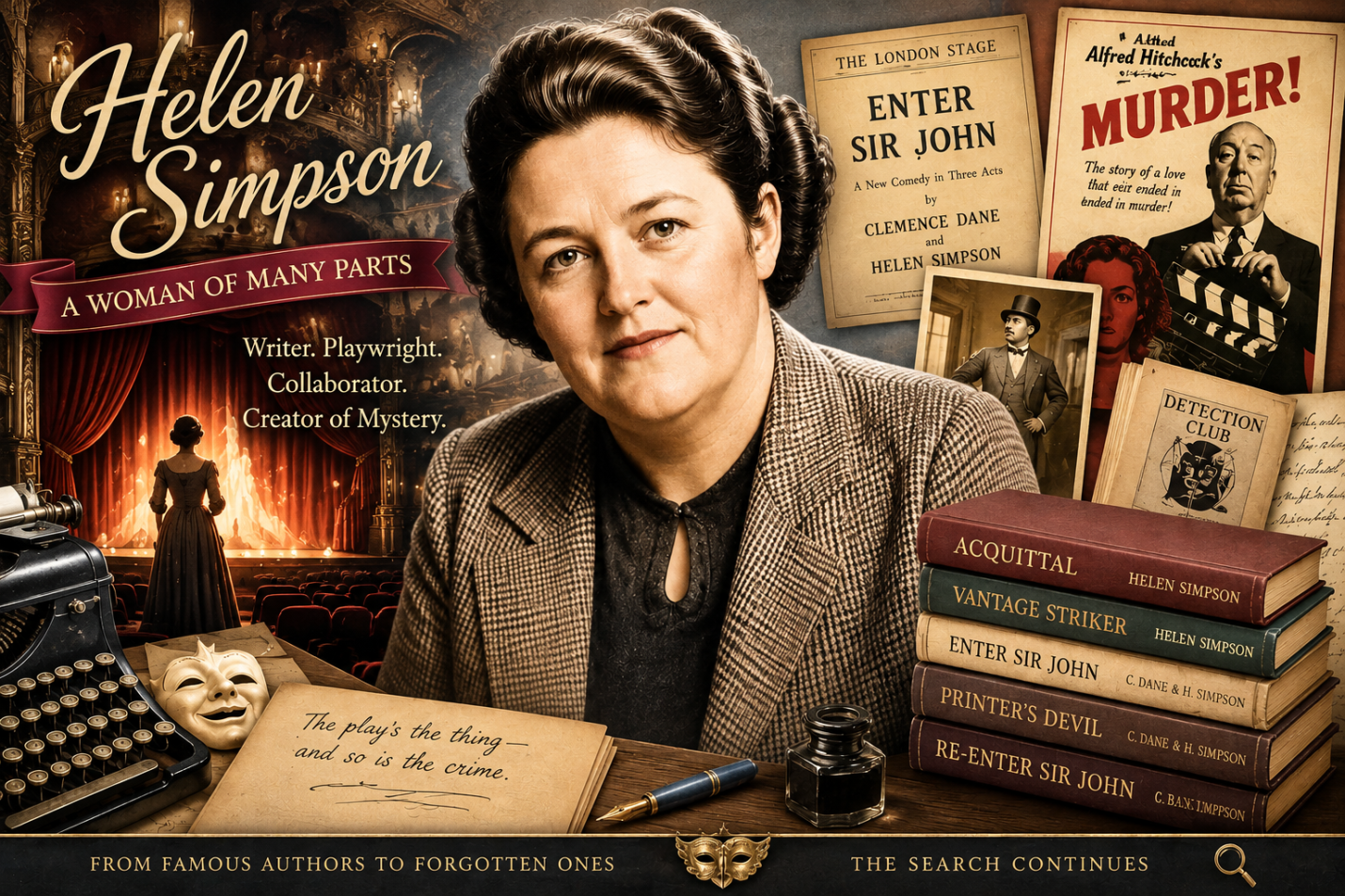
A Woman of Many Parts
Introduction
Helen Simpson was not particularly good at staying where anyone might expect to find her.
Restless, curious and remarkably energetic, she followed her interests wherever they led, leaving behind a trail that refuses to fit neatly into a single category. Her contemporaries knew her name well. Today, following that trail is rather more difficult.

One path leads into the Golden Age of detective fiction—and to a Helen Simpson who has become surprisingly easy to overlook.
So perhaps it is time to pick up the trail again.
Author Behind the Mysteries
Helen de Guerry Simpson was born in Sydney on December 1, 1897, the youngest of four children of solicitor Edward Percy Simpson and Anne de Guerry. Her mother’s family was of French descent, while the Simpsons had been established in New South Wales for generations. She was educated at the Convent of the Sacred Heart at Rose Bay and at Abbotsleigh before leaving Australia for Europe in 1914, shortly before the outbreak of the First World War.

England soon became the centre of her life. Simpson entered Oxford in 1915, initially reading French before wartime service interrupted her studies. In 1918 she joined the Women’s Royal Naval Service and worked at the Admiralty decoding messages in foreign languages. When she returned to Oxford after the war, this time to study music, another interest took over: the theatre. She founded the Oxford Women’s Dramatic Society, wrote and produced plays and developed a reputation for refusing to be constrained by convention. Her Oxford career ended without a degree after she broke university regulations governing men and women appearing together on stage.
Writing proved a better fit. Simpson published poetry, translations and plays before turning to fiction, apparently producing her first novel after accepting a challenge that she could write one in five weeks. The result was Acquittal (1925), a detective story. It was the beginning of an extraordinarily varied career. Novels, short stories, plays, history, biography, translations and even books on cookery and domestic life followed. The supernatural fascinated her as much as crime, and both found their way into her early fiction.
In 1927 she married Denis John Browne, a surgeon who would become a distinguished figure in paediatric surgery, and their daughter Clemence was born the following year. Around the same period Simpson formed an important friendship with the novelist and playwright Clemence Dane. The two women turned that friendship into a literary partnership, collaborating on three detective novels between 1928 and 1932.
But Simpson was never simply a detective novelist. Boomerang (1932), drawing partly upon her Australian family background, won the James Tait Black Memorial Prize and established her as a significant literary novelist. Historical fiction followed, including Saraband for Dead Lovers (1935), while Under Capricorn (1937) returned imaginatively to colonial Australia. By the 1930s she was also lecturing and broadcasting on literature, history and current affairs, moving comfortably through London’s literary world.
Crime fiction, however, remained part of that world. Simpson had entered it almost casually with Acquittal, but she would return to it repeatedly—alone, in collaboration with Clemence Dane, in short stories, and among the writers who were helping to define the Golden Age itself.
The Detection Club
Helen Simpson was not merely acquainted with the writers at the heart of Golden Age detection; she was one of them. In May 1931, when Anthony Berkeley arranged one of the Detection Club’s early initiation ceremonies, Simpson was among the writers due to be formally admitted alongside G. K. Chesterton and Dorothy L. Sayers. Although later Club records confusingly listed her as an Associate Member in 1939–40, Martin Edwards argues that this was almost certainly an administrative inconsistency: Simpson was clearly qualified for full membership and had been actively involved with the Club for years.
Her participation went well beyond dinners and ceremonies. Following the death of Victor Whitechurch, Simpson and Berkeley proposed Gladys Mitchell for the vacant place in the Club. Mitchell was duly elected. Simpson later joined Mitchell and other members in the collaborative Ask a Policeman (1933), an experiment in which the participating writers exchanged and parodied one another’s fictional creations.
Simpson also contributed to the Club’s excursions into true crime. When plans were made for The Anatomy of Murder (1936), a collection in which members reconsidered historical murder cases, Simpson agreed to undertake much of the organizational “spade work.” Her own contribution examined the murder of Henry Kinder, a Sydney bank teller whose death in 1865 had led to the conviction and execution of his wife’s lover, Bertrand. The Australian case was a natural choice for Simpson and allowed her to turn the analytical instincts of the detective novelist toward an actual crime.
By the later 1930s Simpson was serving on the Detection Club’s committee. Her place among its writers was both professional and personal. She developed a particularly close friendship with Dorothy L. Sayers, who admired Simpson’s intelligence, energy and striking personality. Their literary friendship extended beyond detective fiction: Simpson helped create the mock-historical world surrounding the Wimsey family and discussed Sayers’s unfinished Thrones, Dominations with her in considerable detail.
Simpson’s involvement with the Detection Club therefore reveals something easily lost when her career is remembered chiefly for her more literary and historical novels. Within the circle that helped define the Golden Age of detective fiction, she was no visitor at the edge of the room. She proposed new members, joined collaborative experiments, investigated real murder, served on the committee and exchanged ideas with some of the period’s most celebrated crime writers. Whatever posterity may have forgotten, her contemporaries knew exactly where Helen Simpson belonged.
Meet the Detective
Created jointly by Helen Simpson and Clemence Dane, Sir John Saumarez is a celebrated actor-manager and theatre impresario who turns his professional talents toward detection. Successful, sophisticated and thoroughly at home in the theatrical world, he is also charming, self-confident and possessed of a warmth that prevents his assurance from becoming arrogance.
For Sir John, acting and detection are not entirely different arts. An actor survives by observing people: gestures, voices, emotions, motives and the difference between what someone feels and what they choose to display. Sir John believes those same skills have value away from the stage. Human behaviour is something to be watched and interpreted, and appearances can be performances.
That makes him an unusually appropriate detective for two authors who knew the theatre intimately. Dane and Simpson did not simply place an amateur sleuth among actors; they made his profession part of the way he understands people. Sir John brings an actor’s eye to a mystery, looking beyond the role someone presents to the character underneath.
His career as a detective was brief, extending across the three mysteries Dane and Simpson wrote together between 1928 and 1932. Yet Sir John was distinctive enough to be remembered within the Detection Club itself, where another member would eventually be invited to borrow him for one of the Club’s playful literary experiments.
For Sir John Saumarez, then, the world really is a stage—and solving a mystery means discovering who has been playing a part.
Notable Cases
Acquittal (1925)
Helen Simpson’s first novel began with the aftermath rather than the investigation. Its central character has already been acquitted of murdering her husband when the story opens, leaving behind a more unsettling question: does a verdict of not guilty necessarily establish innocence?
The mystery consequently operates as much through psychology and moral uncertainty as conventional detection. Simpson was already interested in the territory between legal judgment and personal judgment—a theme she would explore again in later crime fiction. Acquittal was reportedly written with remarkable speed, but it nevertheless marked Simpson’s first step into the field that would eventually bring her into the Detection Club.
Enter Sir John (1928)
Written with Clemence Dane, Enter Sir John brought Sir John Saumarez onto the stage. Young actress Martella Baring has been convicted of murdering Edna Druce and faces execution, but Sir John attends the trial and becomes convinced that the verdict is wrong. His attempt to uncover what really happened brings the theatrical world directly into the machinery of a murder investigation.


The novel proved important beyond the page. Alfred Hitchcock adapted it as Murder! in 1930, as well as directing the German-language version Mary. The association with Hitchcock would not be Simpson’s last, but Enter Sir John gave her detective fiction a screen life remarkably quickly.
Printer’s Devil (1930) and Re-enter Sir John (1932)
Dane and Simpson continued their collaboration with Printer’s Devil, published in the United States as Author Unknown, shifting their crime fiction from the theatrical milieu into the publishing world. The recurring characters and relationships of the series were allowed to develop rather than simply being reset for another puzzle.
Their final collaboration, Re-enter Sir John, returned explicitly to their actor-manager detective in 1932. It was also the book later singled out by detective-fiction historian Howard Haycraft as superior to its predecessor. With it, Dane and Simpson brought their short collaborative sequence to a close.


Vantage Striker (1931)
Between the collaborative mysteries, Simpson produced one of her most intriguing solo excursions into crime fiction. Vantage Striker—published in the United States as The Prime Minister Is Dead—moves toward the political thriller while asking a distinctly uncomfortable question: can murder ever be justified?
Rather than relying solely upon the identity of a murderer, Simpson uses the crime to examine the conflict between law, morality and justice. One of its murder methods proved memorable enough to provoke a discussion among members of the Detection Club over whether it could actually work.
For Simpson, then, the crime novel was capable of doing more than presenting a puzzle. From the uncertain innocence of Acquittal to the theatrical investigations of Sir John and the moral dilemma of Vantage Striker, she repeatedly returned to the uncomfortable space where a legal answer and a moral answer might not be the same.

Beyond Detection
Detective fiction formed only one part of Helen Simpson’s remarkably varied career. While she continued to move comfortably among the writers of the Detection Club, her reputation increasingly rested on work far beyond the traditional mystery. Novels, historical fiction, plays, short stories, biography, translation and broadcasting all competed for her attention, and Simpson seemed unusually unwilling to remain within a single literary category.
Her greatest contemporary literary success came with Boomerang (1932), a sweeping novel drawing upon Australian history and her own family background. It won the James Tait Black Memorial Prize, confirming that Simpson was regarded not simply as a successful popular novelist but as a serious literary figure. Historical fiction became another important strand of her work. Saraband for Dead Lovers (1935) explored the doomed relationship between Sophia Dorothea of Celle and Philip Christoph von Königsmarck, while Under Capricorn (1937) returned to nineteenth-century Australia.
The stage remained equally important. Simpson’s theatrical interests had begun long before her published career, and her friendship and collaboration with Clemence Dane allowed literature and theatre to overlap repeatedly. Her talents also brought her into film. The adaptation of Enter Sir John had already connected her work with Alfred Hitchcock, and Simpson later contributed dialogue to his 1936 thriller Sabotage. Her association with Hitchcock continued after her death: Under Capricorn was adapted by him in 1949, with Ingrid Bergman and Joseph Cotten in the leading roles.

Simpson was just as difficult to confine away from the writing desk. She lectured internationally, appeared on the BBC and spoke on subjects ranging from literature to cookery. Her interests were famously numerous: music, theatre, fencing, riding and cooking all found places in a life that contemporaries remembered for its energy. Dorothy L. Sayers, who knew her closely, particularly remembered the force of Simpson’s personality and the intensity with which she approached both people and ideas.
That energy eventually carried her into politics. A committed Liberal, Simpson was selected as a parliamentary candidate for the Isle of Wight. The general election expected in 1939 never took place after the outbreak of the Second World War, preventing her from contesting the seat. Characteristically, however, she did not disappear quietly from political life: during her campaigning she travelled around the constituency by donkey-cart, an image that seems particularly well suited to a woman whose career had rarely followed the expected route.
By the end of the 1930s, Helen Simpson had travelled a considerable distance from the young writer who had entered fiction with a detective novel. Yet she never entirely abandoned crime, nor the writers who practised it. Instead, detective fiction became one element in a career that crossed literary, theatrical, historical, cinematic and political boundaries.
That extraordinary range helped make Simpson prominent in her own lifetime. Paradoxically, it may also have helped obscure one part of her achievement: the detective novelist became only one of the many Helen Simpsons that later readers had to rediscover.
Later Years, Media and Legacy
Helen Simpson’s work continued to find an audience on screen, both during her lifetime and after it. Alfred Hitchcock had adapted Enter Sir John as Murder! in 1930, and Simpson later contributed dialogue to his Sabotage (1936). After her death, Saraband for Dead Lovers reached the screen in 1948, followed a year later by Hitchcock’s adaptation of Under Capricorn, starring Ingrid Bergman and Joseph Cotten.
There was little indication during the late 1930s that Simpson’s career was approaching its end. She remained active as a writer, maintained her involvement with the Detection Club and had begun moving seriously into politics. At the same time, her friendship with Dorothy L. Sayers remained close enough for Sayers to discuss her unfinished Lord Peter Wimsey novel Thrones, Dominations with her in considerable detail.
Then came the illness that neither her energy nor her ambitions could overcome. Simpson developed cancer, which eventually proved inoperable. On October 14, 1940, Helen Simpson died at only forty-two years old.
Her death was deeply felt among the writers who had known her. Sayers wrote an obituary for The Spectator, mourning a friend remembered for her remarkable vitality and intelligence. Simpson’s loss was personal, but it also had a literary consequence. Martin Edwards notes that her death deprived Sayers of one of the confidantes with whom she had discussed Thrones, Dominations and helped bring Sayers’s work on the novel to an end.
Simpson’s own work, however, continued without her. The posthumous adaptations of Saraband for Dead Lovers and Under Capricorn carried her stories to new audiences, while the books she left behind testified to a career cut short rather than one that had run its course. At forty-two, Helen Simpson had not reached the end of her literary road. Circumstance had ended the journey for her.
Case Closed?
Helen Simpson’s disappearance from detective fiction is almost as curious as one of the mysteries she wrote. She was neither unsuccessful nor overlooked by her contemporaries. What disappeared was not the writer herself so much as one part of a remarkably varied career.
For readers of detective fiction, recovering Helen Simpson therefore means putting that missing fragment back into place. Crime was never the whole of her career—but it was an important part of a career far too interesting to be remembered only in pieces.
Case closed? Perhaps not. Helen Simpson spent too much of her life refusing to stay in one box for us to put her quietly into one now.
Which Helen Simpson would you rediscover first: the detective novelist, the historical novelist, or the woman behind the
References
Books
- Edwards, Martin. The Golden Age of Murder: The Mystery of the Writers Who Invented the Modern Detective Story. Collins Crime Club, 2015.
- Simpson, Helen. Acquittal. 1925.
- Simpson, Helen. Vantage Striker. 1931.
- Dane, Clemence, and Helen Simpson. Enter Sir John. 1928.
- Dane, Clemence, and Helen Simpson. Printer’s Devil. 1930.
- Dane, Clemence, and Helen Simpson. Re-enter Sir John. 1932.
- Detection Club. Ask a Policeman. 1933.
- Detection Club. The Anatomy of Murder. 1936.
Online Sources
- Australian Dictionary of Biography — Jill Roe, “Simpson, Helen de Guerry (1897–1940).” Australian National University.
https://adb.anu.edu.au/biography/simpson-helen-de-guerry-8433 - Oxford Dictionary of National Biography — biographical entry on Helen de Guerry Simpson (1897–1940).
https://www.oxforddnb.com/ - The Passing Tramp — Curtis Evans, “Sound and Fury: Enter Sir John (1928), by Clemence Dane and Helen Simpson.”
https://thepassingtramp.blogspot.com/2015/03/sound-and-fury-enter-sir-john-by.html - Cross-Examining Crime — Kate Jackson, “Enter Sir John (1928) by Clemence Dane and Helen Simpson.”
https://crossexaminingcrime.com/2017/06/05/enter-sir-john-1928-by-clemence-dane-and-helen-simpson/ - Encyclopedia.com — “Simpson, Helen (1897–1940).”
https://www.encyclopedia.com/women/encyclopedias-almanacs-transcripts-and-maps/simpson-helen-1897-1940
Previous: Dorothy Bowers
🏛️ Back to the Golden Age
Next: The Search Continues…








Hello Gumshoe! On the track or authors? leave us reply!