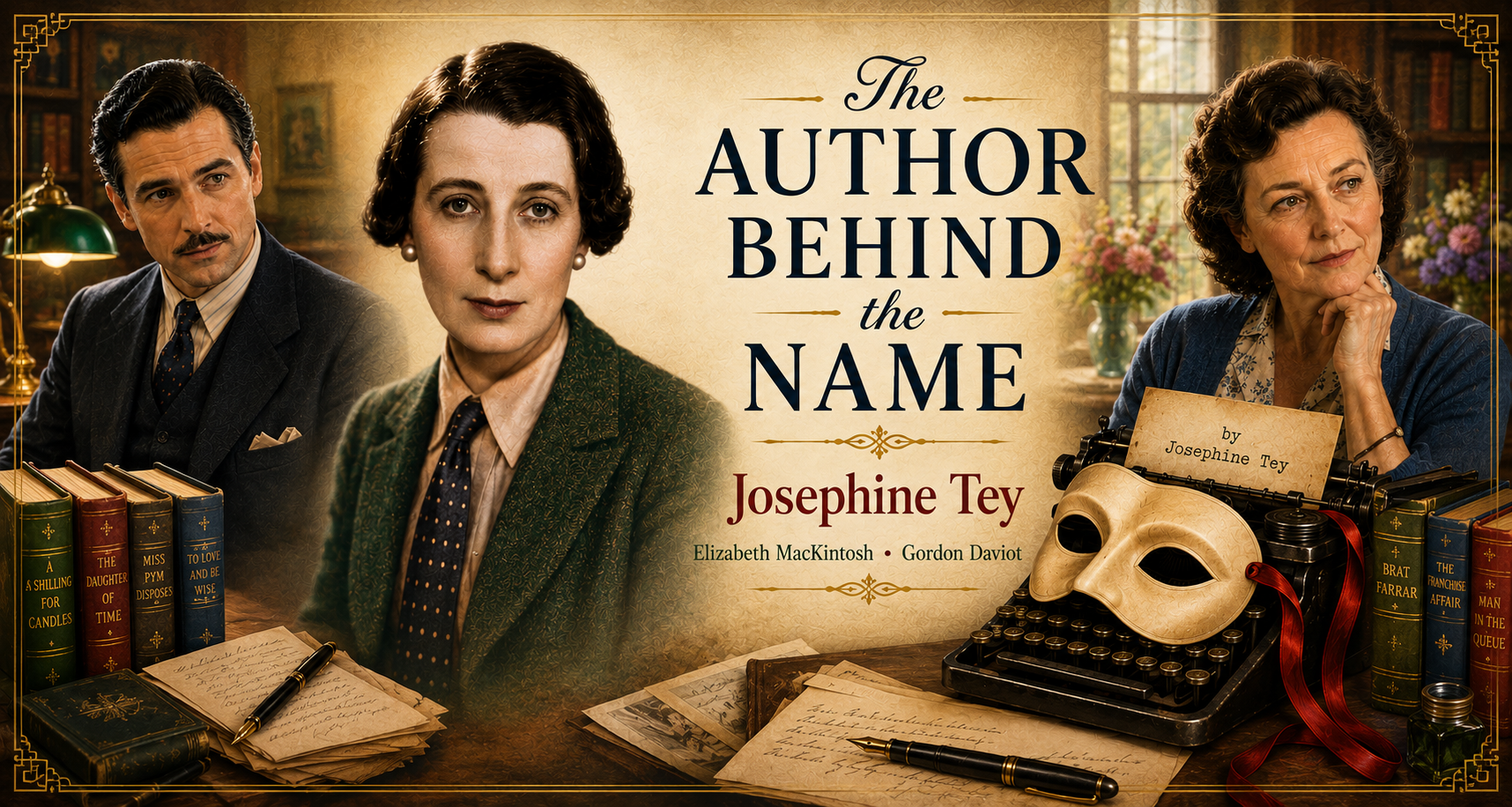
One Woman, Two Literary Lives
Introduction
Josephine Tey is a familiar name on the shelves of classic detective fiction. Her novels are still reprinted, adapted and discussed, and Inspector Alan Grant remains associated with one of the most unusual investigations of the Golden Age.
There is only one small problem.
Josephine Tey did not exist.
The woman who wrote the books was intensely private, lived much of her life far from London’s literary world, and had already built a successful writing career before the name Josephine Tey appeared on a book cover.
And that earlier career had another name attached to it.
Two names, then, and one very private woman behind them.
To find Josephine Tey, we first have to find her.
The Woman Behind the Names
Elizabeth MacKintosh was born in Inverness on 25 July 1896, the eldest of three daughters of Colin MacKintosh, a fruiterer, and Josephine Horne. The Scottish Highlands were not simply where her life began. Inverness would remain her home for much of her life, even when her work eventually carried her into very different worlds.

Writing was not her original profession. MacKintosh had an early interest in art before turning to physical education. In 1914, she entered Anstey Physical Training College in Birmingham, where she trained until 1917. She subsequently worked as a physical-education teacher in England and Scotland.
Those years gave her first-hand experience of a world built around discipline, competition, physical training and the complicated relationships that develop within a close-knit community. Long afterward, she would put that experience to particularly good use in one of her novels.
Her life changed direction after the death of her mother in 1923. MacKintosh returned to Inverness to keep house for her widowed father, leaving behind her career in physical education. What might have seemed like a narrowing of her world instead gave her the opportunity to pursue another interest more seriously: writing.
History fascinated her, particularly the personalities and reputations left behind by the past. Theatre attracted her as well. From her home in Inverness, MacKintosh began producing stories, novels and plays, gradually building a literary career while remaining remarkably removed from the public life that often accompanied success.
She was, by all accounts, intensely private. Even as her work began reaching increasingly large audiences, MacKintosh herself remained rooted in Inverness and reluctant to make herself part of the story.
Perhaps that makes what happened next particularly appropriate.
When Elizabeth MacKintosh began building a name for herself as a writer, the name she chose was not her own.
Behind the First Mask: Gordon Daviot
The first name Elizabeth MacKintosh chose for her writing was Gordon Daviot.
It was under that name that she began publishing fiction in the 1920s, but Daviot would become particularly associated with her work for the theatre. MacKintosh had a strong interest in history, and historical drama gave her an opportunity to explore the people behind familiar names and reputations — an interest that would surface again, in a very different form, much later in her career.
Her great theatrical breakthrough came with Richard of Bordeaux. First produced in London in 1932, with John Gielgud as Richard II, the play became an extraordinary success. Its portrayal of the king emphasized the man behind the historical figure, and audiences responded. The production ran for more than a year and helped establish both Gielgud as a major star and Gordon Daviot as a successful playwright.
Other plays followed, including Queen of Scots, and Daviot’s work reached stages beyond Britain. MacKintosh could be remarkably distant from the literary celebrity her work created: while Gordon Daviot became known to theatre audiences in London and elsewhere, the woman behind the name continued to make her home in Inverness.
But theatre was only part of Gordon Daviot’s story.
Three years before Richard of Bordeaux reached the stage, Daviot had ventured into a very different kind of writing. In 1929, The Man in the Queue appeared, a detective novel built around a murder committed in the middle of a crowd waiting to enter a London theatre.


The book also introduced a Scotland Yard inspector named Alan Grant.
Grant would survive Gordon Daviot.
The next time he appeared, seven years later, what had changed was which name was printed on it.
Enter Josephine Tey
Seven years after The Man in the Queue, Alan Grant returned in A Shilling for Candles (1936). Gordon Daviot, however, did not return with him.
This time, the name on the cover was Josephine Tey.
Elizabeth MacKintosh had not abandoned Gordon Daviot. She continued to use that name for her plays and other writing. Instead, Josephine Tey became a second literary identity, increasingly associated with her detective fiction. One woman was now writing successfully behind two different names, each with a literary life of its own.
There was another long interruption before Tey’s detective fiction truly gathered momentum. After A Shilling for Candles, more than a decade passed before Miss Pym Disposes (1947) appeared. Then the books came quickly: The Franchise Affair (1948), Brat Farrar (1949), To Love and Be Wise (1950), The Daughter of Time (1951) and, finally, The Singing Sands.
Alan Grant remained part of this world, but Tey was never dependent upon him. She could leave Scotland Yard behind entirely, build a mystery around an amateur observer, or make identity, accusation and uncertainty more important than the mechanics of a conventional investigation. The small number of novels she produced under the Tey name proved remarkably varied.
And gradually, something curious happened. Josephine Tey became the name that endured.
And waiting behind that second mask was a detective who had already known her first.
Meet the Detective: Inspector Alan Grant
Inspector Alan Grant is unusual among Golden Age detectives partly because there is relatively little unusual about him.
A Scotland Yard inspector, Scottish by birth, Grant is attractive, cultivated and notably independent. He remains with the Yard not because detective work is an obsession or a grand intellectual game, but for the refreshingly straightforward reason that he likes his job.
Grant is an experienced investigator with a particular interest in faces. He prides himself on his ability to read character from appearance — an interest in physiognomy that becomes especially important in one of his later investigations. He relies on observation and judgement rather than a collection of theatrical detective mannerisms.

He is also very much a man with a life beyond Scotland Yard. Cultivated and well dressed, Grant has interests ranging from theatre and poetry to fishing, riding and golf. His friendship with actress Marta Hallard connects him to the theatrical world, and MacKintosh even allowed herself a private joke at her detective’s expense: Grant is an admirer of Richard of Bordeaux, the great theatrical success written by his own creator under another name.
Across the novels, Grant can investigate in conventional police fashion, disappear almost entirely from the story, or find himself solving a mystery without access to a crime scene at all. He provides continuity without forcing Tey’s books into a single pattern.
Perhaps that is why Grant works particularly well for her. He is distinctive enough to return to, but never so eccentric that the detective overwhelms the mystery.
Meet Miss Pym: An Amateur in Detection
Lucy Pym is not a professional detective. In fact, when she arrives at Leys Physical Training College in Miss Pym Disposes (1947), she has no intention of becoming one.
A former French teacher who has unexpectedly become a successful popular psychologist, Miss Pym is invited to the college to give a lecture and stays on as a guest. What initially appears to be an enclosed world of energetic young women, demanding training and close friendships gradually reveals its tensions: ambition, jealousy, competition and the pressure of deciding who deserves the opportunities waiting beyond the school.

Miss Pym’s principal investigative tool is simply watching people. Her knowledge of psychology helps, but Tey does not turn her into an infallible reader of human nature. She observes, forms opinions, changes them, and eventually finds herself confronted with something much more uncomfortable than a puzzle to be solved.
Because discovering the truth is only part of Miss Pym’s problem. She must also decide what to do with it.
The setting gave Elizabeth MacKintosh unusually familiar ground to work with. Before becoming a writer, she had trained in physical education at Anstey and worked as a physical-education teacher herself. The routines, competitiveness and intense little society surrounding Miss Pym therefore came from a world MacKintosh had known firsthand.
Lucy Pym would appear in only one novel.
She needed only one.
Notable Cases
We have already encountered The Man in the Queue, A Shilling for Candles and Miss Pym Disposes along the way. The cases below show some of the different directions Tey took her detective fiction, moving between Alan Grant and other investigators, and between conventional crime, questions of identity and even the mysteries of history.
The Franchise Affair (1948)
When fifteen-year-old Betty Kane accuses Marion Sharpe and her mother of kidnapping her, holding her prisoner and beating her at their isolated home, the Franchise, the accusation is disturbingly convincing. Betty can describe the house and its contents, and public opinion quickly turns against the two women.
Their solicitor, Robert Blair, finds himself drawn far beyond his usual professional routine as he tries to discover how Betty could know so much if her story is false. Tey makes the mystery depend less upon catching a conventional murderer than upon credibility: whom do we believe, and why?
The case also allows Tey to examine what happens when suspicion becomes public entertainment. Newspapers, neighbours and an increasingly hostile crowd become part of the pressure surrounding the Sharpes. Alan Grant makes only a brief appearance; this is Robert Blair’s investigation.


Brat Farrar (1949)
Years after the presumed suicide of Patrick Ashby, heir to the Latchetts estate, a young man named Brat Farrar is persuaded to take his place. His resemblance to the Ashby family is remarkable, and with careful coaching he may be able to convince them that Patrick never died at all.
Brat enters the household knowing that he is the fraud. What he does not know is whether the story he has been taught about Patrick is true.
That reversal gives the novel its particular tension. Instead of asking whether the apparent heir is an impostor, Tey tells us from the beginning that he is — and gradually makes the mystery about the identity of the dead boy, the secrets within the Ashby family, and what really happened years before.


To Love and Be Wise (1950)
Inspector Grant returns when Leslie Searle, a striking young American photographer, disappears while staying among a circle of writers and artists in the English countryside.
There is no convenient body and, initially, no certainty that a crime has occurred at all. Searle may have drowned, disappeared deliberately, or become the victim of something more sinister. Grant therefore has to investigate not only what happened but whether there is actually a crime to solve.
It is particularly suited to Tey’s recurring interest in appearances and identity. Searle has made a strong impression on almost everyone he meets, but understanding the image a person presents is not necessarily the same thing as understanding the person.

The Daughter of Time (1951)
Hospitalized with a broken leg and thoroughly bored, Grant becomes fascinated by a portrait of Richard III. His instinct for faces makes him question whether the man in the portrait fits the murderous reputation history has given him, particularly the accusation that Richard was responsible for the deaths of the Princes in the Tower.
Unable to investigate in his usual fashion, Grant begins treating history like a cold case. With the help of an American researcher, he compares accounts, considers motives, questions the reliability of witnesses and asks how accepted versions of events become established as fact.
It is an ingenious reversal of the conventional Grant investigation: the detective can barely leave his bed, the suspects have been dead for centuries, and the evidence comes from historical records rather than a contemporary crime scene.
Tey’s conclusion strongly favours Richard III’s innocence, but the historical question remains disputed. What makes the novel important to detective fiction is not that Grant definitively solves the Princes in the Tower, but the way Tey uses the methods of detection to challenge the reader to reconsider how we decide what constitutes evidence in the first place.


What She Brought to Detective Fiction
A Looser Idea of the Detective Novel
Josephine Tey did not seem particularly interested in keeping her mysteries inside a single formula. A Scotland Yard investigation could sit beside an amateur investigation, a psychological mystery or an excursion into history. Even Alan Grant, her recurring detective, was never required to dominate every book.
That flexibility gave her relatively small body of detective fiction an unusual amount of variety. The recurring element was less a particular structure than Tey’s interest in discovering where a mystery might be found.
Character and Psychology
Tey belonged to a generation famous for elaborate puzzles, but character often carries considerable weight in her fiction. Observation, behaviour, personal relationships and judgement matter alongside physical clues.
Her detectives are therefore frequently trying to understand people rather than simply reconstruct movements and timetables. That emphasis could also make the moral consequences of discovering the truth as important as the solution itself.
Stephen Knight’s description of Tey’s novels as “unusually subtle” seems particularly appropriate here. Her mysteries often leave room for ambiguity, discomfort and the possibility that understanding what happened does not necessarily make everything tidy again.
Appearances Can Be Evidence — and Traps
Tey was fascinated by appearances, reputation and identity. Her characters observe faces, make judgements, adopt identities and live with assumptions made about them by other people.
But she was also interested in how unreliable those judgements could be. Reputation can harden into accepted truth; a persuasive account can become more powerful than fact; appearances can reveal something — or lead an observer completely astray.
That tension between seeing and knowing runs remarkably consistently through her detective fiction.
The Freedom to Leave Her Detective Behind
Perhaps one of Tey’s most useful choices was refusing to become trapped by the detective she had created. Alan Grant provided continuity without becoming a requirement.
That allowed Tey to choose the investigator — or sometimes the absence of a conventional investigator — that best suited a particular story. The result was a crime-fiction career of only eight novels that nevertheless covered considerably more territory than its size might suggest.
Tey did not produce a large detective canon. She produced a remarkably flexible one.
Beyond the Page
Josephine Tey’s relatively small body of detective fiction proved surprisingly adaptable to film, television and radio.
The first major screen adaptation came while she was still writing the Grant novels. Alfred Hitchcock’s Young and Innocent (1937) took its starting point from A Shilling for Candles, although the film departed considerably from Tey’s novel.

The Franchise Affair reached cinemas in 1951, directed by Lawrence Huntington, with Michael Denison as Robert Blair, Dulcie Gray as Marion Sharpe and Marjorie Fielding as Mrs. Sharpe. Alan Grant, whose role in the novel is already small, was played by John Bailey.

The story proved particularly durable on television. The BBC produced a six-part adaptation in 1962, followed by another six-part version in 1988, this time starring Patrick Malahide as Robert Blair, Joanna McCallum as Marion and Rosalie Crutchley as Mrs. Sharpe.
Brat Farrar also had an interesting screen life. Hammer Films borrowed the novel for Paranoiac (1963), a considerably altered version starring Oliver Reed. A much fuller adaptation followed in 1986, when the story became a six-part television serial starring Mark Greenstreet as Brat Farrar.

Tey’s stories continued to find a home in audio as well. The Franchise Affair received radio adaptations and readings over several decades, while Brat Farrar was adapted again for BBC Radio 4 in 2025 — more than seventy years after Tey’s death.
For a writer who published only eight detective novels, that is a remarkably persistent afterlife. Tey’s mysteries may have been difficult to reduce to a single formula, but they proved remarkably willing to travel from one medium to another.
Later Years and Legacy
By the beginning of the 1950s, Josephine Tey had produced most of the detective fiction for which she would be remembered. Yet Elizabeth MacKintosh herself remained as private as ever, living largely away from the literary circles in which her work was increasingly respected.
There was one circle she very nearly joined.
In 1949, Dorothy L. Sayers invited Tey to become a member of the Detection Club. Tey was delighted by the invitation, writing that it had “altered the foundations of my life.” But membership required the Club’s traditional initiation ceremony, including a speech, and practical difficulties intervened. Tey was reluctant about the speech and unable to make the journey from Scotland. The initiation was postponed.
It never took place.
During her final years, MacKintosh was suffering from cancer, an illness she kept characteristically private. She died in London on 13 February 1952, aged fifty-five. Because the Detection Club initiation had never been completed, Josephine Tey — despite having been invited and having wanted to join — never formally became a member.
One final Alan Grant investigation remained.
The Singing Sands was completed before her death and published posthumously later in 1952. The novel finds Grant himself struggling with exhaustion and claustrophobia and travelling north to Scotland, where a dead man aboard a train and a few mysterious lines of verse draw him into another investigation. There is something fitting about Grant’s final journey taking him back toward the Scottish landscape that had remained so important to his creator.


MacKintosh left her estate to the National Trust, while the two names under which she had built her literary career followed rather different paths. Gordon Daviot, once successful enough to fill theatres, gradually became the less familiar name. Josephine Tey endured.
Her reputation has rested on only eight detective novels, an unusually small body of work for a writer whose name continues to appear in discussions of Golden Age crime fiction. The Daughter of Time has attracted particular attention and controversy because of its treatment of Richard III, while The Franchise Affair, Brat Farrar and Miss Pym Disposes have continued to find readers and new editions.
Yet reducing Tey’s legacy to one celebrated historical mystery misses what makes the small collection interesting. Across those books she moved between professional and amateur investigators, contemporary and historical mysteries, conventional crimes and problems of identity, reputation and belief. As Stephen Knight observed, her novels could be “unusually subtle.”
Elizabeth MacKintosh spent much of her career behind names that were not her own. Gordon Daviot gave her the theatre. Josephine Tey gave her detective fiction.
And in the end, the second mask outlived them both.
Case Closed?
Elizabeth MacKintosh made an unusual choice for a writer who guarded her privacy so carefully: she gave the world not one public literary identity, but two.
Perhaps that is why Josephine Tey fits so naturally among the authors behind the name. The pseudonym was not simply something printed on a book cover. It became the identity by which generations of readers would know work written by a woman whose own name gradually slipped behind it.
Today, Gordon Daviot is the name most likely to require an explanation. Elizabeth MacKintosh is the woman readers discover when they go looking behind the books. But Josephine Tey?
She is still waiting on the shelf.
Case closed? Perhaps — but which Josephine Tey mystery would you pick up first?
References
Books
- Bourdier, Jean. Histoire du roman policier.
- Edwards, Martin. The Golden Age of Murder: The Mystery of the Writers Who Invented the Modern Detective Story.
- Henderson, Jennifer Morag. Josephine Tey: A Life.
- Knight, Stephen. “The Golden Age.” In The Cambridge Companion to Crime Fiction, edited by Martin Priestman. Cambridge University Press, 2003.
- Scaggs, John. Crime Fiction. Routledge, 2005.
- Spehner, Norbert. Le Détectionnaire: Dictionnaire des personnages principaux de la littérature policière et d’espionnage. Alire.
Online Sources
- National Records of Scotland — Elizabeth MacKintosh / Josephine Tey.
- Jennifer Morag Henderson — Josephine Tey: A Life.
- National Trust — Elizabeth MacKintosh.
- BBC / BBC Genome — television and radio programme records.
- British Film Institute — Young and Innocent (1937) and screen adaptation records.
Further Reading
Josephine Tey — Detective Fiction
- The Man in the Queue (1929) — originally published as Gordon Daviot
- A Shilling for Candles (1936)
- Miss Pym Disposes (1947)
- The Franchise Affair (1948)
- Brat Farrar (1949)
- To Love and Be Wise (1950)
- The Daughter of Time (1951)
- The Singing Sands (1952) — published posthumously
Biography
- Henderson, Jennifer Morag. Josephine Tey: A Life.
Previous: Ellery Queen — Two Men, One Name, and a Detective Caught in the Middle
🏠 Return to The Author Behind the Name
→ Next: Carter Dickson








Hello Gumshoe! On the track or authors? leave us reply!