The Mask Everyone Could See Through
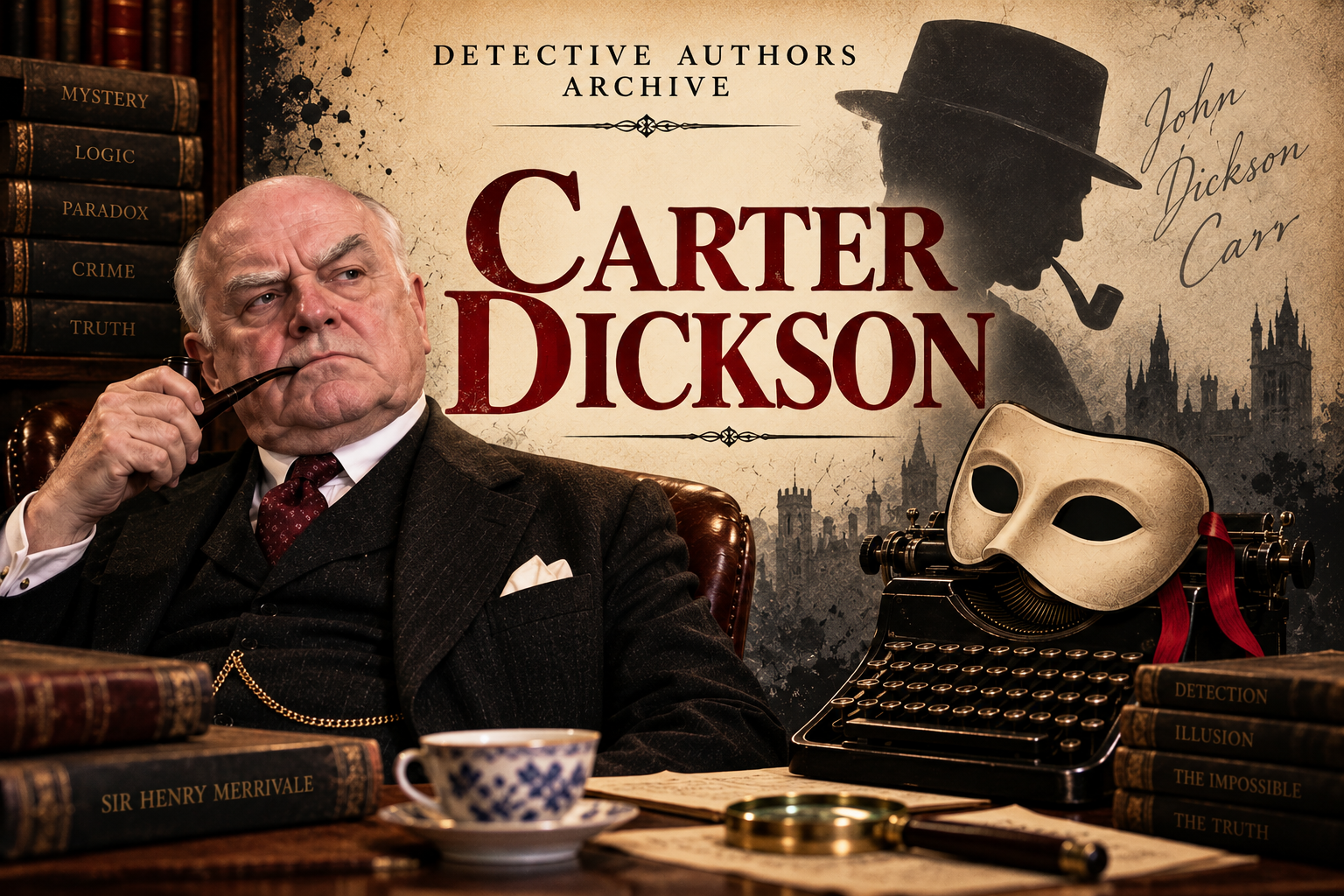
There was never much mystery about the man behind Carter Dickson. By the 1930s, John Dickson Carr was already making his name with mysteries built around seemingly impossible crimes. Then another name began appearing on detective novels: Carter Dickson.

Behind it was… John Dickson Carr. It was hardly a secret, nor was it meant to be.
So why did an author who was already building a name for himself need another one? And what happened when he put on the second mask?
Dickson’s Second Mask
John Dickson Carr was already publishing under his own name when another identity entered the picture: Carter Dickson. Unlike many pseudonyms in detective fiction, this one was never intended to conceal the man behind it. Carr was remarkably prolific, and a second name offered a practical way of keeping up that extraordinary output while working with two publishers. In the United States, Harper published John Dickson Carr, while William Morrow became the home of Carter Dickson. One writer could, in effect, maintain two publishing careers side by side.
For a brief time, even two names were not enough. In 1933, The Bowstring Murders appeared under the wonderfully confusing name Carr Dickson. The experiment did not last. Carr reportedly feared that three identities might bewilder his readers, and Carr Dickson disappeared almost as quickly as he had arrived. Carter Dickson, however, stayed.
For nearly two decades, that second name accompanied Carr’s own. There was no elaborate fictional personality to maintain and no secret identity waiting to be exposed; readers could see perfectly well who stood behind it. Yet what began as a practical publishing arrangement gradually became something more. Carter Dickson had begun to acquire a life of his own.
Meet the Detective: Sir Henry Merrivale
If Carter Dickson was John Dickson Carr’s second mask, Sir Henry Merrivale was the face readers came to associate with it.
Known simply as H.M. — or “the Old Man” — Merrivale is one of the Golden Age’s more improbable great detectives. A baronet, doctor and barrister, as well as a former chief of British counterespionage, he possesses an impressive collection of credentials. His appearance and behaviour, however, do little to suggest the dignified establishment figure they might imply.
Large, bald, bespectacled and decidedly stout, Merrivale has something of Falstaff about him. In his younger days he played rugby at Cambridge and even took to the amateur stage as Shylock. Age has apparently done little to quiet his theatrical instincts. H.M. grumbles, bellows, loses his temper and displays an almost gleeful disregard for decorum. Even his family knows how to provoke him: his two daughters have been known to borrow his car and sound the horn at dawn simply to wake him.

The comedy, however, is deceptive.
Behind the bluster is a formidable criminologist with a particular talent for problems that appear to have no possible solution. Locked rooms and other seemingly inexplicable crimes are precisely the territory in which Merrivale thrives. His reasoning may be surrounded by tantrums, jokes and theatrical behaviour, but beneath all the noise is a sharp and observant mind.
That contradiction is at the heart of H.M.: a man who could look ridiculous while being very dangerous to underestimate.
Notable Cases
Across nearly two decades, Sir Henry Merrivale encountered murders designed to make the rational mind surrender. Locked rooms, impossible footprints and even apparently supernatural powers all came his way. These five cases give a taste of what awaited anyone unfortunate enough to bring an impossibility to the Old Man.
The Plague Court Murders (1934)
Merrivale made his first appearance in appropriately sinister surroundings. Plague Court is an old London house burdened with a violent history, and a séance intended to contact the dead is followed by a very real murder. The victim is found stabbed inside a locked stone house while the surrounding evidence appears to exclude any ordinary intruder.


The White Priory Murders (1934)
Snow should make a murderer’s movements easier to trace. At White Priory, it does precisely the opposite.
An actress is discovered murdered in a pavilion surrounded by freshly fallen snow. There are footprints leading toward the building—but the pattern of tracks seems incompatible with anyone having reached the victim, committed the murder and escaped. Merrivale is left with an apparently simple question whose answer seems physically impossible: how did the murderer get there?


The Judas Window (1938)
A man wakes in a locked room to find himself accused of murder. Beside him lies the body of his prospective father-in-law, killed with an arrow, while the room itself appears to offer no route by which another killer could have entered or escaped.
The evidence seems overwhelming, and this time Merrivale does more than investigate. Drawing upon his legal background, H.M. takes the case into the courtroom, where an apparently impossible murder must survive a very different kind of examination.
A sealed room. An accused man. And H.M. determined to prove that the obvious answer is not necessarily the right one.


The Reader Is Warned (1939)
What happens when the murder weapon may be nothing more than a man’s mind?
Herman Pennik claims to possess “teleforce,” a mental power capable of killing at a distance. It is an outrageous boast—until deaths begin occurring in circumstances that seem disturbingly consistent with his claims.
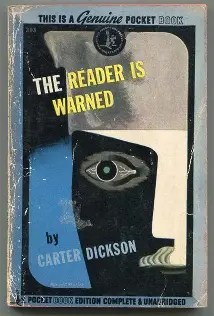
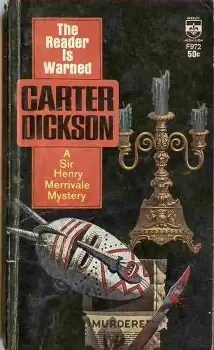
For a detective devoted to finding rational explanations for apparently impossible events, Pennik presents a particularly unsettling challenge. Merrivale must determine whether he is facing an ingenious murderer exploiting superstition—or something that detective fiction is not supposed to allow.
Nine—and Death Makes Ten (1940)
War provides the background for one of Merrivale’s more claustrophobic investigations. A transatlantic voyage becomes a murder scene when one of the passengers is killed, leaving behind evidence that should make identifying the murderer straightforward.
Instead, the fingerprints found at the scene apparently belong to no one aboard.
With the suspects confined together and the Atlantic surrounding them, Merrivale faces an impossibility built not around escape from a locked room, but around identity itself.


What Carter Dickson Brought to the Crime Scene
Carter Dickson did not represent a complete departure from John Dickson Carr. The impossible crime remained at the centre of both names. But the second mask gave Carr room to push familiar ingredients in a different direction.
The Impossible Crime as Spectacle
A Carter Dickson mystery rarely asks only who killed the victim? First, the reader must confront the more disturbing question: how could the crime have happened at all? A locked room, untouched snow, inexplicable fingerprints or a death apparently caused by mental power turns the crime scene itself into part of the puzzle. The solution must account not merely for the murderer, but for the impossibility.
Comedy amid Murder
Sir Henry Merrivale changed the temperature of these mysteries. H.M.’s tantrums, indignities and broad comedy could erupt in the middle of an otherwise sinister investigation. The combination could be deliberately extravagant: a grim impossible murder on one side, the Old Man creating havoc on the other. It is part of what prevents Carter Dickson from feeling like John Dickson Carr with a different name stamped on the cover.
Playing Fair with the Impossible
However outrageous the problem might appear, the challenge remained a rational one. The reader was invited to look at the same evidence as Merrivale and discover the overlooked detail, false assumption or piece of misdirection that made the impossible appear possible. The trick was not simply to astonish, but to make the eventual explanation fit what had been there all along.
Carter Dickson may have begun as a practical second identity, but Carr did more than divide his books between two names. He gave that identity its own rhythm: impossible crimes, Gothic shadows, rational solutions — and one very noisy Old Man standing in the middle of them.
Beyond the Page
Sir Henry Merrivale never became a screen fixture on the scale of some of detective fiction’s most famous sleuths, but the Old Man did escape from the printed page.
Radio proved welcoming to Carter Dickson’s impossible crimes. In 1958, the BBC Light Programme broadcast You Have Been Warned, a six-part adaptation of The Reader Is Warned. The following year, the BBC Home Service turned to He Wouldn’t Kill Patience, with Felix Felton as Merrivale.
British television also opened the door. In 1964, the BBC anthology series Detective adapted The Judas Window, with David Horne as Merrivale. Five years later the same series returned to Carter Dickson with And So to Murder, this time with Martin Wyldeck as H.M.
Merrivale even acquired an Italian incarnation. In 1982, RAI produced L’occhio di Giuda, an adaptation of The Judas Window, with Adolfo Celi taking on the role of the Old Man.
Yet Merrivale never established a permanent face outside the novels. Different actors inherited the role as individual stories were adapted, and no long-running Merrivale screen series followed. H.M. remained above all a creature of Carter Dickson’s pages.
Later Years: Did Carter Dickson Walk Away?
For nearly two decades, Carter Dickson had existed alongside John Dickson Carr. The arrangement that had begun as a practical solution to a prolific writer’s publishing career had lasted long enough for the second name to acquire a substantial career of its own.
But it did not last forever.
In 1953, The Cavalier’s Cup became the twenty-second and final Sir Henry Merrivale novel. There was no dramatic unmasking—there had never been much of a mask to remove—and Carr did not stop writing detective fiction. He simply stopped producing new Merrivale novels, and the Carter Dickson name effectively disappeared with the Old Man.
That distinction matters. John Dickson Carr continued. Carter Dickson did not.
Carr continued writing under his own name, including the historical mysteries that became increasingly prominent in the later part of his career. Carter Dickson, meanwhile, belonged to an earlier period: the years when Carr maintained two publishing identities side by side.
The Mask Comes Off
Carter Dickson had never been much of a disguise. Readers knew John Dickson Carr was behind the name, and Carr made little effort to persuade them otherwise. Yet over nearly two decades, the transparent mask acquired an identity of its own.
It had Sir Henry Merrivale. It had impossible crimes wrapped in Gothic shadows, outrageous comedy and meticulously constructed puzzles. And it produced books that could stand beside those carrying Carr’s own name. What began as a practical way for one remarkably prolific writer to maintain two publishing careers became a second body of detective fiction with its own character and rhythm.
Perhaps that is what makes Carter Dickson unusual among the authors behind the names. There was no secret identity waiting to be discovered and no great revelation when the pseudonym disappeared. When Merrivale’s final case appeared, John Dickson Carr was still there.
The second mask had simply served its purpose. Carr took it off — and carried on.
References & Further Reading
- Bourdier, Jean. Histoire du roman policier.
- Edwards, Martin. The Golden Age of Murder.
- Priestman, Martin, ed. The Cambridge Companion to Crime Fiction. Cambridge University Press, 2003.
- Rzepka, Charles J. Detective Fiction. Polity, 2005.
- Spehner, Norbert. Le Détectionnaire.
- Dickson, Carter. Sir Henry Merrivale novels, 1934–1953.
← Previous: Josephine Tey
🏠 The Author Behind the Name
Next: John Rhode →








Hello Gumshoe! On the track or authors? leave us reply!