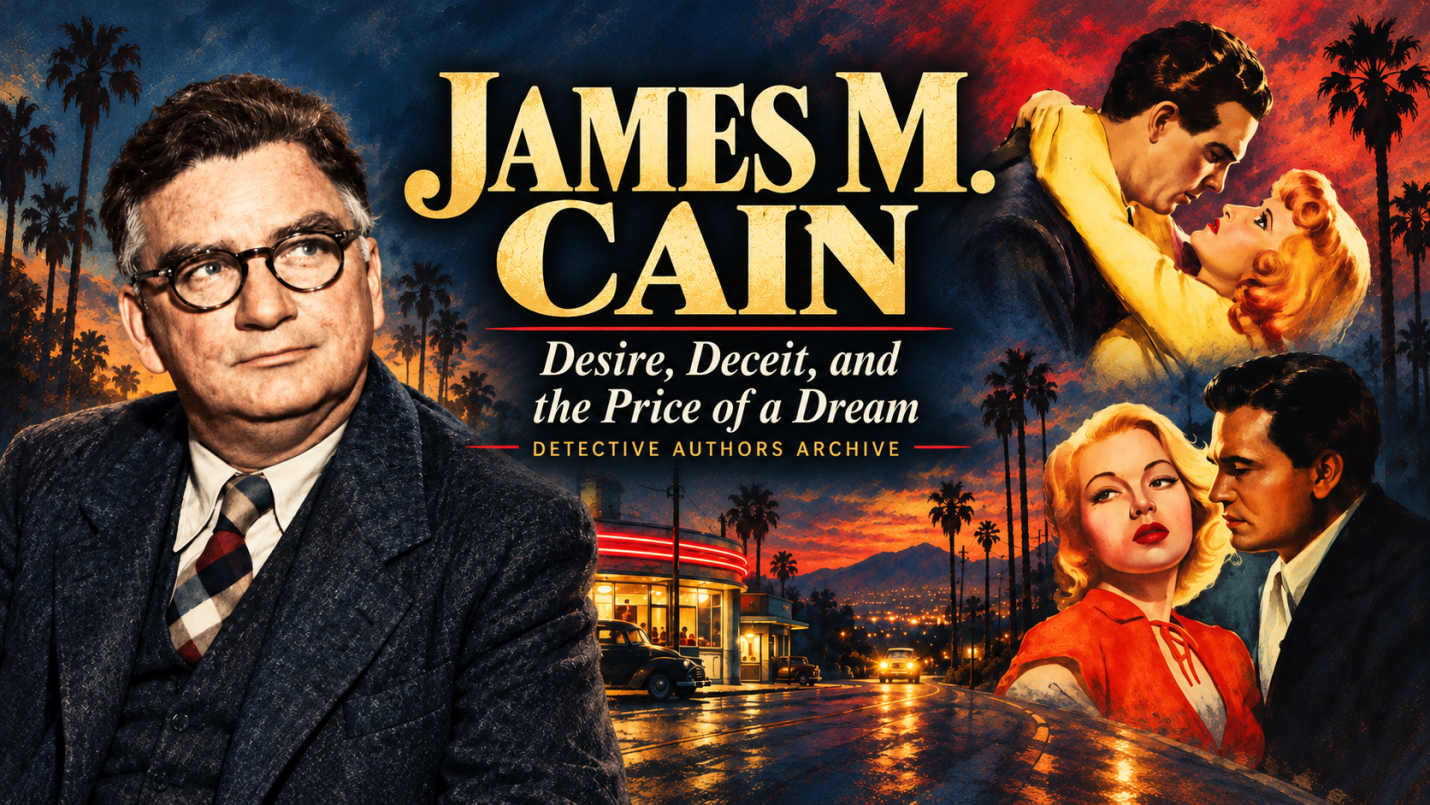
Desire, Deceit, and the Price of a Dream
A roadside job. An insurance policy. A business built from scratch. James M. Cain found dangerous possibilities in everyday American life.

Beneath its familiar surface, he uncovered tensions that gave his fiction its distinctive edge. He made intimate relationships the heart of stories that would leave a lasting mark on noir.
Before the First Confession
James Mallahan Cain was born on July 1, 1892, in Annapolis, Maryland. His father, an educator who became president of Washington College, helped shape an upbringing steeped in books and learning. Cain graduated from the college in 1910, but finding his own direction took considerably longer.

His first great ambition was musical. He hoped to become an opera singer, an aspiration that never developed into a professional career. Music nevertheless remained a lasting passion, eventually finding its way into his fiction. Before establishing himself as a writer, he tried teaching and several other occupations, including selling insurance, with little success.
Journalism finally gave him a foothold. He worked for the Baltimore American and the Baltimore Sun, then served in France during the First World War. There, he edited the Lorraine Cross, the newspaper of the American army’s 79th Division. Reporting and editing became the practical foundations of his writing life.
From the Newsroom to Noir
After the war, Cain returned to journalism, but his ambitions extended beyond the newspaper office. He taught English and journalism at St. John’s College in Annapolis, then moved to New York, where he wrote editorials for the New York World. A brief spell as managing editor of The New Yorker added another prestigious name to his experience. Becoming a novelist, however, proved more difficult: his early attempts remained unpublished.
An important step came in 1928 with “Pastorale,” a darkly comic murder story published in H. L. Mencken’s American Mercury. Its criminal narrator and grisly events anticipated concerns that would become central to Cain’s fiction. His newspaper background also offered something valuable: an ear for everyday speech, which would help his characters tell their stories with unsettling directness.
Hollywood brought him west in 1931. Screenwriting offered employment, but little security, and his first studio position soon ended. California nevertheless held his interest. He stayed, supported himself through freelance writing, and continued working toward the fiction that would establish his reputation.
That breakthrough arrived in 1934 with The Postman Always Rings Twice. Its combination of adultery, violence, and blunt storytelling brought immediate success and considerable controversy. Cain had found an audience for stories told from dangerously close to the crime.
Cain explored how a murder committed to bring two lovers together could ultimately tear their relationship apart. Desire and the promise of a better life draw people together; their shared crime gives suspicion and mistrust room to grow. This became one of his defining contributions to noir: making the criminals’ relationship as compelling as the crime itself.
Lives on the Edge
Frank Chambers and Cora Papadakis
The Postman Always Rings Twice (1934)
Frank Chambers arrives at the Twin Oaks Tavern with little money and no settled plans. A drifter accustomed to moving on, he accepts work from its owner, Nick Papadakis. But it is Nick’s wife, Cora, who gives him a reason to stay.
Cora wants more than an affair. Dissatisfied with her marriage, she dreams of turning the roadside business into something successful and building a life she can take pride in. Frank offers the possibility of escape, although his attachment to the road sits uneasily beside her desire for stability.
Their attraction is immediate, physical, and dangerous. As they begin to imagine a future together, Nick becomes the obstacle around which their plans take shape. Cain brings the reader inside their growing complicity through Frank’s blunt narration, allowing desire, resentment, and calculation to emerge through words and actions.
Frank and Cora give Cain’s noir a recognizably ordinary setting: a roadside tavern, a job, a marriage, and hopes for something better. The danger grows from what they become willing to do to obtain it.
Walter Huff and Phyllis Nirdlinger
Double Indemnity (1936)
Walter Huff knows insurance from the inside. He understands the policies, the risks, and the details that make a claim look suspicious. When a routine business call brings him to the Nirdlinger home, he meets Phyllis, whose interest in accident insurance for her husband soon takes an unsettling turn.
Their attraction develops into a murder scheme. Walter’s professional knowledge gives him the confidence to believe he can anticipate every difficulty. The policy’s double-indemnity clause, which promises an increased payment under particular circumstances, makes the prospect even more tempting.
Phyllis remains harder to read. We encounter her through Walter’s narration, shaped by his fascination and his belief that he understands their partnership. As their plans develop, the uncertainty surrounding her intentions becomes part of the suspense.
Cain places the machinery of an ordinary business at the centre of the crime. Forms, clauses, and calculations become instruments of desire and greed, while Walter’s expertise gives him dangerous reasons to trust his own cleverness.
Mildred Pierce
Mildred Pierce (1941)
When her marriage breaks down, Mildred Pierce must find a way to support herself and her two daughters in Depression-era Southern California. A talented cook with a determination to succeed, she turns the practical business of feeding people into an opportunity to rebuild her life.
Yet earning a living is only part of her struggle. Mildred longs to give her elder daughter, Veda, every advantage. Veda’s musical talent and social ambitions seem to promise a world beyond her mother’s reach, even as her contempt for Mildred’s work makes each sacrifice more painful.
Through Mildred, Cain explores ambition within the family. Business success, respectability, and maternal devotion become entangled, while the need to win a daughter’s love threatens to overwhelm the woman building that success.
The novel broadens our picture of Cain. Told in the third person, it follows a working woman whose abilities can carry her far, but whose emotional attachments leave her vulnerable.
The Crime from Within
James M. Cain helped establish a powerful strand of noir centred on the people committing the crime. His narrators draw readers into their desires and calculations, making a terrible decision seem possible long before its consequences become clear.
His characters often want things that are easy to recognize: money, independence, love, or a place in respectable society. In Depression-era California, those hopes acquire particular urgency. Cain shows how the pursuit of a better life can become bound up with exploitation, betrayal, and violence.
He also made the relationship between accomplices a source of suspense. A murder committed to bring two lovers together could ultimately tear their relationship apart. Their shared secret creates dependence, but also gives each a reason to fear the other.
His direct prose and ear for everyday speech gave these stories their force. Dialogue, practical details, and swift action carry much of the meaning. Even when a character tells the story personally, readers must judge what that narrator fails to understand or chooses to excuse.
Cain’s fiction helped prepare the ground for writers such as Jim Thompson, David Goodis, and Charles Williams. His contribution was to make the criminal’s voice, ordinary ambitions, and intimate relationships central to some of noir’s most disturbing stories.
Later Years: A Return to Maryland
Cain’s personal life included four marriages. His first two, to Mary Rebekah Clough and Elina Sjösted Tyszecka, ended in divorce, as did his marriage to actress Aileen Pringle. In 1947, he married opera singer Florence Macbeth, bringing music into his domestic life as well as his fiction. He had no children of his own.

In 1948, Cain returned to Maryland, settling with Florence in the Hyattsville area. He continued writing, but his later books struggled to match the success of his early novels. Florence remained his wife until her death in 1966, after which he lived alone.
Recognition nevertheless came late in life. In 1974, the Mystery Writers of America named him a Grand Master. Rainbow’s End followed in 1975, and The Institute (1976) became his last novel published during his lifetime.
Cain died of a heart attack on October 27, 1977, aged 85. He had continued working on The Cocktail Waitress during his final years, but the novel remained unpublished. Decades later, Charles Ardai assembled and edited the surviving drafts and notes for its publication in 2012, giving readers one final encounter with Cain’s world of desire, money, and uncertain motives.
Legacy: A Lasting Shadow
James M. Cain’s reputation rests chiefly on a handful of novels, but their influence reaches far beyond their number. The Postman Always Rings Twice, Double Indemnity, and Mildred Pierce remain central to his standing, bringing together ordinary ambitions and relationships strained by desire, money, and pride.
His criminal narrators helped establish a tradition that later writers would take in increasingly disturbing directions. Jim Thompson, David Goodis, Day Keene, and Charles Williams explored related worlds of compromised people, desperate hopes, and self-defeating choices. Cain’s work became an important part of the foundation on which that darker fiction developed.
His characters also resist easy distance. They work, worry about money, seek affection, and imagine better futures. Readers can recognize those desires while watching the choices they produce with growing unease. That uncomfortable closeness remains one of his fiction’s most enduring strengths.
The eventual publication of The Cocktail Waitress in 2012 extended his literary afterlife. Thirty-five years after his death, another Cain narrator stepped forward to tell her version of events, leaving readers to decide how much they should believe.
Media: Cain on Screen
Cain’s success as a novelist gave cinema some of its most memorable stories of desire and betrayal. Three adaptations released in successive years, Double Indemnity (1944), Mildred Pierce (1945), and The Postman Always Rings Twice (1946), secured his place in the history of film noir.
Double Indemnity (1944)
Billy Wilder’s adaptation brought together Fred MacMurray as Walter Neff, Barbara Stanwyck as Phyllis Dietrichson, and Edward G. Robinson as claims investigator Barton Keyes. Wilder wrote the screenplay with Raymond Chandler, bringing another major crime writer into Cain’s world.

The film changes the lovers’ surnames from those in the novella and gives particular weight to Walter’s relationship with Keyes. Robinson’s investigator provides a formidable counterweight to the plotting couple, while Stanwyck’s Phyllis became one of film noir’s defining femmes fatales. The film received seven Academy Award nominations, although it won none.
Le Dernier Tournant (1939)
Directed by Pierre Chenal, the first screen adaptation of The Postman Always Rings Twice relocated Cain’s story to southern France. Fernand Gravey, Corinne Luchaire, and Michel Simon played the central trio.

Its early appearance on French screens demonstrates how quickly Cain’s story attracted filmmakers beyond the United States.
Ossessione (1943)
Luchino Visconti transplanted Postman to Italy, with Massimo Girotti and Clara Calamai as the lovers. The roadside setting and destructive attraction found a new life in an Italian landscape.

Visconti’s first feature also became an important landmark in the emergence of Italian neorealism.
The Postman Always Rings Twice (1946)
Directed by Tay Garnett, the classic Hollywood adaptation starred John Garfield as Frank and Lana Turner as Cora, with Cecil Kellaway as her husband.

Production Code objections to the novel’s adultery and murder delayed its journey to American screens. When the film finally appeared, Turner and Garfield gave Cain’s lovers two of their most recognizable faces.
The Postman Always Rings Twice (1981)
Bob Rafelson returned to Cain’s novel with Jack Nicholson and Jessica Lange, bringing a more sexually explicit treatment of Frank and Cora’s affair to the screen.

The adaptation offered another interpretation of the couple nearly half a century after the novel’s publication.
Mildred Pierce (1945)
Michael Curtiz’s film starred Joan Crawford as Mildred and Ann Blyth as Veda, alongside Zachary Scott, Jack Carson, and Eve Arden. Crawford won the Academy Award for Best Actress, making Mildred one of her signature roles.

The adaptation added a murder mystery and a flashback structure absent from Cain’s novel, reshaping the family drama into a noir thriller.
Mildred Pierce (2011)
Director Todd Haynes returned to the book for a five-part HBO miniseries, starring Kate Winslet, with Evan Rachel Wood as the adult Veda and Guy Pearce as Monty Beragon.

Its longer format allowed greater attention to Mildred’s work, the Depression setting, and her consuming devotion to her daughter. It follows the novel’s family drama more closely than the 1945 film.
Serenade (1956)
Directed by Anthony Mann, Serenade starred Mario Lanza, Joan Fontaine, Sara Montiel, and Vincent Price.

The film brought Cain’s love of singing to the screen, although censorship and extensive rewriting transformed much of his 1937 novel. Lanza’s voice became the centrepiece of an adaptation considerably different from its source.
Slightly Scarlet (1956)
Allan Dwan’s film adapted Love’s Lovely Counterfeit, with John Payne, Rhonda Fleming, and Arlene Dahl.

Its vivid colour photography offers a striking visual departure from the black-and-white shadows associated with Cain’s most famous adaptations, bringing political corruption, criminal ambition, and dangerous relationships into blazing colour.
Case Closed
Cain understood how easily a dream could become a justification. A lover, a fortune, a better life: once the prize seemed close enough, his characters could persuade themselves that almost any price was worth paying.
His stories endure because those desires remain recognizable. We may recoil from what Frank, Cora, Walter, or Phyllis choose to do, yet we understand the hopes they use to excuse themselves. Mildred’s sacrifices bring that uneasy recognition even closer to home.
The dream is within reach. The cost is another matter.
References
- Baudou, Jacques, and Jean-Jacques Schleret, editors. Le Polar. Guide Totem, Larousse, p. 159.
- Bourdier, Jean. Histoire du roman policier. Éditions de Fallois, pp. 201–202, 204–205, 207.
- Deleuse, Robert. Les maîtres du roman policier. Bordas, pp. 80–81.
- Moore, Lewis D. Cracking the Hard-Boiled Detective: A Critical History from the 1920s to the Present, p. 25.
- Nickerson, Catherine Ross, editor. The Cambridge Companion to American Crime Fiction. Cambridge University Press. “The hard-boiled novel,” p. 55; Andrew Pepper, “The American roman noir,” pp. 58–59, 64, 67.
- Rzepka, Charles J. Detective Fiction, pp. 184, 230–231.
- Scaggs, John. Crime Fiction, pp. 69, 84, 109–113.
- Library of Congress: James M. Cain Papers.
- Washington College: James M. Cain Collection.
- James M. Cain official website.
- Turner Classic Movies, American Film Institute Catalog, and HBO: adaptation histories, credits, and production information.
Previous: W. R. Burnett
Next: Cornell Woolrich








Hello Gumshoe! On the track or authors? leave us reply!