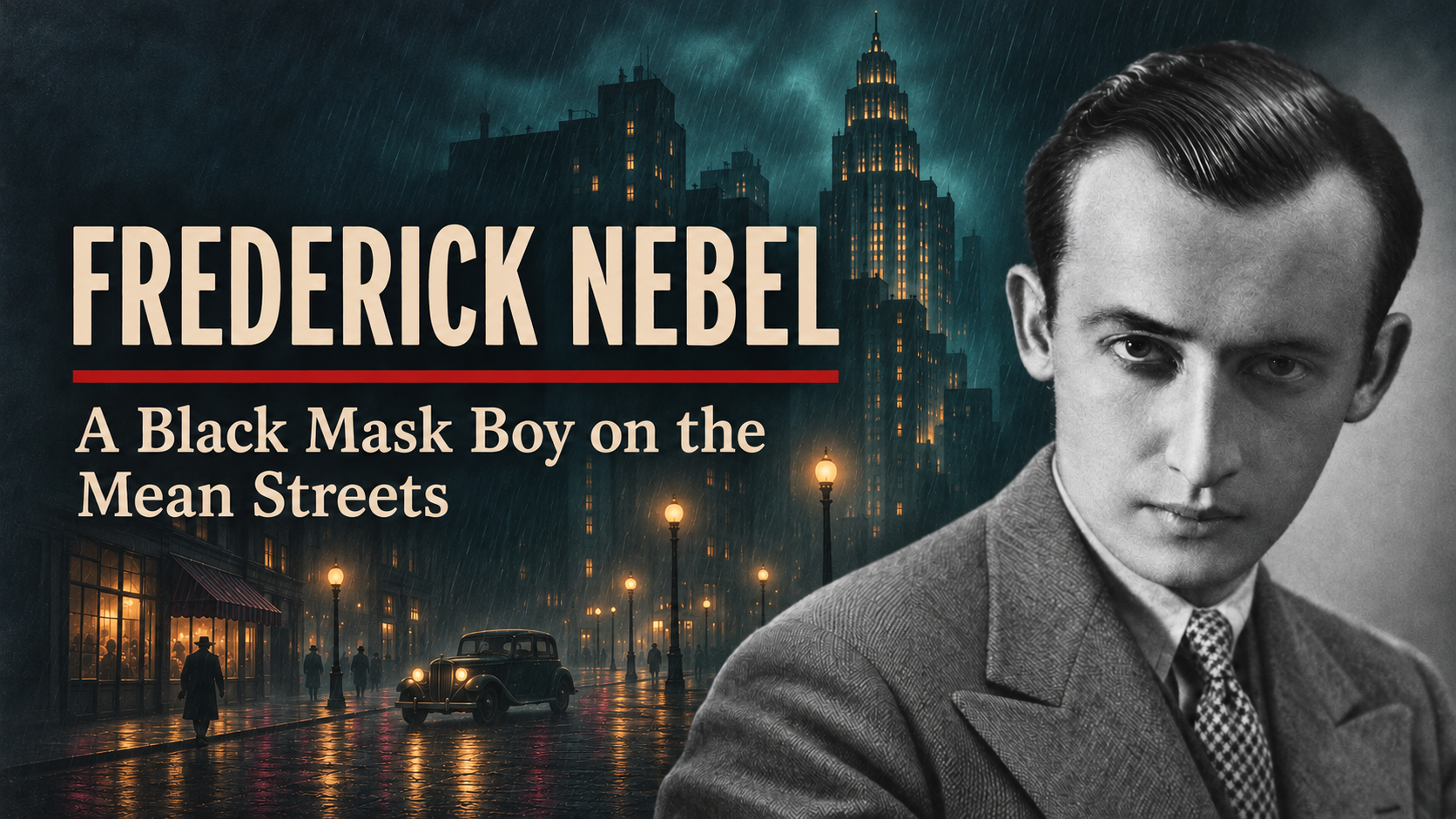
A Black Mask Boy on the Mean Streets
Three novels. That was the first thing that made me stop when I started looking into Frederick Nebel for the Archive. I knew his name from The Black Mask Boys, where he’s listed alongside Hammett and Chandler. So how did a writer with only three novels earn his place among the Black Mask boys?

The more I looked, the more I realized I’d started by counting the wrong thing. To find Nebel, I had to turn to the old magazines, where readers could follow a detective from one issue to the next. That’s where his career opened up for me.
Early Years: From Staten Island to the Northwoods
Frederick Nebel was born on November 3, 1903, on Staten Island, New York. He grew up near Grimes Hill and later borrowed its name for one of his pen names. According to William F. Nolan, Nebel spent just one day in high school. He preferred to educate himself and went to work on the New York waterfront while still in his teens.

In 1920, Nebel went to Canada to work as a farmhand on his great-uncle’s homestead. He took an interest in the history and legends of the Northwoods, and the region would give him the material for some of his earliest published fiction.
After returning to New York in the early 1920s, Nebel found work as a brakeman on passenger trains and wrote in his spare time. The railroad would eventually provide the setting for his first novel, Sleepers East. Canada made it into print first. In July 1925, North West Stories published “Trade Law,” one of the Northwoods tales that launched his career in the pulps.
Writing Career: From Black Mask to the Slicks
Frederick Nebel made his Black Mask debut in March 1926 with “The Breaks of the Game,” published under the name Lewis Nebel. He sold the story to editor Phil Cody, and his second contribution appeared later that year under Joseph T. Shaw. It was the beginning of a working relationship that would last a decade.
Shaw encouraged his writers to develop characters readers could follow from issue to issue. In 1928, Nebel introduced Captain Steve MacBride of the Richmond City police and Kennedy, a reporter for the Free Press. Two years later, he brought another investigator to Black Mask, a former policeman named Donahue who worked for the Inter-State Detective Agency. Nebel was also writing for rival magazines. Jack Cardigan took on cases for the Cosmos Agency in Dime Detective, while Sergeant Brinkhaus appeared in Detective Fiction Weekly. He kept several series going at once, alongside aviation adventures and stories of the Northwoods.

Nebel was still turning out magazine fiction when he began his first novel in 1932. Drawing on his years as a brakeman, he set Sleepers East aboard a passenger train bound for New York. Little, Brown published it in 1933. Its success helped him secure a literary agent, Carl Brandt, and he went on to publish But Not the End in 1934 and Fifty Roads to Town in 1936.
By the end of 1936, Nebel had stopped writing for Black Mask. His last Cardigan story appeared in Dime Detective the following spring. He was already selling to higher-paying magazines such as The Saturday Evening Post and Collier’s. Around 1940, after he failed to sell a short mystery novel called Regret the Night, he concentrated on contemporary romance, finding a market for his stories in magazines including Cosmopolitan, McCall’s, and Redbook.
The Cases : A Captain, a Reporter, and Two Private Eyes
MacBride and Kennedy
In Richmond City, a police captain could use a good reporter. Steve MacBride had Kennedy, who drank too much, looked as though he needed a night’s sleep, and had a knack for picking up on things the police missed. The two first appeared in “Raw Law” in the September 1928 issue of Black Mask.
MacBride took police work personally. In a city where corruption reached into his own department, he regarded a crooked officer as a traitor to the force. Kennedy, a reporter for the Free Press, had his own way of getting at the truth. He asked questions as a newspaperman and often spotted the lead that put MacBride on the right track. In “Fan Dance,” for instance, it’s Kennedy who goes to see the special prosecutor, ostensibly to get a statement for the paper.
Nebel kept the pair in Black Mask through 1936. Over those eight years, Richmond City gave them plenty to investigate. The partnership worked because each man could get somewhere the other couldn’t, and because MacBride could count on Kennedy to tell him what he’d found.
Donahue
Donahue arrived in Black Mask in November 1930 with “Rough Justice.” His first case took him into the heat of a St. Louis summer, where he had to deal with cagey lawyers, publicity-hungry cops, and crooks on the run. The issue also carried a Continental Op story by Dashiell Hammett, so readers met Nebel’s new private eye alongside one of the detectives who had helped establish the magazine’s hardboiled style.
Known as “Tough Dick,” Donahue had been a policeman before joining the Inter-State Detective Agency. He had lost his badge after refusing to go along with corruption on the force. As a private detective, he was willing to bend the rules himself. He had a stubborn sense of justice and hated to lose, qualities that could make him as much trouble for the people who hired him as for the people he was sent after.
Nebel wrote fifteen Donahue stories for Black Mask, ending with “Ghost of a Chance” in March 1935. Six appeared in the 1950 paperback Six Deadly Dames. The complete run was later collected in Tough as Nails, including “Rough Justice.”
Jack Cardigan
Jack Cardigan was there from the first issue of Dime Detective. He made his debut in “Death Alley” in November 1931, less than a year after Donahue’s first case. A tough Irish private detective working for the Cosmos Agency in St. Louis, Cardigan would become the magazine’s most frequently featured series character.
In “Death After Murder,” published in August 1933, Cardigan faces a piece of evidence he can’t dismiss. His own fingerprints are on the murder weapon, and he knows they haven’t been forged. This time, the evidence points straight at the detective.
Nebel wrote forty-four Cardigan stories for Dime Detective. The last, “No Time to Kill,” appeared in May 1937. A selection appeared in The Adventures of Cardigan in 1988, and Altus Press later brought the full run back into print in The Complete Casebook of Cardigan.
The Standalones : A Night Train, a Family in Trouble, and a Snowbound Town
Sleepers East (1933)
Think Murder on the Orient Express without Poirot. An eastbound passenger train is less than ten hours from New York, and twelve lives are about to cross in a story of murder and political intrigue. Nebel knew passenger trains from his years as a brakeman, and in his first novel he uses the tight quarters to bring people with very different concerns into one another’s way.
But Not the End (1934)
There’s a touch of James M. Cain in the setup. A financially ruined stockbroker, his neglected wife, and a prizefighter find their lives entangled in a family drama where money trouble and desire run close together. A private detective appears in a minor role, while Nebel keeps the focus on the three people at the heart of the story.
Fifty Roads to Town (1936)
Imagine Christie’s And Then There Were None, not on an island but in a small town in Maine. A blizzard closes the roads and strands a group of strangers at a hotel. When a fire-extinguisher salesman goes missing, the newspapers take notice. The disappearance draws the guests into one another’s affairs, giving Nebel room for comedy as well as suspense.
What Nebel Brought : Who Gets to Do the Detective Work?
In Richmond City, a lead could come from the newsroom as easily as from police headquarters. Captain Steve MacBride had the authority to act, but Kennedy, a reporter for the Free Press, often spotted the lead that gave him a place to start. By putting a newspaperman alongside a police captain, Nebel gave readers two ways into the same case.
Donahue brought a different set of rules to the job. He’d lost his badge after refusing to go along with corruption, yet in “Rough Justice,” his first case as a private detective, he goes looking for a local cop who can be bribed. The contradiction tells us something about both Donahue and the world he works in. He has his own sense of what’s right, and he knows how to use the very practices that cost him his place on the force.
That’s what makes these stories feel at home in the hardboiled fiction of the Depression. Who can get an answer, who can act on it, and who can afford to look the other way all matter to the outcome. A police captain, a reporter, and a private detective each have a different answer to those questions. Nebel could build a whole series around each way of doing the work.
Later Years: One Last Return to Crime
When Joe Shaw asked to reprint “Winter Kill” in The Hard-Boiled Omnibus, Nebel turned him down. He felt his early detective fiction had dated, and the anthology went ahead without him. A few years later, he agreed to let Avon bring back six of his Donahue stories. They appeared in 1950 as Six Deadly Dames. He also hoped to collect some of the MacBride and Kennedy stories, but the proposed volume failed to find a publisher.

In 1956, editor Frederic Dannay persuaded Nebel to return to crime fiction for Ellery Queen’s Mystery Magazine. “Try It My Way” appeared that June. His last published story, “Needle in a Haystack,” appeared in the same magazine in August 1962.
By then, Nebel and his wife, Dorothy, had settled in Laguna Beach, California. As his health declined, he gave up golf and could write only for short stretches. He had outlined another novel and created its characters, and he continued working on it when he could. The manuscript was unfinished when he died in Laguna Beach on May 3, 1967, at the age of sixty-three.
Legacy: From Pulp Issues to Casebooks
For decades, reading Nebel meant piecing together his career a few stories at a time. Six Deadly Dames gave Donahue a paperback of his own in 1950, and The Adventures of Cardigan brought a selection of Cardigan’s cases back into print in 1988. Readers who wanted to follow either detective from his first case to his last still had to hunt through old magazine issues.

The complete editions changed what readers could see. It’s now possible to follow MacBride and Kennedy through eight years in Richmond City, read all fifteen Donahue stories together, and see how Nebel sustained Cardigan across forty-four cases. Each series shows a different side of the work he did for the pulps. Side by side, they give a fuller picture of the writer who helped make Black Mask and Dime Detective places readers could return to month after month.
Media : From Black Mask to Torchy Blane
Film · From Silent Films to The Bribe
Isle of Lost Men (1928) was a silent film that credited Nebel for the story.

Ships of the Night (1928) was another silent film that carried a story credit for Nebel.

Sleepers East reached the screen in 1934. Kenneth MacKenna directed the first adaptation of Nebel’s railway thriller, with Wynne Gibson and Preston Foster in the leading roles

Warner Bros. adapted Nebel’s Black Mask story “No Hard Feelings” as Smart Blonde (1937). Glenda Farrell played Torchy Blane, the fast-talking reporter who took Kennedy’s place, and Barton MacLane played police detective Steve McBride. The film launched a nine-picture series that ran through 1939.

Later in 1937, Fifty Roads to Town brought Nebel’s snowbound Maine setting to the screen. Norman Taurog directed Don Ameche and Ann Sothern in a version that played up the farce in the novel’s premise.

Fox returned to Nebel’s railway novel in 1941 with Sleepers West. This time, the investigation went to Michael Shayne, the studio’s private detective, played by Lloyd Nolan.

Warner Bros. also went back to “No Hard Feelings” in 1941 for A Shot in the Dark. This version put a reporter named Peter Kennedy back on the case, played by William Lundigan.

The Bribe (1949) brought another Nebel short story to the screen. Robert Taylor plays a federal agent investigating a smuggling operation. Ava Gardner, Charles Laughton, and Vincent Price also star.

Television · Nebel’s Stories on the Small Screen
In the 1950s, television anthologies brought Nebel’s short fiction to a new audience. The adaptations included “Try It My Way,” one of the stories he wrote when he returned to crime fiction.
- The Pepsi-Cola Playhouse (1954) aired “Girl on the Drum.”
- Celebrity Playhouse (1956) aired “Incident in Rio.”
- The George Sanders Mystery Theater (1957) adapted “Try It My Way,” the story that had marked Nebel’s return to crime fiction in Ellery Queen’s Mystery Magazine the previous year.
Audiobooks · Donahue’s First Case in Audio
Donahue’s first case, “Rough Justice,” is available as a 29-minute full-cast dramatization from Blackstone on Kobo Canada. It also appears in Black Mask Audio Magazine, Volume 1 on Audible Canada, alongside stories by Dashiell Hammett, Paul Cain, and others.
Case Closed
Kennedy looks like he could use a night’s sleep, and Richmond City could use a few more people who pay attention the way he does. That’s the pleasure of reading Nebel. A man can look like he’s barely keeping himself together and still be the first to notice where the official story comes apart.
Nebel once thought those old cases had dated. Spend an evening in Richmond City and see how easy it is to leave after just one.
References
Books
- Nolan, William F. The Black Mask Boys: Masters in the Hard-Boiled School of Detective Fiction. “Behind the Mask: Frederick Nebel,” pp. 152–157. Nolan’s anthology also reprints “Rough Justice,” beginning on p. 157.
- Tulard, Jean. Dictionnaire du roman policier, 1841–2005. Fayard. “Nebel Frederick,” pp. 523–524.
Online Sources
- Stuewe, Paul. “Frederick Nebel.” Critical Survey of Mystery and Detective Fiction. Biography, literary analysis, and bibliography. EBSCO Research Starters
- “Frederick Nebel: Hero of Pulpdom.” Biographical profile drawing on The Ridgefield Press. CT Insider
- The Thrilling Detective Web Site. Nebel’s bibliography and the publication history of the Cardigan series. Frederick Nebel · Jack Cardigan
- Black Mask. Original magazine issues and issue index used to check story dates and credits. Issue index · January 1936 issue
- Ellery Queen’s Mystery Magazine. The August 1962 contents list confirms the publication of Nebel’s final story, “Needle in a Haystack.” 1962 issue listings
- Black Mask reprint catalogue. Publication details for the MacBride and Kennedy casebooks and Tough as Nails, the complete Donahue collection. Frederick Nebel catalogue
Film and Television
- American Film Institute. Film credits and literary sources for Nebel’s screen adaptations. AFI filmography
- Turner Classic Movies. Background on the Torchy Blane series and its origins in Nebel’s “No Hard Feelings.” Torchy Runs for Mayor
- The Thrilling Detective Web Site. Episode titles, broadcast dates, and source-story and teleplay credits. Nebel’s television adaptations
Audiobooks
- Blackstone Audio. Rough Justice. Standalone full-cast dramatization, 29 minutes. Kobo Canada listing
- Blackstone Audio. Black Mask Audio Magazine, Volume 1. Includes “Rough Justice.” Audible Canada
← Previous: Fredric Brown | Home | Next: Raoul Whitfield →








Hello Gumshoe! On the track or authors? leave us reply!