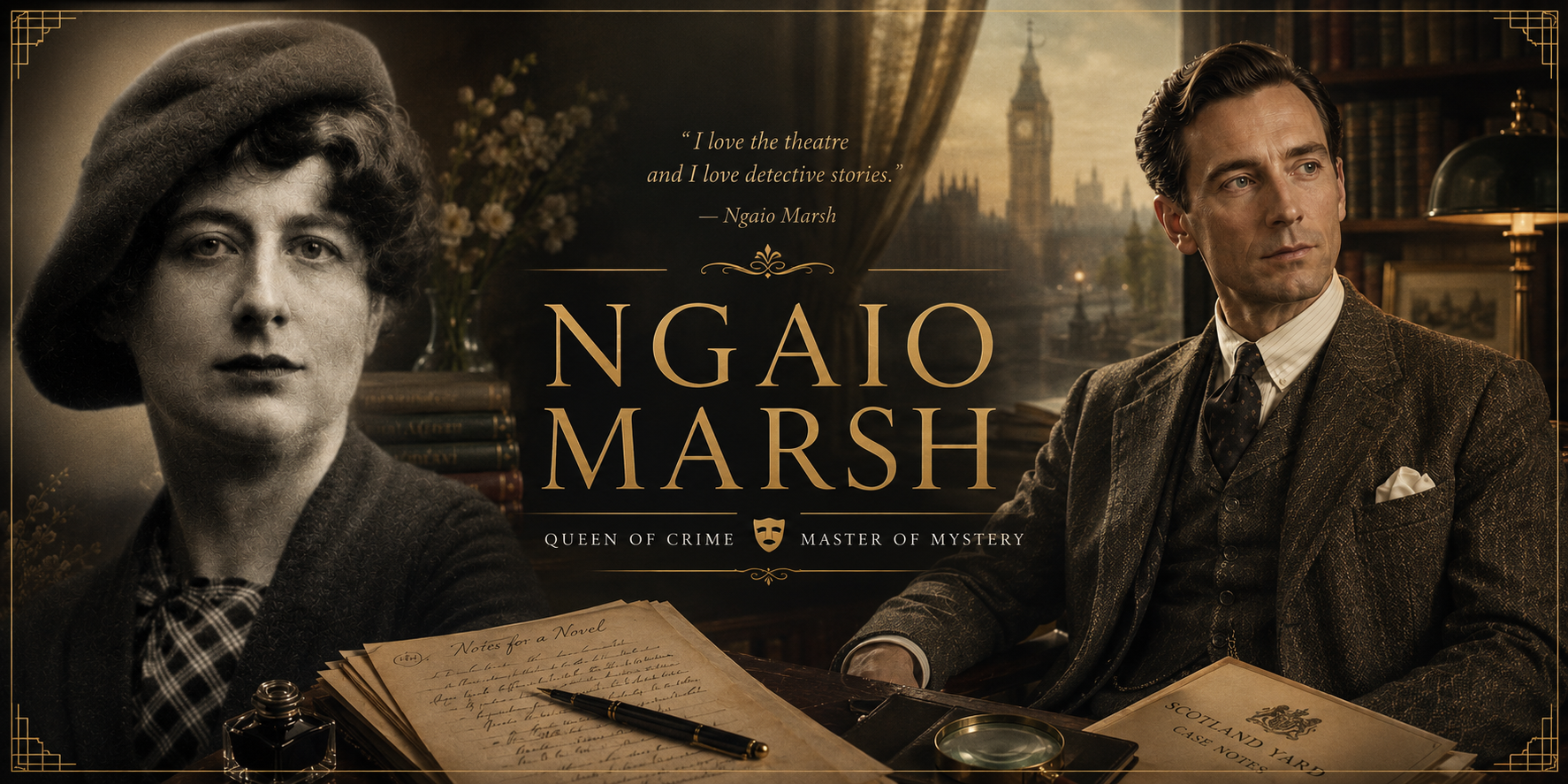
“Murder Behind the Curtain“
Introduction
Before the curtain rises, someone is already lying dead.
In the world of Ngaio Marsh, murder rarely bursts into the room in dramatic fashion. Instead, it waits quietly beneath theatre lights, behind polished conversations, during rehearsals, dinner parties, and carefully arranged performances where appearances matter almost as much as the crime itself.

Often grouped beside Agatha Christie, Dorothy L. Sayers, and Margery Allingham as one of the great Queens of Crime, Marsh brought a distinctly theatrical atmosphere to the Golden Age of detective fiction. Her novels combined elegant puzzles with sharp social observation, layered dialogue, and a deep understanding of performance — both onstage and off.
Actors, artists, aristocrats, directors, writers, and performers move constantly through her stories. People hide behind roles, masks, manners, and rehearsed behavior. In many Marsh novels, solving the crime means understanding not only what happened… but who was pretending to be someone else.
Yet detective fiction was never her only stage.
Long before and long after her novels found international success, Marsh remained deeply connected to the theatre — a world that continued to shape her writing throughout her career.
Biography
Ngaio Marsh was born in 1895 in Christchurch, far from the foggy streets and country estates that would later appear throughout many of her detective novels. Raised in a creative household and surrounded by art from an early age, she developed interests in painting, literature, and especially the theatre — passions that would remain with her throughout her life.


Unlike several of her Golden Age contemporaries, Marsh did not begin her career through journalism or publishing circles. Her artistic path led first toward the stage. She studied art, became involved in theatrical productions, and spent years balancing creative work between New Zealand and England.
During the 1920s and 1930s, detective fiction was rapidly growing in popularity. Writers such as Agatha Christie and Dorothy L. Sayers were helping shape what would become known as the Golden Age of detective fiction: carefully constructed mysteries, eccentric suspects, and crimes hidden beneath respectable society.
Marsh entered that world in 1934 with A Man Lay Dead. The novel marked the beginning of a long career in detective fiction and introduced readers to the elegant atmosphere, sharp dialogue, and theatrical tension that would become closely associated with her work.
But even as her reputation as a mystery writer grew, the theatre never disappeared from her life.
Marsh continued directing productions and remained deeply involved in the performing arts for decades, balancing two creative worlds that constantly influenced one another: the stage and the mystery novel.
Theatre and Other Work
Although Ngaio Marsh became internationally known for detective fiction, the theatre remained one of the defining parts of her creative life.
Before gaining recognition as a novelist, Marsh was already involved in stage productions, visual design, and directing. Much of this work took place in New Zealand, where she became an important figure within local theatre and continued supporting theatrical productions for decades.
Shakespeare remained one of her strongest artistic influences, and the structure of performance often found its way into her fiction. Conversations unfold carefully, scenes build with deliberate rhythm, and characters frequently hide behind social roles, rehearsed behavior, or public performances.
That influence became especially visible in novels centered on actors, artists, and theatrical productions. In works such as Enter a Murderer, the stage is more than a setting — it becomes part of the mystery itself.
Unlike some detective writers who focused almost entirely on fiction, Marsh continued moving between literature and theatre throughout much of her career, allowing both worlds to shape her work.
Beyond her novels, Marsh directed and worked on numerous theatrical productions, many of them linked to Shakespeare. Over the years, she became associated with productions of plays such as:
- Hamlet
- Macbeth
- King Lear
- A Midsummer Night’s Dream
That lifelong connection to the stage gave Marsh’s fiction a distinctive rhythm and atmosphere, helping her stand apart from many of her Golden Age contemporaries.
Meet the Detective: Roderick Alleyn
At the center of most of Ngaio Marsh’s mysteries stands Inspector Roderick Alleyn of Scotland Yard.
Unlike many fictional detectives of the Golden Age, Alleyn does not rely on eccentric behavior or overwhelming personality to dominate a scene. He is calm, observant, intelligent, and socially comfortable in the worlds he investigates — whether among aristocrats, artists, actors, or wealthy families hiding dangerous tensions beneath polite conversation.

Marsh gradually developed Alleyn into a detective who could move naturally through upper-class society while still remaining grounded as a professional investigator. His manner is often restrained, but beneath that calm exterior is a sharp understanding of human behavior and social performance.
Over time, Alleyn became one of the most recognizable detectives of the Golden Age era. While figures such as Hercule Poirot or Lord Peter Wimsey often stand out immediately through strong quirks or dramatic personalities, Alleyn tends to reveal himself more gradually through conversation, patience, and observation.
Several recurring characters also appear throughout Marsh’s novels, helping build a continuing world around the detective. Among the most important is the painter Agatha Troy, whose relationship with Alleyn eventually becomes one of the defining personal elements of the series.
In many ways, Alleyn fits perfectly within Marsh’s theatrical universe: a detective who watches carefully, studies performance, and understands that people are often playing roles long before the murder begins.
Major Works Featuring Roderick Alleyn
Over the course of more than thirty novels, Ngaio Marsh placed Inspector Alleyn into country houses, theatres, aristocratic circles, artistic communities, and carefully controlled social environments where murder often disrupted the appearance of order and refinement.
Some of the most notable entries in the series include:
- A Man Lay Dead — Marsh’s first detective novel and the introduction of Alleyn, built around a classic country house mystery and a deadly party game.
- Enter a Murderer — One of her best-known theatre-centered mysteries, set around a stage production where performance and crime begin to blur together.
- Death in a White Tie — A mystery involving upper-class society, blackmail, and London social circles during the Golden Age era.
- Artists in Crime — A murder tied to the art world, bringing together painters, models, and artistic rivalries.
- Final Curtain — One of Marsh’s later theatrical mysteries, centered on a famous actor and a gathering filled with hidden tensions.
Across these novels, Marsh combined traditional detective structures with sharp dialogue, social observation, and a theatrical sense of pacing that became one of her defining trademarks.
Beyond the English Country House
Although many Ngaio Marsh novels are associated with English society and Golden Age traditions, some works explored different settings and atmospheres.
One notable example is Colour Scheme, which brings Inspector Alleyn into a story more strongly connected to New Zealand. The novel stands apart from some of Marsh’s more familiar theatrical or aristocratic settings and reflects another side of her writing and background.
What Ngaio Marsh Brought to Detective Fiction
Ngaio Marsh helped bring a stronger sense of theatrical atmosphere and social performance into Golden Age detective fiction.
While many mystery writers of the period focused primarily on clues and puzzle construction, Marsh often paid equal attention to conversation, staging, and the tension between public appearance and private behavior. Her characters move through rehearsals, dinner parties, artistic circles, and formal social environments where people are constantly observing one another — and often hiding behind carefully maintained roles.
Her novels also developed a distinctive rhythm. Scenes unfold gradually, dialogue carries much of the tension, and the investigation frequently depends as much on understanding personalities and relationships as on discovering physical evidence. In many Marsh novels, a carefully controlled conversation can feel just as important as the discovery of a clue.
At the same time, Marsh remained firmly connected to the traditions of the Golden Age. Locked rooms, country houses, theatrical murders, family tensions, and carefully structured investigations all remained important parts of her work. Rather than rejecting the classic detective formula, she refined it through atmosphere, performance, and character interaction.
Together with writers such as Agatha Christie, Dorothy L. Sayers, and Margery Allingham, Marsh helped shape the tone and identity of the Golden Age mystery novel.
Did She Walk Away?
Unlike some detective writers who eventually abandoned or openly rejected their famous creations, Ngaio Marsh never fully turned away from detective fiction.
However, mystery writing was only one part of her creative life. Throughout her career, Marsh continued returning to the theatre, directing productions and remaining involved in the performing arts even as her novels gained international recognition.
That balance sometimes created long gaps between books, particularly when theatrical work demanded more of her attention. Yet the connection between the two worlds never disappeared. The stage continued influencing her fiction, just as her experience as a novelist shaped the atmosphere and structure of many of her productions.
Rather than walking away from detective fiction, Marsh spent much of her life moving between two creative identities — novelist and director — without completely leaving either behind.
Legacy and Media
Although Ngaio Marsh is sometimes discussed less frequently than Agatha Christie or Dorothy L. Sayers in popular culture, she remains one of the most respected figures of the Golden Age of detective fiction and is still widely recognized as one of the celebrated Queens of Crime.
Her novels have remained in print for decades and continue to attract readers interested in theatrical mysteries, elegant investigations, and classic Golden Age atmosphere. Audiobooks, modern reprints, and mystery collections have also helped introduce her work to new audiences.

Several of Marsh’s stories featuring Roderick Alleyn were adapted for television in The Inspector Alleyn Mysteries, where Alleyn was portrayed by Patrick Malahide. The series adapted a number of Marsh novels, including A Man Lay Dead, Final Curtain, and Death in a White Tie.
Her work also found an audience through radio adaptations and stage productions, fitting naturally with the theatrical qualities already present in many of her novels.
Beyond detective fiction, Marsh remained an important cultural figure in New Zealand through her continued involvement in theatre and Shakespearean productions. That connection to both literature and performance helped give her career a unique place among the major writers of the Golden Age.
Later Years and Death
In her later years, Ngaio Marsh continued dividing her time between detective fiction and the theatre, remaining active in both worlds long after many of her Golden Age contemporaries had slowed down or disappeared from public literary life.
Her contributions to literature and the arts were increasingly recognized over time. In 1966, she was appointed a Dame Commander of the Order of the British Empire, becoming Dame Ngaio Marsh in recognition of her work in both detective fiction and theatre.
Even as she grew older, Marsh continued writing novels featuring Roderick Alleyn while also remaining connected to theatrical productions and Shakespearean work in New Zealand.
Ngaio Marsh died in 1982 in Christchurch at the age of 87.
By the time of her death, she had secured a lasting place among the major figures of Golden Age detective fiction — not only as a mystery writer, but also as an artist whose lifelong connection to the theatre shaped the atmosphere and identity of her work.
Conclusion
Ngaio Marsh brought a distinctive theatrical elegance to the Golden Age of detective fiction. While her mysteries contained the classic elements readers expected — clever investigations, hidden tensions, carefully placed clues, and deadly secrets beneath respectable society — her work also carried the rhythm of the stage and the atmosphere of performance.
Through actors, artists, aristocrats, rehearsals, and carefully controlled conversations, Marsh created mysteries where appearances could be as dangerous as the crime itself. Her novels often moved quietly rather than explosively, building suspense through dialogue, observation, and social tension.
At the center of that world stood Roderick Alleyn, a detective whose calm intelligence and understanding of human behavior allowed him to move naturally through the performances surrounding him.
Even among the celebrated Queens of Crime, Marsh carved out a voice that felt uniquely her own — one shaped as much by the theatre as by detective fiction itself.
Questions for Readers
- Have you read any novels by Ngaio Marsh?
- Which Golden Age detective do you prefer: Roderick Alleyn, Hercule Poirot, or Lord Peter Wimsey?
- Do you enjoy theatre-centered mysteries, or do you prefer country houses and village crimes?
- Which Marsh novel would you recommend to new readers?
References
Works by Ngaio Marsh
- A Man Lay Dead
- Enter a Murderer
- Death in a White Tie
- Artists in Crime
- Final Curtain
- Colour Scheme
Reference and Critical Works
- The Golden Age of Murder — Martin Edwards
- Talking About Detective Fiction — P. D. James
- Crime Fiction — John Scaggs
- The Cambridge Companion to Crime Fiction
Media and Adaptations
- The Inspector Alleyn Mysteries starring Patrick Malahide
Previous: Dorothy L. Sayers
Next: Margery Allingham








Hello Gumshoe! On the track or authors? leave us reply!