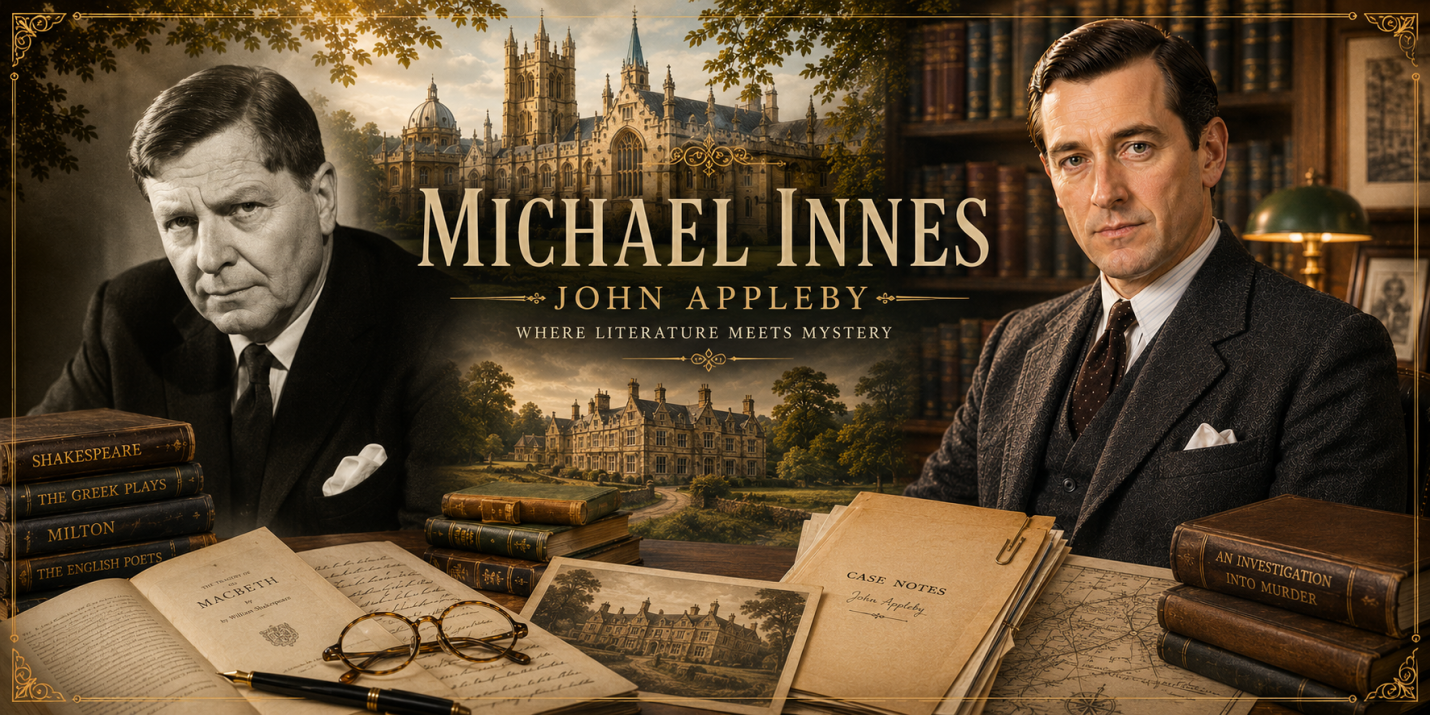
Michael Innes: Murder Among Scholars
Introduction
When most people imagine a detective novel, they picture a country house, a village, or perhaps the streets of London.

Michael Innes invites readers somewhere rather different. His novels possess a distinctive atmosphere, leaving readers with the feeling that they have stepped into a world all their own.
But who was the writer behind these remarkable mysteries?
Early Life and Career
The man who became known to mystery readers as Michael Innes was born John Innes Mackintosh Stewart in Edinburgh, Scotland, on September 30, 1906. From an early age, books and learning played an important role in his life, interests that would later shape both his professional career and his detective fiction.

Stewart studied English literature at Oriel College, Oxford. After graduating, he embarked on a teaching career that took him to several universities, including the University of Leeds, the University of Adelaide in Australia, and Queen’s University Belfast. He later returned to Oxford as a Student of Christ Church, remaining closely connected to the university for many years.
Rather than coming to detective fiction through journalism, law, medicine, or the police, Stewart’s background was firmly rooted in literature and higher education. Alongside his teaching, he published literary criticism and novels under his own name while reserving the pseudonym Michael Innes for his detective fiction.
By the time Inspector Appleby first appeared, Stewart had already established himself as both a respected academic and an accomplished writer. Those two worlds would come together throughout the mysteries he published as Michael Innes.
Meet the Detective
Sir John Appleby first appeared in Death at the President’s Lodging (1936). Calm, intelligent, and quietly observant, he is a detective who rarely seeks the spotlight. Rather than dazzling those around him with dramatic deductions, Appleby relies on patience, careful observation, and an understanding of human nature.

Comfortable among scholars, artists, collectors, aristocrats, and other eccentric personalities, Appleby adapts naturally to the unusual settings that define many of Michael Innes’s novels. His understated manner allows the people around him to reveal themselves, making him an ideal guide through mysteries where conversation, wit, and character are often just as important as physical clues.
Although Appleby spends much of the series with Scotland Yard—eventually rising to the rank of Commissioner—his career never overshadows his personality. After retiring from the Yard, he continues to investigate mysteries, often assisted by his wife, Judith, whose intelligence and insight make her a valuable partner.
Unlike many Golden Age detectives whose personalities dominate every page, Appleby’s quiet confidence allows the stories themselves to take centre stage. He is less an eccentric genius than a thoughtful observer, perfectly suited to the distinctive atmosphere of Michael Innes’s fiction.
Essential Cases
- Death at the President’s Lodging (1936) – First appearance of Sir John Appleby.
- Hamlet, Revenge! (1937) – Shows Innes’s literary imagination.
- Lament for a Maker (1938) – Widely regarded as one of his finest novels.
- Appleby’s End (1945) – A mature Appleby mystery and one of his best-known works.
Other Works
Although Michael Innes is best remembered for his detective fiction, he maintained a distinguished career beyond the mystery genre. Writing under his real name, J. I. M. Stewart, he published literary novels, works of criticism, and studies of English literature while pursuing a long academic career.
Among his best-known non-detective works are the literary novels A Staircase in Surrey, The Gauntlet Is Thrown, and Young Pattullo. He also wrote several respected works of literary criticism, including Character and Motive in Shakespeare and Thomas Hardy: A Critical Biography, reflecting the scholarly interests that shaped much of his professional life.
His academic background enriched his writing without overwhelming it. Rather than turning his mysteries into academic exercises, Stewart brought a deep appreciation for literature, language, and history to the novels he wrote as Michael Innes. Readers may notice echoes of these interests in the settings, conversations, and characters that populate his mysteries, but the stories remain first and foremost engaging detective novels.
Together, his academic and fictional writings reveal a remarkably versatile author whose contributions extended well beyond the Golden Age of detective fiction.
What He Brought to Detective Fiction
Michael Innes occupied a distinctive place among Golden Age detective writers. While many of his contemporaries became known for larger-than-life detectives or highly specialized approaches to crime fiction, Innes drew upon his background as a scholar and university professor to create mysteries with a recognizably literary flavour.
Rather than relying on a single trademark gimmick, his novels combined detective puzzles with cultured settings, memorable characters, and an evident appreciation for literature. This combination helped distinguish his work from many of his contemporaries and continues to attract readers looking for mysteries that offer more than the traditional whodunit.
Although he never achieved the widespread popularity of writers such as Christie or Sayers, Michael Innes remains an admired and distinctive voice within the Golden Age, appreciated for bringing his own perspective to detective fiction.
Walked Away?
Michael Innes never truly walked away from detective fiction. While he continued to publish literary novels and works of criticism as J. I. M. Stewart, he returned regularly to Sir John Appleby throughout his career. Over more than thirty novels, Appleby evolved from a Scotland Yard detective into Commissioner, reflecting the author’s enduring commitment to both the character and the genre.
Rather than treating detective fiction as a temporary diversion, Innes successfully balanced it with his academic career for decades. Even after retiring from university life, he continued writing mysteries, remaining one of the few Golden Age authors to sustain the same detective series across such a long period.
Legacy & Media
Michael Innes’s novels have remained in print for decades, with several titles reissued by publishers specializing in classic crime fiction. These editions have introduced Sir John Appleby to new generations of readers and helped preserve Innes’s place within the Golden Age.
Inspector Appleby also appeared on television. The BBC adapted Death at the President’s Lodging in 1981 as part of its Play of the Month series, with Ian Richardson portraying Sir John Appleby. Although adaptations of Innes’s work have been relatively few, they have kept his best-known detective visible beyond the printed page.
Today, Michael Innes is remembered for a detective series that spanned more than thirty novels and for a body of work that continues to hold a distinctive place within Golden Age detective fiction.
Later Years
As his academic career drew to a close, John Innes Mackintosh Stewart continued writing under both his own name and the pseudonym Michael Innes. Retirement from university life did little to slow his literary output, and readers continued to enjoy new adventures featuring Sir John Appleby alongside the literary novels and criticism he published as J. I. M. Stewart.
In 1986, Stewart published Myself and Michael Innes, a memoir reflecting on his life and his dual career as both scholar and mystery writer. By then, he had earned the respect of readers in two very different literary worlds, successfully balancing a distinguished academic career with decades of detective fiction.

John Innes Mackintosh Stewart died on November 12, 1994, at the age of eighty-eight. He left behind more than thirty Inspector Appleby novels, numerous literary works, and a reputation as one of the Golden Age’s most distinctive voices. Although he never achieved the worldwide popularity of some of his contemporaries, his mysteries continue to attract readers with their intelligence, wit, and literary atmosphere.
Conclusion
Michael Innes occupies a distinctive place within the Golden Age of detective fiction. Across more than thirty Inspector Appleby novels, he built a body of work that reflected both his imagination and his lifelong love of literature while remaining firmly rooted in the detective genre.
Although his name is less familiar today than some of his contemporaries, his novels continue to attract readers interested in exploring another side of the Golden Age. Nearly a century after Sir John Appleby’s first appearance, Michael Innes remains an author whose work deserves to be remembered.
References
Primary Sources
- Innes, Michael. Death at the President’s Lodging. Various editions.
- Innes, Michael. Hamlet, Revenge!. Various editions.
- Innes, Michael. Lament for a Maker. Various editions.
- Innes, Michael. Appleby’s End. Various editions.
- Stewart, J. I. M. Myself and Michael Innes. Victor Gollancz, 1986.
Secondary Sources
- Edwards, Martin. The Life of Crime: Detecting the History of Mysteries and Their Creators. HarperCollins, 2022.
- Priestman, Martin, editor. The Cambridge Companion to Crime Fiction. Cambridge University Press, 2003.
- Scaggs, John. Crime Fiction. Routledge, 2005.
- Spehner, Norbert. Le Détectionnaire: Dictionnaire des auteurs, des personnages et des œuvres policières..
Previous: Christianna Brand
Next: Edmund Crispin








Hello Gumshoe! On the track or authors? leave us reply!