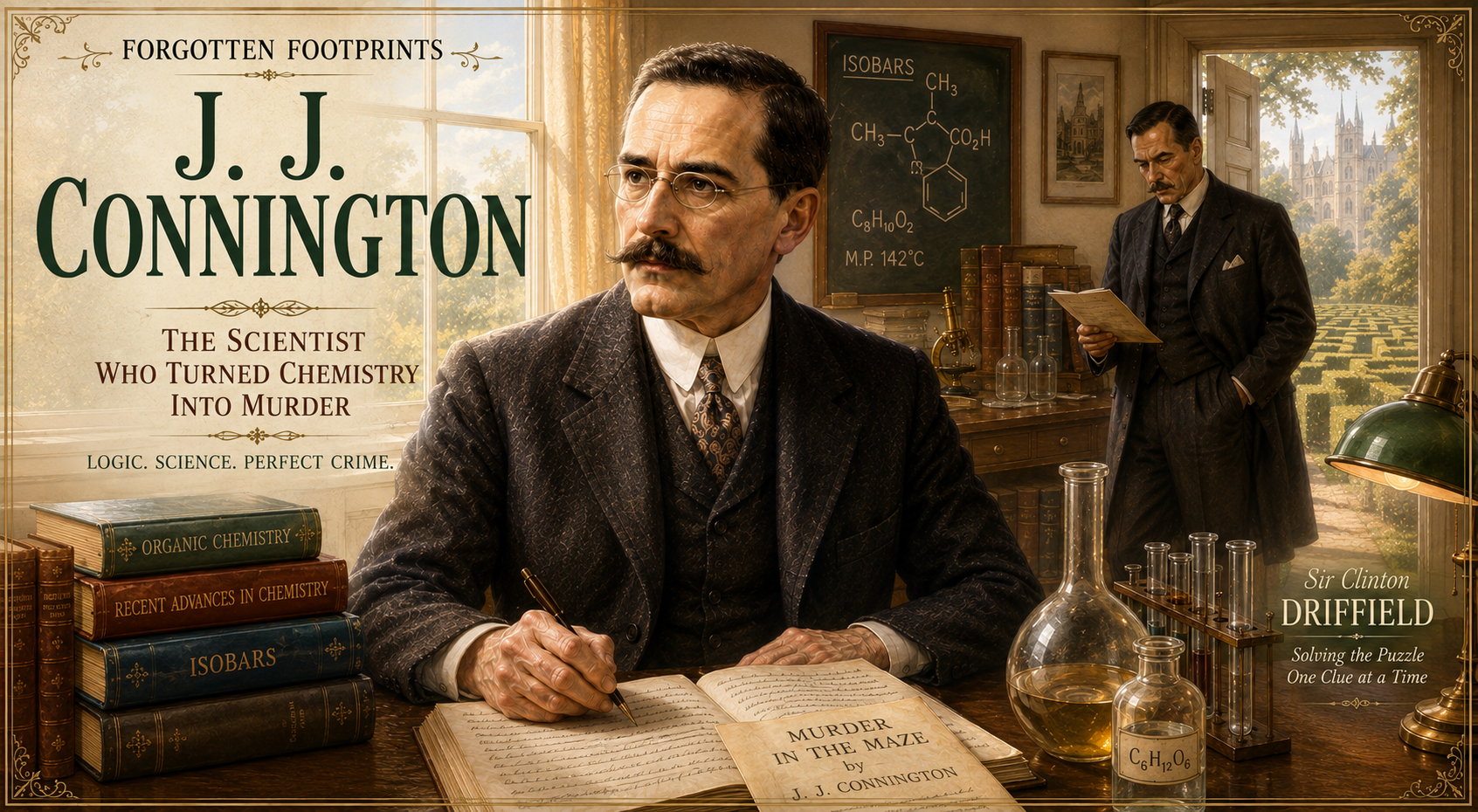
The Scientist Who Turned Chemistry into Murder
Introduction
The Golden Age of detective fiction produced far more remarkable writers than history has remembered. Many authors who once entertained thousands of readers have gradually slipped into obscurity, their novels disappearing from bookshop shelves while their contributions to the genre remain largely overlooked.

J. J. Connington was one of those writers. Renowned in his day for his carefully constructed mysteries and admired by fellow crime novelists, he is now far less familiar to modern readers. Yet beneath his relative obscurity lies a body of work that rewards anyone who appreciates ingenious plotting and the enduring appeal of the classic detective story.
The Author Behind the Mysteries
Behind the pen name J. J. Connington stood Alfred Walter Stewart (1880–1947), a distinguished Scottish chemist whose scientific achievements matched his reputation as a detective novelist. Born in Glasgow, Stewart was educated at Glasgow High School before studying chemistry at the University of Glasgow, where he quickly distinguished himself as a gifted student. After further studies in Germany and London, he embarked on an academic career that eventually led him to Queen’s University Belfast, where he served as Professor of Chemistry. His influential textbook, Recent Advances in Organic Chemistry, became a respected reference work and established him as one of Britain’s leading chemists. He also introduced the scientific term “isobar,” still used today in nuclear chemistry, reflecting the lasting impact of his research.

Long before he became known to mystery readers, Stewart had built an impressive scientific career. His research, teaching, and publications earned him recognition within the academic community, while his work for the Admiralty during the First World War further demonstrated the practical value of his expertise. His analytical mind would later become one of the defining features of his detective fiction, where careful observation and logical reasoning replaced guesswork and coincidence.
His personal life was marked by both joy and tragedy. While still a young man, Stewart became engaged, but his fiancée died unexpectedly before their wedding could take place. He later married and became the father of a daughter. Friends and colleagues remembered him as a modes man with a dry, sometimes biting sense of humour; a personality that contrasted with the cool precision and occasional cynicism found in many of his mysteries.
During the 1920s, Stewart turned to detective fiction under the pen name J. J. Connington. Drawing upon his scientific background, he crafted mysteries built on forensic evidence, logical deduction, and carefully constructed fair-play puzzles. Although best remembered for these novels, he also ventured into science fiction with Nordenholt’s Million (1923), one of the early British works in the genre. As Connington, he established himself as one of the Golden Age’s most distinctive mystery writers, creating stories that continue to reward readers who appreciate ingenuity, careful plotting, and intellectual challenge.
The Detection Club
When Alfred Walter Stewart joined the Detection Club, he brought something few of its members possessed: the perspective of a professional scientist. His expertise in chemistry enriched discussions among fellow mystery writers and naturally found its way into his fiction, where scientific principles became essential parts of carefully constructed puzzles rather than mere decorative details.
Although quieter than many of his contemporaries, Connington earned the respect of his fellow members. Dorothy L. Sayers admired the precision of his plotting, while his novels demonstrated the same commitment to logical deduction and fair play that defined the Club’s ideals. Scientific clues, forensic reasoning, and carefully planted evidence became hallmarks of his work, showing how real scientific knowledge could strengthen rather than overshadow a detective story.
Like many members of the Club, Stewart’s later years brought increasing health problems. Nevertheless, he continued to write until shortly before his death in 1947, leaving behind a body of work that reflected both his scientific discipline and his enduring love of detective fiction.
Meet the Detective
Unlike many Golden Age detectives, Sir Clinton Driffield is not an amateur sleuth but the Chief Constable of an English county, placing him firmly within the professional world of policing. Lean, tanned, moustached, and quietly self-assured, Driffield approaches every investigation with patience, intelligence, and a healthy measure of scepticism. His scientific outlook and determination to dismantle false alibis make him one of the era’s most methodical detectives.

Assisting him is Wendover, a Justice of the Peace and antiques dealer whose curiosity, practical insight, and occasional scepticism provide the perfect complement to Driffield’s analytical mind. Rather than serving as a devoted admirer, Wendover questions, observes, and contributes meaningfully to the investigations, making their partnership one of mutual respect rather than hero worship.

An enthusiastic chess player and student of famous criminal cases, Driffield prefers careful planning to dramatic confrontation. Whether investigating murder in a country maze, following clues hidden in scientific evidence, or untangling complex conspiracies, he remains calm, logical, and ruthlessly capable and willing to act outside the law, qualities that make him one of the Golden Age’s most distinctive police detectives.
Cases Worth Discovering
Connington’s novels stand apart for the way they combine ingenious puzzles with genuine scientific knowledge. Dreffield’s debut, Murder in the Maze (1927), introduces him in a country-house mystery whose elaborate hedge maze becomes both a memorable setting and an essential part of the investigation. It immediately established Connington as a writer capable of blending atmosphere with rigorous deduction.

Science continued to shape many of his best mysteries. The Boat-House Riddle explores chemical evidence, while The Case with Nine Solutions challenges readers with multiple suspects, forensic clues, and one of Connington’s most intricately constructed plots. His mysteries reward careful attention, inviting readers to solve the crime alongside Driffield rather than relying on last-minute revelations.


Connington also experimented with unusual themes. The Sweepstake Murders turns the popularity of horse-racing sweepstakes and gambling into the motive for a cleverly plotted mystery, while The Ha-Ha Case combines country-house intrigue, medical science, and ballistics into one of his most original investigations. Throughout his work, scientific reasoning is never an end in itself but another tool in the detective’s search for the truth.

Legacy
J. J. Connington helped broaden the detective novel by demonstrating how scientific knowledge could be woven naturally into a mystery. Rather than relying on technical detail for its own sake, he used chemistry, medicine, and forensic evidence to strengthen his plots, creating stories that remained both intellectually satisfying and fair to the reader. His work helped bridge the gap between the scientific detective stories of the early twentieth century and the increasingly forensic approach adopted by later crime writers.


Despite severe cataracts that gradually robbed him of his eyesight and a heart attack that further affected his health, Stewart continued to write. His final novel, Common Sense Is All You Need, was published in 1947, the year of his death, bringing the adventures of Sir Clinton Driffield to a close and concluding a remarkable literary career marked by perseverance and determination.
Although Connington never enjoyed the film or television adaptations that kept many of his contemporaries in the public eye, his work has experienced a quiet revival in recent years. New editions, including those published by the Murder Room, together with audiobook releases, have introduced his carefully crafted mysteries to a new generation of readers.
Conclusion
Every Golden Age author offers a different vision of detective fiction. Some excelled through memorable detectives, others through atmosphere or ingenious twists. J. J. Connington’s gift was the careful construction of a mystery: one in which every clue matters, every detail has a purpose, and every solution rewards patient observation.
Perhaps the greatest reward of exploring Forgotten Footprints is discovering authors who still have the power to surprise us. Will J. J. Connington be your next mystery to solve?
References
Books
- Edwards, Martin. The Golden Age of Murder. HarperCollins, 2015.
- Spehner, Norbert. Le Détectionnaire : Dictionnaire des personnages du roman policier. Éditions Alire, 2000.
Online Sources
- Alfred Walter Stewart (J. J. Connington), Encyclopedia.com.
- Alfred Walter Stewart, Wikipedia (consulted for biographical verification and bibliography).
- New Ulster Biography – Alfred Walter Stewart.
- British Library Crime Classics – J. J. Connington editions.
Continue Your Journey
Previous: E. R. Punshon – The Quiet Craftsman of the Golden Age
Next: J. Jefferson Farjeon








Hello Gumshoe! On the track or authors? leave us reply!