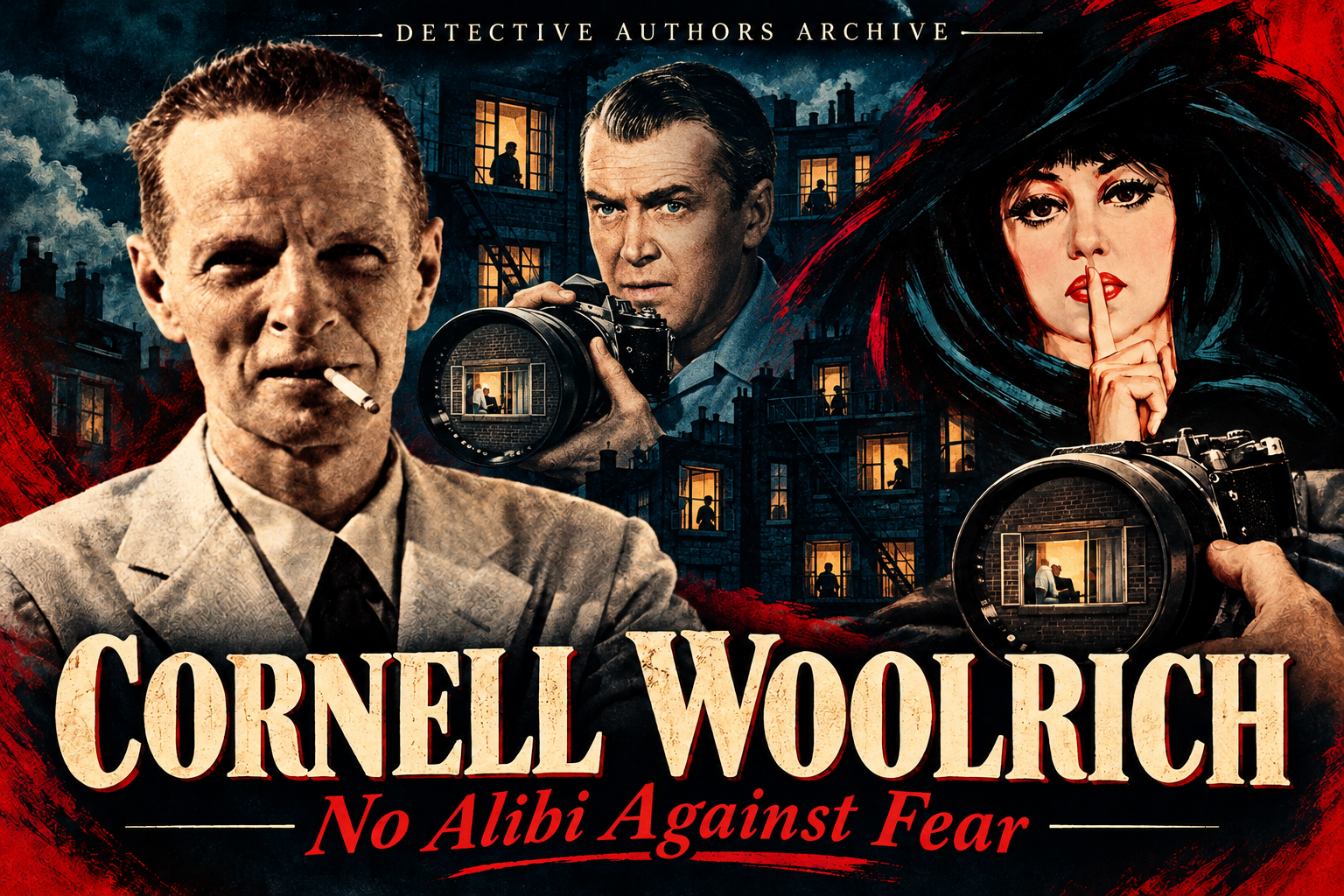
No Alibi Against Fear
Cornell Woolrich offered his characters good reasons to be afraid. Then he gave them the difficult task of persuading someone else. Writing under his own name, as William Irish and George Hopley, he made doubt, longing, and the need to be believed compelling ingredients of suspense.

Among our Heavy Hitters, he brings us close to people discovering how poorly prepared they are for danger. Their uncertainty is an invitation: come a little closer, look again, and see whether you would fare any better.
A Life Between Two Worlds
Cornell George Hopley-Woolrich was born in New York City on December 4, 1903. His father, Genaro, was a civil engineer, and his mother, Claire Attalie Tarler, came from a prosperous New York family. His parents’ separation divided his childhood between time with his father in Mexico and Central America and life with his mother in New York.

He entered Columbia in 1921, attending intermittently over the next five years without completing a degree. During a prolonged period of illness, he began writing a novel. His early literary ambitions followed the fashionable, restless world of the Jazz Age, with F. Scott Fitzgerald (The Great Gatsby) an important influence.
In 1930, he married Violet Virginia “Gloria” Blackton, daughter of silent-film pioneer J. Stuart Blackton. They soon separated, and the marriage was annulled in 1933.
During the Depression, declining prospects for his early fiction left Woolrich in financial difficulty, and his mother provided support. He settled with her at the Hotel Marseilles, where their shared accommodation continued long after his writing became successful, until her death in 1957.
From the Jazz Age to the Black Mask
His first novel, Cover Charge, appeared in 1926. Its publication encouraged him to leave university and pursue writing professionally. His second, Children of the Ritz (1927), won a $10,000 competition sponsored by College Humor and First National Pictures, giving his early career a considerable boost.
Woolrich published six novels between 1926 and 1932, writing about romance, money, and the social world of the Jazz Age. As the Depression changed readers’ tastes, that market became increasingly difficult. A further manuscript failed to find a publisher, and he turned toward crime magazines as another means of earning a living.
In 1934, “Death Sits in the Dentist’s Chair” appeared in Detective Fiction Weekly, marking the beginning of his career in crime fiction. Over the following years, he became a prolific contributor to magazines including Dime Detective, Argosy, and Black Mask. These stories gave him room to develop his particular talent: drawing readers into the fear of someone whose familiar world has suddenly become dangerous.
His characters included ordinary people forced to investigate, spouses searching for answers, and unreliable witnesses. Professional detectives also appeared, but Woolrich could sustain a story through the uncertainty of someone with little experience of crime and everything to lose. A missing person, an inexplicable encounter, or an apparently harmless decision could set the story in motion.
The next major step came with The Bride Wore Black in 1940, his first published crime novel. After years of shorter magazine fiction, Woolrich began the remarkable run of suspense novels that would establish his reputation. Alongside the Cornell Woolrich name, William Irish and George Hopley would appear on his books. All three names belonged to the same increasingly distinctive voice.
Missing Wives and Unreliable Witnesses
Julie Killeen : The Bride Wore Black (1940)
Julie Killeen is a woman with a purpose, moving through other people’s lives under different identities. She studies the men she approaches, discovers what will gain their confidence, and makes herself fit the role. To each, she appears to be someone different.
Her appearances connect a series of seemingly unrelated deaths. As Detective Lew Wanger searches for the pattern, the mystery turns on the woman herself: who she is, what connects her victims, and why she has chosen them. Woolrich lets readers watch her plans unfold while keeping their explanation just beyond reach.
Hal Jeffries : “It Had to Be Murder” (1942), later collected as “Rear Window”
Confined to his apartment by a leg injury, Hal Jeffries passes the time watching his neighbours through the rear window. Their daily routines become familiar enough for him to notice when something changes. Across the courtyard, a woman’s absence and her husband’s behaviour begin to trouble him.
Jeffries can observe, but he cannot easily investigate. With his movements restricted, he relies on his houseman, Sam, to help test his suspicions. Woolrich makes an everyday spectator into an amateur detective whose limited view leaves him struggling to distinguish an ordinary domestic situation from something far more sinister.
Scott Henderson : Phantom Lady (1942), published as William Irish
After an argument with his wife, Scott Henderson spends an evening with a woman he has never met before. They part without exchanging names. When he returns home, his wife has been murdered, and the stranger is the one person who could establish his alibi.
But finding her proves bewilderingly difficult. People who saw them together insist they remember only Scott. As his execution approaches, Carol Richman, the woman who loves him, searches for someone whose existence seems to have vanished from everyone else’s memory. Scott’s survival depends on proving that an ordinary evening really happened.
Helen Georgesson : I Married a Dead Man (1948), published as William Irish
Pregnant, abandoned, and nearly penniless, Helen Georgesson boards a train heading west. During the journey, she meets newlyweds Hugh and Patrice Hazzard, whose kindness offers a brief respite from her troubles. Then a railway disaster leaves Helen mistaken for Patrice.
Welcomed by a family who have never met their son’s bride, Helen sees a chance to give her baby the security she could never provide alone. She allows the mistake to stand. But accepting their affection means living with the fear that someone will discover who she really is. Woolrich gives her something precious to protect, then makes its survival depend on a borrowed identity.
Louis Durand : Waltz into Darkness (1947), published as William Irish
A prosperous coffee merchant in New Orleans, Louis Durand hopes marriage will bring companionship into his lonely life. After a courtship conducted by correspondence, he eagerly awaits his bride. The woman who arrives looks nothing like the photograph she sent, but her explanation reassures him, and his attraction soon outweighs his doubts.

Durand’s vulnerability lies in how desperately he wants this happiness to last. Woolrich follows a man whose emotional investment makes it increasingly difficult to question the person he loves, even when he has reason to do so.
Tom Shawn: Night Has a Thousand Eyes (1945), published as George Hopley
Detective Tom Shawn encounters a young woman on the verge of taking her own life. After bringing her to safety, he listens to the extraordinary circumstances behind her despair: her father has become convinced that a prediction of his approaching death will come true.
Shawn brings an investigator’s practical approach to a situation dominated by dread. How can someone be protected from a threat whose source remains uncertain? Through his efforts, Woolrich explores the terror of believing that death has an appointment which nothing can postpone.
Making Fear Personal
Woolrich made fear itself a driving force in crime fiction. His stories place readers close to people who cannot understand the danger surrounding them, convince others of what they know, or find a way to protect themselves. Solving the mystery matters because someone must survive long enough to reach the answer.
Time gives that fear its pressure. An approaching execution, a predicted death, or the dwindling chance to find a witness turns waiting into an ordeal. As Jean Bourdier observes, Woolrich builds anxiety through carefully measured details. A delay or an unanswered question can become unbearable because the reader understands what it may cost.
He also made ordinary life feel precarious. Marriage, a home, a night out, or a stranger’s kindness might offer comfort, yet each could expose someone to danger. His characters often have modest hopes: love, security, a chance to begin again. The possibility of losing those things gives his suspense its emotional force.
Coincidence, mistaken identity, and cruel chance shape this world. Woolrich sometimes stretches plausibility, but his strongest stories sustain the immediate experience of panic: the desperate reasoning, the brief relief, and the discovery that apparent safety may be fragile. The Guide Polar particularly emphasizes his treatment of time, lost love, and the workings of fate.
His short fiction was central to that achievement. Both Bourdier and the Guide Polar place considerable value on his stories, where a tightly controlled situation could concentrate suspense into a few increasingly urgent scenes. Across novels and shorter works, Woolrich gave a distinctive expression to the threatened individual’s experience of crime.
After the Marseilles
By the 1950s, Woolrich’s extraordinary pace of writing had slowed. The Guide Polar, drawing on biographer Francis M. Nevins, identifies his mother’s prolonged illness as one factor in that reduction. Her death in October 1957 ended a shared life at the Hotel Marseilles that had lasted for roughly a quarter of a century. He subsequently left the hotel, living first at the Hotel Franconia and later at the Sheraton-Russell.
He continued to write and explore other forms. Hotel Room (1958), dedicated to his mother, brought together interconnected stories tracing the history of a New York hotel through its changing occupants. Drawing on surroundings he knew intimately, the book extended beyond crime into the disappointments, hopes, and private dramas of ordinary lives.
His later publications included Death Is My Dancing Partner (1959), The Doom Stone (1960), and the collection The Ten Faces of Cornell Woolrich (1965). The appearance of The Doom Stone was a return to earlier material, previously serialized in Argosy in 1939.
His later years were marked by increasing isolation and serious health problems, including diabetes, difficulties with his eyesight, and alcoholism. In early 1968, gangrene necessitated the amputation of a leg, leaving him dependent on a wheelchair. He died in New York on September 25, 1968, following a stroke. He was sixty-four.
His final manuscripts did not all remain unpublished. Into the Night, left unfinished at his death, was completed by Lawrence Block and published in 1987.
The Fear Outlives the Author
Woolrich’s lasting reputation rests on his ability to make readers share another person’s fear. His vulnerable protagonists represent a distinctive part of noir: people with little knowledge of crime struggling to understand what is happening and preserve the lives they know. His fiction gives powerful expression to the anxiety that ordinary security might disappear without warning.
His novels retain a place in the recognition and republication of American noir. The Library of America included I Married a Dead Man in its collection of crime novels from the 1930s and 1940s. His short stories remain equally central to his reputation, concentrating that emotional intensity into situations from which escape seems increasingly impossible.

Editors and scholars have helped successive generations rediscover his work. Francis M. Nevins became a particularly important advocate through his biography, First You Dream, Then You Die, and his work collecting and examining Woolrich’s fiction. Later editions have continued to bring novels published under his different names back into view, allowing readers to appreciate them as parts of the same body of work.
At Columbia University, the preservation of his papers provides a foundation for continuing study. Woolrich left his papers and copyrights to the university, together with a substantial bequest supporting a scholarship in his mother’s memory. Alongside the stories he left readers, he left practical support for those who would write after him.
Shadows on Screen and Voices in the Dark
Woolrich’s fiction found an extraordinary second life in cinema, radio, and television. His threatened witnesses, missing strangers, and desperate searches gave performers and directors situations charged with suspense. Columbia University’s 2019 retrospective described nearly forty film adaptations, alongside dozens of radio and television episodes.
The Leopard Man (1943) brought Black Alibi to the screen under director Jacques Tourneur and producer Val Lewton. An escaped leopard and a series of deaths place the story at the uneasy boundary between crime and horror, where fear spreads faster than reliable information.

Phantom Lady (1944), directed by Robert Siodmak and produced by Joan Harrison, turned the search for Scott Henderson’s missing alibi into a striking film noir. Ella Raines takes the central investigative role, moving through a threatening nighttime world in her determination to save him.

Black Angel (1946) adapted The Black Angel, with Dan Duryea, June Vincent, and Peter Lorre. Directed by Roy William Neill, it reshapes Woolrich’s novel around a condemned man’s wife and an alcoholic songwriter investigating a singer’s murder. The changes make it an example of how freely filmmakers could rework his material.

Night Has a Thousand Eyes (1948) brought his story of prediction and approaching death to cinema, with Edward G. Robinson, Gail Russell, and John Lund. Its emphasis on foreknowledge carries Woolrich’s suspense toward the supernatural, while preserving the dread of a future that may already be decided.

The Window (1949), directed by Ted Tetzlaff, drew on “The Boy Cried Murder.” Bobby Driscoll plays a boy whose reputation for inventing stories leaves him unable to persuade adults that he has witnessed a real murder. It gives Woolrich’s endangered witness a child’s particular vulnerability: knowing the truth offers little protection when nobody believes you.

No Man of Her Own (1950) gave Barbara Stanwyck the leading role in an adaptation of I Married a Dead Man. Directed by Mitchell Leisen, the film follows a pregnant woman whose mistaken identity offers refuge and a family, with the possibility of exposure threatening everything she has gained.

Rear Window (1954) became the most celebrated screen adaptation of his work. Alfred Hitchcock expanded “It Had to Be Murder” into the story of photographer L. B. Jefferies, played by James Stewart, with Grace Kelly as Lisa Fremont and Thelma Ritter as Stella. The film develops relationships and a courtyard community around Woolrich’s central situation: an immobilized observer suspects that a neighbour has committed murder.

The Bride Wore Black (1968) brought François Truffaut to Woolrich’s fiction, with Jeanne Moreau as Julie, the mysterious woman moving methodically through a succession of men’s lives. Her changing identities and concealed purpose give Moreau a role built around controlled appearances and unanswered questions.

Mississippi Mermaid (1969) reunited Truffaut with Woolrich’s work through Waltz into Darkness. Jean-Paul Belmondo and Catherine Deneuve lead this adaptation of a correspondence courtship that becomes an increasingly dangerous emotional entanglement.

Radio offered another natural home for his suspense. Programmes including Suspense, Escape, and Mollé Mystery Theatre adapted his stories, using voices, sound, and silence to convey danger that listeners had to imagine.
Phantom Lady also reached Lux Radio Theatre in 1944, with Ella Raines and Alan Curtis returning to their film roles.
Television continued that circulation through anthology dramas, including Alfred Hitchcock Presents. His shorter fiction offered concentrated situations well suited to the format, bringing his suspense to a new audience.
“Four O’Clock” (1957) was directed by Alfred Hitchcock for Suspicion, adapting Woolrich’s “Three O’Clock,” with E. G. Marshall in the leading role. Its tightly confined situation demonstrates how readily Woolrich’s shorter fiction could sustain almost unbearable suspense on the small screen.
Case Closed
Cornell Woolrich understood how little it takes to make familiar surroundings feel unsafe. His fiction brings danger close enough to unsettle the reader long after the immediate mystery is resolved.
His characters give that danger its weight. We understand what they hope to keep, and why they are afraid. We turn the page because, for a little while, their chance of getting home safely matters to us.
Case closed. Check the window before you turn out the light.
References
- Baudou, Jacques, and Jean-Jacques Schleret, eds. Le Polar. Guide Totem, Larousse. “Woolrich Cornell,” pp. 346–347.
- Bourdier, Jean. Histoire du roman policier. Éditions de Fallois, 1996, p. 254.
- Rzepka, Charles J. Detective Fiction. Polity, 2005, pp. 184, 230.
- Literary Noir: A Series of Suspense, Volume One: Solve the Crime/Whodunit? Introduction.
- Columbia University Libraries. “Cornell Woolrich,” Jewels in Her Crown.
- Columbia University. Into the Night: Cornell Woolrich and Film Noir, Kit Noir Festival programme, 2019.
- Library of America. Crime Novels: American Noir of the 1930s and 40s, edited by Robert Polito.
- AFI Catalog and British Film Institute: adaptation records, credits, and programme notes.
- Publisher descriptions from Penzler Publishers, Penguin, and Simon & Schuster; Phantom Lady text available through Faded Page.
Navigation
Previous: James M. Cain
Next: Horace McCoy








Hello Gumshoe! On the track or authors? leave us reply!