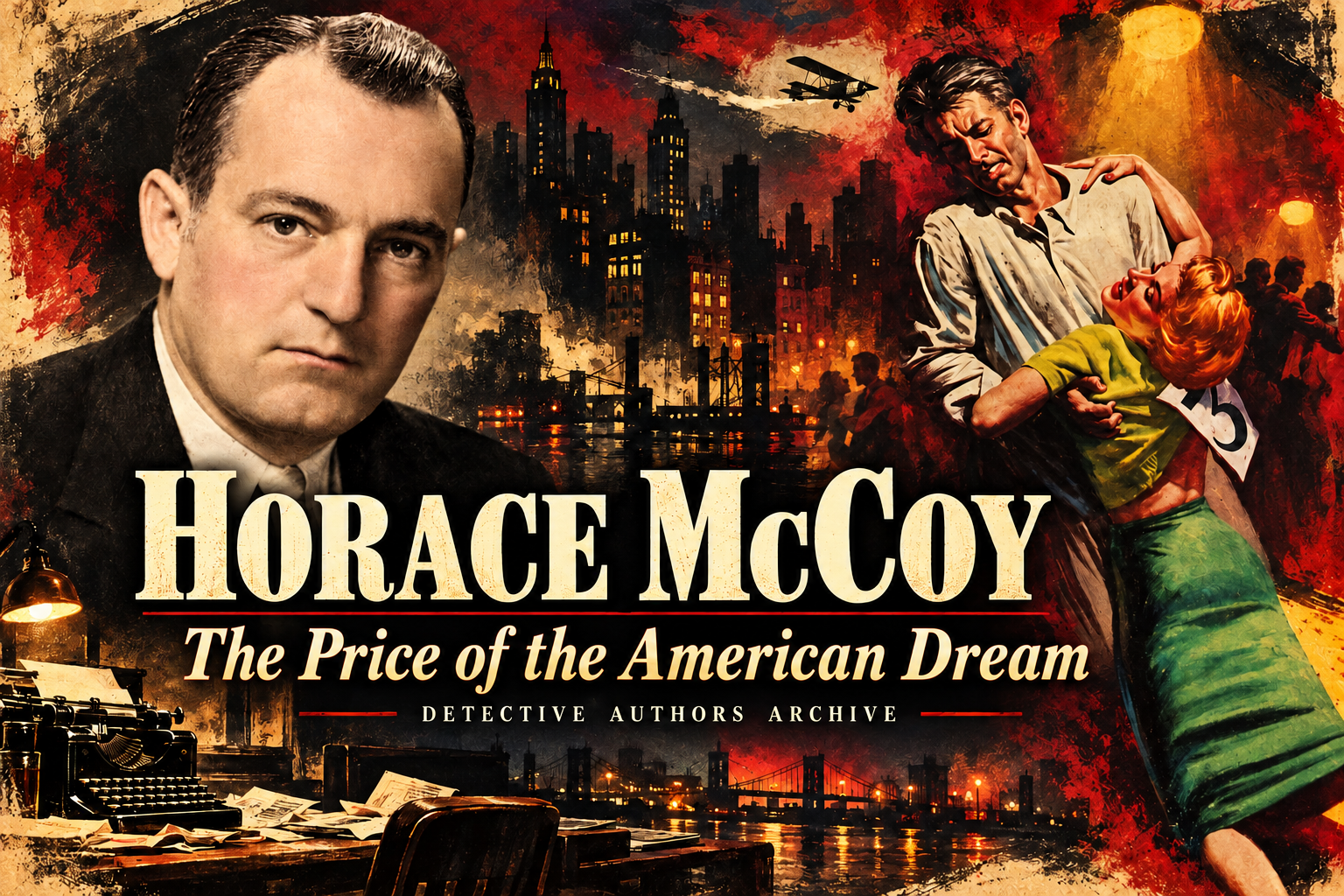
The Price of the American Dream
Everyone wants a chance. In Horace McCoy’s fiction, getting one can be the beginning of the trouble.
A veteran of Black Mask, a newspaperman and a Hollywood screenwriter, McCoy followed an unconventional path through American crime fiction. Along the way, he developed a troubling question: just how much could a chance at success cost?

That question runs through his best-known novels, They Shoot Horses, Don’t They? and Kiss Tomorrow Goodbye, and gives his place in noir its enduring, unsettling force.
Before the Marathon: War, Newspapers and the Stage
Horace Stanley McCoy was born on April 14, 1897, in Pegram, Tennessee. His family moved to Dallas in 1915. During the First World War, he served in military aviation and was wounded before returning to civilian life.

His first attempt at journalism was remarkably brief. After presenting himself as an experienced reporter, he lasted just two days at the Dallas Morning News. He found firmer footing at the Dallas Dispatch and later the Dallas Journal, where he worked as a sportswriter.
Newspapers shared his attention with the stage. From 1925, McCoy appeared in productions at the Dallas Little Theater, including the title role in Liliom. He also began selling pulp stories, particularly to Black Mask. His early fiction included adventures featuring a flying Texas Ranger, a considerable distance from the exhausted dreamers of his later novels.
The Black Mask Years: A Ranger with Wings
Horace McCoy entered Black Mask with “The Devil Man,” published in December 1927. Still working in Dallas journalism, he turned to pulp fiction to supplement his income. Editor Joseph T. Shaw became an important supporter, buying his stories and working to sharpen their sometimes hurried prose.
McCoy’s principal recurring hero was Captain Jerry Frost, a tough Texas Ranger who led the Air Border Patrol. Combining aviation with border crime, the series gave McCoy an outlet for his enthusiasm for flying and his taste for physical action. Frost and his fellow Rangers pursued criminals across territory where an aircraft could be as useful as a revolver.

Yet Frost could also be surprisingly talkative. William F. Nolan criticizes the character’s tendency to interrupt the action with elaborate reflections on morality, life and death. Shaw revised and polished McCoy’s manuscripts, but, in Nolan’s assessment, could not entirely restrain these speeches. The stories show a writer still developing control over his material.
“Frost Flies Alone,” reprinted in Nolan’s The Black Mask Boys, sends the Ranger against a shipload of criminals without his usual companions. It offers a useful glimpse of McCoy’s early combination of danger, movement and an adventurous lawman willing to face long odds.
McCoy’s pulp work extended to magazines including Action Stories, Detective-Dragnet, Battle Aces and Western Trails. His final Frost adventure appeared in Black Mask in October 1934, according to Nolan. By then, he was moving toward the novels that would establish his reputation: stories in which determination offered far less protection than it did for a flying Texas Ranger.
The Novels: Dreams on Borrowed Time
In McCoy’s novels, the resourceful lawman gives way to people struggling for money, recognition or a foothold in an indifferent world. Some are exploited; others become exploiters. Ambition runs through these stories, but its rewards are uncertain and its costs can be terrible.
They Shoot Horses, Don’t They? (1935): The Marathon
Robert Syverten hopes to become a film director. Gloria Beatty has pursued acting with far less optimism left to sustain her. Together, they enter a dance marathon, where meals and the prospect of prize money offer an immediate answer to their precarious circumstances.
Behind the music and publicity lies an endurance contest built around exhaustion. The promoters need a spectacle, the spectators want entertainment, and the contestants must keep moving. Hunger, humiliation and physical strain become part of the show.

Robert’s lingering hopes and Gloria’s bitterness give the novel its uneasy partnership. Through them, McCoy turns a crowded dance floor into a confined world where people compete for the chance to escape their poverty while providing entertainment for others.
Andrew Pepper emphasizes the novel’s economic exploitation while also exploring its despair and sense of absurdity. Those readings meet in the marathon itself: immense effort goes into movement that brings the dancers no closer to freedom.
No Pockets in a Shroud (1937): The Price of Telling the Truth
Reporter Mike Dolan has grown tired of a newspaper that suppresses uncomfortable facts. Starting his own publication offers him the freedom to investigate the corruption surrounding him, but independence brings powerful enemies.
Drawing on McCoy’s newspaper background, the novel follows a journalist whose determination to expose wrongdoing collides with business interests, political influence and prejudice. Dolan is combative and imperfect, making his struggle more complicated than a simple contest between an innocent reporter and a dishonest city.
First published in Britain in 1937, the novel reached American readers in a revised edition in 1948.
I Should Have Stayed Home (1938): Waiting to Be Discovered
Ralph Carston and Mona Matthews are aspiring actors trying to survive on the margins of Hollywood. Work as extras keeps them close to the industry while leaving them painfully distant from the success they imagined.

McCoy returns to the precarious lives of young hopefuls, exploring the humiliations of waiting, dependence and compromise. Ralph’s ambition makes him vulnerable to a world where attention and opportunity come with conditions. Mona’s presence gives the story a relationship through which those pressures become personal.
Hollywood becomes a workplace where dreams are plentiful and steady employment is scarce.
Kiss Tomorrow Goodbye (1948): Ambition Without Restraint
Ralph Cotter is an escaped convict with intelligence, nerve and a talent for exploiting other people’s weaknesses. Freedom offers him the opportunity to pursue money and power through manipulation, violence and corrupt alliances.
Told from Cotter’s perspective, the novel brings readers into the calculations of a criminal who regards people as instruments. His intelligence makes him dangerous; it also allows him to construct elaborate explanations for his conduct.
Here McCoy places a ruthless opportunist at the centre of the story. The surrounding corruption provides room for Cotter’s ambitions to flourish.
Scalpel (1952): The Pursuit of Status
With Scalpel, McCoy moves into the world of medicine. Its central figure is an ambitious surgeon whose professional advancement becomes entangled with wealth, social position and personal relationships.
The setting broadens McCoy’s recurring examination of success. Skill may open doors, but ambition raises questions about whom a doctor serves and what he is willing to sacrifice to rise. The novel became a major commercial success, even though its critical standing has remained below that of McCoy’s best-known noir fiction.
What He Brought to the Genre: The American Dream Under Cross-Examination
Horace McCoy made the pursuit of success a source of danger. His characters want work, security, recognition or money, desires familiar enough to bring his darkest stories uncomfortably close to ordinary life. The trouble begins with what those ambitions expose them to, and what they become willing to accept in pursuit of them.
In They Shoot Horses, Don’t They?, endurance becomes a commodity. The contestants’ determination keeps the entertainment running, while their exhaustion helps sell the spectacle. As Andrew Pepper’s reading emphasizes, the marathon makes exploitation visible through the bodies of people who cannot afford to stop.
Elsewhere, McCoy examines the institutions that promise opportunity or claim to serve the public. The newspaper in No Pockets in a Shroud faces the influence of powerful interests; the aspiring actors of I Should Have Stayed Home discover how little access to Hollywood guarantees. These settings give his fiction a social reach beyond the individual crime. Respectable workplaces can furnish their own forms of coercion, dependence and humiliation.
Yet McCoy’s characters are more than illustrations of injustice. Mike Dolan’s defiance, Ralph Carston’s hunger for recognition and Ralph Cotter’s calculating brutality produce very different responses to the worlds they inhabit. In Cotter, ambition becomes predatory: corruption offers opportunities to someone prepared to exploit it.
McCoy also helped extend noir’s attention toward exhaustion, alienation and despair. His best-known fiction asks what happens when effort loses its promised connection to reward. Pepper explores that question through both economic criticism and the absurd, while Rzepka places They Shoot Horses, Don’t They? within the Depression’s literature of social protest.
That is McCoy’s particular force within the hard-boiled tradition. He brings the reader close to the people chasing the dream, then examines who sets the terms, who collects the profits, and how much of themselves the hopeful must surrender to remain in the running.
Later Years: Success on Borrowed Time
By the late 1940s, Horace McCoy was receiving the literary recognition that had long eluded him at home. French readers and critics embraced his fiction, and the reception of Kiss Tomorrow Goodbye gave him renewed confidence as a novelist. According to William F. Nolan, that encouragement helped revive his desire to devote more time to books.
Family responsibilities and financial pressures complicated those ambitions. McCoy and his wife, Helen Vinmont, whom he had married in 1933, were raising their children while he continued to depend heavily on screenwriting income. Money could arrive in substantial sums, but Nolan describes a pattern of generous spending followed by renewed financial difficulty.
A severe flu attack shortly after the publication of Kiss Tomorrow Goodbye damaged his heart and left him bedridden for months. The illness interrupted a period when his reputation abroad was growing and he was trying to establish a firmer place for himself as a novelist.
Scalpel, published in 1952, was his last novel to appear during his lifetime. Its commercial success brought another welcome improvement in his finances, but lasting security remained elusive. Eventually, he sold books and his prized collection of jazz recordings to help pay outstanding debts.
McCoy continued working on The Hard Rock Man, a novel centred on a construction boss, but did not finish it. His interests also extended to photography and oil painting, pursuits that suggest his creative ambitions still reached beyond the work by which he earned his living.
On December 15, 1955, he died of a heart attack at his home in Beverly Hills, aged fifty-eight. He left behind an unfinished manuscript and a body of fiction whose reputation had travelled farther than its author had lived to see fully rewarded.
Legacy: A Reputation Beyond the Finish Line
Horace McCoy’s reputation developed unevenly across the Atlantic. In France, his novels attracted readers who saw literary significance in their violence, despair and frustrated ambitions. William F. Nolan records the enthusiasm of French intellectuals and critics, whose recognition encouraged McCoy during his lifetime. In the United States, that recognition was less consistent, despite the commercial success of some of his books.
The French response helped establish an enduring way of reading his work. They Shoot Horses, Don’t They? could be approached as both a Depression novel about exploitation and a disturbing examination of existence without reassuring purpose. Andrew Pepper explores these overlapping interpretations, showing how McCoy’s fiction accommodates social criticism alongside questions of freedom, suffering and despair.
That admiration has never amounted to unanimous approval. The Guide Totem entry takes a sharply sceptical view of his French reputation and criticizes weaknesses in several novels. Such disagreement belongs to his legacy too: McCoy’s standing rests on a small, uneven body of work whose strongest achievements continue to invite serious attention.
His published fiction also acquired a posthumous addition with Corruption City (1959), completed by another writer from material he left behind. It requires that qualification when counted among his books; it was not a finished novel McCoy lived to publish.

At the centre of his reputation remains They Shoot Horses, Don’t They?, with Kiss Tomorrow Goodbye offering another forceful expression of his noir vision. Together, they demonstrate the range between people worn down by the pursuit of opportunity and a criminal determined to seize opportunity through others’ weaknesses.
McCoy’s lasting place in noir comes from the pressure he puts on familiar promises. Work, talent and determination matter deeply to his characters. His fiction asks what remains when the world offers no assurance that any of them will be enough.
Media: Hollywood Dreams and Silver-Screen Nightmares
Horace McCoy went to Hollywood in 1931 hoping to become an actor. When that ambition failed to provide a living, writing opened another door. During the 1930s, he established himself as a screenwriter, working on crime pictures, adventures and other studio assignments. Hollywood became his principal source of income, even as his novels examined the disappointments awaiting people who pursued its promises.
One notable credit was Gentleman Jim (1942), directed by Raoul Walsh, with Errol Flynn playing boxer James J. Corbett. McCoy shared screenplay credit with Vincent Lawrence, bringing his experience as a sportswriter into a lively account of ambition inside the boxing ring. catalog.afi.com

Kiss Tomorrow Goodbye (1950) brought Ralph Cotter to the screen with James Cagney in the leading role. Directed by Gordon Douglas, the adaptation gave McCoy’s calculating criminal the presence of an actor already closely associated with Hollywood’s gangsters. Barbara Payton played opposite Cagney in a story of violence, manipulation and corrupt alliances. catalog.afi.com

The Turning Point (1952) drew on a story by McCoy, with a screenplay by Warren Duff. Directed by William Dieterle and starring William Holden, Edmond O’Brien and Alexis Smith, it follows an investigation into organized crime and the interests protecting it. Its struggle against entrenched corruption belongs comfortably alongside McCoy’s recurring concerns about compromised institutions. catalog.afi.com

Bad for Each Other (1953) adapted Scalpel, with Charlton Heston as a doctor facing competing professional and personal demands. Irving Rapper directed, and McCoy shared screenplay credit with Irving Wallace. The movement from novel to film returned his examination of medical ambition to the industry that had supported his writing career. catalog.afi.com

His best-known adaptation arrived fourteen years after his death. Sydney Pollack’s They Shoot Horses, Don’t They? (1969) cast Jane Fonda as Gloria and Michael Sarrazin as Robert, with Gig Young as the marathon’s master of ceremonies, Rocky. The dance floor became a spectacle of mounting exhaustion, with music and encouragement keeping the contestants moving long after pleasure had disappeared. www.bfi.org.uk

The film received nine Academy Award nominations, including recognition for Fonda, Pollack and Susannah York. Young won Best Supporting Actor, giving the smiling public face of the marathon an especially bitter distinction. McCoy’s Depression-era novel had become a major screen achievement more than three decades after its publication. www.oscars.org
France also brought his fiction to the screen. Jean-Pierre Mocky directed and starred in Un linceul n’a pas de poches (1974), adapting No Pockets in a Shroud. Transposed to contemporary France, the story follows journalist Mike Dolannes as he establishes an independent newspaper to expose wrongdoing suppressed by other publications. Its large cast includes Jean Carmet, Michel Galabru, Michel Serrault and Jean-Pierre Marielle. www.cinematheque.fr

Television also drew on McCoy’s storytelling. He received story credit for “According to Hoyle,” an episode of Maverick broadcast on October 6, 1957, nearly two years after his death. Starring James Garner as Bret Maverick, it features Diane Brewster as the resourceful gambler Samantha Crawford. www.worldradiohistory.com
Across these films, McCoy’s work offered both forceful individual roles and conflicts larger than any one character: criminal power, professional compromise, manipulated information and survival sold as entertainment. Hollywood gave him steady employment at intervals. The screen eventually gave some of his darkest fiction a much wider audience.
Case Closed
Horace McCoy knew how to write a tough man into a dangerous situation. His more unsettling achievement was to show how ordinary hopes could lead people into situations from which toughness offered little escape.
Across his novels, ambition takes many forms: a chance at work, a name in lights, a newspaper free to tell the truth, or power acquired at someone else’s expense. He follows those desires closely enough to expose both the people who profit from them and the compromises made along the way.
The band keeps playing. McCoy asks us to look at the dancers.
References
- Deleuse, Robert. Les maîtres du roman policier. Bordas, collection « Les Compacts », pp. 86–88.
- Nolan, William F. The Black Mask Boys: Masters in the Hard-Boiled School of Detective Fiction, pp. 177–185.
- Pepper, Andrew. “The American roman noir.” In The Cambridge Companion to American Crime Fiction, edited by Catherine Ross Nickerson, Cambridge University Press, pp. 58–64 consulted.
- Rzepka, Charles J. Detective Fiction, pp. 184, 201.
- Schleret, Jean-Jacques. “McCoy Horace.” In Le Polar, edited by Jacques Baudou and Jean-Jacques Schleret, Larousse, collection « Guide Totem », pp. 262–263.
- Bennett, Patrick. “McCoy, Horace Stanley.” Handbook of Texas Online.
Film and television details: American Film Institute Catalog; Academy of Motion Picture Arts and Sciences; La Cinémathèque française; Ross Reports Television Index.
Continue the Investigation
← Previous Heavy Hitter: Cornell Woolrich
→ Next Heavy Hitter: David Goodis
Back to: The Usual Suspects — The Hard-Boiled Era
Explore: The Detective Authors Archive








Hello Gumshoe! On the track or authors? leave us reply!