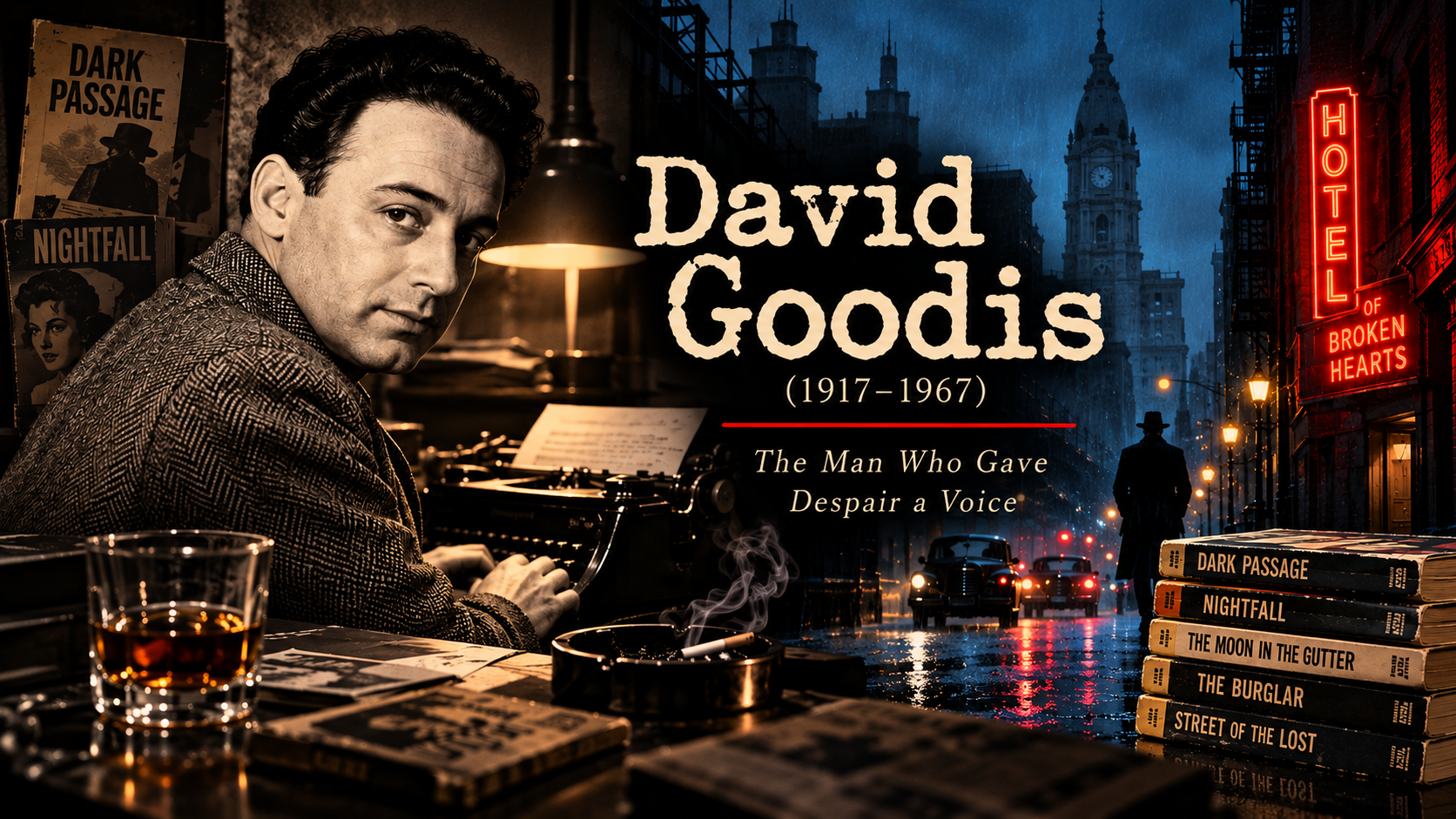
The Man Who Gave Despair a Voice
Somewhere in the darker corners of the American city, a man sits alone in a nearly empty bar. Outside, the rain falls on streets that have seen better days. Whatever brought him here is something he would rather forget.

David Goodis knew this world well. While other crime writers followed detectives through dangerous streets, he was drawn to the people who inhabited their shadows. People with secrets, regrets, and little reason to trust tomorrow.
Behind these troubled lives stood a Philadelphia writer whose own journey was anything but ordinary. His stories would travel far beyond the streets that inspired them, but first, there was a young man with a typewriter and a future yet to be written.
Early Life: A Philadelphia Beginning
David Loeb Goodis was born on March 2, 1917, in Philadelphia, Pennsylvania, the eldest child of William Goodis and Mollie Halpern Goodis. His family had roots in the Russian-Jewish immigrant community, and Philadelphia would remain closely connected to his life and literary career. Long before its streets became the setting for many of his darkest novels, it was the city in which he grew up and received his education.

David Goodis (1917–1967).
Goodis spent his childhood in the city’s Logan neighborhood. He attended General David Bell Birney Elementary School, Jay Cooke Junior High School, and Simon Gratz High School, graduating in 1935. His education continued at Temple University, where he studied journalism and graduated in 1938. Writing was already becoming more than an academic pursuit. He contributed to the university’s literary and student publications while preparing for a career built around words.
The young Goodis had ambitions beyond newspaper reporting. After university, he worked in advertising and pursued fiction, eventually completing his first published novel, Retreat from Oblivion. Issued by E. P. Dutton in 1939, it marked his formal entrance into the literary world. But publication was only the beginning. Goodis still had to find his place in a competitive profession, and the pulp magazines would soon provide an opportunity to develop his craft.
The Pulp Years: Learning to Write in the Shadows
Publishing a first novel was one thing. Making a living as a writer was another. For David Goodis, the next opportunity came from the pulp magazines, where stories were expected to be fast-moving, entertaining, and delivered on schedule. It was a demanding world, but one that offered a young writer the chance to sharpen his craft while earning a living.
During the early 1940s, Goodis became a prolific contributor to popular magazines, producing detective stories, mysteries, westerns, and adventure fiction. His work appeared in publications such as Detective Fiction Weekly, Dime Mystery Magazine, and New Detective Magazine. He also wrote aviation and wartime adventure stories, sometimes using pseudonyms to accommodate the different markets he served.
The pulp business demanded versatility. Goodis had to construct plots quickly, establish characters within a few paragraphs, and maintain suspense across relatively short narratives. Although these early stories often followed the conventions of popular entertainment, the experience gave him a practical understanding of pacing, dialogue, and dramatic tension.
Hollywood: A Ticket to the Dream Factory
Goodis also ventured into radio writing, another field in which storytelling depended on economy and immediacy. Between magazine assignments and other commercial writing, he was building a professional career far removed from the literary recognition he would eventually receive.
Yet his greatest breakthrough would not come from a detective magazine. In 1946, his novel Dark Passage appeared in serialized form in The Saturday Evening Post, bringing his fiction to a much wider audience. Hollywood soon took notice, and Warner Bros. acquired the screen rights. The struggling pulp writer had suddenly attracted the attention of one of America’s major film studios.
Goodis worked in Hollywood under contract to Warner Bros., contributing to screenwriting and story development. His screen credits included The Unfaithful (1947), for which he shared writing credit with James Gunn. But a successful connection with the film industry did not turn him into a permanent Hollywood resident. By the beginning of the 1950s, Philadelphia had reclaimed its writer.
The Return to Philadelphia: Where the Streets Grew Darker
Hollywood had offered Goodis a glimpse of success, but Philadelphia offered something different: familiar streets, familiar faces, and a world far removed from the glamour of the film studios. Around 1950, he returned to his hometown, where he would spend the remainder of his life.
The paperback market provided a new outlet for his fiction. With its appetite for crime, suspense, and inexpensive novels, it offered Goodis an opportunity to develop the darker themes that increasingly interested him. His stories were no longer simply about danger or the pursuit of criminals. They were about people whose lives had already begun to unravel.
During the early 1950s, he published several novels that helped establish his distinctive approach to noir, including Cassidy’s Girl (1951), Street of the Lost (1952), The Burglar (1953), The Moon in the Gutter (1953), and Black Friday (1954). Each approached crime and desperation from a different direction, but together they revealed a writer increasingly concerned with the fragile circumstances of ordinary lives.
Philadelphia became especially important to his fiction. Yet Goodis did not confine every novel to his hometown. What mattered was the atmosphere he created, wherever the story took place.
His protagonists were often men who had once possessed something worth keeping: a career, a family, a reputation, or simply the hope of a better future. By the time readers encountered them, much of it had disappeared. They were not necessarily innocent, nor were they always admirable. Their weaknesses and mistakes were part of what made them human.
Goodis was particularly interested in what happened after the damage had been done. Crime might set events in motion, but guilt, grief, loneliness, and regret often determined their consequences. Even when his characters found opportunities to escape, the past remained difficult to leave behind.
Although his paperback novels did not always receive the literary attention they deserved in the United States, Goodis found an enthusiastic readership in France, where critics and filmmakers recognized the emotional intensity of his work. His reputation would eventually travel much farther than the Philadelphia streets to which he had returned.
The Hotel of Broken Hearts: Goodis’s Lost Souls
Imagine a shabby hotel where the lights burn late and nobody asks too many questions. Its guests have arrived by different roads, but each carries something he would rather leave behind. This is not a hotel for detectives with tidy solutions. It belongs to men whose lives have slipped out of their control.
Goodis rarely promised them redemption. Yet he gave them fears, loyalties, and moments of tenderness that made their troubles more than another crime plot. Six of his best-known troubled men have checked in. Their rooms are waiting.
Room 101: Corey Bradford — Night Squad (1961)
The Disgraced Policeman
Corey Bradford knows the police world from the inside, and not in a way that inspires confidence. Dismissed from the force after taking bribes, he drifts through Philadelphia with a damaged reputation and few prospects. When he crosses paths with underworld figure Walter Grogan, the chance of a new arrangement presents itself.
But the police have their own plans. Caught between Grogan and a covert police unit known as the Night Squad, Corey must decide whom to deceive and how much of himself he is willing to risk. A former policeman might be useful in this hotel, provided the other guests trust him.
Room 102: Vincent Parry — Dark Passage (1946)
The Man Who Lost His Face
Convicted of murdering his wife, Vincent Parry insists he is innocent. Escape from prison offers freedom only in the most precarious sense: his face is recognizable, the police are searching for him, and every encounter threatens to expose him.
His effort to disappear takes an extraordinary turn when he changes his appearance. Yet a new face cannot settle the question that brought him to prison. Parry has checked in under a cloud of suspicion, and the past has followed him through the door.
Room 103: Jim Vanning — Nightfall (1947)
The Man Who Couldn’t Escape Yesterday
Jim Vanning is a commercial artist whose life has been overtaken by a violent encounter in Colorado. Criminals, missing money, and memories he cannot easily piece together make him a target for people who believe he knows more than he does.
The police want answers. So do the criminals. Vanning’s struggle is not simply to get away but to understand the event that turned an ordinary life into a nightmare. He may be the hotel’s quietest guest, but trouble has his room number.
Room 104: Eddie Lynn — Down There (1956)
The Pianist Who Lost His Melody
Edward Webster Lynn, known as Eddie, once had the talent for a concert career. Now he plays piano at Harriet’s Hut, far removed from the life he might have led. The death of his wife remains part of the grief he carries, even when he sits at the keyboard and tries to lose himself in the music.
When his brother Turley appears with dangerous men pursuing him, Eddie is dragged into a crisis he did not seek. Lena, a waitress, offers a measure of human connection in a world where such kindness is rare. Downstairs, the hotel piano is still playing, though the musician has little reason to feel cheerful.
Room 105: William “Bill” Kerrigan — The Moon in the Gutter (1953)
The Man Who Couldn’t Let Go
William Kerrigan works along the waterfront, but his thoughts remain fixed on the death of his sister. Grief has hardened into an obsession with what happened and whether anyone can be held responsible.
His encounters with Loretta Channing, a woman from a different social world, complicate an already troubled existence. Kerrigan has come to the hotel carrying questions that may have no satisfying answers. Some wounds do not heal simply because the night ends.
Room 106: Nat Harbin — The Burglar (1953)
The Burglar Who Checked Himself In
Nat Harbin is a professional thief, bound to a small gang by obligations that go beyond their criminal work. The people around him are an uneasy substitute for family, and his loyalty to Gladden weighs heavily on the decisions he makes.
A burglary promises money, but success does not mean safety. As pressure builds around the gang, Harbin discovers how difficult it can be to separate affection from duty. Whether he booked a room at all is another matter. Corey Bradford, down in 101, might want to keep an eye on him.
What Goodis Brought to Noir: The Art of Losing Everything
The hard-boiled tradition had already produced formidable investigators, dangerous criminals, and writers willing to expose the violence beneath respectable society. Dashiell Hammett and Raymond Chandler had helped establish the private detective as a central figure of American crime fiction, but David Goodis approached the genre from another direction. His stories were less concerned with solving crimes than with the people caught in their consequences.
Goodis was not the first writer to explore ruined lives or psychological despair. James M. Cain had examined the destructive power of desire and betrayal, while Horace McCoy had portrayed people struggling against poverty, disappointment, and shattered ambitions. Goodis belonged to this darker tradition, but his particular interests gave his fiction a distinctive emotional character.
What distinguished him was the intimacy of his attention. He looked beyond the machinery of crime to examine shame, loneliness, tenderness, and the stubborn loyalty of people who had lost their footing. His protagonists were not always innocent or admirable. Some made terrible decisions, while others found themselves trapped by circumstances they could no longer control. Yet Goodis seldom treated them as disposable figures in a crime story.
His characters frequently carried the weight of an earlier life. A promising career, a relationship, a moment of happiness, or the possibility of a different future had slipped away. The past was not merely something to be remembered. It continued to shape their choices, their fears, and their attempts to survive. In Goodis’s fiction, escaping danger did not necessarily mean escaping oneself.
There was also compassion beneath the bleakness. Even among criminals, fugitives, and people living at the edges of society, Goodis allowed room for affection, sacrifice, and unexpected acts of decency. These moments did not erase the darkness surrounding his characters, but they gave their struggles an emotional depth that went beyond violence and suspense.
Philadelphia contributed to this vision. Its streets, bars, and modest rooms offered a recognizable environment for many of his troubled characters. Yet his achievement was not simply a matter of setting. Goodis could turn an ordinary encounter, an old regret, or a damaged relationship into a source of tension. The paperback noir novel became, in his hands, a means of exploring private suffering as well as criminal danger.
His work also found an important audience beyond the United States, particularly in France, where readers, critics, and filmmakers responded to its melancholy atmosphere and psychological intensity. Assessments of his literary achievement have varied, but his continued publication and rediscovery demonstrate the lasting appeal of his particular vision of noir.
Later Years: Time Slipping Away
By the beginning of the 1960s, David Goodis had spent more than two decades making his living through fiction. His career had taken him from pulp magazines to Hollywood and back to Philadelphia, where he continued producing the dark, emotionally charged novels that had become his trademark. Although his days of working for a major film studio were behind him, he had not abandoned the typewriter.
His later fiction continued to explore people living on the margins of society. Night Squad (1961) followed a disgraced policeman navigating the dangerous territory between organized crime and the police, while Somebody’s Done For would become his final novel. The characters and circumstances varied, but Goodis remained drawn to individuals struggling with their pasts and the possibility of losing what little they had left.
Away from his writing, Goodis maintained close ties to his family in Philadelphia. Accounts of his later life describe a man whose private circumstances were considerably quieter than the violent and desperate worlds of his fiction. His domestic life and responsibilities formed part of the background against which he continued to work.
His final years also brought painful family losses. His father, William, died in 1963, followed by his mother, Mollie, in 1966. Biographical accounts describe Goodis briefly entering psychiatric care after his mother’s death. These were difficult years, although we should be careful not to attribute every aspect of his private life to a single cause.
Another concern occupied him during this period. Goodis brought a copyright action against United Artists Television, alleging that the television series The Fugitive had improperly drawn upon his novel Dark Passage. The dispute raised questions about the protection of fictional stories and continued after his death. The litigation would eventually produce a significant appellate decision, but Goodis did not live to see its conclusion.
His final novel, Somebody’s Done For, was published in 1967, the year of his death. It marked the end of a writing career that had moved through several branches of popular fiction, from pulp magazines and Hollywood screenplays to the paperback noir novels for which he would become best remembered. Although he had received recognition during his lifetime, much of the renewed attention to his work still lay ahead.
For a novelist who wrote so often about lost opportunities and the passage of time, the brevity of his own life is especially poignant. David Goodis had spent nearly three decades telling stories, but his own ended before his fiftieth birthday. He died in Philadelphia on January 7, 1967, aged forty-nine.
Legacy: A Second Life in the Shadows
David Goodis did not disappear from crime fiction when his life ended in 1967. Although his reputation in the United States had been shaped largely by paperback publishing and his earlier Hollywood success, his work had already attracted considerable attention in France. There, his novels found readers who recognized something more than conventional crime stories in their bleak atmosphere and troubled characters.
French publishers and critics played an important part in sustaining that reputation. Goodis’s fiction appealed to an audience receptive to the darker possibilities of the roman noir, where psychological conflict could matter as much as the crime itself. His stories of fugitives, disappointed dreamers, and people struggling against their circumstances found a place within a broader appreciation of American noir.
In the United States, Goodis’s literary standing developed less consistently. His books had reached a substantial popular readership, but their association with inexpensive paperback editions did not always encourage sustained critical attention. As interest in American noir expanded, however, critics and scholars increasingly reconsidered writers whose achievements had once been discussed primarily within the boundaries of genre fiction.
The republication of his novels became another important part of that rediscovery. Books that had become difficult to obtain returned to print, allowing readers to encounter Goodis beyond the covers and marketing conventions of the original paperback editions. The Library of America’s publication of David Goodis: Five Noir Novels of the 1940s & 50s, edited by Robert Polito, marked a particularly visible recognition of his place in American crime literature.
Goodis’s legacy rests not simply on the darkness of his stories but on the humanity he discovered within it. His protagonists rarely possessed the confidence of the traditional detective or the glamour of the successful criminal. They stumbled, regretted, endured, and occasionally showed unexpected tenderness. Their struggles gave his fiction an emotional quality that continues to distinguish it within the noir tradition.
David Goodis’s characters seldom received a second chance. His books did.
Media: Hollywood Comes Knocking
Hollywood noticed Goodis early, but his relationship with the screen was not confined to one famous adaptation. His novels became American thrillers, French crime dramas, and films made long after his death. The results varied, as adaptations always do, but together they reveal how readily his stories crossed national and cinematic boundaries.
Dark Passage (1947), directed by Delmer Daves, brought Vincent Parry to the screen with Humphrey Bogart and Lauren Bacall. Its striking early use of subjective camera work places viewers close to a fugitive whose appearance and identity are central to the story.

The Unfaithful (1947) belongs in a different category. Directed by Vincent Sherman and starring Ann Sheridan, it carried a screenplay credit shared by David Goodis and James Gunn. It was screenwriting work, not a film adapted from one of his novels.

Section des disparus (1956), a French production directed by Pierre Chenal, drew on Goodis’s Of Missing Persons. It is an early example of the French screen interest that would become an important part of his legacy.
[Place Section des disparus poster here]
Nightfall, directed by Jacques Tourneur and commonly listed as a 1957 release, adapted Goodis’s novel with Aldo Ray, Anne Bancroft, and Brian Keith. Some catalogues date the film to 1956.

The Burglar (1957), directed by Paul Wendkos and starring Dan Duryea and Jayne Mansfield, is especially notable because Goodis wrote the screenplay adapting his own novel.

Shoot the Piano Player (Tirez sur le pianiste, 1960), directed by François Truffaut and starring Charles Aznavour, transformed Down There into one of the best-known cinematic interpretations of Goodis’s work.

La Casse (1971), directed by Henri Verneuil and starring Jean-Paul Belmondo and Omar Sharif, returned to the material of The Burglar for a new generation of moviegoers.

Le Course du lièvre à travers les champs (1972), directed by René Clément, drew on Goodis’s crime fiction, reworking its material for a French-language thriller. It was a loose adaptation rather than a faithful rendering of a single novel.

La Lune dans le caniveau (1983), directed by Jean-Jacques Beineix and starring Gérard Depardieu, Nastassja Kinski, and Victoria Abril, adapted The Moon in the Gutter in a highly stylized visual language.

Rue barbare, directed by Gilles Béhat, adapted Street of the Lost. Film references differ between 1983 and 1984, reflecting production and release dating.

Descente aux enfers (1986), directed by Francis Girod and starring Claude Brasseur and Sophie Marceau, adapted The Wounded and the Slain, carrying Goodis’s themes into another French production.

Street of No Return (1989), directed by Samuel Fuller and starring Keith Carradine, brought another of Goodis’s novels to the screen. Its late date is a reminder that his stories continued to interest filmmakers decades after his death.

Goodis’s work also reached television, but writing credits and adaptations must be distinguished. He wrote the teleplay for “An Out for Oscar” (1963), an episode of The Alfred Hitchcock Hour based on a story by Henry Kane. Much later, “Professional Man” became an episode of Fallen Angels (1995), directed by Steven Soderbergh with a screenplay by Howard Rodman.
The screen could change the faces, cities, and even the tone of Goodis’s stories. What endured was the attraction of people struggling to escape the consequences of their lives.
Case Closed :The Last Guest Checks Out
David Goodis filled his stories with fugitives, broken dreamers, and desperate men struggling to hold on to their dignity. Beneath the violence and despair, however, he found room for loyalty, compassion, and unexpected courage.
His life ended before his fiftieth birthday, but his fiction survived, finding new audiences far beyond the streets of Philadelphia.
And somewhere in the Hotel of Broken Hearts, the piano is still playing.
David Goodis has checked out. His stories never will.
References
Books consulted directly for this project
- Bourdier, Jean. Histoire du roman policier. Éditions de Fallois, pp. 207, 259.
- Deleuse, Robert. Les maîtres du roman policier. Bordas, p. 101.
- McCann, Sean. “The Hard-Boiled Novel.” In The Cambridge Companion to American Crime Fiction. Cambridge University Press, 2010, p. 55.
- Pepper, Andrew. “The American Roman Noir.” In The Cambridge Companion to American Crime Fiction. Cambridge University Press, 2010, pp. 58–69.
- Schweighaeuser, Jean-Pierre, and Jacques Baudou. “Goodis David.” In Le Polar, edited by Jacques Baudou and Jean-Jacques Schleret. Guide Totem, Larousse, pp. 220–221.
- Tulard, Jean. Dictionnaire du roman policier, 1841–2005. Fayard, pp. 308–309.
Biography identified but not consulted directly
– Garnier, Philippe. Goodis: A Life in Black and White. Black Pool Productions, 2014. (Not consulted directly.)
Archival, literary, and publisher sources
- Temple University Libraries. “David Goodis ’38, Noir Fiction Author.” https://sites.temple.edu/historynews/2023/01/06/david-goodis-38-noir-fiction-author/
- Library of America. “David Goodis.” https://www.loa.org/writers/201-david-goodis/
- Library of America. David Goodis: Five Noir Novels of the 1940s & 50s, edited by Robert Polito. Publisher’s online description, not the complete volume. https://www.loa.org/books/358-five-noir-novels-of-the-1940s-amp-50s/
- Library of America. David Goodis: Nightfall (LOA eBook Classic). Publisher’s online synopsis. https://www.loa.org/books/474-nightfall-loa-ebook-classic/
- University at Buffalo Libraries. “Down There.” Gumshoes, Sleuths & Snoopers: Book Details, George Kelley Paperback and Pulp Fiction Collection. https://library.buffalo.edu/libraries-collections/lml/collections/kelley/plot-summaries/detail.html?ID=100
- Windhauser, Brad. “Down There.” The Encyclopedia of Greater Philadelphia, 2016. https://philadelphiaencyclopedia.org/essays/down-there/
- Los Angeles Review of Books. Review discussing Garnier’s Goodis biography. https://lareviewofbooks.org/article/mysterious-life-david-goodis
- Philadelphia City Council. Biographical legislative record. https://phila.legistar.com/ViewReport.ashx?GID=30&GUID=A309386D-0483-466D-9983-808690EA7CD4&ID=1279452&M=R&N=Text&Title=Legislation+Text
- Goodis v. United Artists Television, Inc., 425 F.2d 397 (2d Cir. 1970). Legal decision concerning the Dark Passage dispute.
Film and television reference databases
- American Film Institute. AFI Catalog. https://catalog.afi.com/
- La Cinémathèque française. Film records and collections. https://www.cinematheque.fr/
- IMDb. David Goodis filmography and individual production records. https://www.imdb.com/name/nm0328959/
Navigation
← Previous: Horace McCoy
| Home: Detective Authors Archive, Hard-Boiled Heavy Hitters |
Next → Jim Thompson (coming soon)








Hello Gumshoe! On the track or authors? leave us reply!