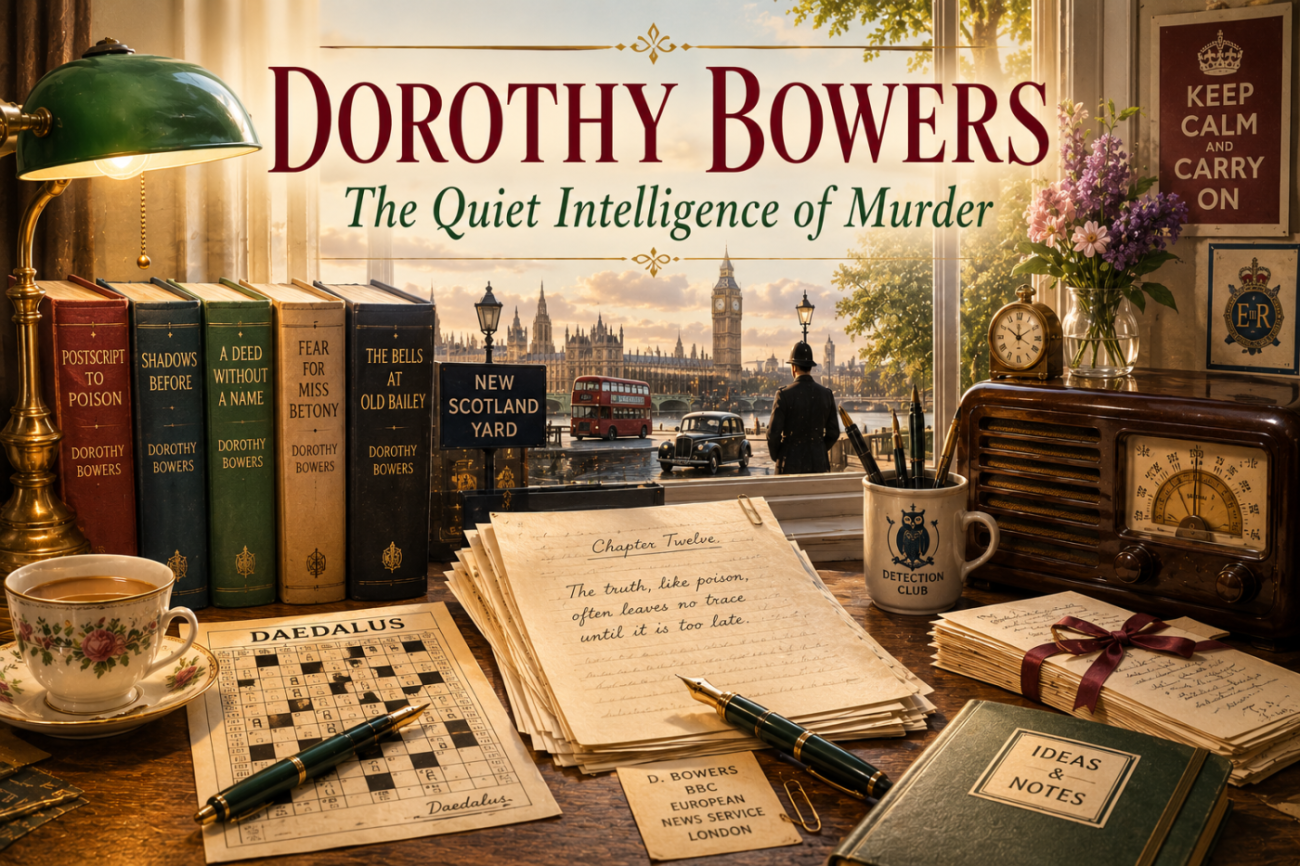
The Quiet Intelligence of Murder
Dorothy Bowers is one of those Golden Age names easily passed over today. Yet behind that unfamiliar name lies a writer whose brief appearance in detective fiction did not go unnoticed by her contemporaries.

Her place in the Golden Age may have been quiet, but it was not insignificant. For a short while, Bowers stood among a generation of writers reshaping what the detective story could be.
It is time to follow her footprints.
The Author Behind the Mysteries
Dorothy Violet Bowers was born on 11 June 1902 in Leominster, Herefordshire, the daughter of Albert Edward Bowers and Annie Marie Dean. She grew up in Monmouth and later studied Modern History at Oxford through the Society of Oxford Home-Students, now St Anne’s College.
A literary career did not come easily. After Oxford, Bowers undertook temporary teaching work in history and English while trying to establish herself as a writer. She also found an outlet for her considerable skill with puzzles by compiling crosswords. Under the appropriately labyrinthine pseudonym “Daedalus,” she contributed them to John O’London’s Weekly, and later produced crosswords for Country Life.
Her persistence finally paid off in 1938, when her first detective novel, Postscript to Poison, was published. After years spent trying to find her place as a writer, Bowers had at last entered the world of detective fiction.
The Detection Club
Recognition from her fellow mystery writers came late in Dorothy Bowers’s career. In 1948, while already seriously ill with tuberculosis, she was elected to the Detection Club, the only new member chosen that year.
The news reached her through Dorothy L. Sayers. Bowers was delighted, not because she expected membership to improve the sales of her books, but because it represented something more important to her: acceptance by writers whose work and judgement she respected. After years of struggling to establish herself, she had been welcomed into the company of the leading figures of British detective fiction.
For Bowers, the honour was above all a recognition of her work by her peers. Her response to the invitation makes clear just how much that recognition meant to her.
Meet the Cast
Chief Inspector Dan Pardoe
Dorothy Bowers’s principal detective is Chief Inspector Dan Pardoe of Scotland Yard, introduced in Postscript to Poison. Pardoe is no flamboyant amateur sleuth and carries none of the eccentric trademarks so often associated with Golden Age detectives. He is a professional policeman: patient, intelligent and methodical, with an urbane manner backed by a determination to see an investigation through.
Pardoe does not always dominate the stories in which he appears. Bowers was willing to allow her characters and their surroundings to take centre stage, leaving the detective to enter when the investigation required him. This is especially noticeable in Fear for Miss Betony, where Pardoe arrives only in the closing part of the novel to unravel what has already become a deeply personal mystery for Emma Betony.
Detective Sergeant Tommy Salt
At Pardoe’s side is Detective Sergeant Tommy Salt, his regular colleague in the four Pardoe novels. Salt is described as a sound police officer with a reassuringly homely appearance. Together, the two form an understated Scotland Yard partnership: capable professionals rather than a brilliant detective and admiring Watson.
Detective-Inspector Raikes
For her final novel, The Bells at Old Bailey, Bowers left Pardoe and Salt behind and introduced Detective-Inspector Raikes. The change suggests that she was not interested in making herself dependent upon a single recurring detective. Her investigators served the mystery rather than becoming the reason for the mystery itself—a choice that allowed Bowers to place greater emphasis on character, atmosphere and the people caught inside the crime.
Notable Cases
Postscript to Poison (1938)
Bowers entered detective fiction with a classic Golden Age situation. An elderly and thoroughly unpopular woman recovers from a serious illness only to die from poison shortly before she is due to change her will. Suspicion falls upon a household filled with relatives and dependants who have ample reason to wish her dead, while anonymous letters add another complication to the case.
The novel introduces Chief Inspector Dan Pardoe and Sergeant Tommy Salt and already displays two qualities that would become characteristic of Bowers: careful characterization and fair-play detection. Contemporary reviewers noticed the newcomer. The Times praised both her plotting and characterization, while Maurice Richardson in The Observer predicted that she “should go far.”


Shadows Before (1939)
Pardoe and Salt returned the following year in Shadows Before. Once again Bowers placed crime within a closely observed domestic setting, allowing tensions and relationships among the characters to become as important as the physical clues.
The novel continued the approach established in Postscript to Poison: the reader is given the information needed to follow the investigation, while motives and personalities provide much of the concealment.


A Deed Without a Name (1940)
With Britain newly at war, Bowers allowed the changing world outside the traditional detective story to enter her fiction. A Deed Without a Name follows Pardoe and Salt into a mystery involving a frightened young man convinced that someone intends to kill him.
The atmosphere is one of uncertainty and unease, heightened by the strange behaviour surrounding the case. Martin Edwards particularly singled out the novel for the way Bowers captured the peculiar mood of the “phoney war,” when Britain was at war but the expected conflict had not yet fully arrived.

Fear for Miss Betony (1941)
Bowers’s fourth novel shifts much of the investigative burden away from Pardoe and onto sixty-one-year-old former governess Emma Betony. Summoned by a former pupil to a struggling girls’ school sharing its premises with the remnants of a nursing home, Miss Betony discovers a household dominated by fear. Someone appears to be poisoning a patient with arsenic, while the mysterious Great Ambrosio, a fortune-teller, exerts a disturbing influence over several of the inhabitants.
Here Bowers combines detection with psychological tension and gives an apparently unremarkable older woman the central role. Pardoe eventually enters the case, but it is Miss Betony who confronts the fear surrounding Makeways and drives the investigation.
The novel brought Bowers some of the strongest praise of her career. The Times Literary Supplement named it the best detective story of the year so far and declared that every page revealed an unusually powerful intelligence.


The Bells at Old Bailey (1947)
Six years passed before Bowers published another detective novel. When she returned, Pardoe and Salt were gone. The Bells at Old Bailey introduced Detective-Inspector Raikes of Scotland Yard, giving Bowers’s final mystery a new investigator.
The change is tantalising. Whether Raikes was intended to begin another series can never be known, but his appearance shows that Bowers was prepared to move beyond the detective who had carried her first four books. The Bells at Old Bailey would prove to be her final novel.


Later Years and Legacy
The Second World War interrupted the rapid pace with which Dorothy Bowers had begun her career. After publishing four mysteries between 1938 and 1941, she worked in London for the BBC’s European News Service. Six years separated Fear for Miss Betony from her return to detective fiction with The Bells at Old Bailey in 1947.
By then, Bowers was seriously ill with tuberculosis. She nevertheless hoped that her health would improve enough for her to continue writing. It was not to be. Dorothy Bowers died on 29 August 1948, aged forty-six, leaving behind only five detective novels.
Their small number makes the reputation she achieved during her lifetime all the more striking. Her work was praised for intelligent plotting, characterization and atmosphere, and Martin Edwards records that she was regarded as potentially a worthy successor to Dorothy L. Sayers. Fear for Miss Betony, in particular, demonstrated how far Bowers could move beyond the mechanics of the puzzle, combining detection with psychological unease and a strong sense of place.
Bowers also showed a willingness to let the story take precedence over the detective. Pardoe and Salt are capable professionals, but they do not overwhelm the people whose lives they investigate. In Fear for Miss Betony, an older former governess becomes the heart of the mystery; in The Bells at Old Bailey, Bowers was prepared to leave her established detectives behind and introduce Raikes. Her brief career suggests a writer still experimenting rather than settling into a formula.
Her early death inevitably limited her reputation. Five novels were a small legacy beside the long careers of many of her contemporaries, and as the books disappeared from circulation, Bowers herself largely disappeared with them. Modern reissues have made her complete detective output available again, allowing readers to reconsider a writer whose promise was recognized by the Golden Age community but never had time to reach its full extent.
Even her appearance has largely been lost to history: no authenticated photograph of Dorothy Bowers is currently known. Yet the novels remain. For an author whose career lasted barely a decade, those five mysteries preserve the clearest portrait we have of her.
Conclusion — Case Closed?
Dorothy Bowers left behind a frustratingly small trail. Five novels, a handful of biographical details, and not even a known photograph with which to put a face to the name. Yet perhaps that makes finding her again all the more rewarding.
There is something particularly fitting about rediscovering a writer through the mysteries she created. Bowers may have disappeared from the shelves for decades, but Pardoe, Salt, Miss Betony and the uneasy worlds they inhabit were still there, waiting for someone to open the books again.
Case closed? Perhaps not. With all five novels available to readers once more, Dorothy Bowers has another chance to find the audience her short career never allowed her to build. Which of her five mysteries would you open first?
References
Books
- Edwards, Martin. The Golden Age of Murder: The Mystery of the Writers Who Invented the Modern Detective Story. Collins Crime Club.
Online Sources
- St Anne’s College, University of Oxford — “The Mysterious Case of Dorothy Bowers.” Biographical research on Bowers, including her Oxford years, early career, crossword work, wartime employment and the absence of a known photograph.
- Moonstone Press — Dorothy Bowers author and reissue material. Information on Bowers’s five detective novels, publication history, her detectives, contemporary reception and the modern republication of her work.
- The Passing Tramp — “Women’s Worlds: Fear for Miss Betony (1941), by Dorothy Bowers.” Discussion of the novel, Emma Betony and the roles of Pardoe and Salt.
- Shiny New Books — Reviews of Postscript to Poison and Shadows Before. Information on Bowers’s early novels and Pardoe and Salt.
- Fantastic Fiction — Dorothy Bowers bibliography and Postscript to Poison. Supplementary bibliographical and contemporary-review information.
Navigation
← Previous: Anthony Wynne
Forgotten Footprints — The Golden Age
Next: Helen Simpson →








































Hello Gumshoe! On the track or authors? leave us reply!